World News in Brief: Global investment plunges, hurricane season in Haiti, rising cholera and hunger in South Sudan

Their latest data shows that the outlook for international investment this year “is negative”, a sharp course correction from January, when “modest” growth seemed possible.

The reasons for this range from trade tensions and tariffs whose main effect has been a “dramatic increase in investor uncertainty”, said UNCTAD Secretary-General Rebeca Grynspan.

She said that investment in renewable energy, water and sanitation fell by some 30 per cent and that agriculture saw a 19 per cent drop in investor confidence.

Only the health sector saw an increase of nearly 20 per cent, Ms. Grynspan said, although that only accounts for “less than $15 billion globally”.

‘Very real consequences’

“Behind those numbers are very real consequences. Jobs not created,” she said. “Infrastructure not built, sustainable development delayed. What we see here is not just a downturn. It is a pattern.”

Ms. Grynspan also cited “growing geopolitical tensions” in addition to rising trade barriers around the world as reasons for the fall in global investment for development.

In critical sectors as hi-tech industries and rare earth minerals, governments are also tightening screening measures on proposed foreign investment, the UN agency noted.

Supplies to limit hurricane impact in Haiti critically low

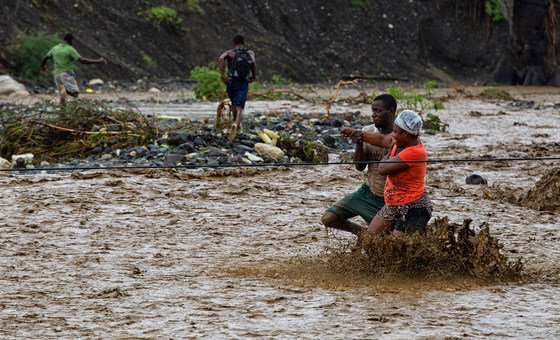
The Humanitarian Country Team in Haiti warned Wednesday that funding and pre-positioned contingency supplies are critically low ahead of what is forecast to be an above-average hurricane season.

Haiti is highly vulnerable to extreme weather, with 96 per cent of the population at risk. Forecasts project 12 to 19 tropical storms and up to five major hurricanes this year.

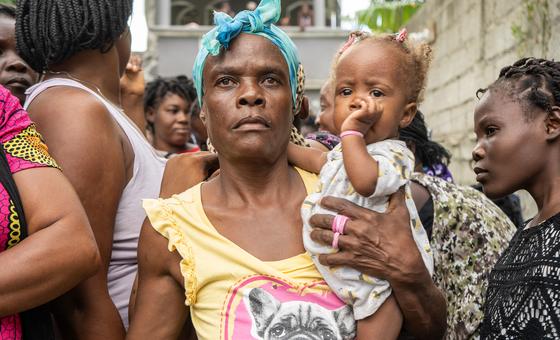
The alert comes as the fragile island nation grapples with a worsening humanitarian crisis. Armed gangs control much of the country, the collapse of essential services and growing displacement have left 5.7 million people food insecure, 1.3 million displaced and 230,000 living in makeshift shelters ill-equipped to withstand severe weather.

Limited preparations  

Humanitarian actors have pre-positioned limited stocks of essential items, but they are at a record low for a hurricane season posing such high risk.  

For the first time, Haiti will begin the hurricane season without pre-positioned food supplies or the financial resources necessary to initiate a rapid response.  

Meanwhile, UN Humanitarian Office (OCHA) is coordinating missions with UN agencies and partners to assess how to safely resume aid operations in high-need areas, following their suspension on 26 May due to insecurity.

“I am deeply concerned for communities, families, and vulnerable groups who have already been affected by violence and are living in precarious conditions,” said Ulrika Richardson, Humanitarian Coordinator in Haiti, calling for immediate support.

As of mid-June, the $908 million Humanitarian Response Plan for Haiti is just 8 per cent funded.

Worsening cholera and hunger in South Sudan

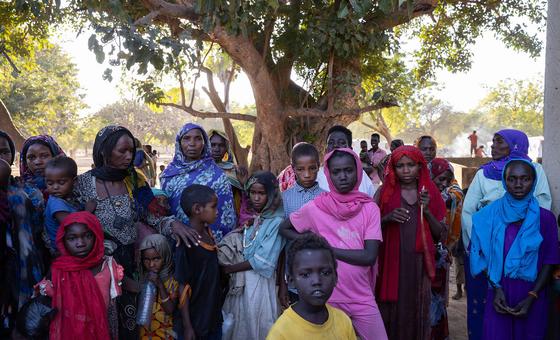
OCHA raised the alarm on Thursday over rising malnutrition and cholera cases in war-torn South Sudan.

An estimated 2.3 million children under five urgently need treatment for acute malnutrition, a 10 per cent increase since last July.

This crisis is unfolding amid the world’s most severe cholera outbreak this year, with almost 74,000 cases and at least 1,362 deaths reported as of 16 June.  

The start of the rainy season and waning immunity risk a significant surge in infections.

UN response

The 2025 Humanitarian Needs and Response Plan for South Sudan is only 20 per cent funded.

Despite limited resources and many challenges, the UN and partners have scaled up efforts, delivering vaccines and life-saving aid to contain the disease and protect the most vulnerable.

“This dire situation is a stark reminder that we need funding urgently to expand food assistance, to expand nutrition and expand health services to those who need it the most,” said UN Spokesperson Stéphane Dujarric at the daily briefing in New York. 
Source link

Haiti: WFP concerned over humanitarian situation as hurricane season begins

With roughly half the population, 5.7 million people, facing some sort of emergency level of hunger, Haiti is one of five countries in the world with catastrophic levels of hunger.  

“Despite all the violence, displacement and collapse”, WFP remains in Haiti, Lola Castro, Regional Director in Latin America and the Caribbean, said during a briefing on Tuesday, having recently returned from the country. 

More than one million people in Haiti are displaced due to ongoing gang violence and insecurity.

As the hostilities are disrupting the food systems and supply chains in the capital Port-au-Prince, WFP is facing a “quite dramatic” situation, Ms. Castro said. 

Displaced population 

Displaced populations, notably in and around Port-au-Prince, are faced with a “very problematic” situation, she said, as hostilities have recently uprooted around 14,000 people from the commune of Kenscoff.  

“Kenscoff is a commune where people used to come and sell their food,” she said, and the same people are now relying on food assistance after their houses were burned and their livelihoods “destroyed.” 

Gender-based violence  

With 6,000 cases of gender-based violence having been reported this year, the situation of women and girls in Port-au-Prince is dramatic, according to Ms. Castro.  

The city is probably “one of the most dangerous places in the world” for women and girls. “We need to provide them support to assure that they become less vulnerable and are not exposed to all this violence,” she said.  

Dwindling aid stocks  

The 2025 Humanitarian Response Plan for Haiti calls for just over $908 million but is only eight per cent funded. Ms. Castro said WFP alone needs $46.4 million over the next six months to sustain its emergency response and address the root causes of hunger and malnutrition. 

The hurricane season began on 1 June and runs through the end of November. She warned that at this moment when half of all Haitians are already going hungry, a single storm could push millions into a humanitarian catastrophe. 

While in past years, WFP had humanitarian stocks ready in the country and could assist between a quarter to half a million people in the immediate aftermath of a disaster, “this year, we start the hurricane season with an empty warehouse,” she said.  

Unless resources are made available, the agency will have no capacity to respond—there are no contingency supplies, no logistical buffer, and no lifeline for the most vulnerable. 

“We cannot forget the people of Haiti,” Ms. Castro said, calling on the humanitarian community to provide urgent support.  

Source link

‘Season of war,’ as norms of humanitarian law ‘cast aside’ UN refugee chief

Speaking in the UN Security Council, Filippo Grandi said in conflicts across the world in places like Sudan, Ukraine, Myanmar, the Democratic Republic of the Congo and Haiti, “violence has become the currency of our age.”

Forcibly displaced people are among the first victims of war. Worldwide, some 123 million people have had to flee due to conflict.

Since the beginning of the war in Sudan, one-third of Sudan’s population has been displaced by indiscriminate violence, disease, starvation, flooding, droughts and sexual violence, “a situation that frankly defies description,” said Mr. Grandi.

In Ukraine, 10 million people have been displaced by the war, experiencing what he described as “terrible toll.” Seven million of them are now refugees, living outside the country.

“Stagnation has defined the response in Myanmar,” said the UN refugee chief. As a result, Rohingya refugees in Bangladesh have been living in camps entirely dependent on humanitarian aid for the past eight years.

Security and self-reliance

Refugees and displaced people will not return to their communities “unless they are confident that the terms of peace are durable, for them and for their country,” he added.

Promoting security and self-reliance is essential to ending humanitarian crises.

However, a return to peace requires compromise and commitment; peace cannot be made passively, said Mr. Grandi.

Reminding the 15 Members of the Security Council that preventing and stopping wars is their primary responsibility, he noted that it was one that “this body has chronically failed to live up to.”

Seizing opportunities

To achieve durable peace, the UN must be ready both to seize unexpected opportunities, and to take calculated risks, High Commissioner Grandi said adding that “there is now an opportunity to break this dangerous inertia.”

As over one million people have already returned to Syria since December 8, with many more expected to follow, the refugee chief urged the Security Council to ease sanctions to support early recovery efforts and spur investment.

“To minimise the risk that the returning Syrians are taking, I am asking you to take some risks yourselves,” he said.

Retrenchment away from aid

Despite the positive signs coming out of Syria, as well as Burundi and the Central African Republic, Mr. Grandi told the Council that “we see a retrenchment away from aid, away from multilateralism, even away from life-saving assistance,” adding that “we hear of prioritizing national interests, of boosting defense spending — all valid concerns of course, and legitimate state pursuits. But these are not incompatible with aid, quite the contrary.”

One way or another, forced displacement has concerned every member of the Security Council, Mr. Grandi pointed out.

“You have been the refugee. You have welcomed those who sought refuge,” he said reminding its members of their collective responsibility “to end war, to bring peace.”

Source link