
UN chief ‘deeply concerned’ by escalation of violence in South Sudan

The tensions are concentrated in South Sudan’s Jonglei State, where many deaths and injuries have been reported in response to renewed fighting between opposition militia and army forces, leading to the displacement of 180,000 people. 

According to news reports, the army launched a major offensive in Jonglei against opposition forces, ordering civilian evacuations on Sunday and telling aid agencies to leave areas where military operations are ongoing. 

Secretary-General António Guterres said in a statement released on Thursday by his Spokesperson that he is “deeply concerned regarding the impact of the escalating violence”, adding that it “will further harm civilian populations who are already in a vulnerable situation”.

Aid and protection at risk

Mr Guterres emphasised the need to prioritise the protection of civilians and ensure the safe delivery of humanitarian aid and security in a country where two-thirds of the population are projected to require some form of aid. 

Calling on the military operations to stop, the Secretary-General urged the Government of South Sudan and opposition forces to take “immediate and decisive action to halt all military operations and deescalate the situation through inclusive dialogue.”

Political solution 

In the wake of a 2018 peace agreement between the president and his vice-presidential rival and following the establishment of a Revitalised Transitional Government in February 2020, elections have continued to be postponed. 

Mr Guterres’s statement reminded relevant parties to find a “political not military solution” and pave the way for a path to credible elections. 

The Secretary-General has welcomed efforts from the African Union and East African regional bloc IGAD in their support for inclusive dialogue.

Source link

Ukraine: Guterres greatly concerned over reported Russian incursion into Polish airspace

Speaking at the regular news briefing in New York, UN Spokesperson Stéphane Dujarric said António Guterres is following the ensuing diplomatic fallout across the NATO military alliance “with great concern” the incident, which reportedly occurred amid a large-scale Russian drone and missile attack on Ukraine.

There is an urgent need for a full, immediate and unconditional ceasefire and for a just, comprehensive and sustainable peace in Ukraine – one that fully upholds Ukraine’s sovereignty, its independence and its territorial integrity, in line with the Charter of the United Nations, international law and relevant UN resolutions,” Mr. Dujarric said.

Multiple drones shot down

According to media reports, Polish authorities, with the support of NATO allies, shot down multiple Russian drones that crossed into the country overnight – the first time Russian drones have been downed over NATO territory.

Poland’s Prime Minster Donald Tusk warned that it put his nation at its closest point to open conflict since World War Two.

Poland joined the North Atlantic Treaty Organization, NATO, in 1999 along with Hungary and the Czech Republic as part of the military alliance’s first expansion into Central and Eastern Europe.

While some violations of Polish airspace have been reported since Russia’s full-scale invasion of Ukraine in 2022, the overnight incident highlights the conflict’s growing regional impact.

Media also reported Russia’s Defense Ministry stating that the strikes targeted Ukraine’s military-industrial sites in its western regions and that there were no intended targets in Poland.

The Secretary-General and the UN continue to urge all parties to respect international law.

Mr. Dujarric noted that the situation “again underlines the regional impact and real risk of expansion of this devastating conflict,” reiterating the UN’s call for protection of civilians and adherence to humanitarian norms.
Source link

Haiti: WFP concerned over humanitarian situation as hurricane season begins

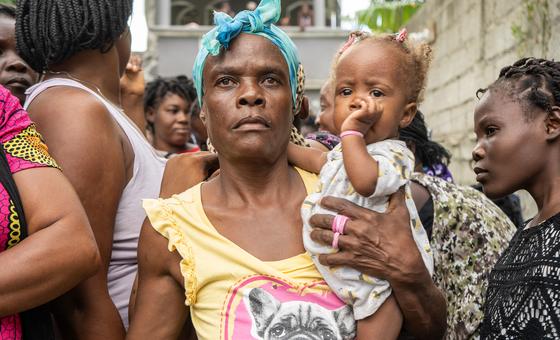
With roughly half the population, 5.7 million people, facing some sort of emergency level of hunger, Haiti is one of five countries in the world with catastrophic levels of hunger.  

“Despite all the violence, displacement and collapse”, WFP remains in Haiti, Lola Castro, Regional Director in Latin America and the Caribbean, said during a briefing on Tuesday, having recently returned from the country. 

More than one million people in Haiti are displaced due to ongoing gang violence and insecurity.

As the hostilities are disrupting the food systems and supply chains in the capital Port-au-Prince, WFP is facing a “quite dramatic” situation, Ms. Castro said. 

Displaced population 

Displaced populations, notably in and around Port-au-Prince, are faced with a “very problematic” situation, she said, as hostilities have recently uprooted around 14,000 people from the commune of Kenscoff.  

“Kenscoff is a commune where people used to come and sell their food,” she said, and the same people are now relying on food assistance after their houses were burned and their livelihoods “destroyed.” 

Gender-based violence  

With 6,000 cases of gender-based violence having been reported this year, the situation of women and girls in Port-au-Prince is dramatic, according to Ms. Castro.  

The city is probably “one of the most dangerous places in the world” for women and girls. “We need to provide them support to assure that they become less vulnerable and are not exposed to all this violence,” she said.  

Dwindling aid stocks  

The 2025 Humanitarian Response Plan for Haiti calls for just over $908 million but is only eight per cent funded. Ms. Castro said WFP alone needs $46.4 million over the next six months to sustain its emergency response and address the root causes of hunger and malnutrition. 

The hurricane season began on 1 June and runs through the end of November. She warned that at this moment when half of all Haitians are already going hungry, a single storm could push millions into a humanitarian catastrophe. 

While in past years, WFP had humanitarian stocks ready in the country and could assist between a quarter to half a million people in the immediate aftermath of a disaster, “this year, we start the hurricane season with an empty warehouse,” she said.  

Unless resources are made available, the agency will have no capacity to respond—there are no contingency supplies, no logistical buffer, and no lifeline for the most vulnerable. 

“We cannot forget the people of Haiti,” Ms. Castro said, calling on the humanitarian community to provide urgent support.  

Source link