The meals which families are able to obtain are nutritiously poor — thin broths, lentils or rice, one piece of bread or sometimes just a combination of herbs and olive oil known as duqqa.
Adults are routinely skipping meals in order to leave more for children, the elderly and the ill. And still, on average since January, 112 children have been admitted on a daily basis for acute malnutrition.
“[When my children wake up at night hungry] I tell them ‘Drink water and close your eyes.’ It breaks me. I do the same – drink water and pray for morning,” as one parent said.
Risking lives for food
Due to these extreme food shortages, people in Gaza are forced to risk their lives on a daily basis to access small amounts of food. Since 27 May, 549 Palestinians have been killed and 4,066 have been injured trying to access food, according to the Ministry of Health (MoH) in Gaza.
“The majority of casualties have been shot or shelled trying to reach US-Israeli distribution sites purposefully set up in militarized zones,” said Johnathan Whittall, head of office for the UN humanitarian affairs agency, OCHA, in the Occupied Palestinian Territories.
Since the end of May, the US-Israeli backed Gaza Humanitarian Foundation (GHF) has been distributing aid in Gaza, bypassing the UN and established NGOs.
The UN has said Palestinians who seek aid from the GHF face threats of gunfire, shelling and stampedes.
“We don’t want to be out there. But what choice do we have? Our kids cry for food. We don’t sleep at night. We walk, wait, and hope we come back,” one Palestinian told WFP.

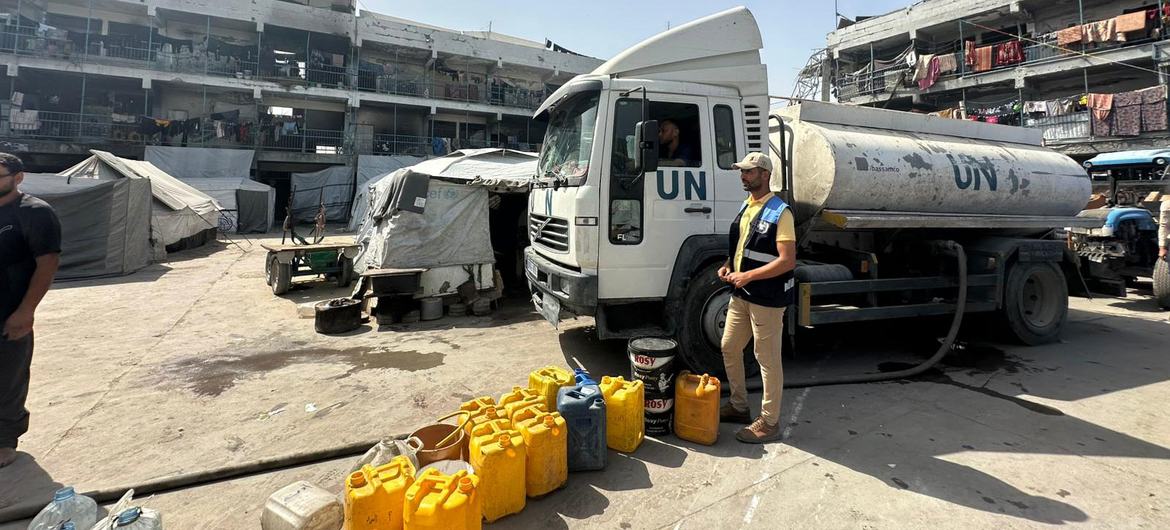
Water is delivered to Gazans sheltering at an UNRWA school.
Systems near collapse
Protracted conflict and bombardment have pushed almost all service systems in Gaza to the brink.
As a result of fuel shortages, only 40 per cent of drinking water facilities are functional and 93 per cent of households face water insecurity.
The fuel shortage is also negatively affecting the provision of medical services with medical equipment and medicine storage reliant on electricity.
For the first time since the resumption of limited aid entry on 19 May, nine trucks containing medical items offloaded supplies on the Israeli side of the Kerem Shalom crossing on Wednesday.
Displaced, over and over again
Since the resumption of Israeli bombardment in Gaza on 18 March after a 42-day ceasefire, over 684,000 Palestinians have been displaced. And for almost all of them, this is not the first time.
With over 82 per cent of Gaza either designated as an Israeli militarized zone or under a displacement order, there are few places — much less safe places — that the newly displaced can go.
They have been forced to take shelter in overcrowded displacement camps, makeshift shelters, damaged buildings and sometimes just on open streets. Schools are no longer buildings of learning but of shelter.
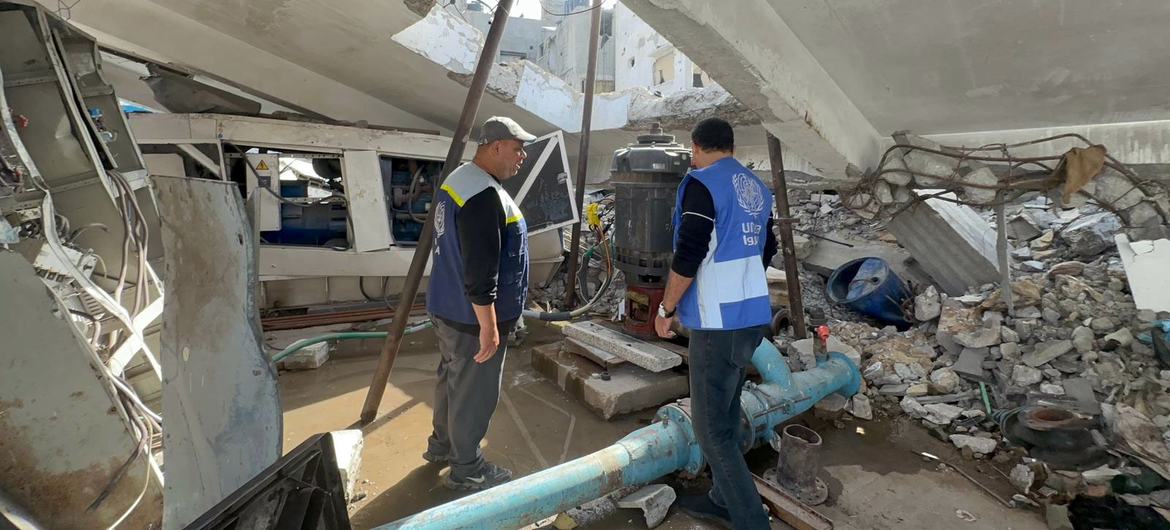
An UNRWA member of staff inspects destroyed infrastructure.
“Schools have transformed into empty shelters, devoid of any elements of a safe learning environment,” said Kamla, a teacher with the UN Relief and Works Agency for Palestinian Refugees in the Near East (UNRWA) in Nuseirat.
All of these shelters are experiencing rapidly deteriorating conditions as a result of insufficient shelter materials, according to Stéphane Dujarric, spokesperson for the Secretary-General.
“No shelter materials have entered Gaza since 1 March, before the Israeli authorities imposed a full blockade on aid and any other supplies for nearly 80 days,” he said at a briefing on 19 June.
“While some commodities have subsequently been allowed in small quantities, tents, timber, tarpaulins and any other shelter items remain prohibited.”
The UN and its partners have 980,000 shelter items prepared to dispatch into Gaza once authorization is granted by the Israeli authorities.
‘Symbols of hope’
Since the beginning of the violence in Gaza, UNRWA has continued to work tirelessly to provide displaced and injured Palestinians with many types of support.
“Despite all this, the eyes and hopes of our community remain fixed on us. UNRWA staff are not merely service providers. In the eyes of people in Gaza, we are pillars of resilience, lifelines of stability and symbols of hope,” said Hussein, an UNRWA worker in Gaza City.
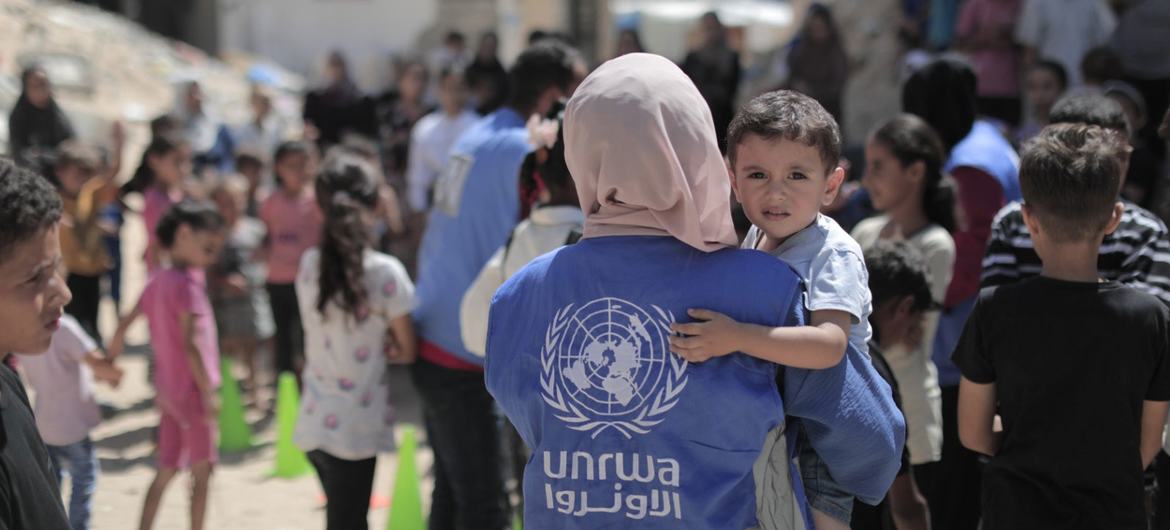
An UNRWA worker carries a young boy in Gaza.
But as fuel shortages continue and only small amounts of humanitarian aid — food, medicine, shelter materials — trickle through the Kerem Shalom border crossing, the job of UNRWA workers and other humanitarians in Gaza is increasingly untenable.
“We have lost all the tools needed to work, so we have had to adapt,” said Neven, a psychosocial UNRWA worker in Khan Younis.
Dspite their best efforts, the bombardment and devastation of Gaza continues with children going hungry and some even expressing suicidal thoughts.
“I told my daughter her deceased father is safe, eating and drinking with God,” one mother said. “Now, she cries every day and says, ‘I’m hungry and want to go to my father because he has food to feed us.’”