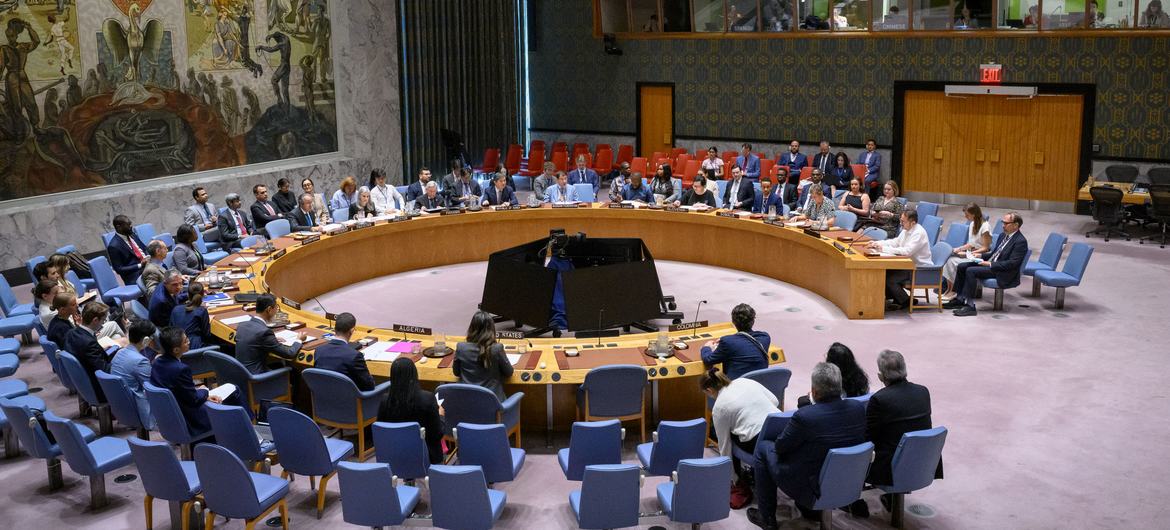
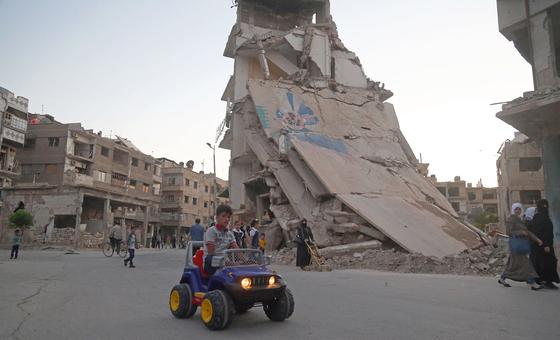
UN envoy urges renewed political push as Yemen tensions rise

Hans Grundberg also warned that rising regional tensions risk dragging Yemen back into broader confrontation. 

I ask this Council to remain united in supporting a credible path back to a political process, and I urge regional actors to align around the same purpose and to use their influence in a coordinated way to steer Yemenis toward engagement,” he said. 

A ‘fragile’ situation 

Since 2014, Yemeni government forces, who are backed by a Saudi-led coalition, and Houthi rebels have been fighting for full control of the fractured country.  

The internationally recognised authorities are largely based in the southern city of Aden while the Houthis, officially known as Ansar Allah, control the capital Sana’a and large areas of the north and west.  

In recent months, forces affiliated with a separatist group in the south have advanced on more territory.  

Mr. Grundberg briefed from the Saudi capital Riyadh, where he held talks with Yemen’s newly appointed Prime Minister Shaya al-Zindani and members of the Presidential Leadership Council. 

He highlighted early positive signs in government areas, including improvements in the provision of electricity and payment of public sector salaries, and commended the appointment of three women cabinet ministers. 

“However, continued tensions, recent security incidents and demonstrations, where in some cases violence and loss of life has been reported, underscore the fragility of the situation,” he said. 

‘Protect recent gains’ 

He told the Council that the new cabinet “can protect recent gains by anchoring them in strengthened institutions and economic reforms”. 

Furthermore, a planned southern dialogue offers an opportunity to begin addressing long-standing grievances and build consensus on issues important to the region’s people and all Yemenis.  

Mr. Grundberg said that stabilisation in any part of the country will not be durable if the broader conflict is not addressed comprehensively. 

“It is high time to take decisive steps in that regard,” he said. “Without a wider negotiated political settlement to the conflict, gains will continue to remain vulnerable to reversal.” 

The way forward 

The UN envoy has been engaging with the warring parties, regional actors and the international community to explore ways to restart an inclusive political process in Yemen.  

His office has also held consultations with a diverse group of Yemenis, leading to three takeaways. 

The first calls for acknowledging what more than a decade of war has done to Yemen. Although the conflict has become more complex, the common objective has remained steady and firm. 

Yemen needs an inclusive political process under UN auspices to reach a negotiated political settlement that can sustainably end the conflict, but getting there requires that the parties adopt a forward-looking approach,” he said. 

Restarting a political process will require engagement across political, economic and security issues in tandem “without making engagement in one track contingent on progress in another”, he added. 

The third point calls for a credible process that enables near-term agreements that reduce suffering and demonstrate progress. At the same time, space must be created for negotiations on longer-term issues, including the future shape of the State, security arrangements and principles of governance. 

Free detained staff 

The Special Envoy also used the briefing to reiterate his call for the unconditional release of scores of UN personnel who have been arbitrarily detained by the Houthis. 

Currently, 73 staff are locked up, along with representatives from civil society and diplomatic missions. 

“Many have been held incommunicado, with serious concerns about their conditions and wellbeing. Some have been referred to Ansar Allah’s special criminal court, which is proceeding with trials that fall far short of basic due process,” he said. 

He noted that this week marked a year since a staff member with the World Food Progamme (WFP) died while being held and no investigation has taken place. 

Houthis storm UN offices 

A senior official with the UN aid coordination office, OCHA, updated the Council on the humanitarian situation in Yemen. 

“As we have said in this Council before, these detentions of humanitarian workers are having a profound impact on operations,” Lisa Doughten, director of OCHA’s financing and outreach division, told ambassadors. 

She reported that the Houthi de facto authorities entered multiple UN offices in Sana’a on 29 January “without permission, commandeering equipment and vehicles”.  

They also continue to withhold clearances for UN Humanitarian Air Service (UNHAS) flights to Marib, though flights to Sana’a resumed over the weekend following a month-long suspension.  

Millions in need 

The “interference and impediments” are happening when 22.3 million people – half the population – need humanitarian assistance this year, or nearly three million more than in 2025.  

Around 18 million face food insecurity, making Yemen the region’s most severe hunger crisis. It is also the country with the largest number of people experiencing emergency food security conditions, some 5.5 million. 

Source link

Protecting children in war is key to lasting peace, top UN envoy warns

In an exclusive interview with UN News, Special Representative for Children and Armed Conflict, Vanessa Frazier, reflected on the alarming rise in grave violations against children and the urgent need to safeguard their future.

“The recruitment and use of children is still one of the most widespread and devastating violations we face. In 2024 alone, over 7,400 children were recruited or used by armed forces and armed groups, and those are only the verified cases,” Ms. Frazier told us, just ahead of Thursday’s international day against the use of child soldiers.

Over the last 30 years, we have separated over 220,000 children from armed gangs,” she emphasised. 

Growing crisis across conflicts

Her office monitors approximately 26 conflict situations around the world, and the numbers tell a grim story.

“The violations are most prevalent in the Democratic Republic of the Congo, Nigeria, Somalia, Syria, and Myanmar,” Ms. Frazier explained. 

Interview with Vanessa Frazier, Special Representative of the Secretary-General for Children and Armed Conflict, for UN News.

“But we’re also seeing worrying trends in Sudan, where children are specifically targeted because they are seen as useful – as border guards, as workers, even as fighters.”

Behind those statistics, she stressed, are young lives forever altered. “Each number in our report represents a child whose innocence has been interrupted,” she said.

From abduction to reintegration

Beyond documenting violations, Ms. Frazier’s office engages directly with combatants to negotiate the release of children and their safe return home.

“One of the strengths of our mandate is that we can negotiate directly with armed groups for the handover of children,” she explained. “Once separated, [children’s agency] UNICEF and our partners work on their reintegration, ensuring they receive psychosocial support, access to education, and the chance to reclaim their childhood.”

An eleven-year-old boy sits in the dormitory of a reintegration centre for recently demobilized child soldiers in Goma, DR Congo. (file)

But reintegration is often fraught with stigma. “Girls who return may be shunned by their communities, especially those who come back with children,” she said. “For societal reasons, some girls cannot be fully reintegrated are considered damaged goods.”

Prevention and accountability 

For Ms. Frazier, prevention is the ultimate goal.

“Prevention is better than cure,” she told us. “You know, this is why we really do advocate that even in times of war and armed conflict, children must remain in school. When they are out of school, they become very vulnerable to recruitment – whether forced or not.”

Accountability, too, plays a key role. The Special Representative – who previously served as Malta’s Ambassador to the UN, including an influential period on the Security Council – pointed to recent prosecutions before national courts and the International Criminal Court (ICC) as vital deterrents.

One of the greatest tools of deterrence is justice and accountability,” she highlighted”. “When warlords or armed group leaders are prosecuted and sentenced for recruiting children – including in national courts and at least three cases before the International Criminal Court – it sends a powerful message. Justice and accountability act as strong deterrents, showing armed groups that this crime carries real consequences.”

A 13-year-old girl formerly associated with an armed group in the Central African Republic holds a mock weapon.

Her conviction is rooted in field experience – from meeting survivors of Boko Haram’s abductions in Nigeria to listening to women once enslaved by the Lord’s Resistance Army in Uganda. 

“You hear about a 13-year-old girl holding her baby, and you realise how deeply conflict steals childhood,” she said. 

“When you hear these stories, you realise those numbers in our reports are individuals – children who were supposed to have their whole future ahead of them,” she said. 

Epitome of innocence 

Ms. Frazier spoke with emotion about why she is so committed to this cause.

“Children are the epitome of innocence,” she said. “They have not taken sides in any war, yet their innocence and childhood have both been interrupted. Children should never be treated as collateral of war.”

Children are the epitome of innocence

She added that the path to lasting peace begins with protecting and empowering those same children.

“The sustainability of peace depends on children’s right to take it forward. When they are brought back from conflict, they must have access to education and the chance to be fully integrated into society — to aspire to become doctors, nurses, lawyers, politicians, engineers — and that can only be achieved through education.”

Messages of hope

The Special Representative outlined her campaign Prove It Matters, which invites children affected by war to send messages to leaders, folded into origami doves, the universal symbol of peace.

“One child wrote to me, ‘I still have hope for a peaceful world. Never again a girl being a wife of a guerrilla fighter. Never again being part of armed groups. Let’s save childhoods and families too.’ It’s such an innocent plea, but it is what we are about,” she said.

A young man and former child soldier in Sultan Kudarat, Philippines, plans to return to school.

As the conversation ended, Ms. Frazier reiterated her conviction that education, justice and hope remain the pillars of peace.

“Children should be able to continue with their innocence even during times of conflict,” she said. “It is about ensuring a sustainable and peaceful future for the world.”

Source link

Potential turning point for Gaza as peace plan enters second phase: UN envoy

Ramiz Alakbarov warned that risks of violence escalating again remain high, while the situation in the occupied West Bank continues to deteriorate.

The Deputy Special Coordinator for the Middle East Peace Process said he was addressing ambassadors “at a moment of both profound opportunity and considerable risk,” pointing to cautious diplomatic progress on Gaza alongside deepening instability elsewhere.

“In front of us we see a potential turning point for Gaza, a genuine chance for a better future,” Mr. Alakbarov said. “But many uncertainties remain.”

He heralded the second phase of President Donald Trump’s 20-point Comprehensive Plan as “a critical step in consolidating the ceasefire in Gaza,” alongside the establishment of new transitional bodies, including the National Committee for the Administration of Gaza and the Office of the High Representative for Gaza.

Deputy Special Coordinator Alakbarov briefs the Security Council members via video link.

Monumental task ahead

Mr. Alakbarov said he had just returned from Cairo, where he met members of the National Committee to discuss how the UN could support efforts to restore essential public services, facilitate humanitarian aid and begin planning for reconstruction, in line with Security Council resolution 2803.

He cautioned that the task ahead is “monumental” and will require close coordination among all stakeholders, considering existing systems and capacities.

The UN envoy welcomed the recovery of the remains of the last hostage held in Gaza, expressing condolences to the family of Ran Gvili and said he hoped that with all hostages returned, “the process of healing for the families and all those affected may begin.”

He also said Israel’s announcement that the Rafah crossing would open for pedestrian movement in both directions was encouraging, while stressing that demilitarisation of the Gaza Strip and effective security arrangements remain essential for the next phase to succeed.

Mr. Gvili was among more than 250 Israeli and foreign nationals abducted by Hamas and other Palestinian armed groups during their 7 October 2023 attack on southern Israel, in which more than 1,250 people were also killed.

The ensuing Israeli military offensive in Gaza resulted in widespread devastation and a massive loss of Palestinian life, with tens of thousands reported killed and countless others wounded, many suffering life-long injuries.

Gazans want a better, stable future

Despite continued hardship, Mr. Alakbarov said his recent visit to Gaza underscored the determination of its people.

The people in Gaza are ready and eager to lead the way to a better, more stable future,” he told the Council, describing students taking exams under extreme conditions, farmers finding ways to plant despite shortages, and small business owners adapting to a devastated market.

At the same time, he emphasised that humanitarian needs remain severe. Nearly the entire population of Gaza still requires assistance, with more than 1.5 million displaced people exposed to winter rains and cold temperatures.

Mr. Alakbarov warned that humanitarian operations are still unable to function at scale, citing insecurity, access restrictions and delays at crossings.

Occupied West Bank unravelling

Turning to the occupied West Bank, the senior UN official said the situation is “unravelling,” marked by ongoing violence, settlement expansion, demolitions and displacement.

These trends, he warned, are undermining prospects for peace and could jeopardise progress on implementing the second phase of the ceasefire plan.

The implementation of the second phase of the Gaza ceasefire plan is critical,” Mr. Alakbarov said, urging the Council to act collectively.

He reaffirmed the UN’s commitment to supporting Palestinians and Israelis in advancing toward a two-State solution, in line with international law and UN resolutions.

Click here for in-depth coverage of this meeting, including national and regional positions.

Source link

UN envoy highlights ‘window to advance peace’ in Colombia

“At a time of tensions both globally and regionally, it is in everyone’s interest to secure lasting peace and security in Colombia,” said Miroslav Jenča, delivering his quarterly briefing. 

He said the coming year “undoubtedly provides a window to advance peace as a strategic national objective, and for Colombia and its partners to engage constructively through dialogue to address shared challenges,” particularly in the border area with Venezuela “where cooperation on all sides is essential.” 

Switch in focus 

Mr. Jenča also heads the UN Verification Mission in Colombia, and he reported on re-organization outlined in Council resolution 2798 (2025), adopted last October. 

The resolution extended the Mission’s mandate for a year and changed its focus to monitoring three provisions of the 2016 peace agreement signed by the Government and FARC-EP rebels:  

  • Comprehensive rural reform 
  • Reintegration of former combatants 
  • Security of both ex-fighters and communities in conflict-affected regions  

Previously mandated verification on transitional justice, ethnic-related issues and ceasefire monitoring was discontinued. 

Challenges in conflict areas 

Mr. Jenča has spent the past three months meeting key counterparts across Colombia who underscored that the three pillars are important for achieving peace. 

During visits to several parts of the country, he was “struck not only by the immense challenges facing communities in conflict-affected regions, but also by their resilience and determination to achieve a better future.” 

In some of the most remote areas, daily life is a struggle “due to the actions of different illegal armed actors and to the limited presence of the state, public services and development opportunities.”  

Limited opportunities  

He noted that re-integration of former combatants is essential to the success of peace agreements and ensuring their transition to civilian life is crucial to avoid a return to violence. 

“Nevertheless, nine years after the FARC-EP laid down arms under the Peace Agreement, the path has proven challenging for the over 11,000 former combatants who remain active in the government’s reintegration programme,” he said. 

 These men and women often live in remote areas with limited infrastructure, access to markets, and threats to their security.  

“For the authorities, it has also entailed major efforts, both financial and programmatic, to facilitate their transition into civilian life,” he added, noting that while substantial progress has been made but more is needed. 

‘Fertile ground’ for armed groups 

Access to land has progressed in Colombia but still needs to be fully resolved, Mr. Jenča said.  Meanwhile, security remains fragile. 

Some 487 former combatants have been killed since laying down their arms. He urged the authorities to step up investigations and prioritize security guarantees for those who signed the peace deal. 

Although violence is far lower now than at the height of the conflict, “the presence of armed groups in areas still affected by conflict continues to inflict suffering on entire communities.” 

This violence is being fuelled by a mix of factors and limited State presence “provides fertile ground for the armed groups to exert control, and for illicit economies to prevail.”  

Rise in child recruitment 

As a result, civilian populations have faced threats, killings of social leaders, forced displacement and confinement, and an alarming increase in child recruitment and use by armed groups.  

The situation in border areas is particularly complex, he said. The UN Mission’s team in Cúcuta, a city on the border with Venezuela, supports response to continuing clashes between rival armed groups. 

Thousands of civilians have been have forced to flee their homes in the Catatumbo region, which he described as “a hub of coca cultivation and cross-border armed activities and criminality.”  

‘Holistic vision’ for peace 

Mr. Jenča insisted that the Peace Agreement can significantly contribute to addressing many of these problems. 

“It offers a much-needed holistic vision, by providing for the strengthening of the State’s capacity to dismantle criminal structures, to promote alternatives to coca cultivation and concrete development measures through its comprehensive rural reform,” he said.  

Source link

‘The UN is here to do the right things’: Envoy Colin Stewart bids farewell but keeps the faith

I started feeling very idealistic about the UN, and I’ve never lost that feeling,” Mr. Stewart told UN News in an exclusive interview.

In early August, he steps down as the Special Representative of the Secretary-General and head of the UN Peacekeeping Force in Cyprus (UNFICYP).

His departure comes at a moment of cautious optimism on the island. Just last week, the Secretary-General reported that talks between the Greek Cypriot and Turkish Cypriot leaders were “constructive”, with “common understanding” on new initiatives.

Mr. Stewart called the talks “an important step” in maintaining momentum.

“We are at a bit of a challenging moment for Cyprus because of upcoming elections in the north and other dynamics,” he explained. “The intent was to keep the ball rolling and keep the momentum going, and I think that succeeded.”

SRSG Colin Stewart speaks to UN News.

Peace by preventing sparks

Looking back at his tenure in Cyprus, Mr. Stewart likened UNFICYP’s daily work to stamping out sparks before they ignite.

“There are all sorts of activities happening in the buffer zone every day, each with the potential to escalate,” he said. “Our job is to prevent those sparks from bursting into flames. When I report to the Security Council that things are calm, it means we have been successful.

Our job is to prevent sparks from bursting into flames. When I report to the Security Council that things are calm, it means we have been successful.

The numbers bear out his point: in more than half a century of UN peacekeeping on the island, not a single shot has been fired between the two militaries.

Some people ask why the peacekeeping mission is still needed, given that it’s been peaceful for 50 years…the answer is simple – it’s peaceful because the mission has been doing its job. Without it, the deep mistrust between the sides could easily spiral into confrontation.”

Lessons on trust and empathy

Mr. Stewart also served as the Special Adviser on Cyprus, leading the Secretary-General’s good offices to support a comprehensive settlement. The greatest obstacle, he said, lies not in public sentiment but in political will.

The people get along fine,” he noted. “Millions cross from one side to the other every year without incident. But among political leaders, distrust runs so deep that even the idea of compromise is viewed negatively.

This distrust, he said, is rooted in decades of hardline narratives that portray the other side as an enemy rather than a partner. Breaking those narratives is essential.

“Peacebuilding requires not just negotiation but a willingness to dismantle these rigid narratives and build empathy,” he said. “And we do this all the time at an individual level. Bring two people who have each lost something in front of each other, and they can quite readily sympathise with each other and share a common grief.”

This belief in the power of empathy, he added, resonates far beyond Cyprus: in many conflicts, peace emerges when people begin to recognise the humanity – and suffering – on the other side.

Peacekeeping not one-size-fits-all

Mr. Stewart’s career has given him a panoramic view of peacekeeping’s evolution.

In Timor-Leste, he saw how UN support can help a fledgling state build resilience. In Addis Ababa, as part of the UN Office to the African Union, he witnessed the power of partnerships. And in Western Sahara, he experienced the limits of peacekeeping when a ceasefire failed to hold.

He highlighted that peacekeeping is not a one-size-fits-all mode – it is modular – “a bit of this and a bit that”, tailored to the circumstances and working with a wide range of partners.

I guess I have lived through the evolution of peacekeeping and seen many different aspects of it, [but] I am ever more convinced that peacekeeping is an absolutely essential tool for the international community.

A quiet exit

Now preparing for life after the UN, Mr. Stewart is clear: he has no plans to return in any advisory or consulting role.

“For me, retirement means retirement,” he said with a smile.

“I want to do all the things I’ve been postponing for my whole career – live in a house I own, spend time with my teenage son who is going to high school…that is the life that I have in mind.”

Idealism remains intact

Concluding the interview, I asked if he had any final words. As he looked around for ideas, I suggested, “maybe your first day on the job.”

He recalled his beginning in the United Nations, a journey that started with the referendum for self-determination in Timor-Leste in the 1990s, against the backdrop of intimidation, violence and a fragile security environment.

I started off feeling very idealistic about the UN, and I’ve never lost that feeling…the UN is here to do good things – the right things

“It was our watch, our responsibility to put on a free and fair vote,” he said, “and that was going to be impossible under these circumstances.” Yet, despite the odds, the Timorese vote went ahead, and the result was clear — a success against all expectations.

That was a very heady, exciting experience to start in the UN…it started me off feeling very idealistic about the UN, and I’ve never lost that feeling that, you know, the UN is here to do good things, to do the right things.

As he steps away from the UN, Mr. Stewart says that idealism remains intact.

It might take time, but we will succeed…even though people get discouraged because it’s very, very hard for all kinds of reasons that are out of our control, it’s a wonderful principle to be serving. So, I leave wishing only the best for my colleagues who will continue the fight.

Source link

UN envoy urges Colombia to ‘stay the course’ as peace faces new strains

Briefing the Security Council for the last time as head of the UN Verification Mission, Special Representative Carlos Ruiz Massieu said the peace agreement provided a roadmap for addressing the root causes of conflict.

The Final Peace Agreement of 2016 set out the path to be followed: a holistic and comprehensive roadmap for addressing deep-rooted structural issues that have driven violence in Colombia for decades,” he told ambassadors.

He cited progress in land reform, rural development, the reintegration of more than 13,000 former combatants, the start of a “complex journey” for truth and reconciliation and opening of political space.

Today, Colombia is a very different country from that it was in the years prior to the signing of the peace agreement,” he added, noting, however, that gaps and challenges remain.

SRSG Ruiz Massieu briefs the Security Council.

Violence persists

Chief among these is the limited presence of civilian and military state institutions in various regions of the country where existing peace dividends remain inadequate and violence persists, including against social leaders and ex-combatants.

At least 472 former fighters have been killed since 2016, four in recent weeks alone, Mr. Ruiz Massieu said, urging measures to strengthen their protection and ensure accountability.

It is also essential to achieve effective complementarity between peacebuilding policies, security strategies and efforts to combat illicit economies,” he added.

Painful moments revived

Mr. Ruiz Massieu highlighted progress on opening political space, noting “a widespread rejection of political violence”, but warning that the attempted assassination of presidential candidate Miguel Uribe in June revived painful memories and underscored the need to remove violence from electoral competition.

To address persistent insecurity, he urged full implementation of security guarantees alongside rural development programmes and strategies to combat illicit economies.

“Expanded and sustained state presence remains essential,” he said, stressing the need for coordinated investments in conflict-prone regions.

A wide view of the Security Council meeting on the UN Verification Mission in Colombia (UNVMC).

Upcoming elections

The briefing also comes as Colombia enters a sensitive period leading to elections next year.

Mr. Ruiz Massieu appealed to all actors to uphold commitments for a peaceful campaign and to advance the comprehensive vision of the 2016 accord, which includes provisions for women as well as Afro-Colombian and Indigenous communities.

In their pursuit of peace, Colombians have a deeply rooted history of resilience and persistence,” he said. “Sometimes their efforts have not yielded the expected results, but other times, thanks to patience and perseverance, they have achieved significant progress.

Path to peace is never easy

The path to peace is never easy, nor is it free of obstacles. But, staying the course is always worthwhile,” he concluded. “The 2016 peace agreement is a striking example of this.”

Mr. Ruiz Massieu, who has led the mission for more than six years, will soon assume duties as the Special Representative of the UN Secretary-General for Haiti.

He thanked the Council for its “consistent and crucial” support, adding that the UN mission’s role in fostering trust “will remain as important as ever in the period ahead”.

Source link

Senior envoy warns Iran-Israel conflict is deepening crisis in Afghanistan

Roza Otunbayeva, the Secretary-General’s Special Representative and head of the UN Assistance Mission in Afghanistan (UNAMA), said the ongoing missile attacks between Iran and Israel are already having a tangible impact.

This conflict is already having an effect in Afghanistan, disrupting trade and increasing the prices of basic goods and fuel, and prompting the return of additional Afghans from Iran,” she said, echoing the Secretary-General’s urgent call for de-escalation.

Anticipating more returnees

More than 600,000 Afghans have returned from neighbouring Pakistan and Iran this year, and she said UN agencies are preparing for potential cross-border movements from Iran considering the “concerning developments” in the region.

Returns from Iran alone in the past few days have been over 10,000 per day,” she said.  

Local communities and the de facto Taliban authorities “have made huge efforts to absorb returnees, but without international assistance, there are limits to safe, orderly and peaceful returns.”

Concerns over engagement

Ms. Otunbayeva updated the Council on the UN’s ongoing engagement with Taliban leaders who returned to power nearly four years ago.

This “Comprehensive Approach” aims to achieve an Afghanistan that is at peace with itself and its neighbours, fully reintegrated into the international community, meets its international obligations, and without going through another cycle of violence.

She stressed that it “does not seek to normalize the status quo but rather ensure that multiple key issues of concern – in particular upholding the country’s international obligations – remain at the core of engagement efforts.”

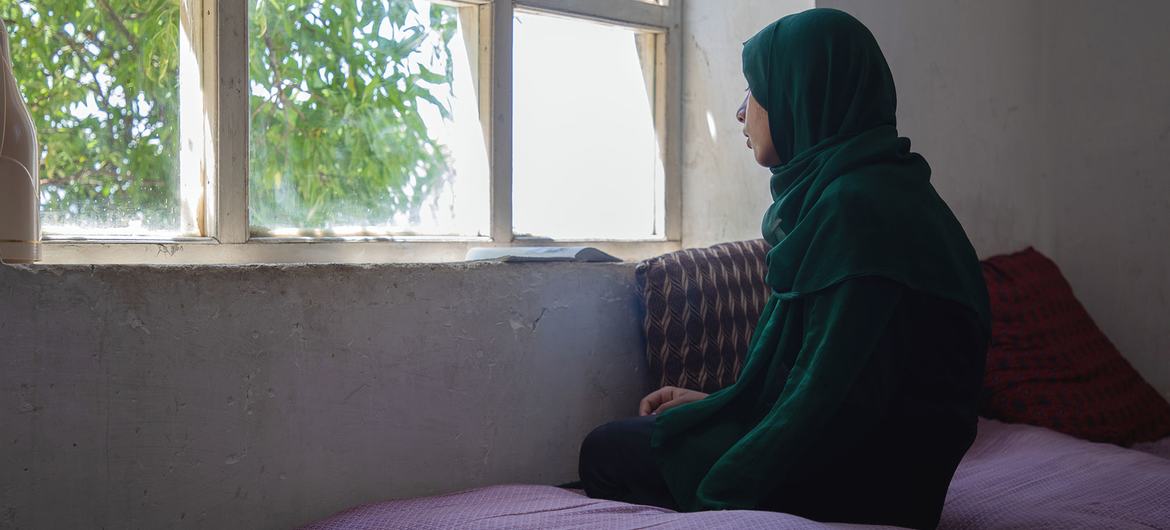
A teenage girl in Afghanistan stays at home as she is no longer allowed to attend school.

Erasure of women and girls’ rights continues

She said the international community “remains extremely concerned that engagement has not improved the unacceptable situation of Afghan women and girls, promoted inclusive governance, or prevented a marked deterioration in human rights.”

Meanwhile, the de facto authorities have conveyed grievances around frozen assets, sanctions, non-recognition, the need for greater development assistance, and an end to aid dependency.

She noted that the UN will convene meetings of two working groups on counter-narcotics and the private sector to be held in Doha, Qatar, in the coming days, calling this “an important development that gives momentum to multilateral engagement and builds confidence in the value of mutual cooperation.”

Relative stability, restrictive policies

Ms. Otunbayeva said Taliban rule has provided relative stability and security in Afghanistan, promoted modest economic growth and foreign investment, initiated dormant infrastructure projects, and deepened diplomatic ties abroad, particularly in the region.

However, authorities “continue to implement highly restrictive and discriminatory policies on the Afghan people,” as embodied in the “law on the propagation of virtue and prevention of vice,” which took effect last August. 

This law “cemented” the Taliban’s systematic, state-sponsored policies that exclude women and girls from participation in public life, including access to education, employment, freedom of movement, and freedom of expression.

Reintegration at risk

Through this law, the de facto authorities are continuing to pursue a path that distances Afghanistan from its international obligations and hinders Afghanistan’s eventual reintegration into the international system,” she said.

“We cannot forget the unacceptable situation of Afghan women and girls, even if their continued marginalisation under increased enforcement of more and more decrees no longer generates headlines.”

The ongoing ban on girls’ education beyond primary school “is the clearest sign of the Taliban’s discrimination against women and continues to set Afghanistan apart from the world,” she said, calling once again for the ban to be lifted and for girls and women to again have the right to education.

One in five going hungry

Joyce Msuya, UN Assistant Secretary-General for Humanitarian Affairs, highlighted how funding cuts are impacting Afghanistan, where half of all people require assistance to survive. 

The population faces “persistent and acute humanitarian needs compounded by decades of conflict, entrenched poverty, an ever-harsher climate, severe restrictions on the rights of women and girls and highly constrained funding environment,” she said.

Today, one in every five Afghans is hungry, 3.5 million children are acutely malnourished and roughly 3.7 million children are out of school, including 2.2 million girls over age 11 who are banned from education. Additionally, the maternal mortality rate is over 2.5 times the global average. 

Health facilities shuttered

She said the aid cuts continue to hamper humanitarian response, and 420 health facilities have been forced to shut their doors, affecting more than three million people.

“Almost 300 nutrition sites have closed, depriving 80,000 acutely malnourished children, pregnant women, and new mothers of essential treatment,” she added.

“Despite challenges, and at great risk, our Afghan female colleagues continue to deliver aid, going where others cannot, listening to communities who would otherwise not be heard, and standing by those who might otherwise be forgotten,” she said.

Hardships increase

Sima Bahous, Executive Director of UN Women, upheld calls for more diplomacy to address the spiralling crisis in the Middle East and Iran.

“The growing regional and global insecurity will only deepen the hardships faced by Afghan women and girls, compounding poverty, displacement, violence and deprivation,” she warned.

Additionally, the ability of the UN and partners to support Afghan women has been drastically undermined by legal and bureaucratic barriers which make it harder than ever to hire women, let alone reach them, at a time when deep cuts to aid budgets “have ever more devastating consequences.”

‘Unshakeable determination’

“Yet, we stay, and we deliver, as we always have,” said Ms. Bahous, highlighting how UN Women continues to navigate through endless restrictions and negotiate with the Taliban.

“And, Afghan women continue to lead the way,” she added.  “They have opened underground schools; organized in silence; built lives in those slivers of space left to them. They have shown unshakable determination, even when the world faltered.” 

Source link

Yemen at breaking point as UN envoy urges action to end suffering

Speaking via videoconference, UN Special Envoy for Yemen Hans Grundberg said the country remains trapped in a prolonged political, humanitarian and development crisis.

Yemen is so much more than the containment of a threat,” he said. “The cost of inaction is high.”

Mr. Grundberg stressed the urgent need for progress towards a sustainable political solution, calling on all parties to show the will to move beyond the current deadlock.

Meanwhile, over 17 million people, nearly half of Yemen’s population, are estimated to be suffering acute malnutrition.

Without sustained humanitarian support, six million more could face emergency levels of food insecurity, said Joyce Msuya, Assistant Secretary-General of UN humanitarian wing (OCHA), speaking on behalf of Humanitarian Affairs chief Tom Fletcher.

Economic hardships

Yemeni citizens continue to shoulder the impact of an economy in freefall,” said Mr. Grundberg, calling for more international support to alleviate the humanitarian and economic hardships they face.

Despite operating under extremely difficult conditions, humanitarian efforts in Yemen continue, but the UN’s response remains constrained and far from meeting the scale of need, according to OCHA.

Still, there are signs of progress. “There is real scope to make progress on the economy,” said Special Envoy Hans Grundberg, pointing to the reopening last May of a key road between Aden and Sana’a, closed for nearly seven years, which has restored a faster and more direct route for civilians and commercial traffic.

“With trust and the right tools, there remains hope,” said Deputy Emergency Relief Coordinator Joyce Msuya.

Fragile frontlines

Marking one year since the arbitrary detention by Houthi rebels – or Ansar Allah – of dozens of aid workers, civil society representatives and diplomatic personnel, Mr Grundberg urged Security Council members to use their “powerful voices” to exert maximum pressure on the group for the unconditional release of the detainees.

While attacks on shipping in the Red Sea and counter measures by Western forces have largely abated since a cessation of hostilities agreement between the United States and the Houthi leadership, the group has launched several recent attacks targeting Israel, in solidarity with the Palestinian cause in Gaza.

With multiple frontlines still fragile and the risk of renewed fighting ever-present, the UN continues to work on a roadmap to help Yemen move beyond its divisions, secure a comprehensive ceasefire, implement critical economic measures and advance an inclusive political process.

Gaza: Top UN envoy calls on Israel to end devastating strikes, starvation of civilians

Sigrid Kaag, interim UN Special Coordinator for the Middle East Peace Process, said that the man-made crisis unfolding in Gaza has plunged civilians into “an abyss.”

“Since the collapse of the ceasefire in March, civilians have constantly come under fire, confined to ever-shrinking spaces, and deprived of lifesaving relief,” she said.

Israel must halt its devastating strikes on civilian life and infrastructure.

Risk of famine

With families cut off from aid for weeks on end, and only a fraction of the needed relief now entering the enclave, starvation looms.

The entire population of Gaza is facing the risk of famine,” Ms. Kaag warned, adding that the limited aid permitted into the enclave is “comparable to a lifeboat after the ship has sunk.”

“Ms. Kaag emphasized that humanitarian aid must not depend on political negotiations, noting that the UN aid operation is prepared to deliver assistance immediately, in accordance with international law.

“Aid cannot be negotiable,” she said.

Full aid access imperative

Ms. Kaag called on Israel to halt its devastating strikes and allow full access for humanitarian aid and commercial goods.

At the same time, she stressed that Israel has the right to live in peace and security.

“This was undeniably shaken by the horrific terror attacks and taking of hostages on 7 October by Hamas and other Palestinian armed groups,” she said, reiterating the call on Hamas and other armed groups to stop rocket attacks against Israel and release all hostages unconditionally.

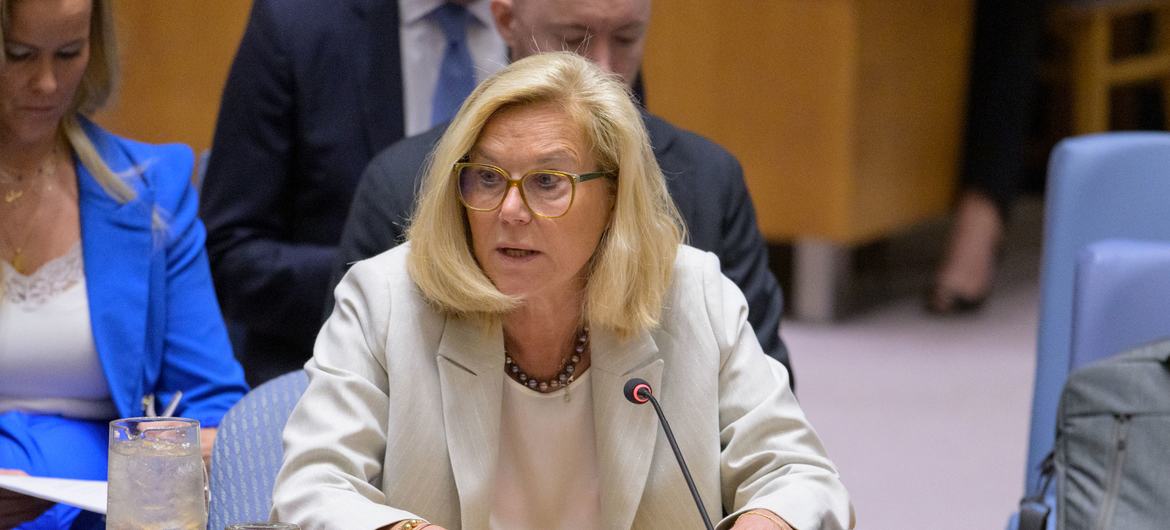
Sigrid Kaag, UN Special Coordinator for the Middle East Peace Process Ad Interim, briefs the Security Council on the situation in the Middle East.

Two-State solution

Ms. Kaag emphasised that durable security “cannot be achieved solely through force”, it must be built on mutual recognition, justice, and rights for all.

“A better path exists that resolves this conflict, de-escalates regional tensions and achieves a shared vision for peace,” she said.

The upcoming high-level international conference in June, co-chaired by France and Saudi Arabia, presents a critical opportunity to relaunch a path toward ending the occupation and realising the two-State solution based on international law, UN resolutions and previous agreements.

It must not be another rhetorical exercise,” she said.

“We need to pivot ourselves from declarations to decisions. We need to implement rather than adopt new texts.”

‘See you in heaven’

In her briefing, Ms. Kaag described the deep despair of civilians in Gaza, where families now bid farewell not with a “goodbye, see you tomorrow”, but with the words “see you in heaven.”

“Death is their companion. It’s not life, it’s not hope,” she continued, stressing that Gazans deserve more than survival – they deserve a future.

Urging bold political action, she called for adherence to international law, and support for a reformed Palestinian Government that can govern both Gaza and the West Bank.

Statehood is a right, not a reward,” Ms. Kaag said.

“Let us not be remembered as the generation that let the two-State solution disappear. Let us be the generation that chose courage over caution, justice over inertia and peace over politics. Let us be part of a generation that can make this happen.”

Special Coordinator a.i. Kaag’s briefing to the Security Council.

US ‘fully stands’ with Israel

Speaking for the United States, John Kelley, Political Coordinator at the US Mission to the UN, said that his country has been working tirelessly to free the hostages and bring the war to an end – “one that Hamas brutally started”.

“Hamas continues to reject proposals from the US, Qatar and Egypt that would release the 58 remaining hostages, who have now been cruelly held for 600 days, and bring calm to Gaza,” he said.

“Every day Hamas demonstrates its lack of regard for the Palestinians it claims to represent, all while it violently suppresses protests against its barbaric rule and diverts aid meant for civilians.”

He underscored that the US “fully stands” behind Israel and its right to defend itself, stating that to move forward, “Hamas must be defeated.”

“As Secretary [Marco] Rubio has said – if an ember survives, it will spark again into a fire. There can no peaceful and prosperous Gaza as long as Hamas governs it by force,” Mr. Kelley said.

The horrors must end: Algeria

Algerian Ambassador Amar Bendjama described the deadly impact of the ongoing war in Gaza on children, citing the specific case of the nine children of a Gazan doctor, all killed in an airstrike, while her sole remaining child and husband remain in a critical condition.

“They were not members of a centre for command and control of Hamas,” he said, adding, “the Israeli army killed them, they killed them deliberately.”

He noted that today, no one in Gaza is spared – and three decades after the optimism surrounding the Oslo peace accords between Israel and Palestinian leadership, “the dream of a Palestinian state is vanishing under the boots of the Israeli occupation and the silence of the international community.”

Stating that the “time for indecision” was over, he called for action – “not words of condemnation”.

“These horrors must end,” he said.

Gaza needs a ceasefire, not more bloodshed: United Kingdom

James Kariuki, Deputy Permanent Representative of the UK, said his country has “always supported” Israel’s right to defend itself but cautioned that it “strongly opposes” Israel’s escalating military action in Gaza, “which is wholly disproportionate.”

“An immediate ceasefire, not more bloodshed is the way to secure the release of the hostages and stop the end cycle of violence,” he said.

The level of human suffering in Gaza is intolerable, he continued, stating that the United Nations had warned of the risks of the Israeli Government’s aid delivery plan.

“In Rafah yesterday, we saw this warning become a reality. The Gaza Humanitarian Foundation lost control of its distribution centre, with multiple casualties reported and great distress for those desperately seeking aid,” he said.

“In contrast, the UN has a clear plan to deliver lifesaving aid at scale. It contains robust mitigations against aid diversion. Brave humanitarians stand ready to do their jobs,” he added. “Let aid in and enable the UN to operate now.”

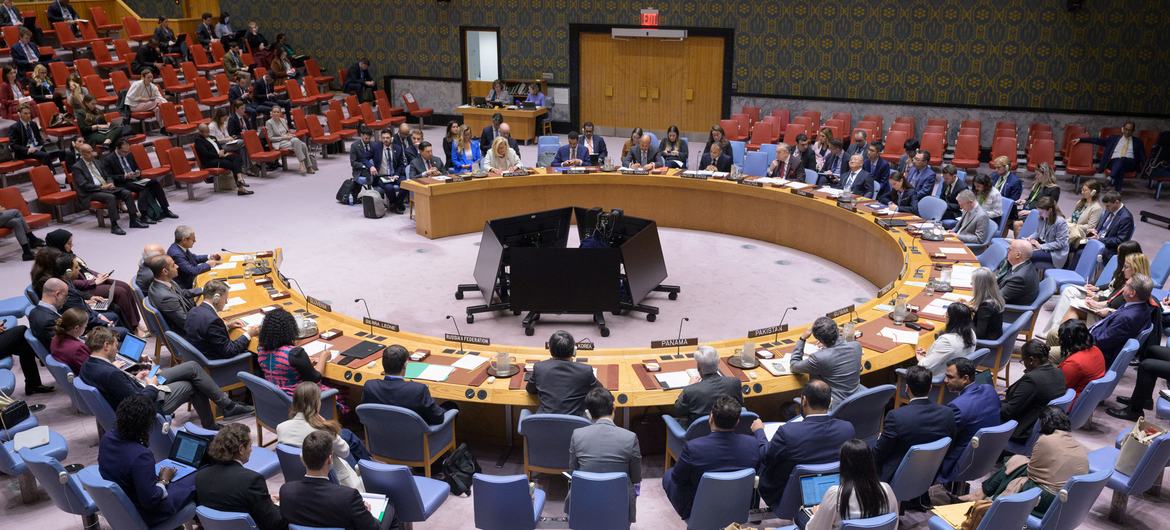
A wide view of the UN Security Council meeting on the situation in the Middle East.

Images of hungry, desperate people ‘gut-wrenching’: Palestine

Riyad Mansour, Permanent Observer of the State of Palestine, said the images of hungry and desperate people trying to get aid supplies in are “gut-wrenching” and “heart breaking.”

“These are people, human beings, deprived of water, food, medicine for so long and hanging to life by a thread,” he said, adding that this is “outraging the Palestinian people – all of them, including me.”

“It is outrageous to see this situation, and still you are not acting,” he said, pointing to Security Council members: “how much more do you want?”

He added that the UN plan for aid, with its proven capacity on the ground remains the only viable plan to deliver relief supplies and it has all necessary safeguards – “if that is the true concern.”

“But the true concern is how to get rid of the Palestinians by killing them, starving them, and destroying Gaza so they have no choice but to leave if they want to live,” Mr. Mansour said.

Israel is facilitating aid into Gaza: Ambassador

Israeli Ambassador Danny Danon said that while the UN “spreads panic and makes declarations detached from reality, the State of Israel is steadily facilitating the entry of aid into Gaza.”

This, he said, is being done via two methods.

“First, under the old framework, via trucks and, second, under the new distribution mechanism developed in coordination with the US and key international partners,” he continued, noting that both mechanisms are “working simultaneously” and will continue to do so for the immediate future.

“We are not only allowing aid in, but we are ensuring that it reaches the people who need it most,” he added.

Aid is already being distributed in Gaza, Ambassador Danon said, despite efforts by Hamas to obstruct people from reaching it by setting up checkpoints and roadblocks.

“Because Hamas knows if it loses control over the aid, it loses control over the people of Gaza,” he said.

Source link

Syria: UN envoy warns of escalating violence in Syria

He described the latest clashes as “unacceptable” and warned of the risk of further escalation in what he called an “extremely fragile situation”.

Fighting erupted earlier this week in Ashrafiah Sahnaya, a town southwest of the capital, when unknown gunmen attacked a security checkpoint.

The following day, another deadly clash took place in the nearby suburb of Jaramana. In total, at least 16 civilians and security personnel were reported killed.

‘Immediate steps’ needed to protect civilians

“The reports of civilian casualties, and casualties among security personnel, are deeply alarming,” said Mr Pedersen in a statement. “Immediate steps must be taken to protect civilians, de-escalate tensions, and prevent any further incitement of communal conflict.”

The violence comes as tensions reportedly remain high between Syria’s interim Government and Druze communities near the capital.

The Druze, a religious minority in Syria, have been engaged in talks about their inclusion in the new Syrian State, following the overthrow of the Assad regime last December.

Many in the community are reportedly calling for some level of autonomy, concerned over the Islamist background of some of Syria’s current leadership.

Amid the domestic unrest, Israel has also carried out military strikes in Syria, reportedly targeting what the Prime Minister described as an “extremist group” allegedly preparing to attack the Druze population south of Damascus.

A second strike reportedly killed a Syrian security officer outside the capital.

Syrian sovereignty ‘must be fully respected’

Mr. Pedersen condemned the Israeli attacks, saying they must stop. “Syria’s sovereignty must be fully respected.”

He stressed the importance of accountability for those responsible for killing civilians and fuelling tensions.

“There can be no progress without genuine inclusion, trust-building, and meaningful dialogue,” he said.

The Special Envoy welcomed efforts already underway to calm the situation and urged all sides to work together to prevent further bloodshed.

Dialogue, not destruction

With tensions still simmering following last month’s sectarian violence in Latakia, which claimed over 1,000 lives, the UN is calling for restraint and unity at a critical juncture for Syria’s future.

“The people of Syria have suffered too much for too long,” Mr Pedersen said.

They deserve peace, dignity, and a future built on dialogue, not destruction.”

Source link