UN envoy highlights ‘window to advance peace’ in Colombia

“At a time of tensions both globally and regionally, it is in everyone’s interest to secure lasting peace and security in Colombia,” said Miroslav Jenča, delivering his quarterly briefing. 

He said the coming year “undoubtedly provides a window to advance peace as a strategic national objective, and for Colombia and its partners to engage constructively through dialogue to address shared challenges,” particularly in the border area with Venezuela “where cooperation on all sides is essential.” 

Switch in focus 

Mr. Jenča also heads the UN Verification Mission in Colombia, and he reported on re-organization outlined in Council resolution 2798 (2025), adopted last October. 

The resolution extended the Mission’s mandate for a year and changed its focus to monitoring three provisions of the 2016 peace agreement signed by the Government and FARC-EP rebels:  

  • Comprehensive rural reform 
  • Reintegration of former combatants 
  • Security of both ex-fighters and communities in conflict-affected regions  

Previously mandated verification on transitional justice, ethnic-related issues and ceasefire monitoring was discontinued. 

Challenges in conflict areas 

Mr. Jenča has spent the past three months meeting key counterparts across Colombia who underscored that the three pillars are important for achieving peace. 

During visits to several parts of the country, he was “struck not only by the immense challenges facing communities in conflict-affected regions, but also by their resilience and determination to achieve a better future.” 

In some of the most remote areas, daily life is a struggle “due to the actions of different illegal armed actors and to the limited presence of the state, public services and development opportunities.”  

Limited opportunities  

He noted that re-integration of former combatants is essential to the success of peace agreements and ensuring their transition to civilian life is crucial to avoid a return to violence. 

“Nevertheless, nine years after the FARC-EP laid down arms under the Peace Agreement, the path has proven challenging for the over 11,000 former combatants who remain active in the government’s reintegration programme,” he said. 

 These men and women often live in remote areas with limited infrastructure, access to markets, and threats to their security.  

“For the authorities, it has also entailed major efforts, both financial and programmatic, to facilitate their transition into civilian life,” he added, noting that while substantial progress has been made but more is needed. 

‘Fertile ground’ for armed groups 

Access to land has progressed in Colombia but still needs to be fully resolved, Mr. Jenča said.  Meanwhile, security remains fragile. 

Some 487 former combatants have been killed since laying down their arms. He urged the authorities to step up investigations and prioritize security guarantees for those who signed the peace deal. 

Although violence is far lower now than at the height of the conflict, “the presence of armed groups in areas still affected by conflict continues to inflict suffering on entire communities.” 

This violence is being fuelled by a mix of factors and limited State presence “provides fertile ground for the armed groups to exert control, and for illicit economies to prevail.”  

Rise in child recruitment 

As a result, civilian populations have faced threats, killings of social leaders, forced displacement and confinement, and an alarming increase in child recruitment and use by armed groups.  

The situation in border areas is particularly complex, he said. The UN Mission’s team in Cúcuta, a city on the border with Venezuela, supports response to continuing clashes between rival armed groups. 

Thousands of civilians have been have forced to flee their homes in the Catatumbo region, which he described as “a hub of coca cultivation and cross-border armed activities and criminality.”  

‘Holistic vision’ for peace 

Mr. Jenča insisted that the Peace Agreement can significantly contribute to addressing many of these problems. 

“It offers a much-needed holistic vision, by providing for the strengthening of the State’s capacity to dismantle criminal structures, to promote alternatives to coca cultivation and concrete development measures through its comprehensive rural reform,” he said.  

Source link

Window to prevent famine spreading in Gaza is ‘closing fast’, UN warns

Tom Fletcher’s statement amid what he described as “a massive military offensive” by Israeli forces against Palestinians in Gaza City, and the failure of ceasefire negotiations with Hamas militants.

By the end of September famine will likely have spread into Deir al Balah and Khan Younis, he said, unless there is a huge influx of humanitarian aid: “Death, destruction, starvation and displacement of Palestinian civilians are the result of choices that defy international law and ignore the international community.”

The horror can be stopped, he continued, if aid is allowed in at scale.

Mr. Fletcher called again for an immediate ceasefire, the protection of civilians, the release of all hostages held inside Gaza by Hamas and other militants and the release of arbitrarily detained Palestinians.

He also insisted on the implementation of the International Court of Justice’s (ICJ) provisional measures which call for prevention of genocidal acts and the immediate and effective delivery of urgent basic services to Gaza’s civilian population.

No money, nowhere to go

Ahead of a second airstrike on a Gaza City high rise apartment block on Saturday in as many days which Israeli forces claimed was being used by Hamas – which the militant group denied – Israel reportedly dropped leaflets warning residents to relocate to the south.

UN News’s correspondent spoke to families trying to survive in the city amid Israel’s ongoing offensive, who are facing an impossible choice over staying or fleeing.

Abu Amer Al-Sharif, A Palestinian in Gaza City.

Abu Amer al-Sharif said, “we are at a loss,” sitting in front of what remains of his house in the city that used to be home to over one million people.

They had salvaged some belongings – but moving again seemed a daunting task.

“You know the financial burden, including transportation costs and rent for new housing. There are no salaries from the authorities and people have no income. Families are required to pay thousands of dollars for the places they move to, in addition to transportation costs. On top of that, our property is damaged,” Abu Amer said.

‘I live on the rubble’

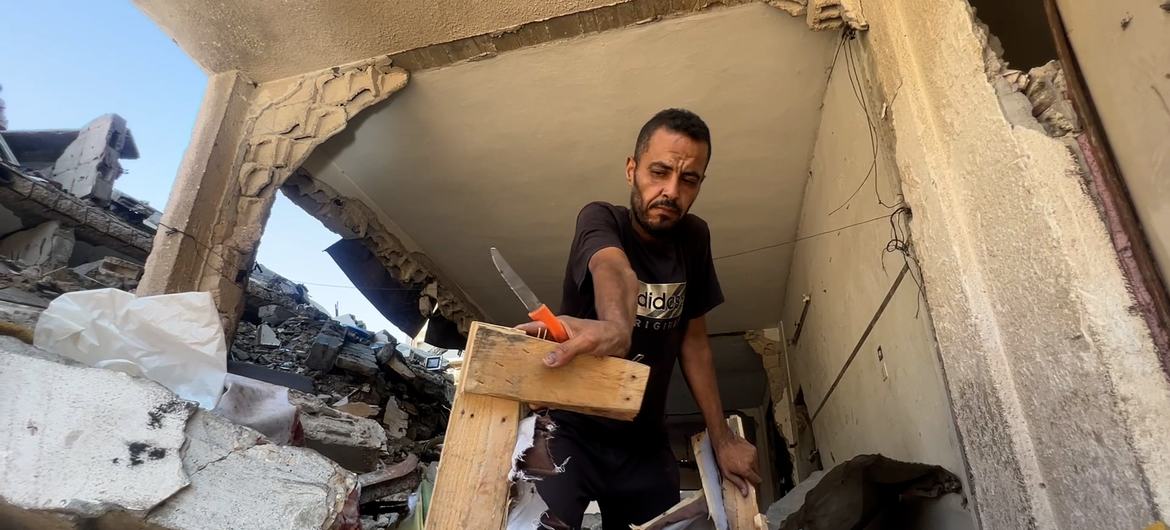
In the same neighborhood, Hossam Madi stands amid the rubble of his home, breaking up furniture to sell as firewood.

We don’t have enough money to move to the southern Gaza Strip,” he said bluntly.

Hossam Madi, a resident of Sheikh Radwan in northern Gaza City removes some of his belongings from his destroyed home.

“I break wood to sell it to buy a kilo of flour for breakfast or lunch. We have nothing. Look at our house, look what happened to it. I am living on the rubble, and now I will take my things and move to western Gaza.”

Saqr Abu Sultan said he wasn’t sure where they were headed, loading his family’s belongings onto a three-wheeled cart in preparation for leaving the Sheikh Radwan neighborhood.

The situation is chaotic now. We’re trying to evacuate, but we don’t know where to go, despite the constant talk of safe areas,” he said.
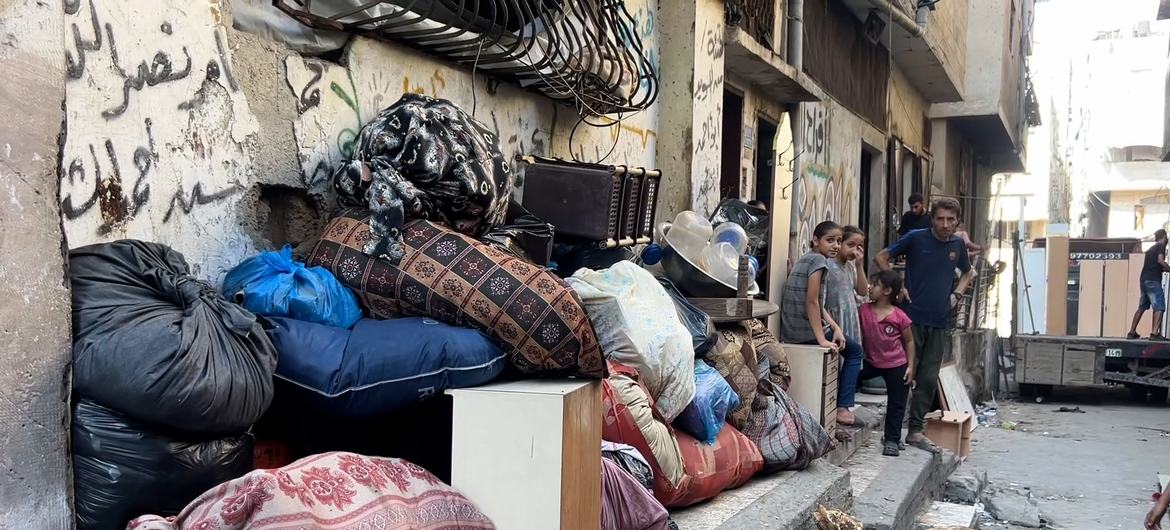
Abu Amer Al-Sharif and his family in Gaza City remove their belongings and household items from their home, preparing for yet another displacement..

Source link