‘Shift the narrative’ on suicide to prevent loss of 720,000 lives annually

Speaking on World Suicide Prevention Day, which is marked annually on 10 September, WHO’s Tedros Adhanom Ghebreyesus said that “each life lost leaves a profound impact on families, friends, colleagues and entire communities.”

All age groups are affected by suicide and was the third leading cause of death among 15–29-year-olds globally in 2021, the last year for which data has been gathered by WHO.

Suicide does not just occur in high-income countries and impacts all regions of the world.

Close to three quarters of global suicides occurred in low and middle-income countries in 2021.

The average number of suicides across the world in 2021 was 8.9 per 100,000 people.

In Africa the figure stood at 11.5, while in both Europe and Southeast Asia the number of suicides was recorded at 10.1 per 100,000 people.

Globally, the lowest suicide rate was in the Eastern Mediterranean region at 4.0 per 100,000, while in the Western Pacific it was 7.5 per 100,000.

Who’s at risk?

The link between suicide and mental disorders, in particular, depression and alcohol use disorders, and a previous suicide attempt is well established in high-income countries.

However, many suicides happen impulsively in moments of crisis with a breakdown in the ability to deal with life stresses, such as financial problems, relationship disputes, or chronic pain and illness.

In addition, experiencing conflict, disaster, violence, abuse or loss and a sense of isolation are strongly associated with suicidal behaviour.

Suicide rates are also high among vulnerable groups who experience discrimination, such as refugees and migrants, indigenous peoples, lesbian, gay, bisexual, transgender, intersex (LGBTI) persons and incarcerated prisoners.

Moving from silence to openness

We must move from silence to openness, from stigma to empathy, and from neglect to support,” said Dr. Tedros.

“We must create environments where people feel safe to speak up and seek help,” he said.

“Shifting the narrative on suicide also means driving systemic change, where governments prioritise and invest in quality mental health care and policies to ensure everyone gets the support they need.”

According to the 2024 Mental Health Atlas report by WHO, median government spending on mental health has remained at a modest 2 percent of total health budgets since 2017.

Moreover, there is a significant disparity between high-income and low-income nations. Whilst high-income nations allocate up to $65 per person to mental health, low-income nations spend as little as $0.04.

WHO recognizes mental health as a universal human right.

Effective prevention measures

WHO says that there are effective measures that can be taken to prevent suicide and self-harm.

LIVE LIFE, the agency’s initiative for suicide prevention, recommends the following key effective evidence-based interventions:

  • limit access to the means of suicide (eg, pesticides, firearms, certain medications);
  • interact with the media for responsible reporting of suicide;
  • foster socio-emotional life skills in adolescents;
  • early identify, assess, manage and follow up anyone who is affected by suicidal behaviours.

Window to prevent famine spreading in Gaza is ‘closing fast’, UN warns

Tom Fletcher’s statement amid what he described as “a massive military offensive” by Israeli forces against Palestinians in Gaza City, and the failure of ceasefire negotiations with Hamas militants.

By the end of September famine will likely have spread into Deir al Balah and Khan Younis, he said, unless there is a huge influx of humanitarian aid: “Death, destruction, starvation and displacement of Palestinian civilians are the result of choices that defy international law and ignore the international community.”

The horror can be stopped, he continued, if aid is allowed in at scale.

Mr. Fletcher called again for an immediate ceasefire, the protection of civilians, the release of all hostages held inside Gaza by Hamas and other militants and the release of arbitrarily detained Palestinians.

He also insisted on the implementation of the International Court of Justice’s (ICJ) provisional measures which call for prevention of genocidal acts and the immediate and effective delivery of urgent basic services to Gaza’s civilian population.

No money, nowhere to go

Ahead of a second airstrike on a Gaza City high rise apartment block on Saturday in as many days which Israeli forces claimed was being used by Hamas – which the militant group denied – Israel reportedly dropped leaflets warning residents to relocate to the south.

UN News’s correspondent spoke to families trying to survive in the city amid Israel’s ongoing offensive, who are facing an impossible choice over staying or fleeing.

Abu Amer Al-Sharif, A Palestinian in Gaza City.

Abu Amer al-Sharif said, “we are at a loss,” sitting in front of what remains of his house in the city that used to be home to over one million people.

They had salvaged some belongings – but moving again seemed a daunting task.

“You know the financial burden, including transportation costs and rent for new housing. There are no salaries from the authorities and people have no income. Families are required to pay thousands of dollars for the places they move to, in addition to transportation costs. On top of that, our property is damaged,” Abu Amer said.

‘I live on the rubble’

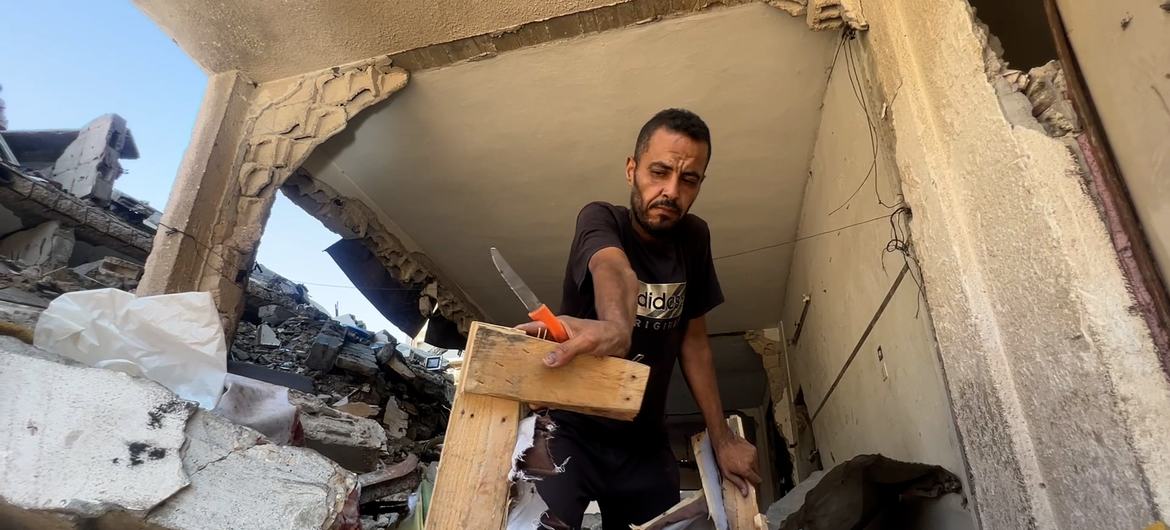
In the same neighborhood, Hossam Madi stands amid the rubble of his home, breaking up furniture to sell as firewood.

We don’t have enough money to move to the southern Gaza Strip,” he said bluntly.

Hossam Madi, a resident of Sheikh Radwan in northern Gaza City removes some of his belongings from his destroyed home.

“I break wood to sell it to buy a kilo of flour for breakfast or lunch. We have nothing. Look at our house, look what happened to it. I am living on the rubble, and now I will take my things and move to western Gaza.”

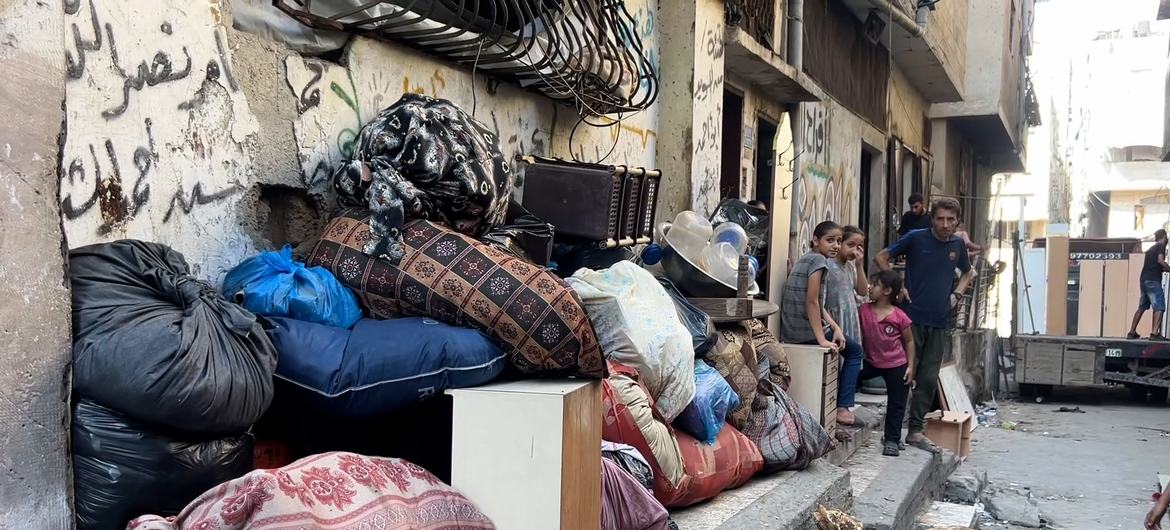
Saqr Abu Sultan said he wasn’t sure where they were headed, loading his family’s belongings onto a three-wheeled cart in preparation for leaving the Sheikh Radwan neighborhood.

The situation is chaotic now. We’re trying to evacuate, but we don’t know where to go, despite the constant talk of safe areas,” he said.

Abu Amer Al-Sharif and his family in Gaza City remove their belongings and household items from their home, preparing for yet another displacement..

Source link

Sudan emergency: We need more help to prevent famine, says WFP

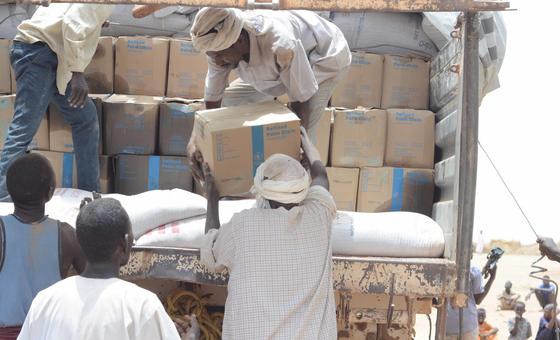
“Over the past six months, WFP scaled up assistance and we are now reaching nearly one million Sudanese in Khartoum with food and nutrition support,” said Laurent Bukera, WFP Country Director in Sudan. “This momentum must continue; several areas in the south are at risk of famine.”

In an update from Port Sudan, Mr. Bukera reported that a mission to Khartoum had found many neighbourhoods abandoned, heavily damaged and akin to a “ghost city”.

Pressure on overstretched resources will only intensify, he insisted.

Fragile frontline communities

And as conflict still rages between the Sudanese Armed Forces and the paramilitary Rapid Support Forces, sparked by a breakdown in transition to civilian rule in 2023, the veteran aid worker also explained that communities on the frontlines were at “breaking point” and unable to support displaced families any longer.

Despite many generous contributions to the UN agency’s work in Sudan, it faces a $500 million shortfall to support emergency food and cash assistance for the coming six months.

The international community must act now by stepping up funding to stop famine in the hardest hit area, and to invest in Sudan’s recovery,” Mr. Bukera insisted.” We must also demand respect for the safety and the protection of the Sudanese people and aid workers.”

No food, water

More than two years of fighting have smashed infrastructure and left communities without basic services, such as clean water.

This – and weeks of heavy rains – have contributed to a deadly cholera outbreak and reports of corpses rotting in the Nile in Omdurman, one of the capital’s three cities.

In an update last week, the UN aid coordination office, OCHA, said that war-related displacement and the spread of cholera have continued to add to needs across Sudan.

“We are deeply concerned and meeting the basic needs, especially food, will be critical and is urgent,” said WFP’s Mr. Bukera. “Urgent action is needed to restore basic services and accelerate recovery through coordinated efforts with local authorities, national NGOs, UN agencies and humanitarian partners.”

This vital work has been prevented by a lack of international support, forcing WFP to reduce the amount and range of relief it can distribute.

“Funding shortfalls are already disrupting some of the assistance we are providing in Khartoum, Blue Nile, Al Jazeera and Sennar states,” the WFP senior official continued. “Our rations and the oil and the pulses in the food basket had to be removed due to lack of resources.”

Rations cuts

In Khartoum, lifesaving nutritional supplements for young children and pregnant and nursing mothers are already “out of reach” because of a lack of resources, he said.

Despite the many challenges, the UN agency now reaches four million people a month across Sudan. This is nearly four times more than at the start of 2024 as access has expanded, including in previously unreachable areas like Khartoum.

Communities are also supported in the longer-term via cash assistance to support local markets and support for bakeries and small businesses planning to reopen.

We have rapidly scaled up our operation to meet increasing needs,” Mr. Bukera said. “We are aiming to reach seven people on a monthly basis, prioritizing those facing famine or other areas at extreme risk”, such as Darfur, Kordofan and Al Jazeera.

Source link