Women and girls in science: Dismantling barriers, closing gender gaps

Across the world, a significant gender gap persists at all levels of science, technology, engineering and mathematics (STEM) disciplines due to lack of research funding, gender stereotypes, and discriminatory workplace practices. 

UN Secretary-General António Guterres said the gap is particularly pronounced in technology, where women represent just 26 per cent of the workforce in data and artificial intelligence, and 12 per cent in cloud computing

 “Excluding women from science weakens our collective capacity to address urgent global challenges, from climate change to public health to space security,” he warned. 

Greater inclusion 

As societies continue to grapple with widening inequalities, the UN believes that the integration of artificial intelligence (AI), social science, STEM and finance provides a way to accelerate inclusive and sustainable development.  

The approach is being highlighted on the International Day of Women and Girls in Science, observed on Wednesday. 

Synergizing these four domains can help dismantle persistent barriers by closing gender gaps in digital skills, catalysing women-driven start-ups, advancing gender-responsive AI governance, and mobilising finance that embeds social inclusion as a performance metric. 

“From advancing renewable energy to preventing the next pandemic, our future hinges on unlocking as much human talent as possible,” the Secretary-General said. 

“Today and every day, let us ensure that women and girls can realise their scientific ambitions – for their rights, and for the benefit of all.” 

Scientist, entrepreneur, ambassador 

Chemist and entrepreneur Asel Sartbaeva from Kyrgyzstan is a role model in this regard. 

She is an associate professor of chemistry at the University of Bath in the United Kingdom and co-founder and CEO of the biotech company EnsiliTech. 

Her work tackles one of global health’s most persistent challenges: how to make vaccines stable at high temperatures so they can be transported to the most remote communities without complex refrigeration. 

Supporting girls in STEM 

Alongside her research, Ms. Sartbaeva works with the UN Children’s Fund (UNICEF) as an ambassador for the Girls in Science programme in Kyrgyzstan, encouraging girls to pursue higher education and careers in STEM. 

She told UN News that in many communities, decisions about a girl’s future are shaped by her family – particularly her father. 

Most of the time, the biggest worry I’ve heard, especially from fathers, was that they thought that if their girls would go into science, they will not have a family,” she said.  

“For me, really, the first thing was to show that actually that is not true. They can have both and it’s not mutually exclusive.” 

‘We need you’ 

The UNICEF programme combines science masterclasses with mentoring, communication training and confidence-building. Thousands of girls have taken part, and many have gone on to pursue university degrees in STEM. 

Ms. Sartbaeva believes opportunities for women in science are improving. Women professors were rare when she was at university, but today she sees far more balance and stronger policies supporting inclusion.  

Still, more talent is still needed and she had a clear, simple message for girls considering STEM: “We need you.” 

Source link

Window to prevent famine spreading in Gaza is ‘closing fast’, UN warns

Tom Fletcher’s statement amid what he described as “a massive military offensive” by Israeli forces against Palestinians in Gaza City, and the failure of ceasefire negotiations with Hamas militants.

By the end of September famine will likely have spread into Deir al Balah and Khan Younis, he said, unless there is a huge influx of humanitarian aid: “Death, destruction, starvation and displacement of Palestinian civilians are the result of choices that defy international law and ignore the international community.”

The horror can be stopped, he continued, if aid is allowed in at scale.

Mr. Fletcher called again for an immediate ceasefire, the protection of civilians, the release of all hostages held inside Gaza by Hamas and other militants and the release of arbitrarily detained Palestinians.

He also insisted on the implementation of the International Court of Justice’s (ICJ) provisional measures which call for prevention of genocidal acts and the immediate and effective delivery of urgent basic services to Gaza’s civilian population.

No money, nowhere to go

Ahead of a second airstrike on a Gaza City high rise apartment block on Saturday in as many days which Israeli forces claimed was being used by Hamas – which the militant group denied – Israel reportedly dropped leaflets warning residents to relocate to the south.

UN News’s correspondent spoke to families trying to survive in the city amid Israel’s ongoing offensive, who are facing an impossible choice over staying or fleeing.

Abu Amer Al-Sharif, A Palestinian in Gaza City.

Abu Amer al-Sharif said, “we are at a loss,” sitting in front of what remains of his house in the city that used to be home to over one million people.

They had salvaged some belongings – but moving again seemed a daunting task.

“You know the financial burden, including transportation costs and rent for new housing. There are no salaries from the authorities and people have no income. Families are required to pay thousands of dollars for the places they move to, in addition to transportation costs. On top of that, our property is damaged,” Abu Amer said.

‘I live on the rubble’

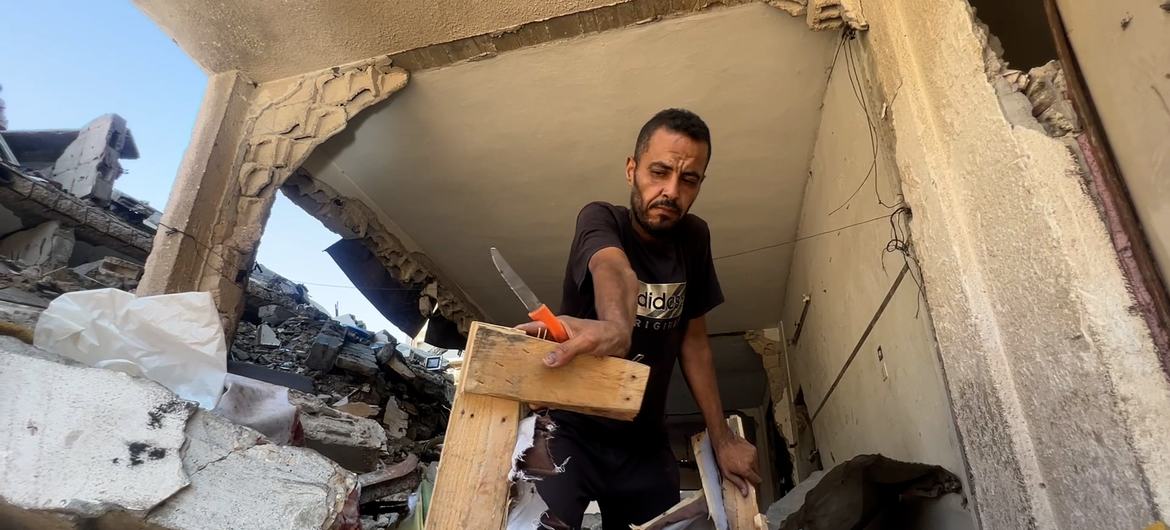
In the same neighborhood, Hossam Madi stands amid the rubble of his home, breaking up furniture to sell as firewood.

We don’t have enough money to move to the southern Gaza Strip,” he said bluntly.

Hossam Madi, a resident of Sheikh Radwan in northern Gaza City removes some of his belongings from his destroyed home.

“I break wood to sell it to buy a kilo of flour for breakfast or lunch. We have nothing. Look at our house, look what happened to it. I am living on the rubble, and now I will take my things and move to western Gaza.”

Saqr Abu Sultan said he wasn’t sure where they were headed, loading his family’s belongings onto a three-wheeled cart in preparation for leaving the Sheikh Radwan neighborhood.

The situation is chaotic now. We’re trying to evacuate, but we don’t know where to go, despite the constant talk of safe areas,” he said.
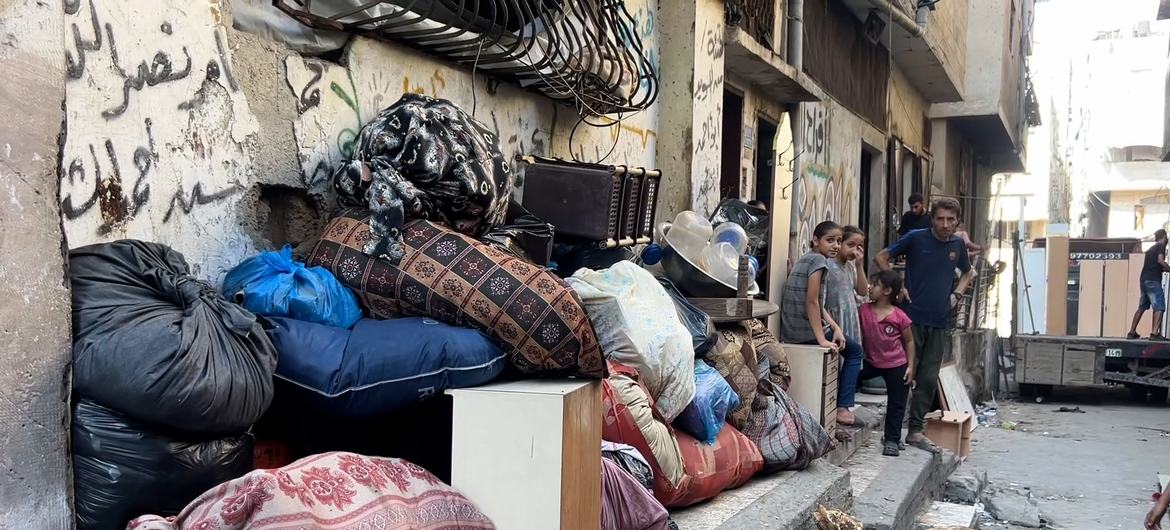
Abu Amer Al-Sharif and his family in Gaza City remove their belongings and household items from their home, preparing for yet another displacement..

Source link

Safety on and off the pitch: Closing down child trafficking in sport

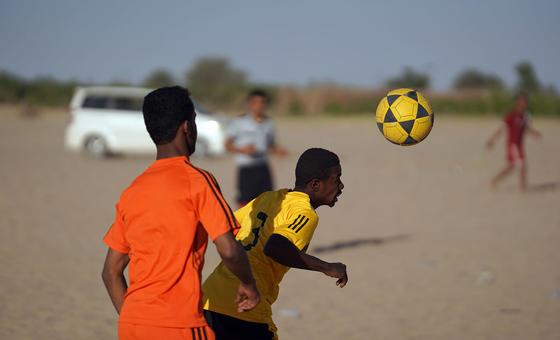
“Sports give me a sense of belonging as a girl. When I play, it affirms my right to play sports and exposes me to wider opportunities,” she said.  

This is what sport should represent for young people worldwide. However, a new campaign supported by the International Organization for Migration (IOM) works to counter a darker side of the multi-billion dollar industry – by ending child trafficking through sports.

‘Gateway to exploitation’

Sport should be a source of joy and achievement, not a gateway to exploitation. Yet traffickers prey on the ambitions of young athletes, using false promises to lure them into abuse and deception,” said Ugochi Daniels, the IOM deputy director general for operations. 

Of the approximately 50 million people worldwide who are subjected to trafficking-related abuses, 38 per cent of them are children. And of these children victims, 11 per cent are trafficked through false promises.  

In the sports industry, this takes many forms, including joining fake sports academies or signing what appear to be professional contracts.

For many young people like Saido, sport can be a pathway out of disadvantaged backgrounds. Saido, for example, dreams of seeing more Somali and refugee women playing in international professional leagues.  

“I want to see a basketball academy full of Somali girls and other girls from different communities here in Kakuma. I want to see Somali girls playing basketball at the WNBA level,” Saido said, referencing the top women’s league in the United States.  

But these dreams and their disadvantaged backgrounds, according to the campaign, can also make them uniquely vulnerable to the false promises of traffickers.  

Do not ignore the risks

Working alongside Mission 89 – an organisation which fights young athlete exploitation – IOM is calling upon stakeholders within the $1.2 trillion sports industry to strengthen protection mechanisms.  

This includes reforming unethical recruitment strategies which can be exploited by traffickers and providing education to the entire industry about the harms and risks of trafficking.  

In addition to these tangible changes, the campaign is also calling on industry leaders to sign commitments which declare zero tolerance of the scourge.  

While we continue to celebrate the power of sport, we cannot ignore the risks faced by young athletes,” said Lerina Bright, the founder and executive director of Mission 89.  

“This campaign is about ensuring that every child who dreams through sport is safe, supported and never exploited.” 

Source link