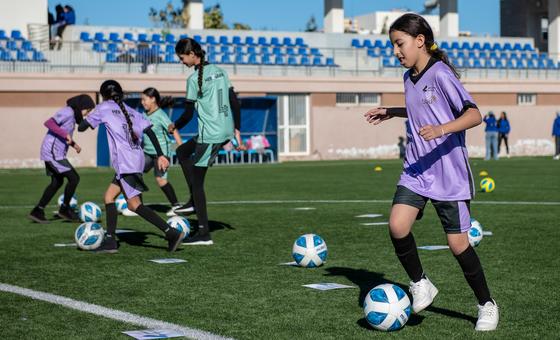

“Sports give me a sense of belonging as a girl. When I play, it affirms my right to play sports and exposes me to wider opportunities,” she said.
This is what sport should represent for young people worldwide. However, a new campaign supported by the International Organization for Migration (IOM) works to counter a darker side of the multi-billion dollar industry – by ending child trafficking through sports.
‘Gateway to exploitation’
“Sport should be a source of joy and achievement, not a gateway to exploitation. Yet traffickers prey on the ambitions of young athletes, using false promises to lure them into abuse and deception,” said Ugochi Daniels, the IOM deputy director general for operations.
Of the approximately 50 million people worldwide who are subjected to trafficking-related abuses, 38 per cent of them are children. And of these children victims, 11 per cent are trafficked through false promises.
In the sports industry, this takes many forms, including joining fake sports academies or signing what appear to be professional contracts.
For many young people like Saido, sport can be a pathway out of disadvantaged backgrounds. Saido, for example, dreams of seeing more Somali and refugee women playing in international professional leagues.
“I want to see a basketball academy full of Somali girls and other girls from different communities here in Kakuma. I want to see Somali girls playing basketball at the WNBA level,” Saido said, referencing the top women’s league in the United States.
But these dreams and their disadvantaged backgrounds, according to the campaign, can also make them uniquely vulnerable to the false promises of traffickers.
Do not ignore the risks
Working alongside Mission 89 – an organisation which fights young athlete exploitation – IOM is calling upon stakeholders within the $1.2 trillion sports industry to strengthen protection mechanisms.
This includes reforming unethical recruitment strategies which can be exploited by traffickers and providing education to the entire industry about the harms and risks of trafficking.
In addition to these tangible changes, the campaign is also calling on industry leaders to sign commitments which declare zero tolerance of the scourge.
“While we continue to celebrate the power of sport, we cannot ignore the risks faced by young athletes,” said Lerina Bright, the founder and executive director of Mission 89.
“This campaign is about ensuring that every child who dreams through sport is safe, supported and never exploited.”