Protecting children in war is key to lasting peace, top UN envoy warns

In an exclusive interview with UN News, Special Representative for Children and Armed Conflict, Vanessa Frazier, reflected on the alarming rise in grave violations against children and the urgent need to safeguard their future.

“The recruitment and use of children is still one of the most widespread and devastating violations we face. In 2024 alone, over 7,400 children were recruited or used by armed forces and armed groups, and those are only the verified cases,” Ms. Frazier told us, just ahead of Thursday’s international day against the use of child soldiers.

Over the last 30 years, we have separated over 220,000 children from armed gangs,” she emphasised. 

Growing crisis across conflicts

Her office monitors approximately 26 conflict situations around the world, and the numbers tell a grim story.

“The violations are most prevalent in the Democratic Republic of the Congo, Nigeria, Somalia, Syria, and Myanmar,” Ms. Frazier explained. 

Interview with Vanessa Frazier, Special Representative of the Secretary-General for Children and Armed Conflict, for UN News.

“But we’re also seeing worrying trends in Sudan, where children are specifically targeted because they are seen as useful – as border guards, as workers, even as fighters.”

Behind those statistics, she stressed, are young lives forever altered. “Each number in our report represents a child whose innocence has been interrupted,” she said.

From abduction to reintegration

Beyond documenting violations, Ms. Frazier’s office engages directly with combatants to negotiate the release of children and their safe return home.

“One of the strengths of our mandate is that we can negotiate directly with armed groups for the handover of children,” she explained. “Once separated, [children’s agency] UNICEF and our partners work on their reintegration, ensuring they receive psychosocial support, access to education, and the chance to reclaim their childhood.”

An eleven-year-old boy sits in the dormitory of a reintegration centre for recently demobilized child soldiers in Goma, DR Congo. (file)

But reintegration is often fraught with stigma. “Girls who return may be shunned by their communities, especially those who come back with children,” she said. “For societal reasons, some girls cannot be fully reintegrated are considered damaged goods.”

Prevention and accountability 

For Ms. Frazier, prevention is the ultimate goal.

“Prevention is better than cure,” she told us. “You know, this is why we really do advocate that even in times of war and armed conflict, children must remain in school. When they are out of school, they become very vulnerable to recruitment – whether forced or not.”

Accountability, too, plays a key role. The Special Representative – who previously served as Malta’s Ambassador to the UN, including an influential period on the Security Council – pointed to recent prosecutions before national courts and the International Criminal Court (ICC) as vital deterrents.

One of the greatest tools of deterrence is justice and accountability,” she highlighted”. “When warlords or armed group leaders are prosecuted and sentenced for recruiting children – including in national courts and at least three cases before the International Criminal Court – it sends a powerful message. Justice and accountability act as strong deterrents, showing armed groups that this crime carries real consequences.”

A 13-year-old girl formerly associated with an armed group in the Central African Republic holds a mock weapon.

Her conviction is rooted in field experience – from meeting survivors of Boko Haram’s abductions in Nigeria to listening to women once enslaved by the Lord’s Resistance Army in Uganda. 

“You hear about a 13-year-old girl holding her baby, and you realise how deeply conflict steals childhood,” she said. 

“When you hear these stories, you realise those numbers in our reports are individuals – children who were supposed to have their whole future ahead of them,” she said. 

Epitome of innocence 

Ms. Frazier spoke with emotion about why she is so committed to this cause.

“Children are the epitome of innocence,” she said. “They have not taken sides in any war, yet their innocence and childhood have both been interrupted. Children should never be treated as collateral of war.”

Children are the epitome of innocence

She added that the path to lasting peace begins with protecting and empowering those same children.

“The sustainability of peace depends on children’s right to take it forward. When they are brought back from conflict, they must have access to education and the chance to be fully integrated into society — to aspire to become doctors, nurses, lawyers, politicians, engineers — and that can only be achieved through education.”

Messages of hope

The Special Representative outlined her campaign Prove It Matters, which invites children affected by war to send messages to leaders, folded into origami doves, the universal symbol of peace.

“One child wrote to me, ‘I still have hope for a peaceful world. Never again a girl being a wife of a guerrilla fighter. Never again being part of armed groups. Let’s save childhoods and families too.’ It’s such an innocent plea, but it is what we are about,” she said.

A young man and former child soldier in Sultan Kudarat, Philippines, plans to return to school.

As the conversation ended, Ms. Frazier reiterated her conviction that education, justice and hope remain the pillars of peace.

“Children should be able to continue with their innocence even during times of conflict,” she said. “It is about ensuring a sustainable and peaceful future for the world.”

Source link

For every $1 spent protecting nature, $30 goes to destroying it

The UN on Thursday issued a call for widespread financial reform as the most powerful way to shift global markets towards realising a better world, for people and the planet.

For every dollar invested in protecting nature, 30 dollars are spent on destroying it – that’s the central finding of the State of Finance for Nature 2026 report, which calls for a major policy shift towards scaling up solutions that help the natural world – and support the economy at the same time.

Damage control

The data identifies several areas where the damage is particularly stark: utilities, industrials, energy and basic materials; and sectors which benefit from environmentally harmful subsidies – namely fossil fuels, agriculture, water, transport and construction.

“If you follow the money, you see the size of challenge ahead of us,” said Inger Andersen, Executive Director of UNEP, in response to the report, contrasting the slow progress of nature-based solutions with harmful investments and subsidies which, she declared, are surging ahead. 

We can either invest in nature’s destruction or power its recovery – there is no middle ground.”

A wealth of solutions

As well as identifying the size of the imbalance, the report’s authors lay out a vision of a “big nature turnaround,” highlighting examples of solutions that both work, and are economically viable. 

They include:

  • greening urban areas to counter heat-island effects and improve liveability for citizens; 
  • embedding nature in road and energy infrastructure; 
  • Producing emissions-negative building materials.

The study also charts a path for phasing out harmful subsidies and destructive investment in systems of production and scaling up investments that are “nature-positive.”

Protecting lives in a warming world: Health takes centre stage at COP30

As climate negotiations continue in the Amazonian city of Belém, Brazil, governments, UN agencies and partners have adopted the Belém Health Action Plan, placing an emphasis on addressing healthcare inequalities.

For updates on all the action and UN News coverage so far, head to our dedicated page here.

A planet heading to ‘intensive care’

The adoption took place on COP’s designated Health Day – a recognition that the climate crisis is also a health crisis.

“If our planet were a patient, it would be admitted to intensive care,” World Health Organization (WHO) Director-General Tedros Adhanom Ghebreyesus warned on the eve of the conference.

Extreme heat, floods, droughts and storms are not only environmental threats –they are driving disease outbreaks, food and water insecurity, and the disruption of essential health services.

A UNFPA mobile health clinic midwife assesses a pregnant woman at a displacement camp in Marib, Yemen.

Blueprint for resilience

Developed by the WHO, UN University (UNU) and other UN partners in collaboration with the Brazilian Government, the Action Plan sets out practical steps to integrate health into climate strategies

  • Strengthening health systems to withstand climate shocks
  • Mobilising finance and technology for adaptation and
  • Ensuring communities have a voice, promoting their participation in governance.

Brazil’s Health Minister Alexandre Padilha described the launch as “a crucial moment to demonstrate the strength of the health sector in global climate action”

© UNFCCC/Diego Herculano

Civil society demonstration at COP30

Solutions hub

Thursday’s high-level sessions in the main conference rooms are dominated by speeches and discussions about climate and health – but throughout COP30, the WHO-led Health Pavilion has been the hub for solutions and dialogue.

The topics covered at the pavilion range from AI to waste management, jobs, education and human rights – all from the perspective of health.

Friday in the pavilion will be dedicated to the Alliance for Transformative Action on Climate and Health, a WHO-led initiative to accelerate the transition to climate-resilient and low carbon health systems. 

Food Waste Breakthrough

Also today, the UN Environment Programme (UNEP) and its partners launched an initiative to cut food waste in half by 2030 and cut up to seven per cent of methane emissions as part of efforts to slow climate change.

UNEP notes that the world wastes more than one billion tonnes of food every year, contributing up to 10 per cent of global greenhouse gas emissions and accounting for up to 14 per cent of methane emissions, which is a short-lived climate pollutant that is 84 times more potent at warming the atmosphere than carbon dioxide over 20 years.

Funded by the Global Environment Facility, the UN Environment Programme will launch a $3 million, four-year global project to implement the targets of the Food Waste Breakthrough.  

World News in Brief: UN chief condemns Russian attacks on Ukraine, Gaza crisis continues, protecting civilians in DR Congo

Secretary-General António Guterres said it marked a “further escalation” of the conflict.

Authorities reported more than 80 civilian casualties, including a national non-governmental organization (NGO) worker and her two-month-old son in Kyiv.

Other affected cities included Zaporizhzhia, Odesa, Chernihiv, Kharkiv, Kremenchuk, Kryvyi Rih and Kherson. Energy infrastructure was also hit, causing temporary power and water outages ahead of winter, with repair crews working to restore services.

“Attacks against civilians and civilian infrastructure violate international humanitarian law. They are unacceptable and must end immediately,” UN Spokesperson Stéphane Dujarric said Monday at the regular news briefing in New York.

“The Secretary-General reiterates his call for a full, immediate and unconditional ceasefire as a first step towards a just, comprehensive and sustainable peace in Ukraine, one that fully upholds Ukraine’s sovereignty, independence and territorial integrity, in line with the UN Charter, international law and relevant UN resolutions,” he added.

Meanwhile, humanitarian support continues. On 5 September, UN agencies and partners delivered medical kits and hygiene supplies to roughly 1,000 people in several Donetsk villages, marking the tenth convoy to the region this year.

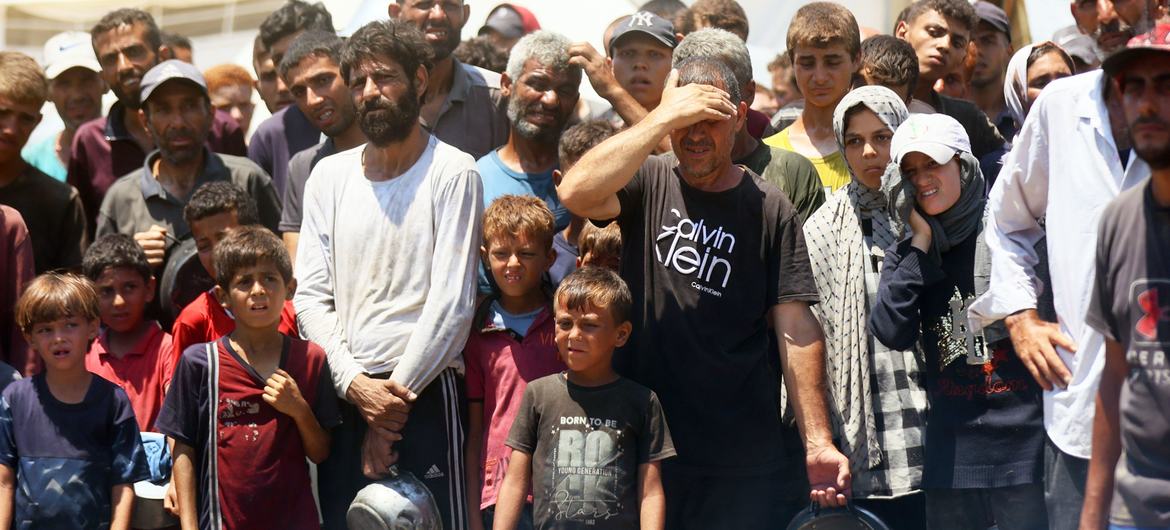
People seek food at a community kitchen in western Gaza City.

Gaza: Civilian toll continues to climb

Civilians in Gaza continue to face mounting deaths, displacement and famine as hostilities continue, with UN agencies warning that the window to prevent widespread starvation is closing.

According to local health authorities, some 67 people were killed and 320 injured in the past 24 hours, Mr. Dujarric said, adding that since the end of the ceasefire in mid-March nearly 12,000 people have died amid repeated displacement and attacks.

“We continue to condemn all killings of civilians,” he said.

The humanitarian situation remains dire. The UN aid coordination office, OCHA, noted urgent needs for food, water and shelter.

“Our colleagues remind us that over 80 per cent of Gaza is either under displacement orders or within militarized areas,” Mr. Dujarric added.

The Gaza Ministry of Health reported that over 100 people, a quarter of them children, have died from malnutrition since famine was confirmed in Gaza governorate.

Humanitarian operations remain heavily constrained.

Only 11 of 24 coordinated missions were facilitated on Sunday, including fuel collection at crossings, while others were denied or cancelled. Humanitarians were able to distribute water in northern Gaza and collect food shipments from Kerem Shalom, Karem Abu Salem and Zikim crossings.

UN peacekeepers in DR Congo continue to protect population against ‘grave danger’

Hundreds of thousands of people fleeing conflict in the eastern Democratic Republic of the Congo (DRC) continue to be protected against “grave danger” by United Nations peacekeepers, according to the head of UN Peace Operations.

Jean-Pierre Lacroix was speaking at the end of a mission to the DRC, where he visited the troubled Ituri and North Kivu regions.

Mr. Lacroix emphasised that hundreds of thousands of Congolese people, including displaced people, rely on the UN peacekeeping mission, MONUSCO for daily protection, particularly in the areas of Fataki and Beni, in North Kivu, where joint operations with the Congolese armed forces continue against armed groups.

USG Lacroix on the role of MONUSCO

Dire situation continues

The security situation in the eastern DRC remains dire, despite diplomatic efforts to bring lasting peace to the country.

The DRC is currently facing one of the most acute humanitarian emergencies in the world, with food insecurity on the rise and 5.9 million Congolese currently internally displaced.

“People are protected here by our MONUSCO colleagues, and they are provided with humanitarian support and protection”, said Mr. Lacroix adding that the UN remains committed to supporting government efforts towards peace and stability in the country.

Source link

Preparing for the next flood: Protecting women’s health in Bangladesh

Sunamganj is a district in the wetland ecosystem in northeast Bangladesh, which is particularly vulnerable to climate change. Floods arrive quickly and suddenly and can last for weeks. They disrupt life, displace families and cut off access to services.

For the over 670,000 women of reproductive age living in the area, increasingly extreme weather events are threatening their access to reproductive healthcare.

Preparation and planning

To help prepare for these crises, UNFPA is training reproductive-aged women to protect themselves and their children during the next flood.

Shakila Akhter, a 24-year-old mother of two, was eight months pregnant during the last flood.

“Thanks to the training I received, I knew what to carry, how to prepare and how to protect my family,” she recalled. She now uses family planning tools she didn’t know about before: “I want to choose when I’m ready for another child.” 

She also underscored the link between climate change and these severe floods: “We understand that the climate has changed over the past 20 years. In Bangladesh, the flood season has become longer, sudden floods are more frequent, heatwaves have intensified, and winters are now shorter.  

“So, we all should be prepared to manage it to survive.”

Local volunteers

This training is made possible by volunteers trained to help others prepare for climate shocks.

Shakila Begum, 26, began volunteering with just two days of training. She works with the Climate Resilience Health System and Community initiative – supported by the UNFPA and the Swedish International Development Cooperation Agency – which educates women on topics from menstruation to childbirth during floods.

Ms. Begum is now the point of contact for 75 families, helping them with issues like family planning and maternal healthcare.

“One woman had dangerously high blood pressure just before giving birth,” she recalled. “I advised her family to go to the local hospital, where she safely delivered – completely free of cost.”

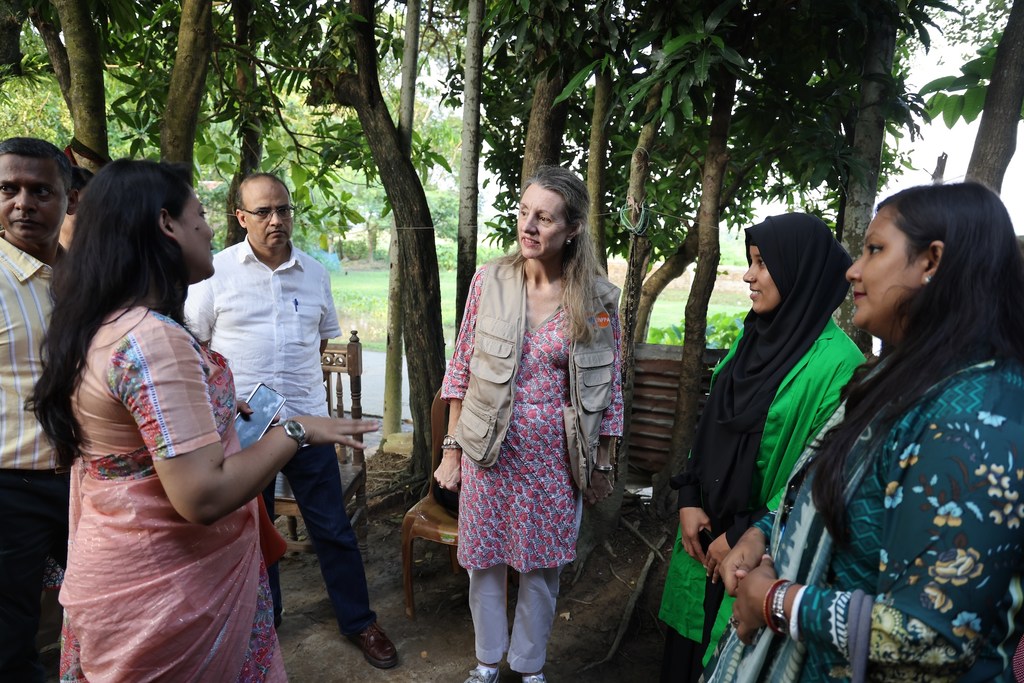
UNFPA Representative Catherine Breen Kamkong (centre) meets Shakila Begum (right, in green), a 26-year-old volunteer with the Climate Resilience Health System and Community Project in Sunamganj.

Empowerment through safe spaces

The initiative also offers safe community spaces where women can learn about sexual and reproductive health.

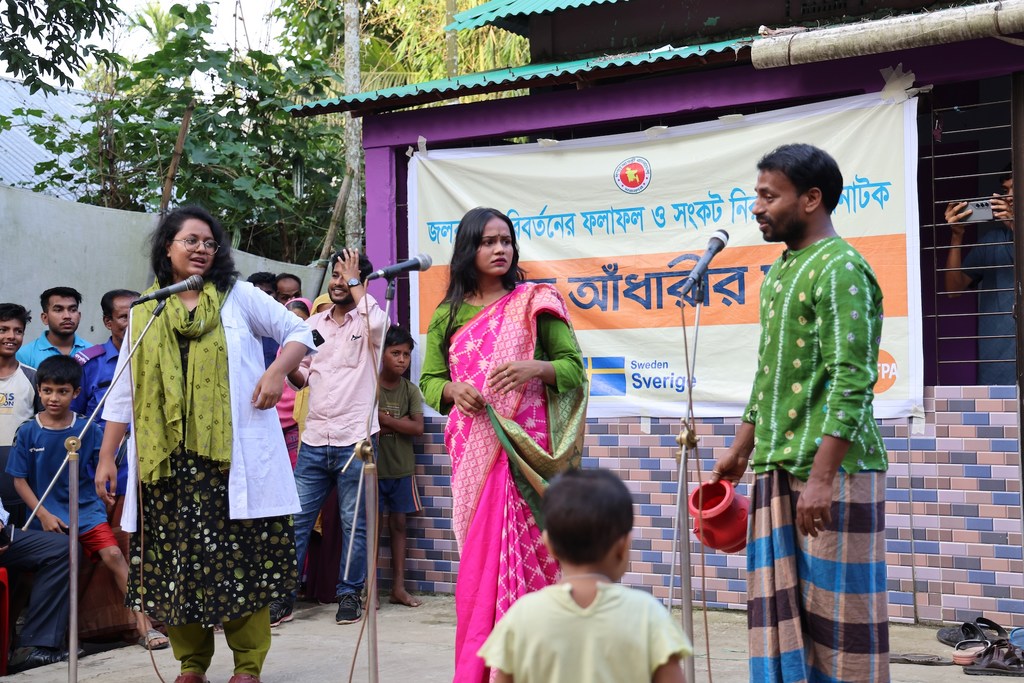
In Kurban Nagarn, an area in Sunamganj, volunteers have begun hosting “street dramas”. The volunteers act out scenes related to issues such as maternal health, disaster preparedness and child marriage prevention, with over 500 people attending each performance.

Taskira Hauque Tazin, a local student, is one of the moving theatre’s core members. She has attended many conferences in Bangladesh and abroad, where she shares her experiences and is recognised for her work.

“I feel proud to work for women’s empowerment and to support underprivileged communities. Through these plays, we raise awareness so that women don’t fall behind. We want to stop early marriage, promote girls’ education, and ensure that women get access to maternal health care,” she said. “Whether it’s in the sun, rain, or storm – we’ll keep doing this work for the people.”

Villagers gather for an afternoon street drama in Bodipur, Kurban Nagar Union, Sunamganj, as part of the Climate Resilience Health System and Community Project.

Anima Akhter, a 24-year-old mother in Kurban Nagarn, explained that the street dramas provide a safe space for difficult conversations: “We want to share our problems, especially about our bodies – but we often can’t speak.”

With the support of local volunteers, Anima delivered her youngest child safely at the hospital.  

Amina’s husband, Nurul, now accompanies her to community sessions and has become a role model in the community, receiving training from volunteers to teach his neighbours about women’s and girls’ health.  

“Since my wife underwent training, I took it very seriously and felt inspired to help our neighbours, especially concerning women’s and girls’ health,” he said. “I regularly talk about these important messages with other men at the tea stall, encouraging them to be prepared for disasters and to take the same precautions.  

“I urge them to seek help from service providers if they face any problems, especially concerning pregnant women’s deliveries and family planning methods.”  

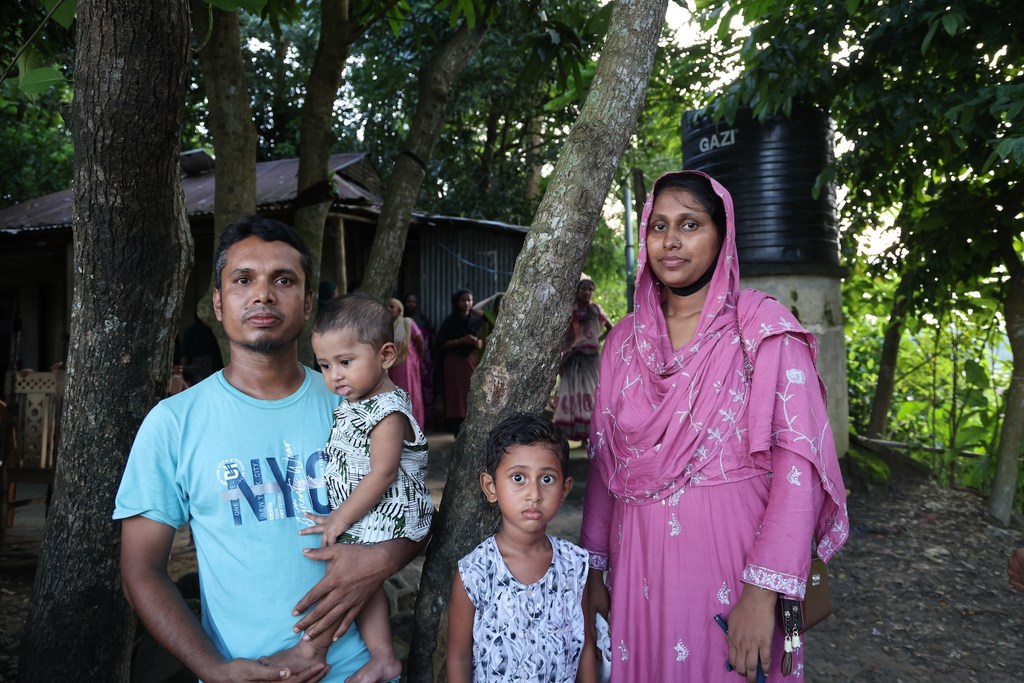
Anima Akhter, 24, with her husband Ruhul Amin, 30, a steelworker, and their two children outside their home in Bodipur village in Kurban Nagar Union.

Ongoing challenges

But challenges remain despite the best efforts of the UNFPA and other UN partners.

In flood-prone villages in Sunamganj, over half of deliveries still occur at home.

Many women and girls also still feel shame discussing topics like menstruation, and cultural norms often restrict women who attempt to generate their own income.

These vulnerabilities faced by women and girls are exacerbated by climate-related disasters, which often hit them the hardest.

Continued commitments

From 28 to 31 July, global experts convened at the Global Symposium on Climate Justice and Impacted Populations in Brasília, co-hosted by UNFPA and the Government of Brazil.  

There, leaders worked to address the disproportionate impact of climate change on women and girls. The event called for gender-inclusive climate negotiations and a renewed commitment to understanding the impact climate change has on sexual and reproductive health and rights.

Diene Keita, Acting Executive Director of UNFPA, highlighted the gendered impact of climate change at the event: “The evidence tells us that climate change is increasing the risk of maternal mortality, disrupting access to contraceptives and increasing the risk of gender-based violence.”

“Our collective efforts need to strengthen the resilience of women, girls and health systems to withstand and adapt to climate shocks,” Ms. Keita stressed. “Being prepared, responding rapidly, and building forward better must be central pillars for our work.”