
World News in Brief: Iran in the Human Rights Council, Myanmar election ‘fraud’, migration chief in Cyprus, Mozambique flood update

Addressing the Human Rights Council in Geneva, Mr. Türk said that although the “killing on the streets of Iran may have subsided…the brutality continues”.

He said that violent repression did not solve any of Iran’s problems but instead created conditions for further violations, instability and bloodshed.

“We have indications that the security forces made mass arrests in several cities, even pursuing injured people into hospitals, and detaining lawyers, human rights defenders, activists, and ordinary civilians,” he told diplomats.

Prosecutions ongoing

“The Tehran Prosecutor’s Office has reportedly opened criminal cases against athletes, actors, people involved in the movie industry, and the owners of cafes, on charges of supporting the protests,” Mr. Türk continued. 

Protests erupted across Iran on 28 December in response to the collapse of the national currency, soaring inflation and worsening living conditions.

Also speaking at the Council, former international prosecutor Payam Akhavan described how one protester pretended to be dead in a body-bag for three days until his parents found him. 

The civil society representative said that parents looking for their relatives usually started at hospitals, where “many of the wounded (protesters) have been abducted and killed”. 

Others have been forced to sign confessions which blame imaginary “terrorists” for the murder of their children, Mr. Akhavan maintained.

He cited a medical report circulating among Iranian doctors that 16,500 people had been killed during the demonstrations. “The number increases by the day, because the killings haven’t stopped,” he said.

Rejection of Myanmar military’s ‘fraudulent’ election must be unequivocal: UN independent expert

The international community must unequivocally reject as illegitimate the election results in Myanmar and any power arrangement that follows, said Tom Andrews, the Special Rapporteur on human rights in Myanmar on Friday.

The UN-appointed independent expert described the elections, which began in late December and are expected to be concluded this weekend, as ‘fraudulent’, urging countries not to accept the results. 

“The junta is banking on the world’s fatigue, hoping that the international community will accept military rule dressed up in civilian clothing,” he said. “Governments must not allow that to happen.”

‘Fear and coercion’

The junta’s election scheme was marked by violence, low turnout and widespread coercion, said Mr. Andrews.

Voters reported being monitored and pressured by local authorities, with threats explicit or implied. Junta officials were pushing citizens to polling stations even as military jets bombed villages throughout the country.

Mr. Andrews added that the junta banned credible opposition parties, jailed popular political figures and muzzled the press, “crushing fundamental freedoms, and using fear and coercion to drive a reluctant electorate to the polls.”

UN migration chief backs EU presidency efforts on migration

This week, the UN migration agency (IOM) Chief Amy Pope concluded a visit to Cyprus after a round of high-level talks, which focused on advancing a comprehensive migration and asylum agenda. 

“Cyprus knows what it means to be on the frontline – and that experience really matters right now,” said Ms Pope. “As the European Union (EU) moves from agreement to action, this is the moment to make sure policies really work – for migrants, for communities, and countries.

This trip marks the IOM Chief’s first visit to Cyprus in her current role, as Cyprus assumes the EU Council Presidency and the EU begins implementing the landmark Migration and Asylum Pact.

Humane returns 

With persistent instability Afghanistan, Syria, Sudan and the Sahel, Ms Pope reaffirmed IOM’s support and engagement with the EU to ensure refugee returns are humane and dignified. 

During her visit, she underscored the urgent need to address conditions along key migration routes, with IOM emphasising efforts to curb irregular migration, disrupt smuggling networks, meet humanitarian needs, and save lives.

Ms Pope also called for stronger migration data systems and evidence-based policymaking.

Nearly 600,000 people upended by Mozambique floods

Nearly 600,000 people have been affected by severe flooding across southern and central Mozambique. Weeks of heavy and sustained rainfall have caused homes to collapse and roads to wash away, displacing more than 73,000 people, according to figures from the IOM

Flooding has been reported in 10 of Mozambique’s 11 provinces, with Gaza Province “hosting significant concentrations of displaced people”. Humanitarian response partners expect reported figures to rise as access to affected communities improves.

IOM teams there have described acute shortages of shelter, constraints on food and basic services, overcrowded centres, and limited access to safe water, sanitation and hygiene – increasing the risk of waterborne diseases spreading.

Preliminary reports from the International Red Cross (IFRC) indicated between 50 and 60 deaths, a figure likely to rise as waters levels recede. 

Response ahead of cyclone season 

Following a Government request for international support on 16 January including air assets for search and rescue efforts, the IOM plans to appeal for up to $20 million to reinforce life-saving assistance and strengthen water, sanitation and hygiene. 

With this being only the start of the cyclone season and dams at near capacity, representatives from the IFRC have underscored the need for investment in early warning systems, climate‑resilient infrastructure, and locally led preparedness. 

Source link

Preparing for the next flood: Protecting women’s health in Bangladesh

Sunamganj is a district in the wetland ecosystem in northeast Bangladesh, which is particularly vulnerable to climate change. Floods arrive quickly and suddenly and can last for weeks. They disrupt life, displace families and cut off access to services.

For the over 670,000 women of reproductive age living in the area, increasingly extreme weather events are threatening their access to reproductive healthcare.

Preparation and planning

To help prepare for these crises, UNFPA is training reproductive-aged women to protect themselves and their children during the next flood.

Shakila Akhter, a 24-year-old mother of two, was eight months pregnant during the last flood.

“Thanks to the training I received, I knew what to carry, how to prepare and how to protect my family,” she recalled. She now uses family planning tools she didn’t know about before: “I want to choose when I’m ready for another child.” 

She also underscored the link between climate change and these severe floods: “We understand that the climate has changed over the past 20 years. In Bangladesh, the flood season has become longer, sudden floods are more frequent, heatwaves have intensified, and winters are now shorter.  

“So, we all should be prepared to manage it to survive.”

Local volunteers

This training is made possible by volunteers trained to help others prepare for climate shocks.

Shakila Begum, 26, began volunteering with just two days of training. She works with the Climate Resilience Health System and Community initiative – supported by the UNFPA and the Swedish International Development Cooperation Agency – which educates women on topics from menstruation to childbirth during floods.

Ms. Begum is now the point of contact for 75 families, helping them with issues like family planning and maternal healthcare.

“One woman had dangerously high blood pressure just before giving birth,” she recalled. “I advised her family to go to the local hospital, where she safely delivered – completely free of cost.”

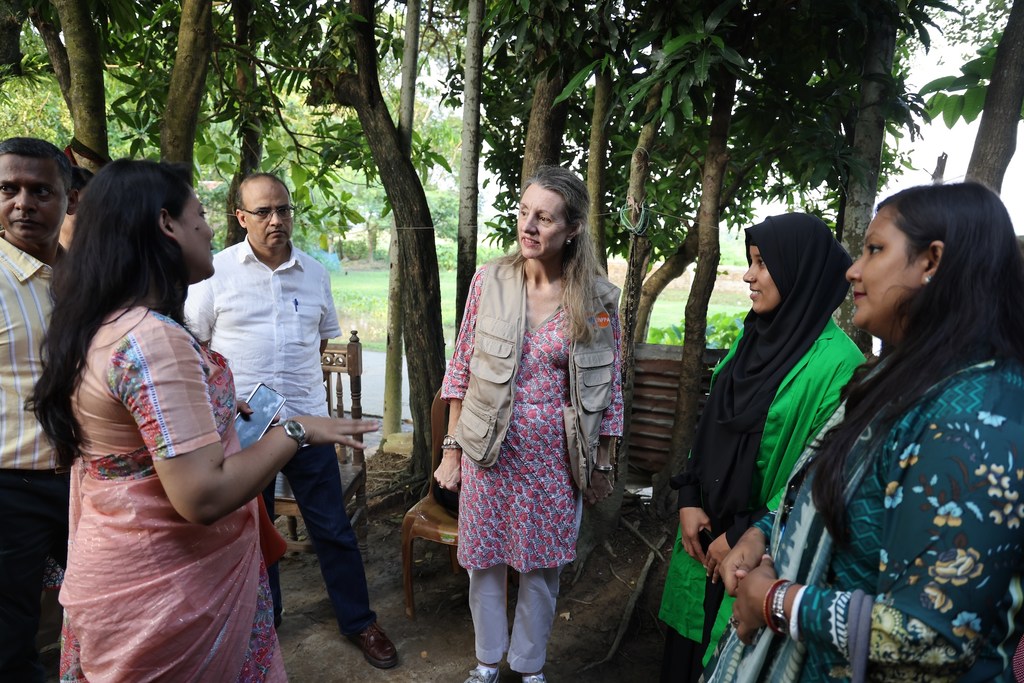
UNFPA Representative Catherine Breen Kamkong (centre) meets Shakila Begum (right, in green), a 26-year-old volunteer with the Climate Resilience Health System and Community Project in Sunamganj.

Empowerment through safe spaces

The initiative also offers safe community spaces where women can learn about sexual and reproductive health.

In Kurban Nagarn, an area in Sunamganj, volunteers have begun hosting “street dramas”. The volunteers act out scenes related to issues such as maternal health, disaster preparedness and child marriage prevention, with over 500 people attending each performance.

Taskira Hauque Tazin, a local student, is one of the moving theatre’s core members. She has attended many conferences in Bangladesh and abroad, where she shares her experiences and is recognised for her work.

“I feel proud to work for women’s empowerment and to support underprivileged communities. Through these plays, we raise awareness so that women don’t fall behind. We want to stop early marriage, promote girls’ education, and ensure that women get access to maternal health care,” she said. “Whether it’s in the sun, rain, or storm – we’ll keep doing this work for the people.”
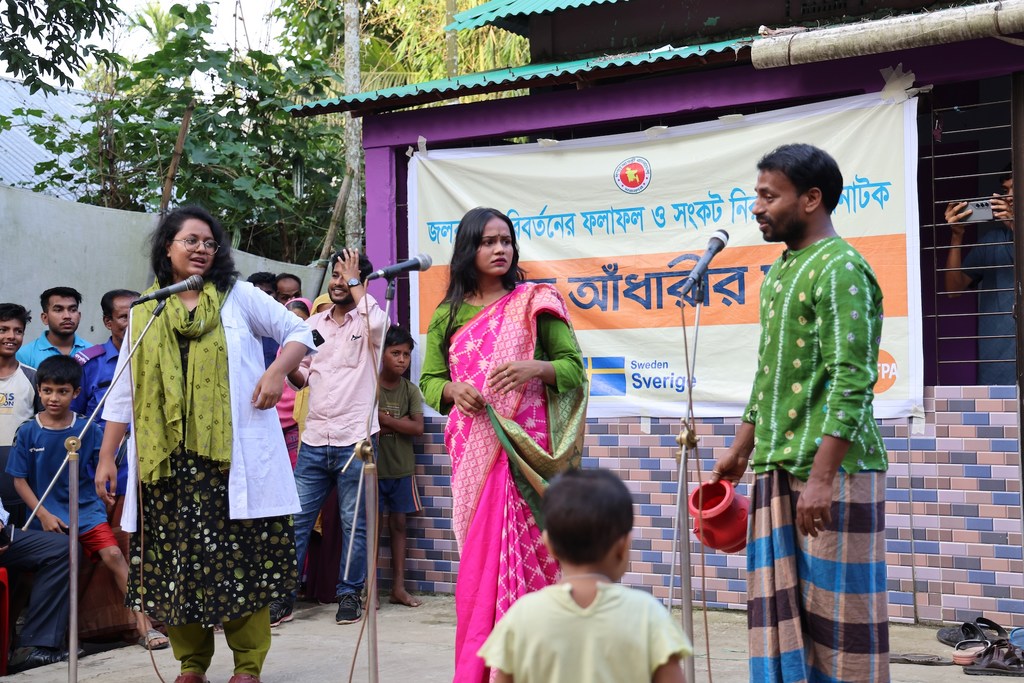
Villagers gather for an afternoon street drama in Bodipur, Kurban Nagar Union, Sunamganj, as part of the Climate Resilience Health System and Community Project.

Anima Akhter, a 24-year-old mother in Kurban Nagarn, explained that the street dramas provide a safe space for difficult conversations: “We want to share our problems, especially about our bodies – but we often can’t speak.”

With the support of local volunteers, Anima delivered her youngest child safely at the hospital.  

Amina’s husband, Nurul, now accompanies her to community sessions and has become a role model in the community, receiving training from volunteers to teach his neighbours about women’s and girls’ health.  

“Since my wife underwent training, I took it very seriously and felt inspired to help our neighbours, especially concerning women’s and girls’ health,” he said. “I regularly talk about these important messages with other men at the tea stall, encouraging them to be prepared for disasters and to take the same precautions.  

“I urge them to seek help from service providers if they face any problems, especially concerning pregnant women’s deliveries and family planning methods.”  
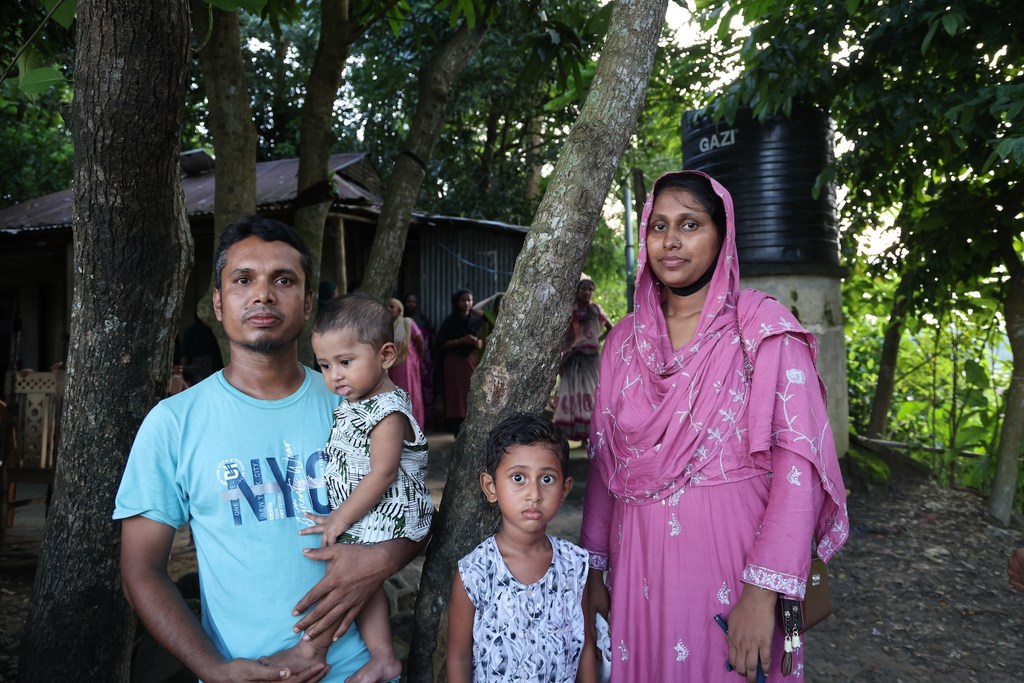
Anima Akhter, 24, with her husband Ruhul Amin, 30, a steelworker, and their two children outside their home in Bodipur village in Kurban Nagar Union.

Ongoing challenges

But challenges remain despite the best efforts of the UNFPA and other UN partners.

In flood-prone villages in Sunamganj, over half of deliveries still occur at home.

Many women and girls also still feel shame discussing topics like menstruation, and cultural norms often restrict women who attempt to generate their own income.

These vulnerabilities faced by women and girls are exacerbated by climate-related disasters, which often hit them the hardest.

Continued commitments

From 28 to 31 July, global experts convened at the Global Symposium on Climate Justice and Impacted Populations in Brasília, co-hosted by UNFPA and the Government of Brazil.  

There, leaders worked to address the disproportionate impact of climate change on women and girls. The event called for gender-inclusive climate negotiations and a renewed commitment to understanding the impact climate change has on sexual and reproductive health and rights.

Diene Keita, Acting Executive Director of UNFPA, highlighted the gendered impact of climate change at the event: “The evidence tells us that climate change is increasing the risk of maternal mortality, disrupting access to contraceptives and increasing the risk of gender-based violence.”

“Our collective efforts need to strengthen the resilience of women, girls and health systems to withstand and adapt to climate shocks,” Ms. Keita stressed. “Being prepared, responding rapidly, and building forward better must be central pillars for our work.” 

3-D models help scientists gauge flood impact

Heavy rainfall can cause rivers and drainage systems to overflow or dams to break, leading to flood events that bring damage to property and road systems as well potential loss of human life.

One such event in 2008 cost $10 billion in damages for the entire state of Iowa. After the flood, the Iowa Flood Center (IFC) at the University of Iowa (UI) was established as the first center in the United States for advanced flood-related research and education.

Today, simplified 2-D flood models are the state of the art for predicting flood wave propagation, or how floods spread across land. A team at IFC, led by UI Professor George Constantinescu, is creating 3-D non-hydrostatic flood models that can more accurately simulate flood wave propagation and account for the interaction between the flood wave and large obstacles such as dams or floodplain walls. These 3-D models also can be used to assess and improve the predictive capabilities of the 2-D models that government agencies and consulting companies use for predicting how floods will spread and the associated risks and hazards.

Using one of the world’s most powerful supercomputers–Titan, the 27-petaflop Cray XK7 at the Oak Ridge Leadership Computing Facility (OLCF)–Constantinescu’s team performed one of the first highly resolved, 3-D, volume-of-fluid Reynolds-averaged Navier-Stokes (RANS) simulations of a dam break in a natural environment. The simulation allowed the team to map precise water levels for actual flood events over time. RANS is a widely used method for modeling turbulent flows.

“Flood events, like those generated by dam breaks, can be computationally very expensive to simulate,” Constantinescu said. “Previously, there wasn’t enough computer power to do these kinds of time-accurate simulations in large computational domains, but with the power of high-performance computing [HPC] and Titan, we are achieving more than was previously thought possible.”

The project was supported in 2015 and 2016 within the OLCF’s Director’s Discretionary user program. The OLCF, a US Department of Energy (DOE) Office of Science User Facility located at DOE’s Oak Ridge National Laboratory, provides HPC resources for research and development projects to advance scientific discovery.

The team’s 3-D simulations showed that commonly used 2-D models may inaccurately predict some aspects of flooding, such as the time over which dangerous flood levels last at certain locations and the amount of surface area flooded. Simulation results also demonstrated that 2-D models may underestimate the speed at which floods spread and overestimate the time at which flood waves reach their highest point.

When the water sources that empty into a river rise simultaneously, they can trigger one or more successive flood waves. Accuracy of the 1-D, 2-D, or 3-D flood models that track how these waves move is crucial for predicting maximum flood depth, hazardous conditions, and other variables.

“We need to know what’s going to happen for situations in which a dam breaks,” Constantinescu said. “We need to know who’s going to be affected, how much time they will have to evacuate, and what else might happen to the environment as a result.”

Because 2-D models make simplified assumptions about some aspects of the flow, they can’t account for changes in the flow, such as when the flood wave moves around large obstacles, changes rapidly in direction, or fully immerses bridge decks. The team needed a leadership-class supercomputer to run the 3-D simulations and accurately capture these changes.

Titan Changes the Current

Using a fully non-hydrostatic 3-D RANS solver, the team performed the first simulations of the hypothetical failure of two Iowa dams: the Coralville Dam in Iowa City and the Saylorville Dam in Des Moines. Each used a computational grid of about 30-50 million cells and covered a physical area of about 20 miles by 5 miles.

The team used the state-of-the-art computational fluid dynamics software STAR-CCM+. This software features a volume-of-fluid method to track the position of the water’s free surface–the areas where water meets the air. In a scalability study, the team determined the peak performance of the code for the dam break simulations. The researchers used 2,500 of Titan’s CPU processors for peak performance in each simulation.

The researchers also computed the same dam break test cases using a standard 2-D model commonly used by IFC. When they compared the 2-D results against those of the 3-D simulations, they found that the 2-D model underestimated how quickly the flood wave moved across land and overestimated the time at which the maximum flood occurred. This finding is important because government agencies and consulting companies use 2-D shallow flow models to predict dam breaks and floods, as well as to estimate flood hazards.

“By performing these 3-D simulations, we provided a huge data set that can be used to improve the accuracy of existing 2-D and 1-D flood models,” Constantinescu said. “We can also examine the effectiveness of deploying flood protection structures for different flooding scenarios.” The team ultimately showed that HPC can be used successfully to answer engineering questions related to the consequences of structural failure of dams and related hazards.

Constantinescu said that as computers become faster and more powerful, simulations of full flooding events over larger physical regions will be possible. Summit, the OLCF’s next-generation supercomputer that is scheduled to come online in 2018, will unearth new possibilities for Constantinescu’s research.

“Advances in numerical algorithms, automatic grid generation, and increased supercomputer power will eventually make the simulations of flood waves over large durations of time possible using Titan, and even more so with Summit,” Constantinescu said. “Eventually, things we previously had to do by hand, such as generating a high-quality computational grid, will just be part of the typical software package.”