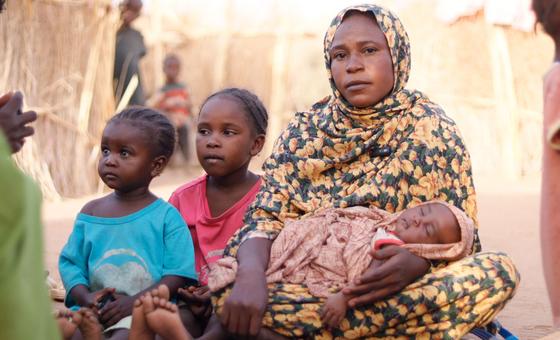
Around 260,000 civilians – including 130,000 children – remain trapped in the area’s main camp for internally displaced people, enduring desperate conditions without aid for more than 16 months.
The Rapid Support Forces (RSF), which has been battling forces of the military government for control of Sudan for over two years, has cut off all supply lines.
RSF militia have been besieging the city since May last year and it is the last urban area still under government control.
“We are witnessing a devastating tragedy – children in Al Fasher are starving while UNICEF’s lifesaving nutrition services are being blocked,” said Catherine Russell, UNICEF Executive Director.
Deadly violence
Reports this week point to yet another mass-casualty incident, with seven children reportedly killed in an attack on Abu Shouk camp for internally displaced people, on the outskirts of El Fasher.
Since the start of the siege in May 2024, more than 1,100 grave violations have been verified in El Fasher alone, including the killing and maiming of over 1,000 children.
Meanwhile, at least 23 children have been subjected to rape, gang rape, or sexual abuse. Others have been abducted, recruited, or used by armed groups, said UNICEF.
Health and education facilities have also come under sustained attack, with 35 hospitals and six schools struck, killing and injuring many, including children.
Aid blocked
Meanwhile, the UN aid coordination office (OCHA) warned Wednesday that the already dire situation in North Darfur continues to worsen.
“Blocking humanitarian access is a grave violation of children’s rights, and the lives of children are hanging in the balance,” Ms. Russell said, reiterating UNICEF’s call for immediate and full access to El Fasher.
The toll on children is catastrophic, the agency suspension of medical services due to depleted supplies has left an estimated 6,000 children suffering from Severe Acute Malnutrition (SAM) without treatment, UNICEF said.
Without therapeutic food and medical care, these children face an extremely high risk of death. News reports indicate at least 63 people, mostly women and children, died of malnutrition in just a single week.
UNICEF continues to call for unimpeded humanitarian access for the delivery of therapeutic food, medicines, clean water, and other essentials.
Cholera outbreak
The siege is colliding with Sudan’s worst cholera outbreak in decades. More than 2,400 deaths have been reported since July 2024.
In overcrowded camps around Tawila, Zamzam and El Fasher, children weakened by hunger are now especially vulnerable to cholera and other deadly waterborne diseases.
“Children must be protected at all times, and they must have access to life-saving aid,” said Ms Russell.
In a statement issued on Monday by his spokesperson, António Guterres said he was “deeply saddened by the tragic loss of life, notably of a large number of children,” during what should have been a time of celebration.
Friday, 4 July, marked Independence Day in the United States – a time when families and communities traditionally gather for outdoor celebrations.
The Secretary-General extended his “heartfelt condolences to the families of the victims” and expressed solidarity with all those affected, including the people of Texas and the government of the United States.
According to media reports, the floods – triggered by heavy rainfall over the July Fourth weekend – caused massive damage in parts of central Texas, particularly along the Guadalupe River. The deluge struck Camp Mystic, killing at least 27 campers and counselors.
Catherine Russell, Executive Director of the UN Children’s Fund (UNICEF), said in a post on social media that “all of us at UNICEF are heartbroken at the reports coming out of Central Texas.”
“Our hearts and thoughts are with those mourning loved ones and those still waiting for news of the missing, including children,” she said.
Search and recovery efforts continue as the region braces for more rain, according to media reports.
“Since the collapse of the ceasefire in March, civilians have constantly come under fire, confined to ever-shrinking spaces, and deprived of lifesaving relief,” she said.
“Israel must halt its devastating strikes on civilian life and infrastructure.”
Risk of famine
With families cut off from aid for weeks on end, and only a fraction of the needed relief now entering the enclave, starvation looms.
“The entire population of Gaza is facing the risk of famine,” Ms. Kaag warned, adding that the limited aid permitted into the enclave is “comparable to a lifeboat after the ship has sunk.”
“Ms. Kaag emphasized that humanitarian aid must not depend on political negotiations, noting that the UN aid operation is prepared to deliver assistance immediately, in accordance with international law.
“Aid cannot be negotiable,” she said.
Full aid access imperative
Ms. Kaag called on Israel to halt its devastating strikes and allow full access for humanitarian aid and commercial goods.
At the same time, she stressed that Israel has the right to live in peace and security.
“This was undeniably shaken by the horrific terror attacks and taking of hostages on 7 October by Hamas and other Palestinian armed groups,” she said, reiterating the call on Hamas and other armed groups to stop rocket attacks against Israel and release all hostages unconditionally.
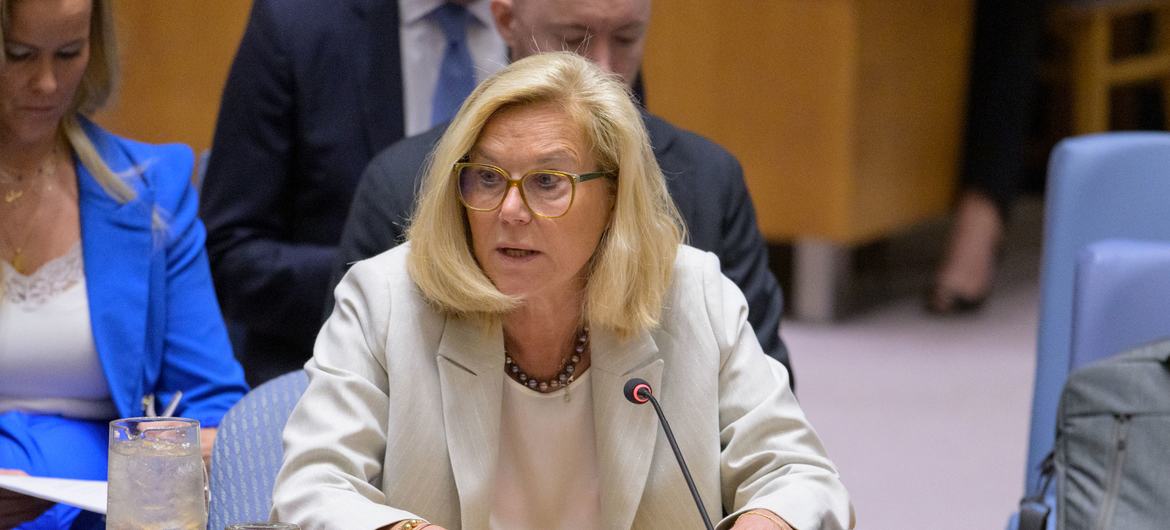
Sigrid Kaag, UN Special Coordinator for the Middle East Peace Process Ad Interim, briefs the Security Council on the situation in the Middle East.
Two-State solution
Ms. Kaag emphasised that durable security “cannot be achieved solely through force”, it must be built on mutual recognition, justice, and rights for all.
“A better path exists that resolves this conflict, de-escalates regional tensions and achieves a shared vision for peace,” she said.
The upcoming high-level international conference in June, co-chaired by France and Saudi Arabia, presents a critical opportunity to relaunch a path toward ending the occupation and realising the two-State solution based on international law, UN resolutions and previous agreements.
“It must not be another rhetorical exercise,” she said.
“We need to pivot ourselves from declarations to decisions. We need to implement rather than adopt new texts.”
‘See you in heaven’
In her briefing, Ms. Kaag described the deep despair of civilians in Gaza, where families now bid farewell not with a “goodbye, see you tomorrow”, but with the words “see you in heaven.”
“Death is their companion. It’s not life, it’s not hope,” she continued, stressing that Gazans deserve more than survival – they deserve a future.
Urging bold political action, she called for adherence to international law, and support for a reformed Palestinian Government that can govern both Gaza and the West Bank.
“Statehood is a right, not a reward,” Ms. Kaag said.
“Let us not be remembered as the generation that let the two-State solution disappear. Let us be the generation that chose courage over caution, justice over inertia and peace over politics. Let us be part of a generation that can make this happen.”
Special Coordinator a.i. Kaag’s briefing to the Security Council.
US ‘fully stands’ with Israel
Speaking for the United States, John Kelley, Political Coordinator at the US Mission to the UN, said that his country has been working tirelessly to free the hostages and bring the war to an end – “one that Hamas brutally started”.
“Hamas continues to reject proposals from the US, Qatar and Egypt that would release the 58 remaining hostages, who have now been cruelly held for 600 days, and bring calm to Gaza,” he said.
“Every day Hamas demonstrates its lack of regard for the Palestinians it claims to represent, all while it violently suppresses protests against its barbaric rule and diverts aid meant for civilians.”
He underscored that the US “fully stands” behind Israel and its right to defend itself, stating that to move forward, “Hamas must be defeated.”
“As Secretary [Marco] Rubio has said – if an ember survives, it will spark again into a fire. There can no peaceful and prosperous Gaza as long as Hamas governs it by force,” Mr. Kelley said.
The horrors must end: Algeria
Algerian Ambassador Amar Bendjama described the deadly impact of the ongoing war in Gaza on children, citing the specific case of the nine children of a Gazan doctor, all killed in an airstrike, while her sole remaining child and husband remain in a critical condition.
“They were not members of a centre for command and control of Hamas,” he said, adding, “the Israeli army killed them, they killed them deliberately.”
He noted that today, no one in Gaza is spared – and three decades after the optimism surrounding the Oslo peace accords between Israel and Palestinian leadership, “the dream of a Palestinian state is vanishing under the boots of the Israeli occupation and the silence of the international community.”
Stating that the “time for indecision” was over, he called for action – “not words of condemnation”.
“These horrors must end,” he said.
Gaza needs a ceasefire, not more bloodshed: United Kingdom
James Kariuki, Deputy Permanent Representative of the UK, said his country has “always supported” Israel’s right to defend itself but cautioned that it “strongly opposes” Israel’s escalating military action in Gaza, “which is wholly disproportionate.”
“An immediate ceasefire, not more bloodshed is the way to secure the release of the hostages and stop the end cycle of violence,” he said.
The level of human suffering in Gaza is intolerable, he continued, stating that the United Nations had warned of the risks of the Israeli Government’s aid delivery plan.
“In Rafah yesterday, we saw this warning become a reality. The Gaza Humanitarian Foundation lost control of its distribution centre, with multiple casualties reported and great distress for those desperately seeking aid,” he said.
“In contrast, the UN has a clear plan to deliver lifesaving aid at scale. It contains robust mitigations against aid diversion. Brave humanitarians stand ready to do their jobs,” he added. “Let aid in and enable the UN to operate now.”
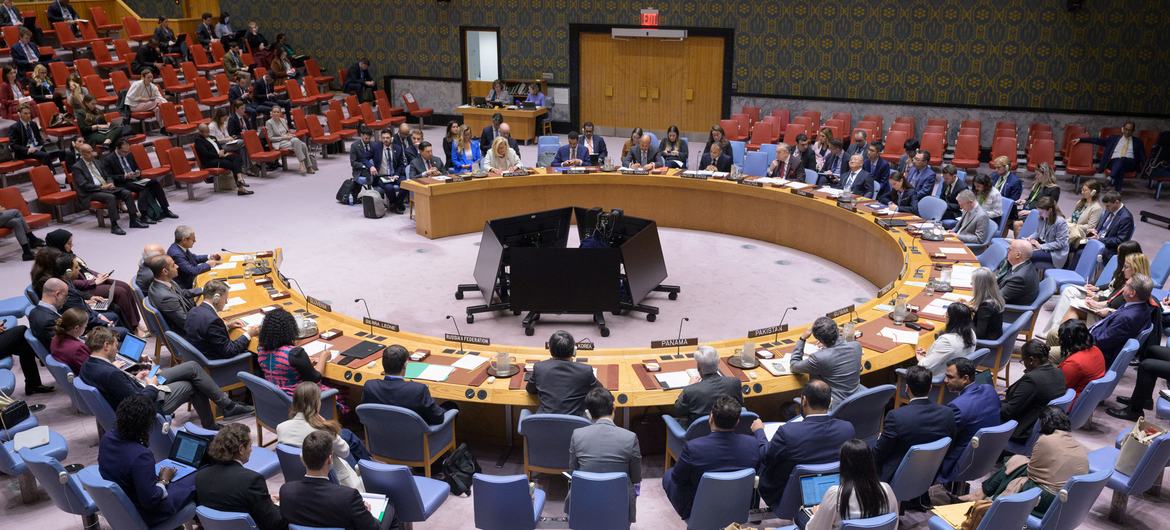
A wide view of the UN Security Council meeting on the situation in the Middle East.
Images of hungry, desperate people ‘gut-wrenching’: Palestine
Riyad Mansour, Permanent Observer of the State of Palestine, said the images of hungry and desperate people trying to get aid supplies in are “gut-wrenching” and “heart breaking.”
“These are people, human beings, deprived of water, food, medicine for so long and hanging to life by a thread,” he said, adding that this is “outraging the Palestinian people – all of them, including me.”
“It is outrageous to see this situation, and still you are not acting,” he said, pointing to Security Council members: “how much more do you want?”
He added that the UN plan for aid, with its proven capacity on the ground remains the only viable plan to deliver relief supplies and it has all necessary safeguards – “if that is the true concern.”
“But the true concern is how to get rid of the Palestinians by killing them, starving them, and destroying Gaza so they have no choice but to leave if they want to live,” Mr. Mansour said.
Israel is facilitating aid into Gaza: Ambassador
Israeli Ambassador Danny Danon said that while the UN “spreads panic and makes declarations detached from reality, the State of Israel is steadily facilitating the entry of aid into Gaza.”
This, he said, is being done via two methods.
“First, under the old framework, via trucks and, second, under the new distribution mechanism developed in coordination with the US and key international partners,” he continued, noting that both mechanisms are “working simultaneously” and will continue to do so for the immediate future.
“We are not only allowing aid in, but we are ensuring that it reaches the people who need it most,” he added.
Aid is already being distributed in Gaza, Ambassador Danon said, despite efforts by Hamas to obstruct people from reaching it by setting up checkpoints and roadblocks.
“Because Hamas knows if it loses control over the aid, it loses control over the people of Gaza,” he said.
Speaking in Port Sudan after a visit to Khartoum, Samantha Chattaraj, Emergency Coordinator for the UN’s World Food Programme (WFP) in Sudan, said that “vast parts of the city are destroyed. Levels of hunger and desperation are extremely high,” but she added “people remain hopeful.”
Sudan is currently the only country in the world where famine has been officially confirmed.
Half of its population is facing extreme hunger, and nearly five million children and breastfeeding mothers are severely malnourished.
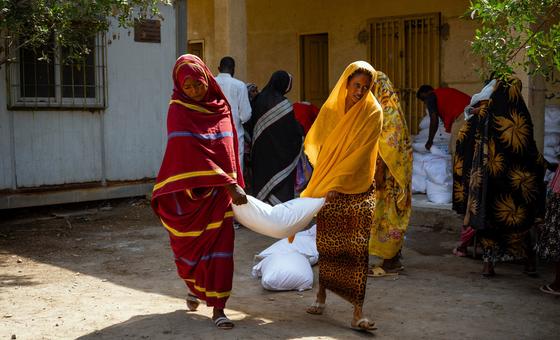
Ms. Chattaraj said that in March, WFP was able to reach four million people across Sudan, the highest number since the conflict broke out over two years ago.
“This marked an important step in getting food to people who have been cut off from aid for a long time,” she added.
However, she added that “the need is far greater. With 27 areas either in famine or at high risk, the recent progress still covers only a small part of what’s required to stop the crisis.”
Destruction and hunger
In Darfur, in the west of Sudan, nearly 450,00 people who were already facing famine and horrific levels of violence have been forced to flee from El Fasher and Zamzam camps in the last few weeks, amidst an increase in fighting.
“Reports from the ground are shocking,” said Mrs Chattaraj, explaining that WFP is currently mobilising assistance to reach populations wherever they have fled to – across various parts of Darfur and Northern State.
Planning for returnees
Many people are expected to return to Khartoum in the coming monthsandWFP is working to strengthen its presence in the city and ensure it can deliver food regularly to those coming back.
Together with local authorities, the UN aims to provide emergency food aid to one million people in the greater Khartoum area next month.
Racing against the rain
Ahead of the rainy season set to begin in June, which will leave many routes across Darfur impracticable, WFP only has a few weeks to pre-stock food close to populations in need, Ms. Chattaraj said.
In preparation WFP is setting up mobile warehouses across Darfur to safely store food supplies and keep operations running even during the rains.
Meanwhile, around 100,000 people remain trapped in the besieged city of El Fasher.
WFP is urgently calling for more funding and safe access to areas in need so it can continue its work in what is now the world’s largest humanitarian crisis.