Sudan: ‘Fighting shows no signs of abating,’ senior UN official tells Security Council

On Friday, the UN Security Council heard sobering briefings from Martha Ama Akyaa Pobee, UN Assistant Secretary-General for Africa, and Shayna Lewis, Sudan Specialist and Senior Advisor with Preventing and Ending Mass Atrocities (PAEMA), a US-based organization.

Ms. Pobee stressed that front lines continue to shift as the RSF and SAF press on with their military objectives, warning, “the warring parties appear unrelenting in their resolve to pursue military objectives.”

She noted the growing use of advanced weaponry, including long-range drones, which have expanded the violence into previously stable areas.

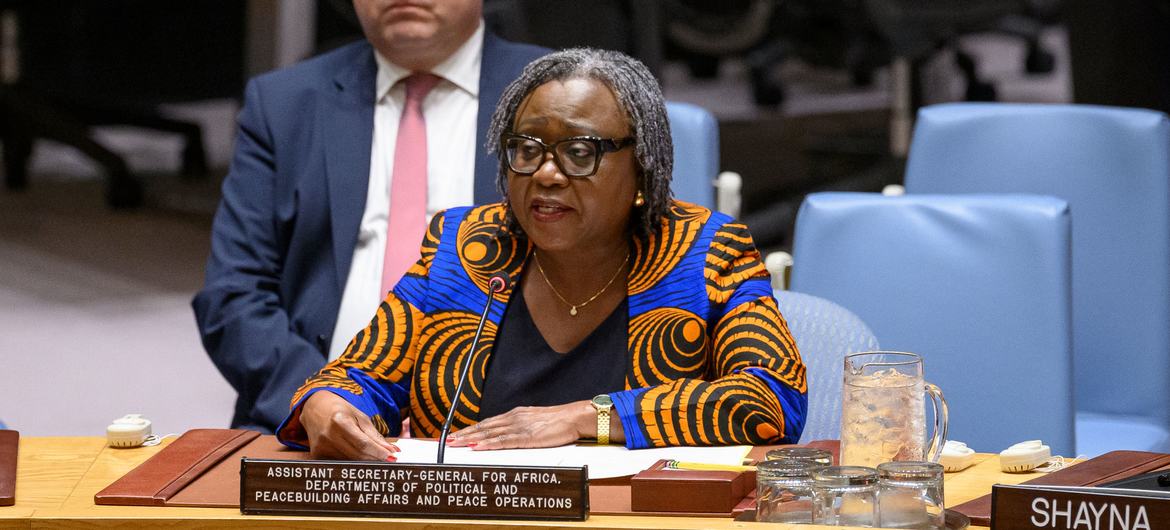
Martha Ama Akyaa Pobee, Assistant Secretary-General for Africa in the UN Department of Political and Peacebuilding Affairs and Peace Operations, briefs the Security Council meeting on the situation in Sudan.

Ms. Pobee further warned of the conflict spilling further into the region, citing recent reports of violent clashes in the tri-border area between Sudan, Libya and Egypt, involving the SAF, RSF and forces affiliated with the Libyan National Army.

Human rights violations

Ms. Pobee also referenced UN human rights reports documenting a tripling of arbitrary civilian killings between February and April this year.

“Entrenched impunity is fuelling these and other gross human rights violations and abuses. All parties to the conflict must be held accountable,” she stressed.

Ms. Lewis’s briefing focused on the worsening humanitarian situation, highlighting the over 15 million children now in need of assistance due to ongoing attacks on civilians.
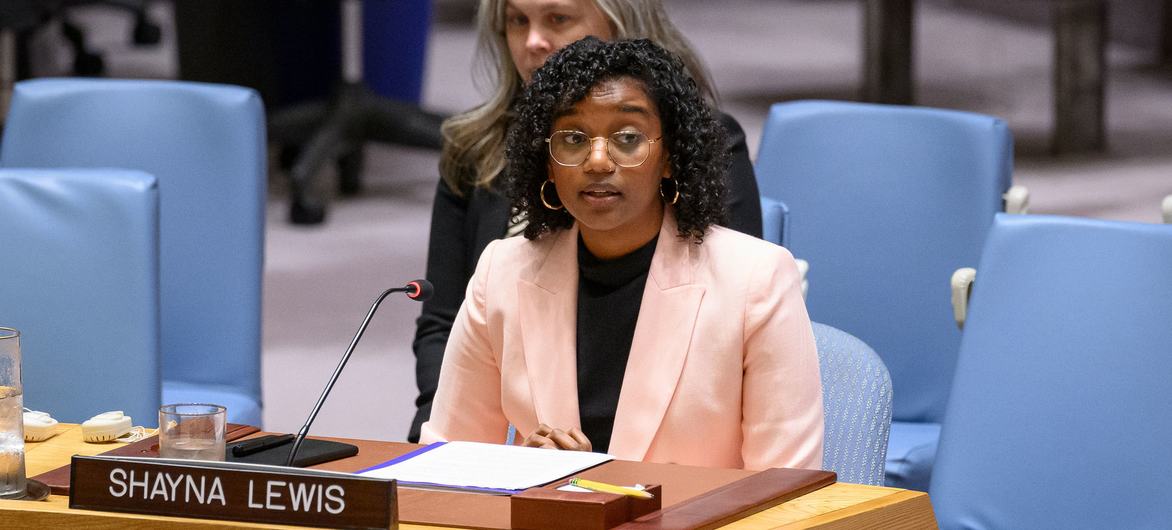
Shayna Lewis, Senior Advisor and Sudan Specialist at Preventing and Ending Mass Atrocities (PAEMA), addresses the Security Council meeting on the situation in Sudan.

Returning from a recent visit to Sudan, she shared accounts of severely injured children in hospitals and stressed that up to 80 per cent of health facilities in conflict areas are no longer functioning.

She also cited examples of indiscriminate attacks on hospitals by both the SAF and RSF, including a suspected SAF drone strike on 21 June that hit a hospital in West Kordofan, killing over 40 people and destroying critical lifesaving equipment.

Both Ms. Lewis and Ms. Pobee raised alarm over the warring parties’ widespread use of sexual and gender-based violence against women and girls across Sudan.

Government of Hope

Despite the ongoing violence and human rights abuses, Ms. Pobee underscored the significance of the new “Government of Hope.”

On 31 May, a new interim Prime Minister was inaugurated, announcing reform plans and immediately appointing a cabinet of professional technocrats.

Ms. Pobee also acknowledged the efforts of the Personal Envoy of the UN Secretary-General for Sudan, Ramtane Lamamra, who has been engaging with the Prime Minister, civilian groups and the warring parties.

Through this crucial communication, the Personal Envoy is helping these stakeholders work toward an inclusive political resolution.

“I urge this Council – once again – to unite in lending full support to Personal Envoy Lamamra’s efforts, and to use its influence with the parties and their external backers to press for a genuine commitment to dialogue and de-escalation,” Ms. Pobee said.

Ambassadors also heard a briefing from the Chair of the Sudan Sanctions Committee, established by the Council pursuant to Resolution 1591 (2005), on the work of the Committee. Following the open briefing, the Council held closed consultations during which Personal Envoy Lamamra also briefed members.

Source link

Bold new initiative aims to strengthen and improve the UN, senior officials tell Member States

The informal meeting on the UN80 Initiative also provided a chance for ambassadors to share their views on the reform agenda, launched by Secretary-General António Guterres in March.

UN80 is centred around three workstreams focused on efficiencies and improvements, a mandate implementation review, and structural changes and programme realignments across the entire UN system.

Improving the UN

It also aims to reinforce the UN’s capacity to respond to global challenges such as conflict, displacement, and the climate crisis, while also managing external pressures effectively, such as shrinking budgets and growing political divisions. 

I think the UN80 Initiative is often characterised, but I think mischaracterised, simply as an exercise in downsizing in economy,” said Guy Ryder, Under-Secretary-General for Policy and chair of the Task Force overseeing the plan.

“But the Secretary-General has been rather clear in saying that whilst we have to respond to the resource situation, the overall intention of the Initiative is to strengthen and improve the workings of the UN system.”  

Learn why UN80 matters to the world in our explainer here.

Widespread impact

Mr. Ryder alongside UN Controller Chandramouli Ramanathan (who prepares and oversees the budget and manages the Organization’s funds) presented updates on two workstreams during the morning session of the day-long meeting.

He set the scene with a slideshow outlining the background for UN80 and the circumstances confronting the UN today.

Over the years, it has adopted some 40,000 mandates delivered by “a fairly numerous and complex constellation of entities,” more than 140.

In 2023, the global body delivered some $69 billion in support and services worldwide, with “the lion’s share”, $31 billion or around 45 per cent, going to humanitarian action.  

This was followed by development, $21 billion (30 per cent), peace and security, $9 billion (13 per cent), and human rights, $1 billion, or less than one per cent.

“We believe that the global population, in one manner or another…is connected to the global agenda of the United Nations,” he said.  Additionally, some 440 million lives are directly impacted by its development work, and 140 million people in crisis situations receive support

Reduction in resources

Mr. Ryder said the $69 billion mark two years ago represented “a peak” and it is estimated that the UN has some $50 billion in resources available today amid “a situation of significant uncertainty.”

This 30 per cent reduction means “we’re down to 380 million people who we’re able to reach directly in development work, and we’re down to 110 million as a reduction in emergency situations of our humanitarian spending.”

In light of this context, “maybe we can streamline the manner in which we implement the mandates that you hand down; maybe we can optimize the structures which form this archipelago of entities,” he suggested.

“The success of the UN80 Initiative depends on us being able to increase the impact that our work in the UN system has on the people who we are here to serve.”

Proposals to enhance efficiency

Mr. Ramanathan briefed delegates on workstream one.  He said a working group was established to develop concrete proposals to enhance efficiency, reduce duplication, standardize services, and relocate functions to existing lower-cost duty stations where appropriate. 

The “exhaustive list” includes measures such as consolidating existing human resources, finance and procurement services into unified support hubs. The process would start in New York and Geneva as they host the largest number of Secretariat entities and staff.

Another proposal involves having payroll operations centralized in three global processing centres, compared to 10 locations today.

The working group is finalising the proposals to be submitted to the Secretary-General and “if approved, they will be incorporated into the revised estimates for the 2026 proposed programme budget for the consideration of the General Assembly by 1 September,” said Mr. Ramanathan.

“Separately from the UN80 Initiative, we are reviewing the programme budget proposals for 2026 with a view to achieving between 15 and 20 per cent reductions for 2026, including a 20 per cent reduction in work force, post reduction, but with a focus on preserving capacity at entry levels and reducing senior posts where feasible,” he added.

A ‘universe of mandates’

Mr. Ryder returned to present workstream two, where the first step involved mapping out “the universe of mandates” that the UN implements, with initial focus on Secretariat departments and offices, peacekeeping operations, political missions, regional commissions and other bodies.

The Pact for the Future and the 2030 Agenda for Sustainable Development were among the most frequently cited mandates.  

The overall “landscape” of mandates means that the Secretariat services some 400 intergovernmental organs and roughly 27,000 meetings each year and processes some 2,300 pages of documentation on average every day, amounting to around $360 million annually. 

A mandate resource registry has been produced, and a report should be available by the end of July which will inform the way forward.

Concern over proposed budget cuts

During the session, several representatives expressed their views on UN80, such as Iraqi Ambassador Dr. Abbas Kadhom Obaid, who spoke on behalf of the Group of 77 and China.

He voiced concern over the proposed 15 to 20 per cent budget reductions, and the 20 per cent staff reduction, requesting more insight into how these figures were determined.

“This is important since we know that the departments, divisions, in the Organization’s funds, programmes and agencies vary greatly,” he said.

“We must also protect the geographical and gender balance in the context of any downsizing.  As the Group has reiterated several times, the matters of transparency, accountability and inclusivity are paramount during this process.”

Fit for the future

The meeting took place just days before the 80th anniversary of the signing of the UN Charter on 26 June 1945, as General Assembly President Philémon Yang noted in his opening remarks.

He said it was a time to “reflect on the last 80 years and all that this Organization has achieved, and also a time to look to the future,” so the UN can remain fit for purpose – and ready for the next 80 years.  

Source link

Senior envoy warns Iran-Israel conflict is deepening crisis in Afghanistan

Roza Otunbayeva, the Secretary-General’s Special Representative and head of the UN Assistance Mission in Afghanistan (UNAMA), said the ongoing missile attacks between Iran and Israel are already having a tangible impact.

This conflict is already having an effect in Afghanistan, disrupting trade and increasing the prices of basic goods and fuel, and prompting the return of additional Afghans from Iran,” she said, echoing the Secretary-General’s urgent call for de-escalation.

Anticipating more returnees

More than 600,000 Afghans have returned from neighbouring Pakistan and Iran this year, and she said UN agencies are preparing for potential cross-border movements from Iran considering the “concerning developments” in the region.

Returns from Iran alone in the past few days have been over 10,000 per day,” she said.  

Local communities and the de facto Taliban authorities “have made huge efforts to absorb returnees, but without international assistance, there are limits to safe, orderly and peaceful returns.”

Concerns over engagement

Ms. Otunbayeva updated the Council on the UN’s ongoing engagement with Taliban leaders who returned to power nearly four years ago.

This “Comprehensive Approach” aims to achieve an Afghanistan that is at peace with itself and its neighbours, fully reintegrated into the international community, meets its international obligations, and without going through another cycle of violence.

She stressed that it “does not seek to normalize the status quo but rather ensure that multiple key issues of concern – in particular upholding the country’s international obligations – remain at the core of engagement efforts.”

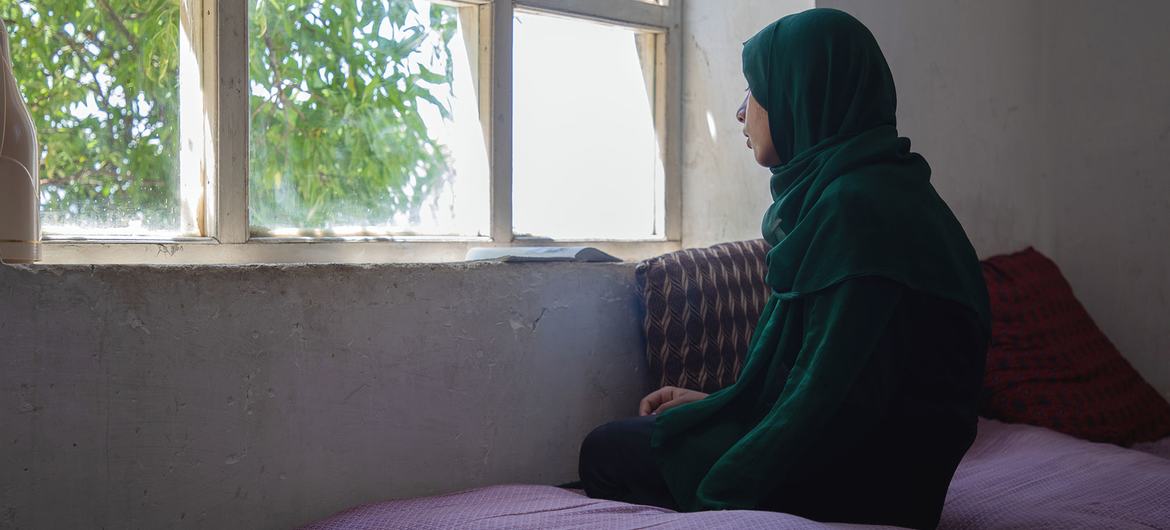
A teenage girl in Afghanistan stays at home as she is no longer allowed to attend school.

Erasure of women and girls’ rights continues

She said the international community “remains extremely concerned that engagement has not improved the unacceptable situation of Afghan women and girls, promoted inclusive governance, or prevented a marked deterioration in human rights.”

Meanwhile, the de facto authorities have conveyed grievances around frozen assets, sanctions, non-recognition, the need for greater development assistance, and an end to aid dependency.

She noted that the UN will convene meetings of two working groups on counter-narcotics and the private sector to be held in Doha, Qatar, in the coming days, calling this “an important development that gives momentum to multilateral engagement and builds confidence in the value of mutual cooperation.”

Relative stability, restrictive policies

Ms. Otunbayeva said Taliban rule has provided relative stability and security in Afghanistan, promoted modest economic growth and foreign investment, initiated dormant infrastructure projects, and deepened diplomatic ties abroad, particularly in the region.

However, authorities “continue to implement highly restrictive and discriminatory policies on the Afghan people,” as embodied in the “law on the propagation of virtue and prevention of vice,” which took effect last August. 

This law “cemented” the Taliban’s systematic, state-sponsored policies that exclude women and girls from participation in public life, including access to education, employment, freedom of movement, and freedom of expression.

Reintegration at risk

Through this law, the de facto authorities are continuing to pursue a path that distances Afghanistan from its international obligations and hinders Afghanistan’s eventual reintegration into the international system,” she said.

“We cannot forget the unacceptable situation of Afghan women and girls, even if their continued marginalisation under increased enforcement of more and more decrees no longer generates headlines.”

The ongoing ban on girls’ education beyond primary school “is the clearest sign of the Taliban’s discrimination against women and continues to set Afghanistan apart from the world,” she said, calling once again for the ban to be lifted and for girls and women to again have the right to education.

One in five going hungry

Joyce Msuya, UN Assistant Secretary-General for Humanitarian Affairs, highlighted how funding cuts are impacting Afghanistan, where half of all people require assistance to survive. 

The population faces “persistent and acute humanitarian needs compounded by decades of conflict, entrenched poverty, an ever-harsher climate, severe restrictions on the rights of women and girls and highly constrained funding environment,” she said.

Today, one in every five Afghans is hungry, 3.5 million children are acutely malnourished and roughly 3.7 million children are out of school, including 2.2 million girls over age 11 who are banned from education. Additionally, the maternal mortality rate is over 2.5 times the global average. 

Health facilities shuttered

She said the aid cuts continue to hamper humanitarian response, and 420 health facilities have been forced to shut their doors, affecting more than three million people.

“Almost 300 nutrition sites have closed, depriving 80,000 acutely malnourished children, pregnant women, and new mothers of essential treatment,” she added.

“Despite challenges, and at great risk, our Afghan female colleagues continue to deliver aid, going where others cannot, listening to communities who would otherwise not be heard, and standing by those who might otherwise be forgotten,” she said.

Hardships increase

Sima Bahous, Executive Director of UN Women, upheld calls for more diplomacy to address the spiralling crisis in the Middle East and Iran.

“The growing regional and global insecurity will only deepen the hardships faced by Afghan women and girls, compounding poverty, displacement, violence and deprivation,” she warned.

Additionally, the ability of the UN and partners to support Afghan women has been drastically undermined by legal and bureaucratic barriers which make it harder than ever to hire women, let alone reach them, at a time when deep cuts to aid budgets “have ever more devastating consequences.”

‘Unshakeable determination’

“Yet, we stay, and we deliver, as we always have,” said Ms. Bahous, highlighting how UN Women continues to navigate through endless restrictions and negotiate with the Taliban.

“And, Afghan women continue to lead the way,” she added.  “They have opened underground schools; organized in silence; built lives in those slivers of space left to them. They have shown unshakable determination, even when the world faltered.” 

Source link