
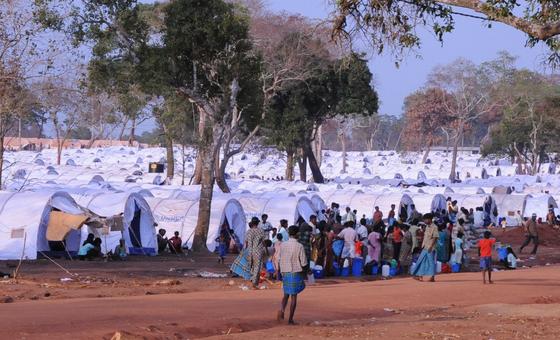
UN says Sri Lanka has ‘historic opportunity’ to end impunity, deliver justice

The 26-year conflict, from 1983 to 2009, pitted Government forces against the separatist Liberation Tigers of Tamil Eelam (LTTE) – more commonly referred to as the Tamil Tigers – who sought an independent state for the island’s Tamil minority in the north and east.

The civil war claimed an estimated 80,000 to 100,000 lives, and thousands more were forcibly disappeared, their fates still unknown. Hundreds of thousands were also displaced from their homes.  

The final months were among the bloodiest, with tens of thousands of civilians killed in indiscriminate shelling, extrajudicial executions, and other violations of international law committed by both sides.

Turn pledges into results

In a new report issued on Wednesday, UN human rights chief Volker Türk said the Government’s pledges to deliver justice, restore the rule of law, and eliminate discrimination and divisive politics must finally yield concrete results.

Today, an opportunity presents itself for Sri Lanka to break from the past,” he said. “It now needs a comprehensive roadmap to translate these commitments into results.

The report follows Mr. Türk’s recent visit to Sri Lanka, where he met officials, civil society, victims’ groups, political parties and religious leaders, and travelled to Trincomalee, Jaffna and Kandy – among the worst-affected areas.

It calls for a clear acknowledgment of the violations, abuses and crimes committed – including during the civil war – and recognition of the State’s responsibility and that of its security forces personnel as well as non-state armed groups, including the LTTE.

The pain and suffering of victims remains palpable and their demands for truth and justice must be addressed,” Mr. Türk stressed.

Call for sweeping reforms

The report recommends comprehensive security sector reform and broader constitutional, legal and institutional changes to meet international human rights obligations. It welcomes the planned creation of an independent Public Prosecutor’s office.

It also urges the establishment of a dedicated judicial mechanism, including an independent special counsel, to handle cases involving serious human rights violations and grave breaches of international humanitarian law.

Other recommendations include the release of military-held land in the north and east, repeal of the Prevention of Terrorism Act (PTA), and the release of long-term PTA detainees – some imprisoned for decades.

The report further calls for amendments or repeal of several restrictive laws, including those relating to data and online safety, NGOs, and civil and political rights.

International support

While the primary responsibility for investigating and prosecuting crimes lies with the Government, the report calls for complementary international support.

It urges UN Member States to contribute to accountability and reconciliation efforts, leveraging OHCHR’s strengthened capacity to undertake related work.

These measures are crucial to realizing the Government’s vision of ‘national unity’ and above all ensuring there can never be recurrence of past violations,” Mr. Türk said.

Source link

UN urges MPs to deliver on development promises for 600 million in landlocked nations

Speaking at Monday’s Parliamentary Forum of the Third UN Conference on LLDCs, senior UN leaders stressed that political will, matched with national legislative action, is essential if a new decade-long development plan is to make a real difference.

There are 32 such countries globally, home to over half a billion people. Many are also among the world’s least developed, hindered by high transport costs, limited access to global markets, and heightened vulnerability to climate impacts.

Cost burden

“These challenges are persistent and structural,” said High Representative Rabab Fatima who leads the office championing LLDCs. “They stem not just from being landlocked but from limited infrastructure, narrow export bases, and lack of access to finance.”

The figures, she said, tell a stark story: LLDCs account for seven per cent of the world’s population but only one per cent of global GDP. Trade costs are 30 per cent higher than for coastal states. Just 61 per cent of LLDC populations have electricity access, compared to 92 per cent globally — and fewer than 40 per cent are connected to the internet.

“These are not just statistics. They reflect real human challenges,” said Ms. Fatima.

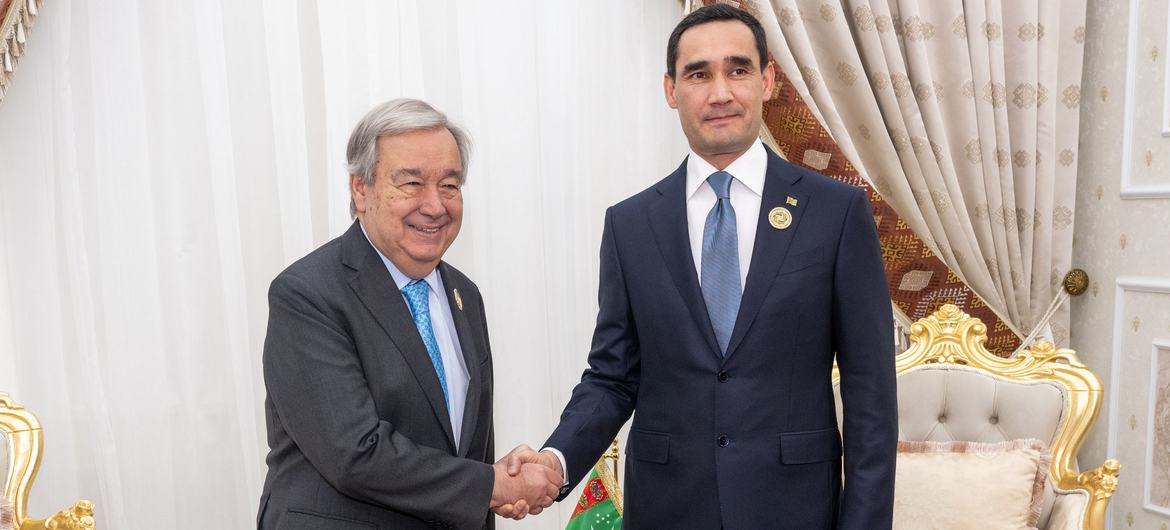
UN Secretary-General António Guterres (left) meets President Serdar Gurbangulyýewiç Berdimuhamedow of Turkmenistan, during his visit for the Third United Nations Conference on Landlocked Developing Countries being held in Awaza.

Be ‘champions of change’

She described the Awaza Programme of Action as “a milestone” and “a clear roadmap” to help transform structural disadvantages into opportunities. But she stressed that delivering on its goals requires action at the national level.

“Parliaments have a decisive role,” Ms. Fatima said. She urged lawmakers to align national strategies with the programme, secure financing, promote trade and integration, support good governance, and form parliamentary groups dedicated to implementation.

“You are lawmakers, you are budget-makers — and champions of change. Your leadership is essential to ensure that the Awaza Programme delivers tangible and lasting results for the 600 million people of LLDCs,” she told delegates.

Foundational role

President of the UN General Assembly Philémon Yang echoed her message, highlighting that “parliaments are essential to translating global commitments into measurable national progress.”

He emphasised that parliaments provide the legal framework for development in areas like infrastructure, innovation, and trade — and that they also hold the purse strings for key sectors such as education, healthcare, and climate action.

Addressing the urgency of environmental responsibility, Mr. Yang cited the July 2025 advisory opinion of the International Court of Justice (ICJ), which affirmed that climate action is a legal duty of all states.

Stronger cooperation

“Parliaments monitor government performance and ensure the efficient use of public funds,” Mr. Yang said. “Beyond policy and budgets, they are the bridge between the State and citizens.”

He also called for stronger inter-parliamentary cooperation — regionally and globally — to address the shared and specific challenges faced by LLDCs.

Concluding, Mr. Yang reaffirmed the UN General Assembly’s role as “the parliament of humanity,” committed to tracking progress and keeping LLDCs on the global development agenda.

“Let us strengthen this partnership between national parliaments and our global institutions,” he said, “so that we can deliver on the promise of sustainable development — a promise grounded in peace, prosperity, and dignity for everyone, everywhere.”

Source link

Humanitarians must be able to deliver aid in Gaza, UN agencies insist

The humanitarian network is currently at a standstill because the internet shut down earlier this week after the last fibre cable route serving central and southern areas was cut during heavy fighting.

As the outage continues, partners are unable to communicate or coordinate response activities, and people in need remain isolated and without the information they need to access life-saving support and emergency services,” UN aid coordination office OCHA said in an update.

Connectivity a life or death issue

Restoring connectivity is urgent. OCHA said the Israeli military recently posted a warning on social media where areas marked in red on a map are considered dangerous combat zones, calling on people to stay away from them.

Although these areas apparently cover most of the Gaza Strip’s territory, most people have no way to access the announcement.

Meanwhile, partners working on telecommunications continue efforts to coordinate urgent repairs of the fibre optic cable routes in Gaza, including those that were previously damaged. 

However, since April, Israeli authorities have denied more than 20 requests to carry out this work.  

“It is critical that repair of the lines is enabled immediately,” OCHA said.

Humanitarian missions denied

The agency further reported that the Israeli authorities continue to deny many humanitarian movements aimed at providing support to Gaza’s population, which numbers over two million.

On Thursday, they rejected eight out of 18 UN attempts to coordinate such movements, including efforts to retrieve wheat flour and fuel supplies. 

Four other missions were unable to be accomplished, either because of impediments or because they had to be cancelled for security or logistical reasons. 

The remaining six missions, which included the movement of staff, were successful.

‘Recipe for chaos’

Conditions continue to deteriorate in Gaza after 20 months of war followed by a total blockade of aid and commercial goods which began on 2 March.

People are crammed in shelters, or living in tents, and lack basic essentials.  For example, the accumulation of solid waste is severely impacting health and environmental conditions, the UN Palestine refugee agency UNRWA said on Friday.

Israel temporarily lifted the ban in mid-May, and the UN was able to bring in small amounts of key aid items such as flour and medicines – though far from enough to prevent starvation from impacting the population.

Since late May, the UN and partners have been sidelined as a new aid distribution model began operations.

The Gaza Humanitarian Foundation, which is backed by Israel and the United States, uses private military contractors, according to media reports.  More than 200 people have been killed, and thousands more injured by gunfire near its hubs.

The mechanism is “a recipe for chaos,” UNRWA tweeted on Friday, echoing the words of its chief Philippe Lazzarini.

It is weaponising aid and resulting in fear, discrimination, and growing desperation,” the agency said.

“It is time to lift the siege and let the UN, including UNRWA, do the work. Aid must be delivered safely and at scale.”

‘Hunger must never be met by bullets’

The UN Humanitarian Affairs Coordinator Tom Fletcher underscored the need to act now in a statement issued late on Thursday.

“Hunger must never be met with bullets,” he said. “Humanitarians must be allowed to do their work. Lifesaving aid must reach people in need, in line with humanitarian principles.” 

Mr. Fletcher said attacks against civilians in Gaza “are unacceptable”, which includes the killing and injury of hungry people seeking food and those delivering aid.

He said UN humanitarian convoys have been intercepted by armed Palestinian gangs, endangering staff and drivers.

“Civilians in desperate need of the food we’re able to bring in, have not been spared; some have been shot by Israeli forces, and others crushed by trucks or stabbed while trying to retrieve food,” he added.

UN Relief Chief Tom Fletcher talks to a child at an UNRWA shelter during a visit to Gaza in February.

Let humanitarians work

He also mentioned incidents “concentrated around militarized distribution centres, where starving people tell us that Israeli forces opened fire on them.” 

Hospitals report that they have received 245 fatalities and over 2,150 injuries from these areas over the past two weeks,” he said.

Furthermore, the Gaza Humanitarian Foundation said on Thursday that Palestinians involved in their distribution were killed, injured, and captured by Hamas.

“Without immediate and massively scaled-up access to the basic means of survival, we risk a descent into famine, further chaos, and the loss of more lives,” the UN relief chief warned.

“We stand ready, as we have repeatedly emphasized, to deliver life-saving aid at scale,” he said.  “Let us do our work.”