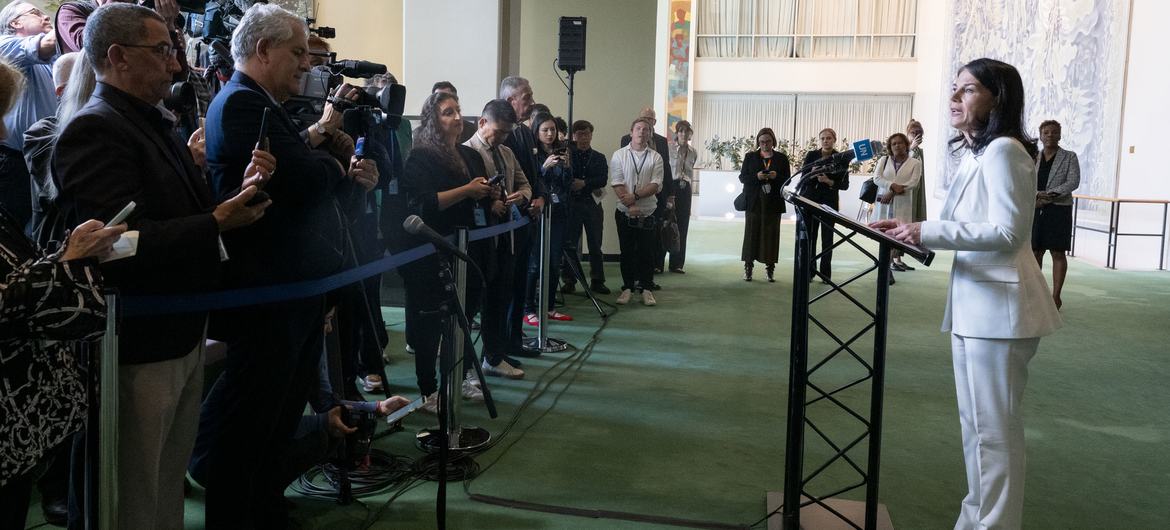
This will be “no ordinary session,” she pledged, with the multilateral system beset by overlapping crises and heightened disunity.
A former foreign minister of Germany, Ms. Baerbock becomes only the fifth woman in history to preside over the General Assembly.
In a symbolic gesture linking past to present, she swore her oath on the UN’s founding Charter from the San Francisco Conference in 1945 – and accepted the Assembly’s ornate gavel from her predecessor, Philémon Yang of Cameroon.
The Charter itself, preserved by the US National Archives, has returned to UN Headquarters for the first time in decades.
Now on display through September, the 1945 document is more than a historical artifact – it is a living reminder of the collective pledge to build peace, uphold human rights and pursue shared values and goals through multilateral cooperation.
The gavel carries its own storied weight. A gift from Iceland, it is larger and more ornate than the ones used in UN conference rooms. The symbol of order in the “parliament of the world,” it is used to open and close meetings, adopt resolutions, and, at times, bring the Assembly to silence.

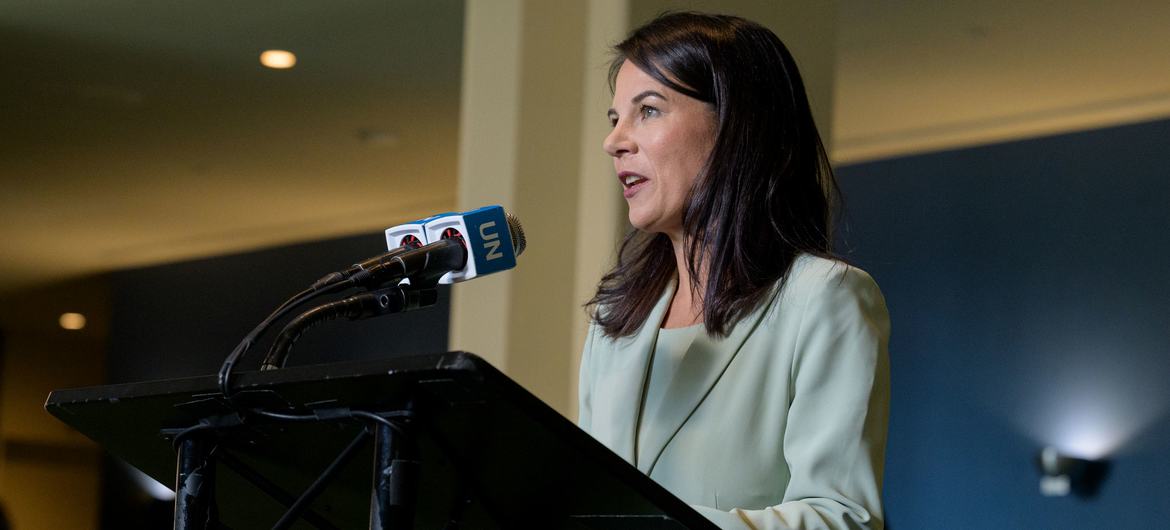
Assembly President Baerbock speaks to reporters outside the General Assembly Hall.
The world needs the United Nations
In her address, Ms. Baerbock acknowledged the grim realities facing millions across the globe – from children starving in Gaza and Afghan girls barred from school – to families in Ukraine hiding from missile attacks, and Pacific Islanders watching their homes swallowed by the sea.
“Our world is in pain, indeed,” she told delegates in the General Assembly Hall.
“But imagine how much more pain there would be without the United Nations.”
Ms. Baerbock underscored the UN’s vital role in humanitarian assistance, citing the millions who rely on agencies such as the UN Children’s Fund (UNICEF), the World Food Programme (WFP) and the World Health Organization (WHO).
She urged Member States to make the UN “fit for the 21st century” by advancing reforms, implementing the Pact for the Future adopted last year, and focusing on substance over procedure.
“The General Assembly must focus on its mandates and deliver on its commitments,” she said, promising to serve all 193 members equally, to be “a bridge builder,” and to ensure every voice is heard.
Among the priorities she set for the year ahead are implementing the UN80 reform agenda, guiding the process of selecting the next Secretary-General, and advancing peace, sustainable development, and human rights.
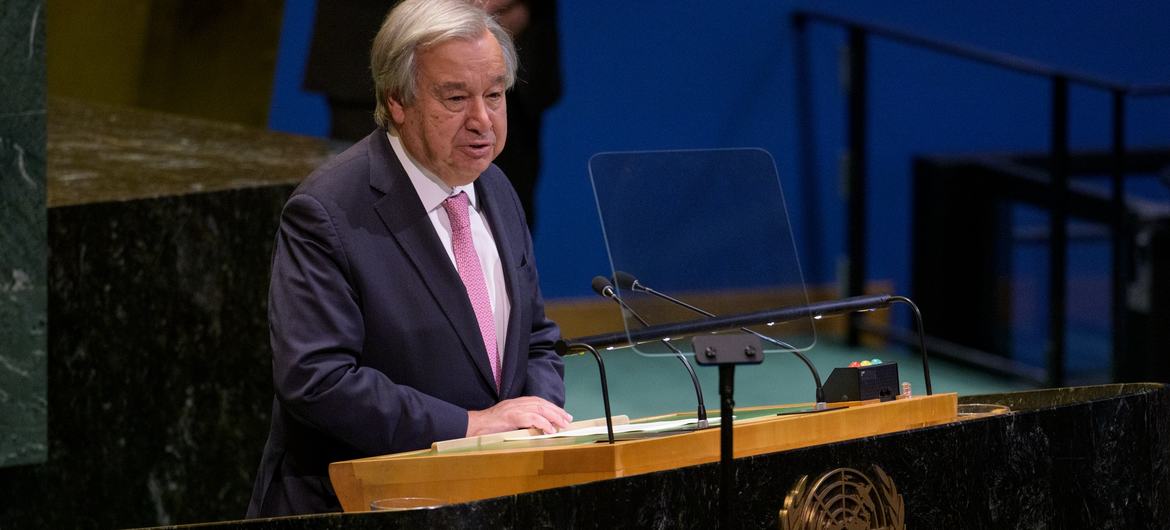
Secretary-General António Guterres addresses the first plenary meeting of the 80th session of the General Assembly.
The Charter is not self-executing: Guterres
Secretary-General António Guterres, congratulating Ms. Baerbock on her election, praised her vision and experience, while urging governments to summon the same resolve that brought nations together to establish the UN 80 years ago.
“The United Nations provides the place. The Charter provides the tools,” he said. “But nothing can happen without this Assembly – all of you – working as one.”
Mr. Guterres stressed the need to heal divisions, recommit to international law, accelerate action on the Sustainable Development Goals, and transition to renewable energy while supporting developing countries.
He pointed to last year’s Pact for the Future as a “shot in the arm” for multilateralism and called on Member States to “re-build trust and faith in one another.”
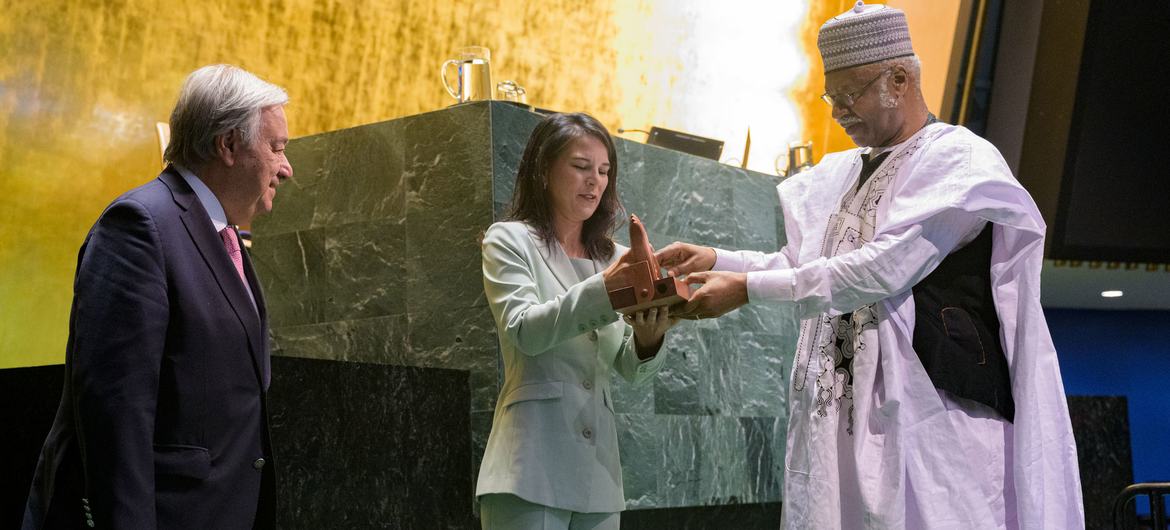
Philémon Yang (right), President of the General Assembly at its 79th session presents the Assembly’s iconic gavel to Annalena Baerbock (centre), President of the Assembly at its 80th session. On the left is Secretary-General António Guterres.
‘Collective promise’ remains
Earlier in the day, outgoing Assembly President Philémon Yang closed the 79th session, highlighting initiatives on humanitarian law, small arms control, sustainable development, and child labour – as well as dialogues on multilingualism and the role of women in mediation.
Mr. Yang, who emphasised gender equality and Security Council reform during his tenure, also oversaw the 80th anniversary commemoration.
“Member States made clear that in spite of rising global conflicts, the Charter, and the United Nations itself, represent a collective promise for a better future world,” he said.
A year of high stakes
Ms. Baerbock’s presidency comes at a pivotal moment for the United Nations.
Alongside navigating conflicts from Ukraine to Sudan, the Assembly will oversee the implementation of the Pact for the Future and prepare for the critical selection of the next Secretary-General.
She challenged delegates to embrace courage and unity: “If girls in Afghanistan or parents in Gaza can wake up – in the darkest hours of life – and push forward, then so can we. We owe it to them. But we owe it also to ourselves, because there is simply no alternative.”