Canada, Australia and UK Recognise Palestine’s Statehood, Palestine Welcomes

Palestine has hailed the coordinated move by Canada, Australia and the United Kingdom to formally recognise it as an independent and sovereign state, calling the decision a step in line with international law and legitimacy resolutions.

In a statement shared on X, Palestine’s Mission to the United Nations said its Ministry of Foreign Affairs “welcomes and expresses gratitude” to the three countries for what it described as “courageous decisions” that affirm the Palestinian right to statehood.

The recognition was announced on Sunday in synchronised declarations from Ottawa, Canberra and London, marking a significant diplomatic shift aimed at reviving prospects for a two-state solution in the Middle East.

Australian Prime Minister Anthony Albanese and Foreign Minister Penny Wong, in a joint statement, said recognition was effective immediately and underscored Australia’s “longstanding commitment” to the two-state framework. “Australia recognises the legitimate and long-held aspirations of the people of Palestine to a state of their own,” they said, adding that the move was tied to international efforts to secure a Gaza ceasefire and the release of hostages taken during the October 7, 2023 attacks.

Palestine Authority pledges reforms

They stressed that the Palestinian Authority had renewed its recognition of Israel’s right to exist and pledged reforms in governance, elections, finance and education, while making clear that Hamas would have “no role in Palestine.”

UK Prime Minister Keir Starmer echoed that position in a video message, saying Britain’s recognition was intended to “revive the hope of peace for Palestinians and Israelis” and to lay the ground for renewed dialogue.

Canadian Prime Minister Mark Carney, in a statement, sharply criticised Israel’s current policies, accusing its government of systematically blocking Palestinian statehood through settlement expansion and a prolonged military campaign in Gaza. He said Canada’s recognition was rooted in “principles of self-determination and fundamental human rights” and aligned with Ottawa’s longstanding foreign policy traditions.

“This recognition is not a panacea,” Carney cautioned, “but it is a necessary step to preserve the possibility of a two-state solution and to help build the promise of a peaceful future for both Israel and Palestine.”

The joint move by three major Western powers is expected to intensify international pressure on Israel, which has consistently opposed recognition of Palestinian statehood outside a negotiated settlement.

What to know ahead of Sept 22 UN summit on Palestine

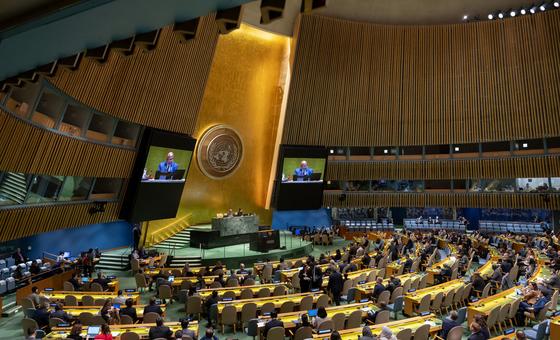
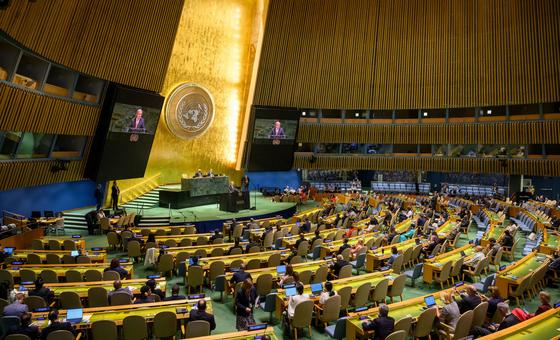
Held on the opening day of the UN General Assembly’s high-level week, the annual September gathering of world leaders, the initiative comes amid a deeply worrying regional backdrop of  intensified Israeli military operations that have allegedly killed more than 60,000 people in Gaza since October 7, 2023, Israel’s strikes against Hamas officials in Qatar on September 9, and accelerating settlement expansion in the West Bank.

Despite the volatile regional context, the two-state solution is regaining diplomatic traction. On September 12, the General Assembly adopted by a wide margin the “New York Declaration,” following a July conference also co-hosted by France and Saudi Arabia. It called for “just and lasting peace grounded in international law and based on the two-state solution.”

To end the war, it urged Hamas to “end its role in Gaza, and handover its weapons to the Palestinian Authority.” The United States and Israel, which had boycotted the July conference, voted against the text.

The September 22 summit will likely build on that momentum, French President Emmanuel Macron is expected to announce France’s recognition of the State of Palestine, and several other Western countries, including the UK, Canada, Belgium, and Australia, are reportedly considering following suit.

In short, the summit’s impact could inject new momentum into efforts to establish a UN roadmap towards two states.

ALSO READ: London’s Far-Right Rally Sends Shockwaves Through South Asian Communities

General Assembly endorses New York Declaration on two-State solution between Israel and Palestine

The New York Declaration is the outcome of an international conference held in July at UN Headquarters, organized by France and Saudi Arabia, which resumes later this month.

The General Assembly comprises all 193 UN Member States and 142 countries voted in favour of a resolution backing the document.

Israel voted against it, alongside nine other countries – Argentina, Hungary, Micronesia, Nauru, Palau, Papua New Guinea, Paraguay, Tonga and the United States – while 12 nations abstained.

‘Roadmap’ for the future

Prior to the vote, French Ambassador Jérôme Bonnafont recalled that the New York Declaration “lays out a single roadmap to deliver the two-State solution”.

This involves an immediate ceasefire in Gaza, release of all hostages held there, and the establishment of a Palestinian State that is both viable and sovereign.

The roadmap further calls for the disarmament of Hamas and its exclusion from governance in Gaza, normalization between Israel and the Arab countries, as well as collective security guarantees.

Speaking ahead of the vote, Israeli Ambassador Danny Danon said that “this one-sided Declaration will not be remembered as a step toward peace, only as another hollow gesture that weakens this Assembly’s credibility.” 

He said that “Hamas is the biggest winner of any endorsement here today” and will declare it “the fruit of 7 October”.

The high-level international conference in July was held against the backdrop of the war in Gaza and deteriorating prospects for the two-State solution.

In remarks to the opening segment, UN Secretary-General António Guterres noted that “the central question for Middle East peace is implementation of the two-State solution, where two independent, sovereign, democratic States – Israel and Palestine – live side-by-side in peace and security.” 

LIVE COVERAGE: Day 3 of high-level conference on two-State solution for Israel and Palestine

UN Secretary-General António Guterres on Monday warned that the Israeli-Palestinian conflict is “at a breaking point” and headed toward a one-State reality marked by perpetual occupation and inequality, unless the international community takes urgent, irreversible steps to implement the two-State solution.

Source link

LIVE COVERAGE: Day 2 of high-level conference on two-State solution for Israel and Palestine

Welcome to our continuing live coverage of the high-level international conference at UN Headquarters, aimed at advancing practical steps toward achieving a two-State solution to the Israel-Palestine conflict. Mandated by the General Assembly, the three-day meeting features plenaries, working groups and interventions from senior UN officials and Member States. UN News app users can follow here.

Source link

LIVE COVERAGE: High-level conference on two-State solution for Israel and Palestine

A world in which a sovereign State of Palestine and Israel co-exist peacefully seems a distant prospect, particularly in light of the 7 October 2023 attacks by Hamas on Israel, and the subsequent Israeli bombardment of Gaza. A high-level UN conference opening on 28 July will, nevertheless, serve as the latest UN-backed attempt to find a way to end the conflict. 

Diplomats prepare ground for June conference on two-State solution for Israel and Palestine

The preparatory session brought together UN Member States to align expectations and finalise arrangements for eight thematic roundtables that will help shape the conference’s outcome.

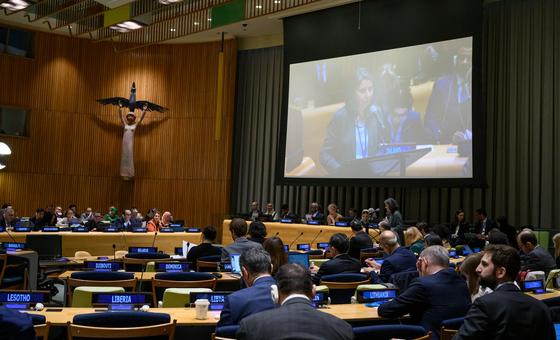
General Assembly President Philémon Yang urged countries to seize the crucial opportunity to finally make progress.

“The horrors we have witnessed in Gaza for over nineteen months should spur us to urgent action to end the Israeli-Palestinian conflict. The devastating cycles of death, destruction, and displacement cannot be allowed to continue,” he said.

“This conflict cannot be resolved through permanent war, nor through endless occupation or annexation. It will only end when Israelis and Palestinians can live side by side in their own sovereign, independent States, in peace, security, and dignity,” he added.

General Assembly President Yang addresses the preparatory meeting.

Concrete outcomes needed

Co-chairs France and Saudi Arabia emphasised the need for the June conference to go beyond reaffirming principles and achieve concrete results on the ground.

“We must urgently move from words to deeds. We must move from ending the war in Gaza to ending the conflict itself,” said Anne-Claire Legendre, Middle East and North Africa advisor to French President Emmanuel Macron.

“Faced with the facts on the ground, the prospects of a Palestinian State must be maintained. Irreversible steps and concrete measures for the implementation thereof are necessary.”

Alongside, she reiterated calls for a lasting ceasefire, an immediate influx of humanitarian aid and the release of hostages.

Historic moment

Manal bint Hassan Radwan, head of the Saudi Arabian negotiating team, called the moment “historic,” stating that the preparatory meeting must “chart a course for action, not reflection.”  

“Civilians continue to pay the price of a war that must end immediately. The escalation in the West Bank is equally alarming. Despair grows deeper by the day,” she said.

“This is precisely why we must speak not only of ending the war, but of ending a conflict that has lasted nearly eight decades,” she continued, adding efforts to end fighting and secure release of hostages and detainees must be “anchored in a credible and irreversible political plan that addresses the root cause of the conflict and offers a real path to peace, dignity and mutual security.”

Outcome document

The General Assembly decided to convene the conference in its resolution ES-10/24. Further details were outlined in resolution 79/81.

As outlined in General Assembly resolution 79/81, the Conference will produce an action-oriented outcome document entitled “Peaceful settlement of the question of Palestine and implementation of the two-State solution”.

The aim is to chart a clear and irreversible pathway toward a comprehensive, just, and lasting peace in accordance with UN resolutions.

About the Conference

The conference will include a plenary session with statements from the President of the General Assembly, the UN Secretary-General, and the co-chairs, followed by interventions from Member States and observers.

According to a concept note from the co-chairs, the conference will also feature eight thematic roundtables, each focused on critical dimensions of the two-State solution. 

The working groups include security arrangements for both Israelis and Palestinians, the economic viability of a Palestinian State, and humanitarian action and reconstruction.

Source link