From rural margins to media trailblazers: India’s women journalists are rewriting the news

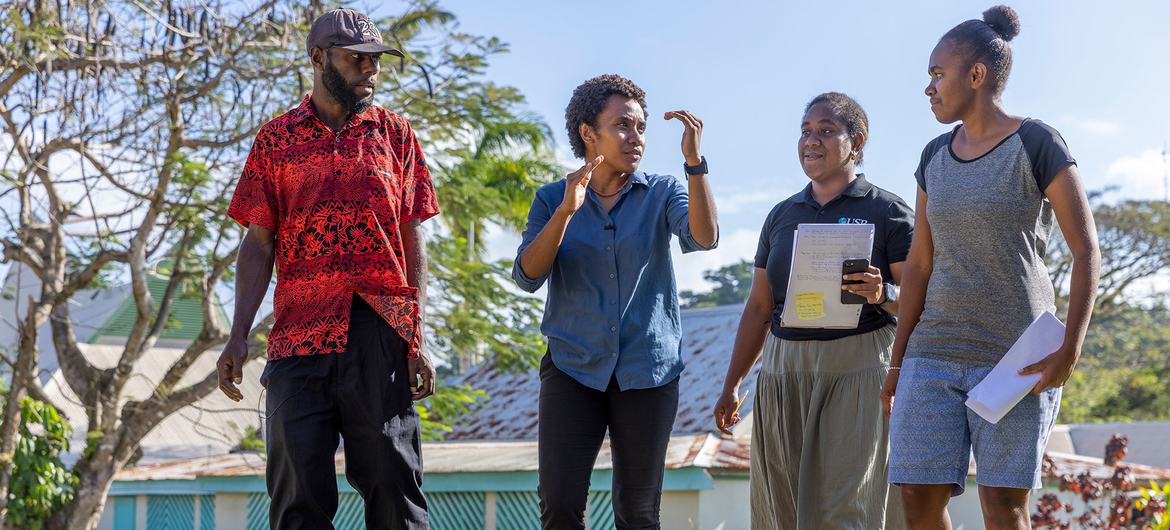
Khabar Lahariya, literally “news waves”, is an all-women media organisation run since 2002 by rural reporters, many of them Dalit, Adivasi and Muslim, dispatching fresh stories from some of the most marginalised regions.

“We faced challenges at every level,” founder Kavita Devi told UN News. “People would say women can’t be journalists, but we went to villages, persisted and proved that women can not only report but tell stories that others cannot.”

Long before global conversations about diversity entered newsrooms, these women were building their own.

From illiterate to multimedia producer

Villagers initially doubted women could be journalists and educational barriers made recruiting reporters a daunting challenge, Ms. Devi said, recalling the scepticism they encountered.

At the time, female reporters were virtually absent from newsrooms in Uttar Pradesh and Bihar. Many of the women who joined Khabar Lahariya had little formal education.

One such journalist, Shyamkali, transformed from being illiterate to becoming a senior reporter.

Khabar Lahariya reports in local languages, including Bundeli, Awadhi and Bhojpuri, rejecting the idea that legitimacy requires elite, urban Hindi or English.

Reporting from the margins

“I didn’t know how to write a resume or handle a camera, but with training and guidance, I was able to learn everything, from interviewing to mobile journalism, and now I report stories that mainstream media ignore,” Shyamkali told UN News.

Khabar Lahariya’s reporting also goes beyond mere representation. Shyamkali recounted a story about a woman who, driven to desperation, acted violently against her abusive husband. 

Mainstream media reported the incident without context, focusing only on the shocking act, she said. But, Shyamkali’s reporting brought the woman’s perspective and underlying social realities to light, demonstrating how women journalists can add nuance, empathy and depth to stories often ignored or misrepresented.

Women ‘see their own image in the news’

Language plays a critical role in Khabar Lahariya’s mission. Publishing in local dialects like Bundeli, Awadhi and Bhojpuri, ensures that news is accessible, relatable and empowering for rural communities. 

“When we explain issues in their language, people understand better,” Ms. Devi said.

“They see their own image in the news, especially women.”

Game changing digital media

Transitioning from print to digital platforms has been a game changer for Khabar Lahariya, with its staff embracing mobile journalism, learning to anchor, produce and share news on social media platforms like Facebook, YouTube and Instagram.

Technology has empowered us to amplify voices from communities that were always ignored.

“Technology has empowered us to amplify voices from communities that were always ignored,” Shyamkali said, recalling the initial fear and excitement of tackling digital media.

“I never imagined handling a camera or sending live reports from a phone, but now I can.”

This digital expansion not only increases visibility, but enhances women’s agency, confidence and economic independence, proving that technology and training can transform social realities at the grassroots level.

Founded in 2002, Khabar Lahariya is an all-women media organisation run by rural reporters, many of them Dalit, Adivasi and Muslim.

Telling the whole story

Women remain just one in four people seen, heard or read about in the media, according to the 2025 Global Media Monitoring Project (GMMP) report.

When women’s voices are missing, the public is denied half the story.

Kalliopi Mingeirou, chief of UN Women’s section to end violence against women and girls, told UN News “this is not because women lack expertise or leadership” but because media continues to rely on the same narrow set of voices, too often defaulting to men as experts and decision makers.

Indeed, democracy depends on informed debate and inclusive decision making, she said.

“When women’s voices are missing, the public is denied half the story,” she said. “This distorts reality, weakens accountability and narrows the democratic space. In today’s context of backlash against gender equality, the exclusion of women in news is not only a gender issue, it is a democratic deficit.”

‘Radical rethink’ required

Progress on gender representation in media has not only stalled, it is under threat, according to the new report.

“These findings are both a wake-up call and a call to action,” said Kirsi Madi, Deputy Executive Director of UN Women. “When women are missing, democracy is incomplete.”

Despite making up half of the world’s population, women today account for just 26 per cent of news subjects and sources globally, a figure that has barely shifted in the last 15 years, the report found.

“A radical rethink is needed so that media can play its role in advancing equality,” Ms. Madi said. “Without women’s voices, there is no full story, no fair democracy, no lasting security and no shared future.”

Source link

Five climate trailblazers: UNEP’S 2025 Champions of the Earth

As the world moves to slow climate change and create a more sustainable future, the UN Environment Programme (UNEP) named five new climate visionaries on Wednesday as its 2025 Champions of the Earth — the UN’s highest environmental honour.

These five extraordinary leaders, who work on issues ranging from climate justice to sustainable cooling and forest protection, show that bold action can drive real change for people and planet.

“As the global impacts of the climate crisis intensify, innovation and leadership across every sector of society have never been more essential,” said Inger Andersen, Executive Director of UNEP. 

“Young students demanding climate justice, subnational governments and architects leading on sustainable cooling and smart building design, research institutes slowing deforestation – and passionate individuals driving methane emissions reductions – this year’s Champions of the Earth show the kind of leadership that will inspire the world to face down the challenge of climate change.”

This year, the laureates are tackling some of the most urgent challenges of our time: climate justice, methane emissions, sustainable cooling, resilient buildings, and forest conversation, according to the UN’s environment agency.

UNEP’s 2025 Champions of the Earth are: 

Pacific Islands Students Fighting Climate Change – Policy Leadership

When Cynthia Houniuhi addressed the International Court of Justice in The Hague a year ago, she spoke plainly: climate change is devastating Pacific Island nations like her home, the Solomon Islands.  

Through her youth-led NGO, which secured a landmark International Court of Justice (ICJ) opinion affirming states’ legal duties to prevent climate harm and uphold human rights, she is helping to reshape global climate law and empower vulnerable nations. 

Champions of the Earth Award winner Cynthia Houniuhi, a climate justice advocate from the Solomon Islands who co-founded and led Pacific Islands Students Fighting Climate Change.

Supriya Sahu, Additional Chief Secretary, Government of Tamil Nadu – Inspiration and Action

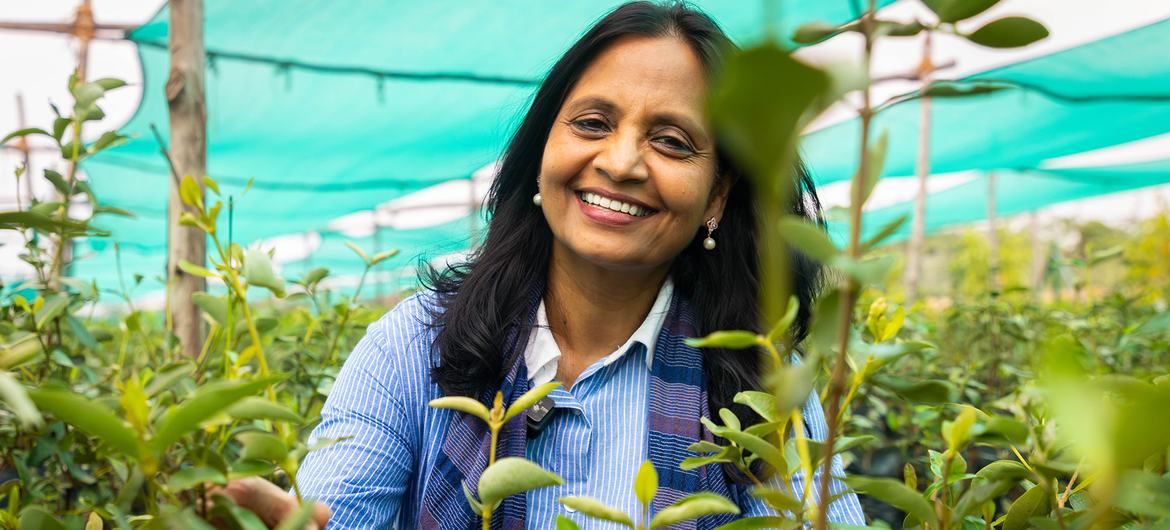
Indian environmentalist Ms. Sahu is redefining how communities adapt to extreme heat – restoring nature to cool cities, redesigning schools for safety, and promoting climate-smart infrastructure.  

Her sustainable cooling and restoration initiatives have created 2.5 million green jobs, expanded forest cover, and improved resilience for 12 million people. 
© UNEP/Florian Fussstetter

Champions of the Earth Award winner Supriya Sahu is recognized for her groundbreaking leadership in subnational climate action, restoring ecosystems and scaling sustainable cooling innovations across Tamil Nadu.

Mariam Issoufou, Principal and Founder, Mariam Issoufou Architects, Niger/France – Entrepreneurial Vision

By grounding her architecture in local materials and cultural heritage, Ms. Issoufou is redefining sustainable, climate-resilient buildings across the Sahel and inspiring a new generation of designers shaping Africa’s built environment.  

Through projects like the Hikma Community Complex in Niger, she pioneers passive cooling techniques that keep buildings up to 10°C cooler without air conditioning. 
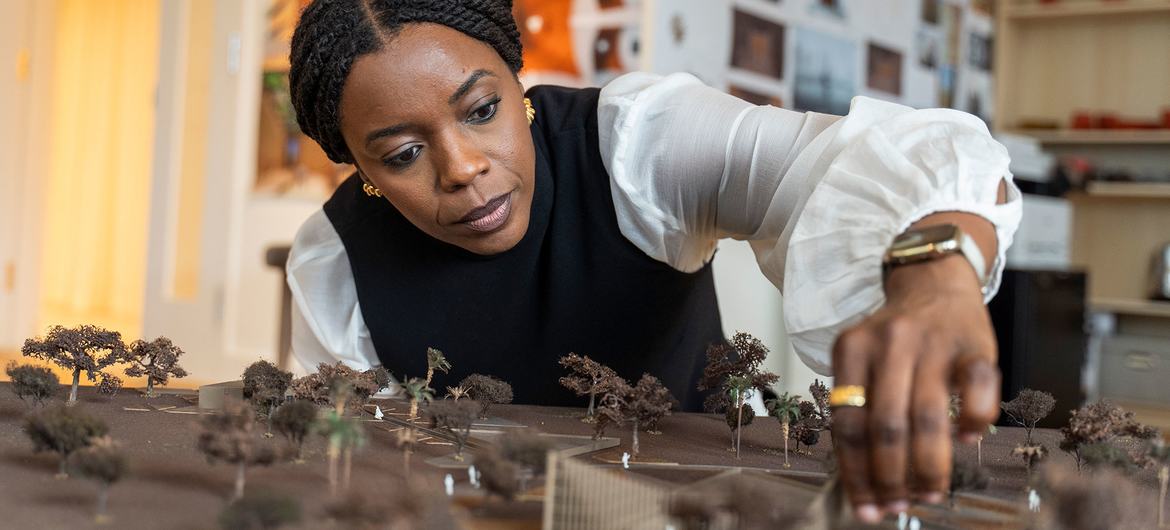
Champions of the Earth Award winner Mariam Issoufou is a Nigerien architect whose work redefines the relationship between contemporary design and cultural heritage.

Imazon, Brazil – Science and Innovation

Imazon has developed AI deforestation prediction models that inform policies and help law enforcement protect the Amazon rainforest, while promoting sustainable economic growth.        

By combining science and AI-driven geospatial tools to curb deforestation, Imazon’s non-profit research institute has strengthened forest governance, supported thousands of legal cases, and revealed the scale of illegal deforestation, driving systemic change in the Amazon basin. 
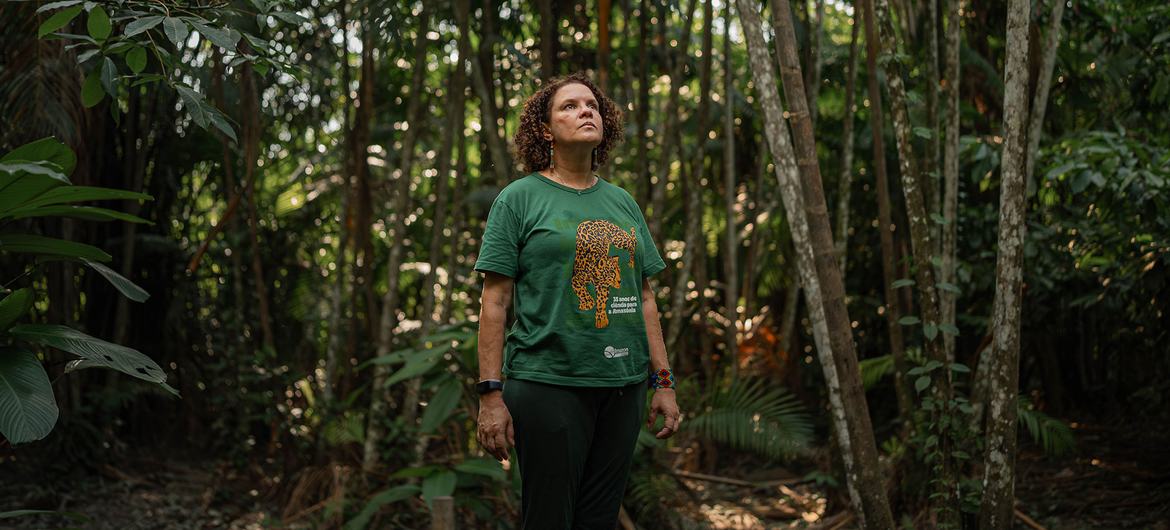
Champions of the Earth Award winner Cynthia Houniuhi is awarded for pioneering forest monitoring systems that combine cutting-edge geospatial science and AI to prevent deforestation in the Amazon.

Manfredi Caltagirone (posthumous) – Lifetime Achievement

Mr. Caltagirone has dedicated his career to one of the most urgent challenges of our time. Guided by his vision for open, reliable, and actionable data, he has driven efforts to turn knowledge into climate action.  

As the former head of UNEP’s International Methane Emissions Observatory, he advanced transparency and science-based policy on methane emissions, helping shape the EU’s first regulation on methane emissions and shaping global energy policy. 
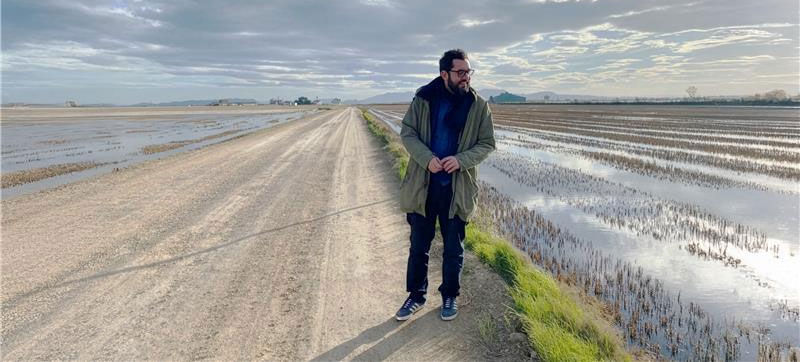
Manfredi Caltagirone, posthumously honoured with the Lifetime Achievement Award for his visionary leadership in founding the International Methane Emissions Observatory and advancing global action on methane.
 

Indigenous youth meet trailblazers ahead of Nelson Mandela Day

Accompanied by their parents and mentors from the midwestern state of Wisconsin, the group wore handmade ribbon skirts and vests featuring seven coloured bands, each symbolizing a Sustainable Development Goal (SDG) of personal significance, such as good health and gender equality.

Also visiting the UN in New York for the first time that day was Brenda Reynolds, a social worker from Canada and a member of the Fishing Lake First Nation. She was joined by her husband, Robert Buckle, and 12-year-old granddaughter Lillian, and wore one of her own ribbon skirts for the occasion.

Ms. Reynolds will be awarded the 2025 United Nations Nelson Rolihlahla Mandela Prize on 18 July. The Prize, presented every five years, recognizes two individuals whose life work exemplifies service to humanity. Ms. Reynolds will receive the award alongside Kennedy Odede, a social entrepreneur from Kenya.

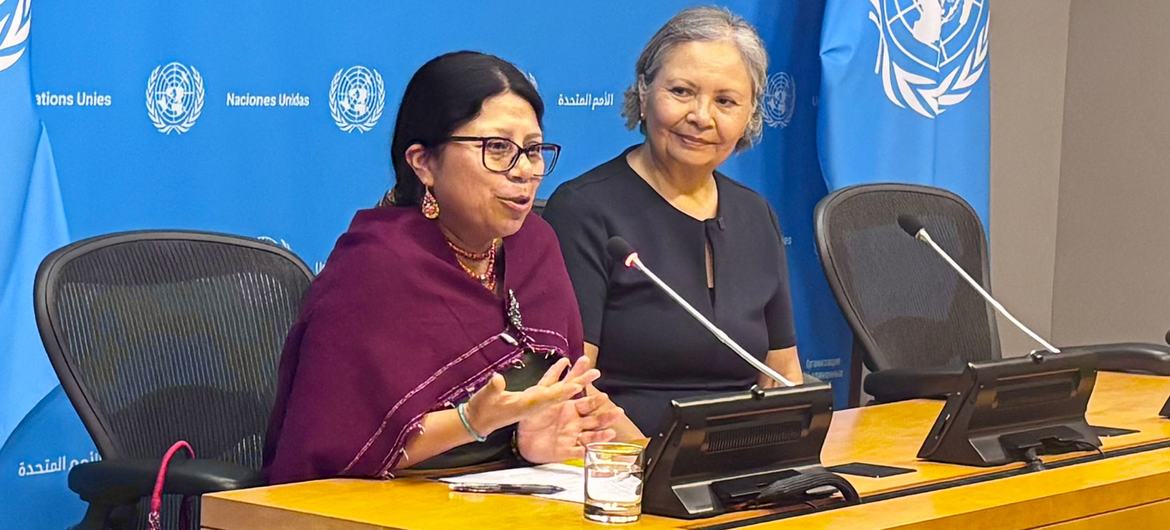
Mirian Masaquiza Jerez, a UN Social Affairs Officer, and Brenda Reynolds, a recipient of the 2025 United Nations Nelson Rolihlahla Mandela Prize, brief Indigenous youth visiting UN Headquarters in New York.

Agents of change

After a UN tour (unanimously enjoyed) and a quick stop for lunch and souvenirs at the UN Bookshop (where one plushie hummingbird was traded for a green turtle named “Coral”), the group settled into a briefing room.

Onstage, Ms. Reynolds was joined by Mirian Masaquiza Jerez, a Kichwa woman from Ecuador and a Social Affairs Officer at the UN Department of Economic and Social Affairs (UNDESA), easily recognized in the UN corridors for always wearing traditional regalia from her Indigenous community of Salasaka,

“Wherever you go to public spaces, wear who you are,” she said.  “The UN is the place to raise your voice. Be free to be who you are.”

Encouraging them to speak their languages and honour their cultures, Ms. Masaquiza urged the young students to see themselves as agents of change.

“You didn’t come by invitation. You came because you belong,” she said. “You are the future. You are the present. As Indigenous, we have the space. Use it.”

A painful past

Ms. Reynolds shared her personal story with the group, reflecting on her early career as a counsellor at Gordon’s Indian Residential School in Saskatchewan, the last federally funded residential school to close in Canada.

She described seeing children as young as five separated from their families for a year at a time and issued shirts with numbers instead of their names written inside: “The only other time I had seen people identified that way was when Jewish people had numbers tattooed on them.”

During her first year at Gordon’s in 1988, a young girl confided that she had been abused. By the next morning, 17 would come forward, launching what would become the province’s first major residential school abuse case.

Ms. Reynolds, then labeled a “troublemaker,” went on to help shape the Indian Residential Schools Settlement Agreement and advise the Truth and Reconciliation Commission. Her work has impacted hundreds of thousands of Indigenous People across Canada.

The room echoed with laughter, knowing nods and tears, and phrases from Ojibwe and other languages represented by the Indigenous Peoples in the room, including Potawatomi, Ho-Chunk, Ojibwe, Menomonee, Oneida, Navajo, Hawaiian, Pacific Islander, and Afro-Indigenous communities.

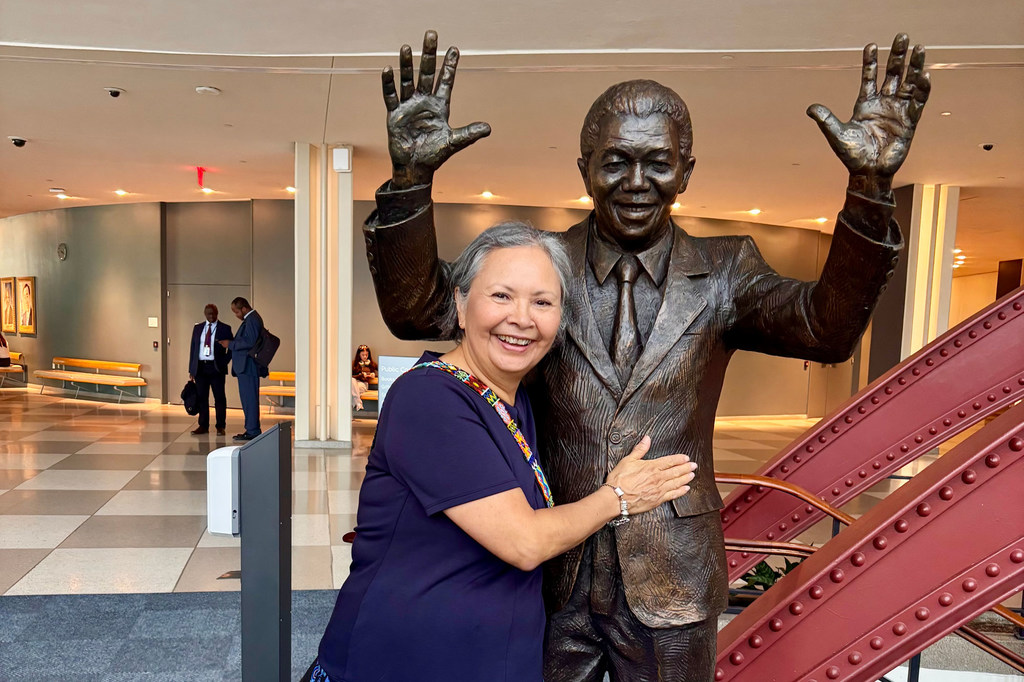
Brenda Reynolds, a recipient of the 2025 United Nations Nelson Rolihlahla Mandela Prize, poses with a statute of the late South African President at UN Headquarters in New York.

Coming full circle

The youth came from the Daughters of Tradition and the Sons of Tradition, part of a long-running healing initiative by Milwaukee’s Healing Intergenerational Roots (HIR) Wellness Institute, which supports Indigenous communities with no-cost, comprehensive mental healthcare and other services.

The founder, Lea S. Denny, wants Indigenous youth to see themselves in positions of power. This particular group has been together for eight years, with some heading off to college in the fall.

One father, attending with his three daughters, reflected on raising Indigenous youth in the digital age. “We want them to access the world out there,” he said, “but also protect the inside world we want to hold dear.” He said he also offered the advice that “if you don’t see yourself on the screen, sometimes you have to be the first.”

The day finished with hugs and exchanges of handmade leis as a symbol of the breath of life and sharing a good life source.

They will reunite on 18 July to see Ms. Reynolds accept the Mandela Prize in the General Assembly Hall.

Before then, a planned detour to visit Times Square.

Meanwhile, Ms. Reynolds and her family discussed their plans for a Broadway show. On the way out, she paused to hug a life-sized bronze statue of Nelson Mandela, a gift from the South African Government to the UN.

“I started my work with children,” she said. “And today, I spoke to children. This feels full circle for me.”

Source link