Taipei mayoral candidates make final push as Beijing weighs in

Taipei Mayor Chiang Wan-an and challenger Puma Shen took their campaigns through the capital on 24 November, four days before Taiwan’s local elections. Both candidates canvassed by motorcade, Radio Taiwan International reported, as the race drew attention from Beijing over the ruling Democratic Progressive Party’s choice of Shen.

Chiang, of the opposition Kuomintang, is seeking another term. Shen, a lawmaker, said the final stretch of campaigning was focused on getting people to vote. He urged residents to take part regardless of whom they backed. The two candidates’ appearances came as parties concentrated their efforts on Taipei and other closely watched municipalities.

Taiwan’s Central Election Commission has scheduled voting for Saturday, 28 November, from 8 a.m. to 4 p.m. local time. Voters will choose mayors, county leaders and councillors, among other local officials. Focus Taiwan reported that 11,051 posts are to be filled across the contests. The vote determines who runs local governments. Taiwan’s presidency is decided in a separate election.

Beijing targets the DPP candidate

China claims Taiwan as its territory. Taiwan governs itself. Chinese police have sought Shen over allegations of separatism, Reuters reported. Chinese state media have accused him of emphasising the threat from Beijing to win votes. Those statements reflect Beijing’s position in the dispute and provide no measure of how Taipei residents intend to vote.

Chiu Chui-cheng, Taiwan’s senior official on mainland affairs, told Reuters that Beijing had long linked its Taiwan policy to the outcome of elections on the island. He characterised the pressure before the vote as interference. In a separate case, Taipei prosecutors in October indicted four people over alleged surveillance involving devices placed on a scooter outside Shen’s home, Reuters reported. The indictments are allegations, and the case remains distinct from the election result.

The dispute has put a local campaign in the international spotlight. Taiwan’s wider role in the region also draws attention through its technology industry, including the chip production and packaging networks reported earlier on Nvidia’s Asian suppliers.

Taiwan’s local elections at a glance
Polling day
Saturday, 28 November 2026
Polling hours
8 a.m. to 4 p.m., Taiwan time
Local offices to fill
11,051
Sources: Central Election Commission and Focus Taiwan.

Parties focus on the capital and New Taipei

The main opposition Kuomintang is also seeking to win New Taipei with Lee Shu-chuan as its candidate. The Democratic Progressive Party is backing Su Chiao-hui in that city. Focus Taiwan reported that President Lai Ching-te and former President Tsai Ing-wen were scheduled to campaign on election eve for the party’s candidates in Taipei and New Taipei, citing a party source.

The two neighbouring municipalities hold separate contests. Each result will show which candidate won the local race, while the wider set of results will show how the parties performed across cities and counties. Municipal concerns and candidates’ local records can shape those votes alongside the national debate over relations with China.

Shen’s campaign said it planned an election-eve event near the Sun Yat-sen Memorial Hall, Radio Taiwan International reported. The campaign appearances and statements from Beijing provide a picture of the final days of the race. The first direct test of their effect will come when ballots are cast and counted on Saturday.

Whar are “blue tears”? New AI algorithm allows scientific monitoring of this unique phenomenon

Blue tears is a stunning, natural bioluminescent phenomenon where coastal waters glow with an ethereal blue light, primarily caused by massive blooms of microscopic marine plankton, such as Noctiluca scintillans or ostracod crustaceans, disturbed by wave motion. Often seen in China, Taiwan, and the Maldives, this glowing,, sometimes toxic, “sea of stars” usually occurs in warmer months.

The chasing of blue tears has emerged as a common tourism activity in the recent years along the coastlines in order to experience the natural spectacular. Nonetheless, algal blooms occurrences and movements are unpredictable, and this affects the quality of tourist experiences as well as introducing safety risks and ecological pressures.

A group of researchers headed by the professor of the Shenzhen Institutes of Advanced Technology of the Chinese Academy of Sciences, Li Jianping, and the partners of the Ministry of Natural Resources came up with a novel algorithm to monitor videos in real-time called BT-YOLO in one of the studies published in the Ecological Informatics.

Bt-YOLO algorithm makes it possible to pixel-by-pixel segment the glowing parts of video footage and localize and analyze bloom strength and distribution in a quantitative manner. In contrast to the traditional approach of revealing the existence of the so-called blue tears, the given algorithm offers the scientific rationale to rate the blooms harshness and advance to the creation of a predicting algorithm.

(Courtesy: AGU–Advanced Earth and Space Sciences)

We have made scales and rulers to measure blue tears. It is after the implementation of the coastal surveillance camera network that this algorithm will enable us to carry out quick quantification and get closer to an operational forecasting system, as explained by Prof. LI. The algorithm can also be used to track other features in the seas like the red tide and marine debris, and there is a solution to smart coastal management.

The research forms a basis upon which the time, place, magnitude, and severity of the occurrence of blue tears can be predicted. The forecasting system will be further refined through the data of the coastal camera networks that will bring the system nearer to the real world which will allow balancing the ecological protection with the sustainable tourism.

Also Read:

End of the World champion Meade surfaces again, says April 23 the Doomsday

‘Aliens Real But Not in Form We Imagine’: Reiterates Alien Hunter Bill Diamond of SETI

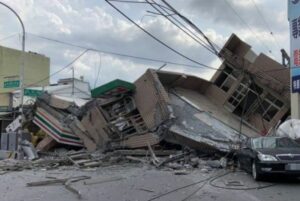
6.9-magnitude quake hits Taiwan; Three-storey building collapsed

Sep 18 (IANS):A 6.9-magnitude earthquake hit eastern Taiwan’s Hualien County at 2:44 p.m. Sunday Beijing Time, according to the China Earthquake Networks Center (CENC).

The epicenter was monitored at 23.15 degrees north latitude and 121.30 degrees east longitude, at a depth of 10 km, Xinhua news agency reported quoting the CENC.

Strong tremor was felt across the island. A three-storey building in Hualien, whose ground floor was a convenience store, collapsed, trapping some people, according to local media.

Earthquake/Ians

A train carriage was turned over by a fallen rain shed in a railway station in Hualien, but all passengers left safe. A bridge fracture left two people injured. The rescue work is underway, according to local media.