

NASA’s Voyager 1 has achieved a remarkable milestone in space exploration, becoming the first human-made object to reach a distance of one light-day from Earth, approximately 25.9 billion kilometres. The spacecraft crossed the historic threshold on November 18, 2026, at 2:16 a.m. Pacific Standard Time, more than 49 years after its launch on September 5, 1977.
The milestone was confirmed on November 19 when a radio signal from Voyager 1 reached NASA’s Jet Propulsion Laboratory (JPL) in California after travelling through space for 24 hours.
However, the celebration comes amid a fresh technical challenge. NASA has confirmed that Voyager 1 has not returned science or engineering data since November 14, although its radio carrier signal remains detectable. Engineers are investigating the interruption.
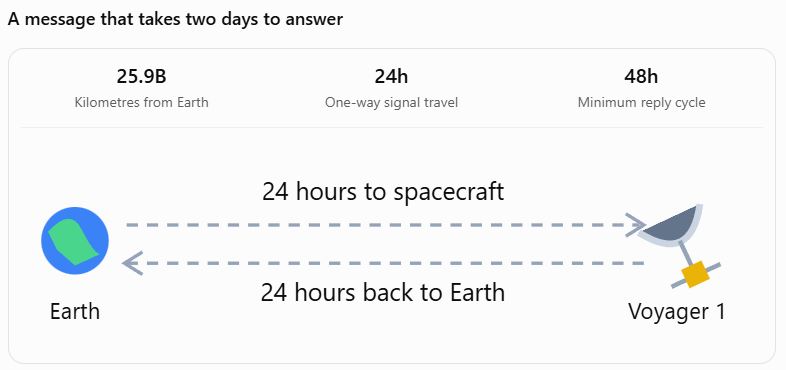

The distance introduces an extraordinary complication for mission controllers. A command transmitted from Earth now takes a full day to reach Voyager 1. Even if the spacecraft responds immediately, its reply requires another 24 hours to return. Consequently, engineers must wait at least 48 hours to determine whether an instruction has worked.
This makes diagnosing technical problems considerably more difficult than with spacecraft operating closer to Earth. Voyager project manager Suzanne Dodd said NASA continues to monitor the spacecraft daily and transmit commands weekly, despite the enormous communication delay
Voyager 1 completed historic encounters with Jupiter in 1979 and Saturn in 1980, returning valuable photographs and scientific observations that transformed understanding of the outer planets.
In 1990, the spacecraft captured the celebrated Pale Blue Dot photograph, showing Earth as a tiny point of light against the vastness of space. In August 2012, Voyager 1 became the first spacecraft to enter interstellar space after crossing the heliopause, the boundary where the Sun’s solar wind gives way to the surrounding interstellar environment.
Its twin spacecraft, Voyager 2, followed in 2018. Although both spacecraft have crossed the heliopause, they have not yet travelled beyond the distant Oort Cloud.
NASA investigates fresh data transmission failure
The most significant development accompanying the milestone is the loss of scientific and engineering telemetry. According to NASA, the problem was first identified on November 14 when a Deep Space Network antenna in Canberra, Australia, detected Voyager 1’s carrier signal but received no accompanying data. The carrier signal indicates that the spacecraft remains oriented towards Earth and that essential radio transmission equipment is functioning.
However, the absence of telemetry suggests a possible problem involving the onboard computer responsible for collecting and formatting information from the spacecraft’s instruments and systems. NASA has not established the precise cause. A similar malfunction occurred in 2023, when Voyager 1 continued transmitting a signal but stopped delivering usable data. Engineers eventually traced that problem to an onboard computer.
The agency is also examining whether the latest interruption is connected to a separate communications outage in October 2026, when contact with the spacecraft was lost for approximately 48 hours before recovering. NASA says resolving the current issue could take weeks or longer because of the immense communication delays. Despite these challenges, Voyager 1 remains an important scientific platform for studying conditions beyond the Sun’s protective magnetic influence.
Voyager 1 also carries a Golden Record containing sounds, images, music and greetings representing life on Earth. Designed as a message for any civilisation that might someday encounter the spacecraft, the record symbolises humanity’s curiosity about the universe. Even after Voyager 1 eventually loses the ability to communicate with Earth, it will continue travelling through interstellar space.
The one-light-day milestone is therefore more than a distance record. It reflects nearly half a century of scientific achievement, technological endurance and human ambition. As NASA approaches the mission’s 50th anniversary in 2027, Voyager 1 remains a powerful reminder that exploration can continue far beyond the limits originally imagined by its creators.