From ruins to rebuilding: Three Jamaican mothers face the future after hurricane

Three women in Jamaica whose lives were upended by the destructive force of a hurricane which battered the Caribbean island are looking to rebuild their future. 

Right before Hurricane Melissa swept across Jamaica in late October 2025, Rose* took her two children to a friend’s sturdy concrete home to keep them safe. When they returned the next morning, everything had vanished.

“The house was gone,” she said. “I didn’t even see the roof, just a piece of lumber.”

A school serves a temporary shelter for people whose lives were upended by Hurricane Melissa.

Entire neighbourhoods were reduced to splinters by the hurricane which left 36 per cent of houses in the western part of the country either damaged or destroyed.

Schools became shelters overnight, turning classrooms into temporary homes. Roads disappeared under water, power outages spread, and thousands were cut off for days. 

Nearly half a million people were left in precarious living conditions, facing profound uncertainty.

Among them are Rose, Sharon, and Sonia – three mothers whose lives changed overnight.

‘I have a key but no house’

For nine years, Rose lived in her small wooden home, a donated structure that had become her family’s refuge. 

Now, only the foundation remains. “I have a key to the house but no house,” she said. The air reeked of mud and decay. Nothing could be saved.
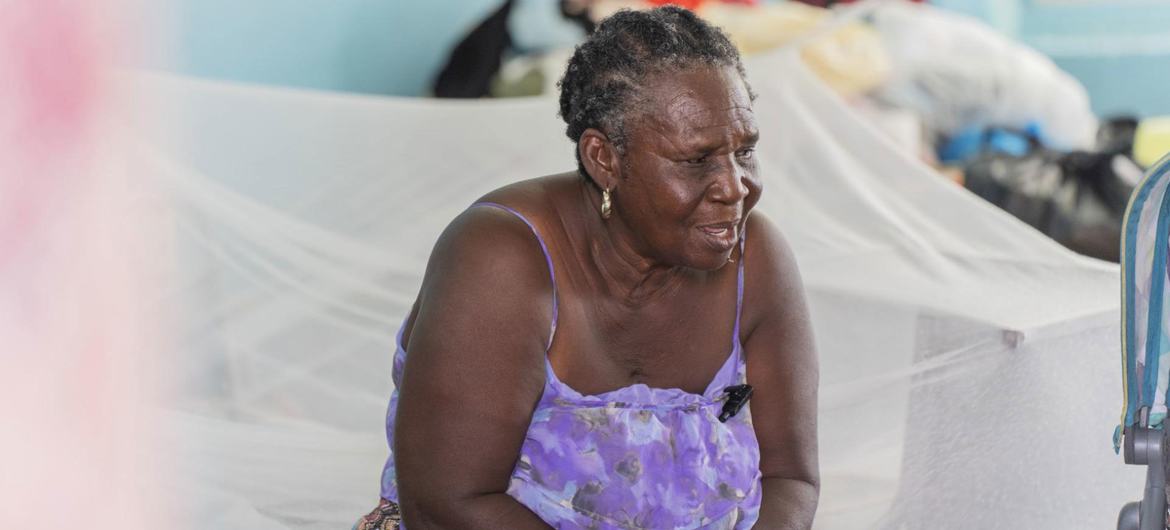
Sonia sits on a bed at a shelter for people who lost their homes due to Hurricane Melissa.

Before the storm, Rose worked as a cruise dispatcher in Negril, and her son as a hotel photographer. Both lost their jobs when the tourism industry shut down.

A few classrooms away, Sharon* faces a similar struggle. She arrived at the shelter with her two small children the same day her home, and her father’s collapsed. 

Before the storm, she worked as a gas station supervisor, now her workplace is closed indefinitely. Her children sleep on desks in the sweltering heat.

Between the rows of desks and makeshift beds, families share what little they have: a meal, a blanket, a few words of comfort. Amid loss, small acts of kindness create fragile connections.

Living in limbo 

More than 1,100 people remain in 88 shelters in Jamaica, and over 120,000 households need urgent repairs after Melissa’s destruction. 

Among them is Sonia*, who fled her coastal home carrying her grandson with a heart condition. 

“I can’t swim, so I grabbed him and ran,” she recalled.

Since the start of the emergency, the International Organization for Migration (IOM) teams have supported the Government of Jamaica and the wider UN response, delivering tarpaulins, shelter repair materials, hygiene kits, generators, and other essentials to families whose homes were damaged or destroyed.

For women like Rose, Sharon, and Sonia, each day is a test of endurance and solidarity. Their homes are gone, but the support of their communities helps them move forward. 

Their lives, once far apart, are now linked by loss, uncertainty, and the slow process of rebuilding.

*Names changed to protect identities


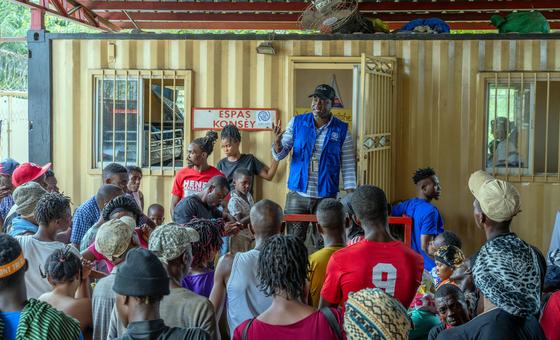
UN warns of rising deportations of Haitian mothers and newborns from Dominican Republic

According to the UN migration agency, IOM, recent weeks have seen an increase in the deportation of women, including those who are pregnant or breastfeeding, as well as children and newborn babies. 

The agency has emphasised the heightened risks these groups face being returned to Haiti, where access to basic services remains severely limited.

On Tuesday alone, IOM staff at the Belladère border crossing in Haiti received 416 deportees, including 11 pregnant women and 16 women who are still breastfeeding.

Meeting the needs

“While IOM teams are not present during the deportation process itself, their efforts focus on the needs of deportees upon arrival, many of whom arrive in precarious and highly vulnerable conditions, often without any resources,” said UN Spokesperson Stéphane Dujarric, speaking in New York.

He explained that IOM provides immediate humanitarian assistance, including food, water, and hygiene kits, as well as first aid, medical referrals, and psychosocial support.

Special attention is given to maternal health, and temporary places to live are arranged for women who are breastfeeding when necessary, he added.

Worsening conditions

Mr. Dujarric also updated on the situation in Haiti, where rising violence and recent funding cuts are undermining essential services and worsening the humanitarian situation, particularly in the Centre Department.

Escalating violence on the part of armed groups has triggered mass displacement, with more than 51,000 people, over half of them children, fleeing recent attacks. Many are now stranded at makeshift sites or seeking safety in other regions. 

No safety inside hospitals

He noted that the University Hospital of Mirebalais – a major referral facility with about 300 beds – has suspended operations following a wave of insecurity in the area. 

“Armed attacks, a mass prison break and the destruction of public infrastructure forced the hospital to gradually shut down. Before its closure, it served nearly 850 patients each day, including through maternal care and advanced cancer treatment,” he said.

Meanwhile, two other hospitals in the area – St. Therese in Hinche and Albert Schweitzer Hospital in Artibonite – are now coming under increased strain and face critical shortages, including oxygen and emergency medical kits. 

Since the closure of the University Hospital in Mirebalais, they have treated more than 200 patients for gunshot wounds, strokes, suspected cholera and malnutrition. 

“St. Therese alone has received more than 3,500 internally displaced people – tripling its outpatient caseload,” Mr. Dujarric said.

The UN Children’s Fund (UNICEF) and humanitarian partners are working to relieve pressure on the health system in Centre Department.

Mobile clinics are being deployed to reach 30,000 people in host communities and displacement camps, in coordination with the Haitian authorities and the Catholic charity Caritas.

Humanitarians are seeking $908 million to support nearly four million people in Haiti this year. Only six per cent of the funding, $57 million, has been received to date

Source link

How the mother’s mood influences her baby’s ability to speak

Up to 70 percent of mothers develop postnatal depressive mood, also known as baby blues, after their baby is born. Analyses show that this can also affect the development of the children themselves and their speech. Until now, however, it was unclear exactly how this impairment manifests itself in early language development in infants.

In a study, scientists at the Max Planck Institute for Human Cognitive and Brain Sciences in Leipzig have now investigated how well babies can distinguish speech sounds from one another depending on their mother’s mood. This ability is considered an important prerequisite for the further steps towards a well-developed language. If sounds can be distinguished from one another, individual words can also be distinguished from one another. It became clear that if mothers indicate a more negative mood two months after birth, their children show on average a less mature processing of speech sounds at the age of six months.

The infants found it particularly difficult to distinguish between syllable-pitches. Specifically, they showed that the development of their so-called Mismatch Response was delayed than in those whose mothers were in a more positive mood. This Mismatch Response in turn serves as a measure of how well someone can separate sounds from one another. If this development towards a pronounced mismatch reaction is delayed, this is considered an indication of an increased risk of suffering from a speech disorder later in life.

“We suspect that the affected mothers use less infant-directed-speech,” explains Gesa Schaadt, postdoc at MPI CBS, professor of development in childhood and adolescence at FU Berlin and first author of the study, which has now appeared in the journal JAMA Network Open. “They probably use less pitch variation when directing speech to their infants.” This also leads to a more limited perception of different pitches in the children, she said. This perception, in turn, is considered a prerequisite for further language development.

The results show how important it is that parents use infant-directed speech for the further language development of their children. Infant-directed speech that varies greatly in pitch, emphasizes certain parts of words more clearly – and thus focuses the little ones’ attention on what is being said – is considered appropriate for children. Mothers, in turn, who suffer from depressive mood, often use more monotonous, less infant-directed speech. “To ensure the proper development of young children, appropriate support is also needed for mothers who suffer from mild upsets that often do not yet require treatment,” Schaadt says. That doesn’t necessarily have to be organized intervention measures. “Sometimes it just takes the fathers to be more involved.”

The researchers investigated these relationships with the help of 46 mothers who reported different moods after giving birth. Their moods were measured using a standardized questionnaire typically used to diagnose postnatal upset. They also used electroencephalography (EEG), which helps to measure how well babies can distinguish speech sounds from one another. The so-called Mismatch Response is used for this purpose, in which a specific EEG signal shows how well the brain processes and distinguishes between different speech sounds. The researchers recorded this reaction in the babies at the ages of two and six months while they were presented with various syllables such as “ba,” “ga” and “bu.

Also Read:

Evidence that babies react to taste, smell in the womb; Carrot for “laughter-face” response, kale for “cry-face” response: Study

Fish oil, vitamin D supplements during pregnancy lower risk of croup in babies

A scientific recipe that helps babies stop crying, calm down and sleep in bed

A scientific recipe that helps babies stop crying, calm down and sleep in bed

New research published in Current Biology on September 13 demonstrates the importance of carrying crying infants rather than simply holding them. Led by Kumi Kuroda at the RIKEN Center for Brain Science (CBS) in Japan, the study details how crying babies are physiologically affected by being held, carried, and laid down. The data yield a simple but cost-free and effective technique that increases the chance of getting a crying infant to calm down and sleep in bed.

Most parents know the occasional frustration and discomfort of dealing with a crying baby. For some, it’s a regular occurrence that affects the baby’s ability to sleep and stresses out the parents. What can you do in this situation? Kuroda and her team found a “Transport Response” in distressed mouse pups and human babies in which infants calm down when carried by their mothers. The response is a complex series of parallel biological processes that result in reduced crying and lower heart rates, which helps parents to transport the infants.

Based on the ‘Transport response’ in which distressed animals calm down when carried, the behavioral and physiological data in this study showed that when babies are crying a lot, walking for about 5 minutes, following by sitting for about 8 minutes should help calm them down and put them to sleep. Note, sitting and holding a crying baby never calmed them down and heart rates rose. Putting babies to sleep immediately after walking often led to higher heart rates and woke babies up./photo:RIKEN


The new study used a baby ECG machine and video cameras to systematically compare changes in heart-rate and behavior as mothers acted out activities that are commonly used to calm infants, including carrying, being pushed in a stroller, and holding while sitting. Data during these activities were recorded from babies that were crying, awake and calm, or sleeping. At each heartbeat, behavior was assessed as asleep, alert, or crying, and scored accordingly. This way the researchers could track changes in both behavior and physiology with sub-second precision.

The experiment led to a few important findings. First, as Kuroda explains, “walking for five minutes promoted sleep, but only for crying infants. Surprisingly, this effect was absent when babies were already calm beforehand.” Among the babies studied, all had stopped crying by the end of the five-minute walk and had reduced heart rates, and about half were asleep. Second, sitting and holding crying babies was not calming; heart rates tended to go up and crying persisted.

The heartbeat measure allowed the researchers to dissect the effect of each micro-activity as infants were handled. The researchers found that the babies were extremely sensitive to all movements by their mothers. For example, heartrates went up when mothers turned or when they stopped walking. The most significant event that disturbed the sleeping infants happened just when they became separated from their mothers.

infant-small child

Every mother has experienced the disappointment of having a finally sleeping baby wake up again after being put down. The researchers pinpointed the problem using the heartbeat data. “Although we did not predict it,” says Kuroda, “the key parameter for successful laydown of sleeping infants was the latency from sleep onset.” Babies often woke up if they were put down before they got about 8 minutes of sleep. Thus, based on the data, Kuroda recommends that when babies are crying too much and can’t sleep, mothers should carry them steadily for about 5 minutes with few abrupt movements, followed by about 8 minutes of sitting before laying them down for sleep.

Although this procedure does not address why some babies cry excessively and cannot sleep, it offers an immediate solution that can help parents of newborns. Additionally, the researchers recognize the usefulness of heartrate data in this age of wearable fitness devices. “We are developing a “baby-tech” wearable device with which parents can see the physiological states of their babies on their smartphoness in real-time,” says Kuroda. “Like science-based fitness training, we can do science-based parenting with these advances, and hopefully help babies to sleep and reduce parental stress caused by excessive infant crying.”