
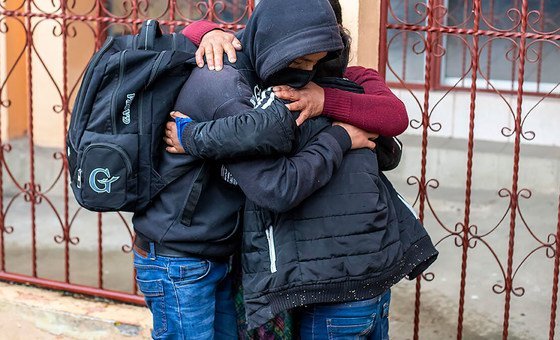
US deportations raise serious human rights concerns

His Office, OHCHR, has received information that over 100 Venezuelan deportees are being detained at a notorious prison in El Salvador. 

OHCHR said 142,000 people were deported from the US between 20 January and 29 April, according to official data.

Harsh treatment in detention

In particular, the fate and whereabouts of at least 245 Venezuelans and some 30 Salvadorans sent to El Salvador remain unclear. 

Many were deported under the US Alien Enemies Act as alleged members of criminal groups and have reportedly been detained at the Centre for Terrorism Confinement (CECOT) in the Central American country.

Detainees at the maximum-security prison are treated particularly harshly, without access to legal counsel or family members and have no contact with the outside world.

Serious rights concerns

OHCHR has received information from family members and lawyers regarding more than 100 Venezuelans believed to be held in CECOT. 

The reports indicate that many were not informed of the US Government’s intention to deport them to be detained in a third country.  

Furthermore, many had no access to a lawyer and were unable to challenge the lawfulness of their removal before being flown out.

“This situation raises serious concerns regarding a wide array of rights that are fundamental to both US and international law,” Mr. Türk said.

They include the rights to due process, protection from arbitrary detention, equality before the law, and protection from exposure to torture or other irreparable harm in other States.

Families feel powerless

Neither the US or Salvadoran authorities have published official lists of the detainees, and their legal status in El Salvador remains unclear. 

Many family members interviewed by OHCHR voiced deep distress at not knowing where, and in what circumstances, their loved ones are being held. Some only became aware when they recognized their relatives from videos on social media of them in or being taken to CECOT. 

“Families we have spoken to have expressed a sense of complete powerlessness in the face of what has happened and their pain at seeing their relatives labelled and handled as violent criminals, even terrorists, without any court judgment as to validity of what is claimed against them,” said Mr. Türk.

“The manner in which some of the individuals were detained and deported – including the use of shackles on them – as well as the demeaning rhetoric used against migrants, has also been profoundly disturbing,” he added.

The High Commissioner welcomed the essential role that the US judiciary, legal community and civil society are playing to ensure the protection of human rights in this situation.

“I have called on the US Government to take the necessary measures to ensure compliance with due process, to give prompt and full effect to the determinations of its courts, to safeguard the rights of children, and to stop the removal of any individual to any country where there is a real risk of torture or other irreparable harm,” he said. 
Source link

UN warns of rising deportations of Haitian mothers and newborns from Dominican Republic

According to the UN migration agency, IOM, recent weeks have seen an increase in the deportation of women, including those who are pregnant or breastfeeding, as well as children and newborn babies. 

The agency has emphasised the heightened risks these groups face being returned to Haiti, where access to basic services remains severely limited.

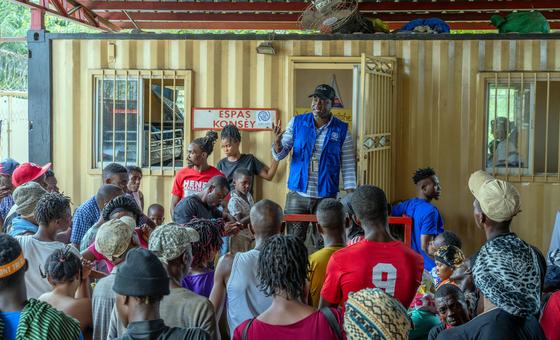
On Tuesday alone, IOM staff at the Belladère border crossing in Haiti received 416 deportees, including 11 pregnant women and 16 women who are still breastfeeding.

Meeting the needs

“While IOM teams are not present during the deportation process itself, their efforts focus on the needs of deportees upon arrival, many of whom arrive in precarious and highly vulnerable conditions, often without any resources,” said UN Spokesperson Stéphane Dujarric, speaking in New York.

He explained that IOM provides immediate humanitarian assistance, including food, water, and hygiene kits, as well as first aid, medical referrals, and psychosocial support.

Special attention is given to maternal health, and temporary places to live are arranged for women who are breastfeeding when necessary, he added.

Worsening conditions

Mr. Dujarric also updated on the situation in Haiti, where rising violence and recent funding cuts are undermining essential services and worsening the humanitarian situation, particularly in the Centre Department.

Escalating violence on the part of armed groups has triggered mass displacement, with more than 51,000 people, over half of them children, fleeing recent attacks. Many are now stranded at makeshift sites or seeking safety in other regions. 

No safety inside hospitals

He noted that the University Hospital of Mirebalais – a major referral facility with about 300 beds – has suspended operations following a wave of insecurity in the area. 

“Armed attacks, a mass prison break and the destruction of public infrastructure forced the hospital to gradually shut down. Before its closure, it served nearly 850 patients each day, including through maternal care and advanced cancer treatment,” he said.

Meanwhile, two other hospitals in the area – St. Therese in Hinche and Albert Schweitzer Hospital in Artibonite – are now coming under increased strain and face critical shortages, including oxygen and emergency medical kits. 

Since the closure of the University Hospital in Mirebalais, they have treated more than 200 patients for gunshot wounds, strokes, suspected cholera and malnutrition. 

“St. Therese alone has received more than 3,500 internally displaced people – tripling its outpatient caseload,” Mr. Dujarric said.

The UN Children’s Fund (UNICEF) and humanitarian partners are working to relieve pressure on the health system in Centre Department.

Mobile clinics are being deployed to reach 30,000 people in host communities and displacement camps, in coordination with the Haitian authorities and the Catholic charity Caritas.

Humanitarians are seeking $908 million to support nearly four million people in Haiti this year. Only six per cent of the funding, $57 million, has been received to date

Source link