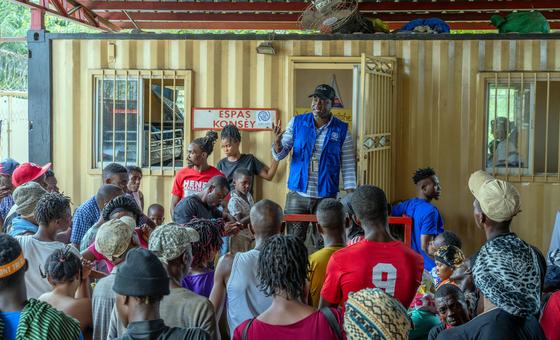
Desks become beds as Haitian school shelters people displaced by violence

The classrooms at Anténor Firmin school in Hinche in central Haiti are no longer studiously quiet.

Once a place of learning, it now echoes with the sounds of babies crying, water containers clanking, and voices murmuring through the night.

Over 700 people displaced by violence are crammed into the crumbling compound, sleeping on floors where children once solved math problems.

Among them is Edens Désir, a former teacher, who continues to believe that education should be the key to a more prosperous and peaceful future for this beleaguered Caribbean Island nation.

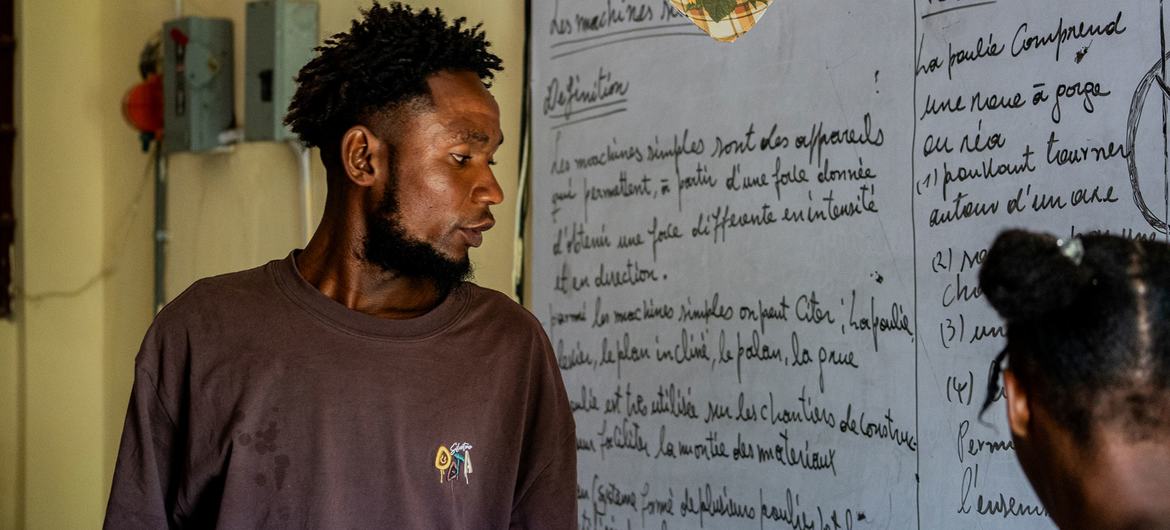
Edens Désir teaches a class at Anténor Firmin school.

A trained accountant and former secondary-school teacher, his life was upended by the violent clashes that erupted in March 2025 in Saut-d’Eau and Mirebalais, two small towns south of Hinche.

Like 6,000 others, he fled massacres, rape, arson, and looting.

“Everything I built, little by little, was destroyed,” he said. “I walked away with nothing.”

Warring gangs have long controlled most of the Haitian capital, Port-au-Prince, some 30 miles (48 km) away.

It is only recently that their sphere of influence has moved to more the more rural areas of Centre department where, Hinche and Saut-d’Eau are located.

Edens Désir, found refuge in the school where he once studied, a place now stripped of its purpose. Desks have become beds. Classrooms have turned into shelters. Families lie packed into rooms never meant to house them.
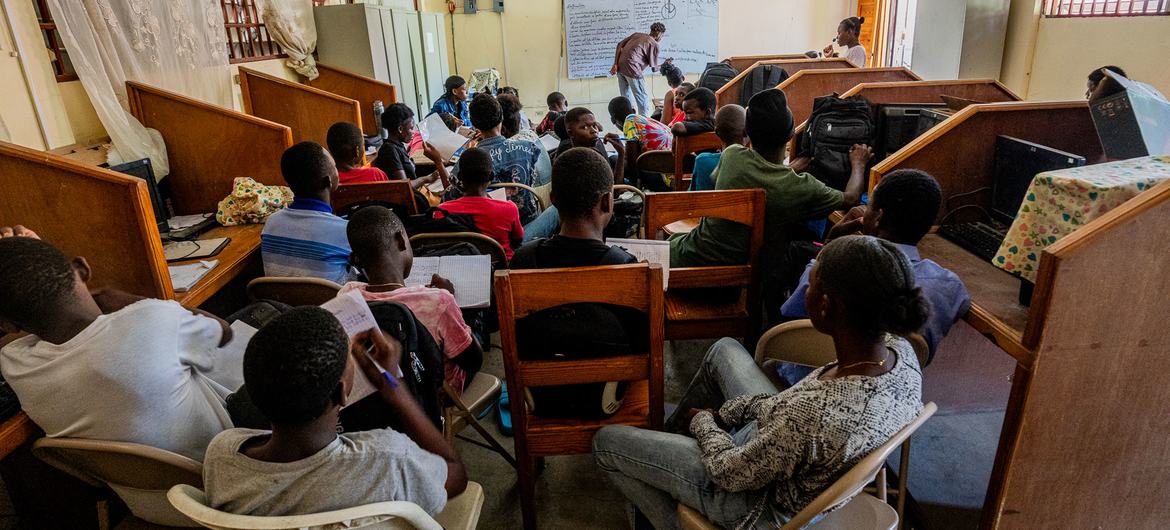
A classroom at Anténor Firmin school in Hinche now serves as both a shelter and an informal learning space for displaced children.

Even in these crowded rooms, he found a way to start over. Not for himself, but for the children around him. With a whiteboard, a marker, and quiet determination, he has brought a sense of purpose to lives that have been thrown off course.

“Ever since I was a kid, I loved teaching,” he explained. “It’s what matters most to me. I’d rather be in front of a class than sitting around doing nothing. For these kids, school is the only real chance they’ve got.”

Living in limbo

Once on the verge of expanding a small business, Mr. Désir now lives in limbo. “That plan is gone. Violence made sure of it. My only option now is to leave and try to start over somewhere else. But as long as I’m here, I will keep sharing what I know.”

These days, he takes life one day at a time. “I can’t make plans anymore,” he said. “Each day, I just figure things out as they come. Each night, I wonder if there will be food tomorrow.”

Clean water is scarce. Long queues stretch at distribution points, where women and children wait patiently, balancing heavy containers.

Hygiene conditions are dire. With few latrines and showers available, hundreds are left without privacy or sanitation. The health risks are growing, especially for the most vulnerable.

Food is just as uncertain. “There are nights I go to sleep without eating,” he says. “But I keep teaching because the kids are here.”
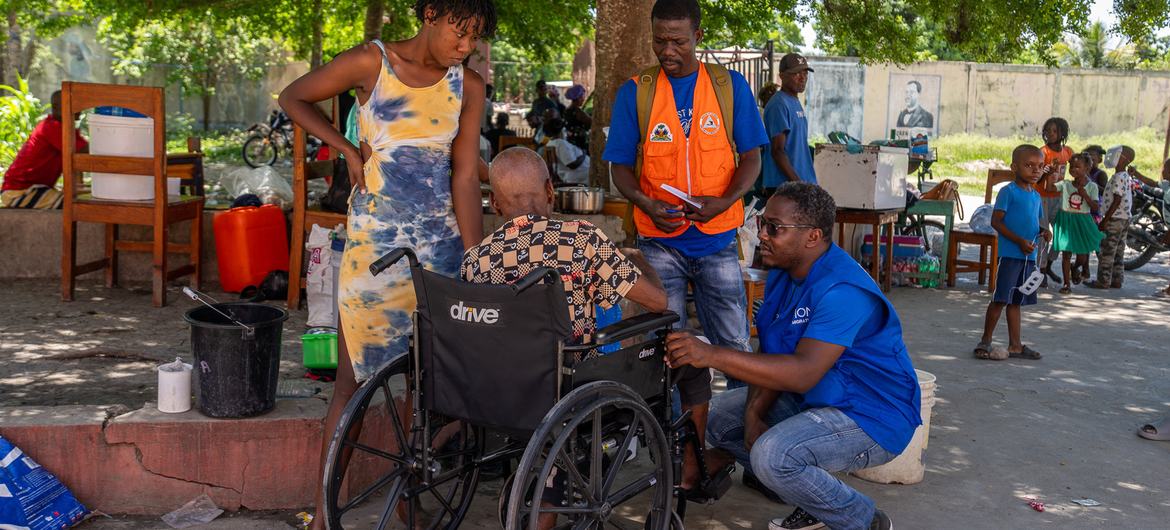
IOM staff and a civil protection agent asses the needs of displaced people

Delivering aid to the displaced is no easy task. The main road between Port-au-Prince and Hinche remains blocked by insecurity, cutting off supply routes and isolating entire communities.

Despite the hurdles, the UN’s International Organization for Migration (IOM) has reached over 800 families across 17 displacement sites, providing emergency items such as shelter kits, blankets, kitchen sets, and jerrycans.

IOM teams continue working directly with displaced families, host communities, and local authorities to assess needs and provide relief.

Site committees and civil protection teams are being trained to better manage the shelters. The most fragile sites are being relocated to safer areas and mental health support is offered to those affected by the violence.

Protect the vulnerable

These efforts aim to protect the most vulnerable, especially children, from a crisis they did not choose but are now forced to navigate.

Edens Désir believes that knowledge is the best defence against dehumanization. When violence tears everything apart, forcing children into displacement, splitting families, and cutting off access to education, teaching becomes an act of resistance.

Even when the days feel heavy, he keeps showing up for the children who still believe in him.

“If we want things to change, we need people who grow into better citizens,” he said. “I don’t know if what I’m doing is enough to make that happen, but it gives me purpose. It breaks my heart to know that one day I’ll have to leave them behind and look for a better future.”

Source link

Haitian capital ‘paralysed and isolated’ by gang violence, Security Council hears

 Since January, the UN Integrated Office in Haiti (BINUH), recorded over 4,000 individuals deliberately killed – a 24 per cent increase compared to the same period in 2024.  

The capital city was for all intents and purposes paralysed by gangs and isolated due to the ongoing suspension of international commercial flights into the international airport,” Miroslav Jenča, Assistant Secretary-General for the Americas at the department of political affairs (DPPA), told ambassadors in the Security Council on Wednesday.

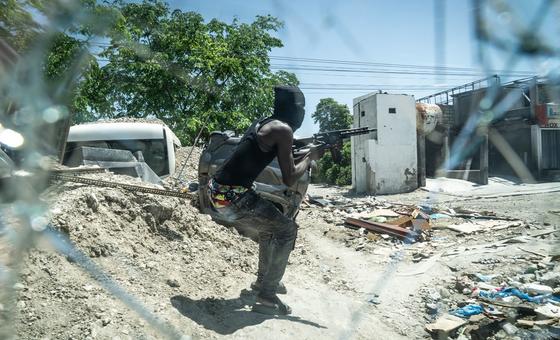
Having visited the country recently, he warned that, gangs have only “strengthened their foothold”, which now affects all communes of the Port-au-Prince metropolitan area and beyond, “pushing the situation closer to the brink.”

He called on the international community to act decisively and urgently or the “total collapse of state presence in the capital could become a very real scenario”.

Gang control expands

Ghada Fathi Waly, Executive Director of the UN Office on Drugs and Crime (UNODC), echoed that warning.

“As gang control expands, the state’s capacity to govern is rapidly shrinking, with social, economic and security implications,” she told ambassadors, briefing remotely from Vienna.

“This erosion of state legitimacy has cascading effects,” she said, with legal commerce becoming paralysed as gangs control major trade routes, such conditions worsening “already dire levels of food insecurity and humanitarian need,” she added.  

Rise of ‘vigilante’ groups

Amidst increasing public frustration with the limited protection capacity of the state, “vigilante” or self-defence groups are now gaining in popular appeal.  

Although some are motivated by the urgent need to protect their communities, many operate outside existing legal frameworks, in some cases, engaging in extrajudicial actions and colluding with gangs.  

The rise of these actors is pushing demand for guns and military-grade weapons, “fuelling illicit arms markets and raising the risk of licit weapons being diverted to criminal elements,” Ms. Waly said.  

Human trafficking

Meanwhile, the broader deterioration of the security and economic situation in the capital and the rest of the country continues to fuel a sharper escalation in human rights violations.  

Despite persistent under-reporting of sexual violence due to fear of reprisals, social stigma and lack of trust in institutions, BINUH reported an increase in sexual violence committed by gangs in the past three months.  

In May, Haitian police raided a medical facility in Pétion-Ville suspected of being involved in illicit organ trade, as allegations of trafficking in persons for the purpose of organ removal are now arising.  

As the situation in Haiti remains desperate, “there is not a moment to lose,” Mr. Jenča urged. 

Source link

UN warns of rising deportations of Haitian mothers and newborns from Dominican Republic

According to the UN migration agency, IOM, recent weeks have seen an increase in the deportation of women, including those who are pregnant or breastfeeding, as well as children and newborn babies. 

The agency has emphasised the heightened risks these groups face being returned to Haiti, where access to basic services remains severely limited.

On Tuesday alone, IOM staff at the Belladère border crossing in Haiti received 416 deportees, including 11 pregnant women and 16 women who are still breastfeeding.

Meeting the needs

“While IOM teams are not present during the deportation process itself, their efforts focus on the needs of deportees upon arrival, many of whom arrive in precarious and highly vulnerable conditions, often without any resources,” said UN Spokesperson Stéphane Dujarric, speaking in New York.

He explained that IOM provides immediate humanitarian assistance, including food, water, and hygiene kits, as well as first aid, medical referrals, and psychosocial support.

Special attention is given to maternal health, and temporary places to live are arranged for women who are breastfeeding when necessary, he added.

Worsening conditions

Mr. Dujarric also updated on the situation in Haiti, where rising violence and recent funding cuts are undermining essential services and worsening the humanitarian situation, particularly in the Centre Department.

Escalating violence on the part of armed groups has triggered mass displacement, with more than 51,000 people, over half of them children, fleeing recent attacks. Many are now stranded at makeshift sites or seeking safety in other regions. 

No safety inside hospitals

He noted that the University Hospital of Mirebalais – a major referral facility with about 300 beds – has suspended operations following a wave of insecurity in the area. 

“Armed attacks, a mass prison break and the destruction of public infrastructure forced the hospital to gradually shut down. Before its closure, it served nearly 850 patients each day, including through maternal care and advanced cancer treatment,” he said.

Meanwhile, two other hospitals in the area – St. Therese in Hinche and Albert Schweitzer Hospital in Artibonite – are now coming under increased strain and face critical shortages, including oxygen and emergency medical kits. 

Since the closure of the University Hospital in Mirebalais, they have treated more than 200 patients for gunshot wounds, strokes, suspected cholera and malnutrition. 

“St. Therese alone has received more than 3,500 internally displaced people – tripling its outpatient caseload,” Mr. Dujarric said.

The UN Children’s Fund (UNICEF) and humanitarian partners are working to relieve pressure on the health system in Centre Department.

Mobile clinics are being deployed to reach 30,000 people in host communities and displacement camps, in coordination with the Haitian authorities and the Catholic charity Caritas.

Humanitarians are seeking $908 million to support nearly four million people in Haiti this year. Only six per cent of the funding, $57 million, has been received to date

Source link