
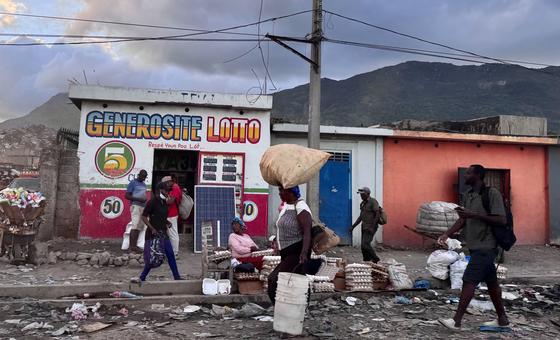
Limited access restored to Syria’s Al Hol camp amid security concerns

Briefing reporters in New York, Farhan Haq said the UN refugee agency, UNHCR, was able to access the camp on Friday together with Syrian Government officials and establish contact with some residents. Essential supplies have also resumed.

Al Hol is one of the region’s largest displacement sites, housing tens of thousands of people, mostly women and children, many with alleged family links to ISIL terrorist fighters.

UN agencies have long warned of dire humanitarian conditions there, including overcrowding, poor access to healthcare, water and sanitation, and persistent protection and security risks, while repeatedly urging durable solutions, including safe returns, reintegration and repatriation in line with international law.

“Trucks carrying bread entered the camp today, facilitated by UNHCR, following a three-day interruption caused by the volatile security situation inside the camp,” Mr. Haq said, adding that water trucks reached the camp on Thursday, helping to partially restore access to basic services for the camp population.

Al Hol camp, located in Syria’s northeast, hosts tens of thousands of people, including internally displaced Syrians and family members of suspected former fighters.

UN agencies have long warned that insecurity, overcrowding and limited services leave residents – many of them women and children – in extremely vulnerable conditions.

UN agencies and aid partners reaffirmed their commitment to supporting the Syrian authorities in delivering humanitarian assistance, while underscoring the critical need to ensure security inside the camp.

They also highlighted the importance of facilitating the movement of personnel and supplies between Al-Hasakeh and Qamishli.

Concerns in Aleppo

Beyond Al Hol, the situation in Kobani, in Aleppo Governorate, remains concerning.

According to the UN relief coordination office, OCHA, all roads connecting to the city are currently closed, while disruptions to electricity, water and internet services are hampering access to basic needs.

Partners have begun reporting shortages of food, essential items and medicines, although health facilities remain operational, Mr. Haq said.

Source link

Human Rights Council hears concerns over displacement, genocide risks and migrant trafficking

Of the record 83 million people internally displaced worldwide, at least 1.2 million were displaced by crime-related violence in 2024 – more than double the 2023 figure – amid a global decline in support for international norms, human rights and the rule of law.

The growing reach of organised crime in driving displacement and rights violations was the focus of a report delivered Monday morning by the Special Rapporteur on the human rights of internally displaced persons, Paula Gaviria Betancur.

Driving displacement

As violent conflicts worsen globally, displacement is increasingly driven by the threat of violence or the desire of criminal groups to control territory, resources and illicit economies.

Additionally, in places like Sudan, Palestine and the Democratic Republic of the Congo (DRC), occupying powers and criminal groups are systematically uprooting communities to alter demographics, treating IDPs as military targets.

“Displacement is no longer just a consequence of conflict – it is increasingly its deliberate objective,” Ms. Betancur warned.

In these regions, either the State enables impunity for violent groups or national security operations worsen the crisis by punishing victims and fuelling further displacement, eroding state legitimacy.

IDPs in these contexts “face grave violations of their human rights,” including “murder, violent assault, kidnapping, forced labour, child recruitment and sexual exploitation,” she said.

The rise in global displacement is the result of systemic failure – the failure of States and the international community to tackle its root causes,” Ms. Betancur concluded, calling for stronger support for the UN and accountability for criminal groups.

Genocide risks in conflict areas

Virginia Gamba, Special Adviser on the Prevention of Genocide, briefed the council on escalating risks in Sudan, Gaza, the DRC and beyond during Monday’s session.

In Sudan, where over 10.5 million have been displaced since fighting erupted in April 2023, both the Sudanese Armed Forces and the Rapid Support Forces (RSF) are committing grave rights violations.

Ethnically motivated attacks by the RSF in certain regions mean “the risk of genocide, war crimes and crimes against humanity in Sudan remains very high,” Ms. Gamba underscored.

Turning to Gaza, she called the scale of civilian suffering and destruction “staggering and unacceptable,” noting the conflict has also fuelled rising antisemitism and Islamophobia worldwide.

Hate speech fuelling violence

As attacks on civilians and ethnic violence continue in the DRC, hate speech and discrimination have surged.

But this surge is also occurring worldwide, further exacerbating the risk of genocide.

“Hate speech – which has been a precursor for genocide in the past – is present in far too many situations, often targeting the most vulnerable,” said Ms. Gamba, highlighting refugees, Indigenous peoples and religious minorities.

For genocide prevention, she urged greater efforts to monitor hate speech, expand education efforts, and strengthen partnerships with regional organizations.

The task of preventing genocide remains critical and urgent—the moment to act is now,” she stressed.

Trafficking of migrant domestic workers

Special Rapporteur on trafficking in persons, Siobhán Mullally, presented her report on the trafficking risks faced by migrant domestic workers.

“The specific nature of domestic work, and weak regulatory responses by States, produce a structural vulnerability to exploitation,” Ms. Mullally said.

The crisis disproportionately affects women, as they make up the majority of domestic workers and 61 per cent of trafficking victims detected globally in 2022.

Conditions of domestic work

Many women from disadvantaged communities are promised jobs abroad, but upon arrival, realise they have been conned. They endure violence, labour abuses and sexual exploitation but are unable to pay the exorbitant penalty for terminating their work contracts.

Ms. Mullally cited the legacy of slavery, gendered and racialised views of domestic work and intersecting discrimination as key factors behind poor conditions and trafficking risks.

Most States lack the political will to enforce labour laws in the domestic work sector, reinforcing this crisis, she said, calling for stronger labour laws, safe migration pathways, bilateral agreements grounded in human rights and an end to the criminalisation of trafficking victims.
Source link

US deportations raise serious human rights concerns

His Office, OHCHR, has received information that over 100 Venezuelan deportees are being detained at a notorious prison in El Salvador. 

OHCHR said 142,000 people were deported from the US between 20 January and 29 April, according to official data.

Harsh treatment in detention

In particular, the fate and whereabouts of at least 245 Venezuelans and some 30 Salvadorans sent to El Salvador remain unclear. 

Many were deported under the US Alien Enemies Act as alleged members of criminal groups and have reportedly been detained at the Centre for Terrorism Confinement (CECOT) in the Central American country.

Detainees at the maximum-security prison are treated particularly harshly, without access to legal counsel or family members and have no contact with the outside world.

Serious rights concerns

OHCHR has received information from family members and lawyers regarding more than 100 Venezuelans believed to be held in CECOT. 

The reports indicate that many were not informed of the US Government’s intention to deport them to be detained in a third country.  

Furthermore, many had no access to a lawyer and were unable to challenge the lawfulness of their removal before being flown out.

“This situation raises serious concerns regarding a wide array of rights that are fundamental to both US and international law,” Mr. Türk said.

They include the rights to due process, protection from arbitrary detention, equality before the law, and protection from exposure to torture or other irreparable harm in other States.

Families feel powerless

Neither the US or Salvadoran authorities have published official lists of the detainees, and their legal status in El Salvador remains unclear. 

Many family members interviewed by OHCHR voiced deep distress at not knowing where, and in what circumstances, their loved ones are being held. Some only became aware when they recognized their relatives from videos on social media of them in or being taken to CECOT. 

“Families we have spoken to have expressed a sense of complete powerlessness in the face of what has happened and their pain at seeing their relatives labelled and handled as violent criminals, even terrorists, without any court judgment as to validity of what is claimed against them,” said Mr. Türk.

“The manner in which some of the individuals were detained and deported – including the use of shackles on them – as well as the demeaning rhetoric used against migrants, has also been profoundly disturbing,” he added.

The High Commissioner welcomed the essential role that the US judiciary, legal community and civil society are playing to ensure the protection of human rights in this situation.

“I have called on the US Government to take the necessary measures to ensure compliance with due process, to give prompt and full effect to the determinations of its courts, to safeguard the rights of children, and to stop the removal of any individual to any country where there is a real risk of torture or other irreparable harm,” he said. 

Source link