Limited access restored to Syria’s Al Hol camp amid security concerns

Briefing reporters in New York, Farhan Haq said the UN refugee agency, UNHCR, was able to access the camp on Friday together with Syrian Government officials and establish contact with some residents. Essential supplies have also resumed.

Al Hol is one of the region’s largest displacement sites, housing tens of thousands of people, mostly women and children, many with alleged family links to ISIL terrorist fighters.

UN agencies have long warned of dire humanitarian conditions there, including overcrowding, poor access to healthcare, water and sanitation, and persistent protection and security risks, while repeatedly urging durable solutions, including safe returns, reintegration and repatriation in line with international law.

“Trucks carrying bread entered the camp today, facilitated by UNHCR, following a three-day interruption caused by the volatile security situation inside the camp,” Mr. Haq said, adding that water trucks reached the camp on Thursday, helping to partially restore access to basic services for the camp population.

Al Hol camp, located in Syria’s northeast, hosts tens of thousands of people, including internally displaced Syrians and family members of suspected former fighters.

UN agencies have long warned that insecurity, overcrowding and limited services leave residents – many of them women and children – in extremely vulnerable conditions.

UN agencies and aid partners reaffirmed their commitment to supporting the Syrian authorities in delivering humanitarian assistance, while underscoring the critical need to ensure security inside the camp.

They also highlighted the importance of facilitating the movement of personnel and supplies between Al-Hasakeh and Qamishli.

Concerns in Aleppo

Beyond Al Hol, the situation in Kobani, in Aleppo Governorate, remains concerning.

According to the UN relief coordination office, OCHA, all roads connecting to the city are currently closed, while disruptions to electricity, water and internet services are hampering access to basic needs.

Partners have begun reporting shortages of food, essential items and medicines, although health facilities remain operational, Mr. Haq said.

Source link

First Person: Echoes of war as aid arrives in Syria’s historical city

Eleonora Servino was on the first UN aid convoy to Suweida, which saw a recent escalation of violence that left many dead and thousands displaced.

As the International Organization for Migration (IOM) chief of mission to Syria, Ms. Servino said the difference on the road to Bosra is stark.

“You know that feeling when you visit somewhere as a tourist, how the memories embed themselves in your mind? Happy, peaceful places filled with stunning sights, delicious food, warm smiles and a relaxed mood. That’s how I remember Bosra, Syria, 20 years ago.

©UNESCO/Véronique Dauge

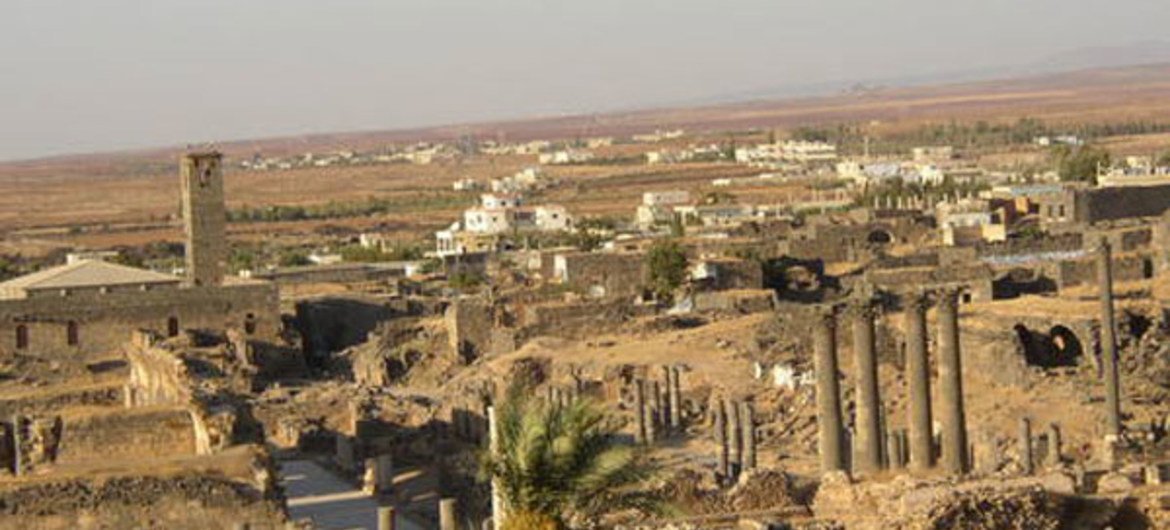
The ancient city of Bosra, Syria, a UNESCO World Heritage site, in 2015. (file)

Rivals ancient Italian relics

I went to see its ancient Roman theatre, a [UN Educational, Scientific and Cultural Organization] UNESCO World Heritage site. I recall the perfectly preserved brickwork in the tunnels leading to the stage, the intricate carvings.

Everything rivalled, even surpassed, the monuments in my native Italy. I felt at home, with a shared history. 

Recently, I returned for very different reasons.
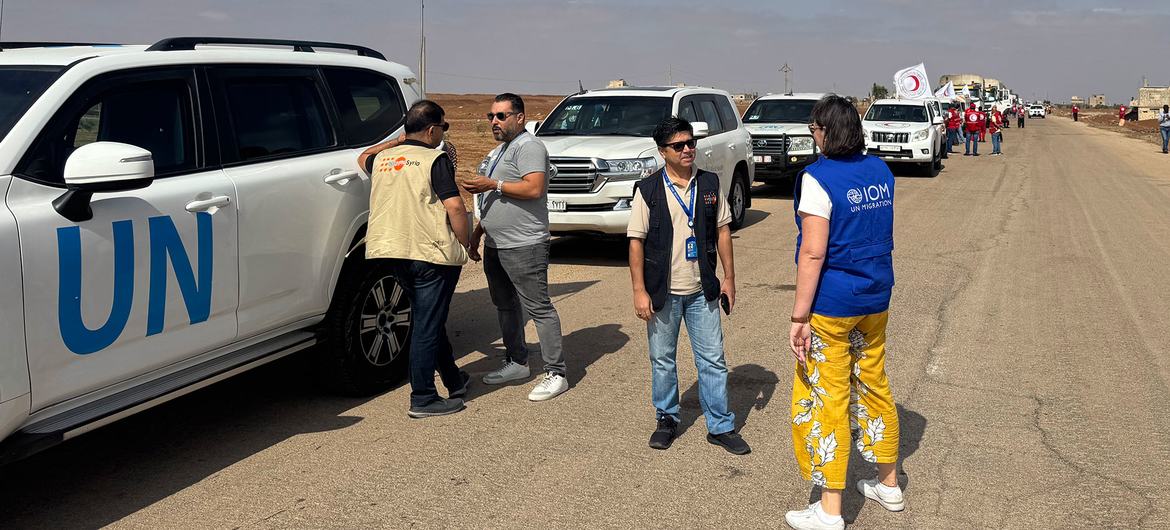
IOM chief of mission to Syria Eleonora Servino (right) on the first UN aid convoy to the city of Sweida.

Tourists long gone

Syria has endured 14 years of brutal civil war, displacing millions. The tourists are long gone. But now, with the war over and stability slowly returning, people are coming back. My organisation, IOM, has just been officially allowed to resume operations. One of my first acts as chief of mission ad interim was to take the road back to Bosra.

It’s the only route to As-Sweida governorate, which recently experienced weeks of violence, leaving many dead and over 168,000 displaced.

I was part of the first UN assessment mission. With support from OCHA [UN humanitarian agency] and the Syrian Arab Red Crescent, the convoy delivered 40 truckloads of aid from various agencies and organizations.
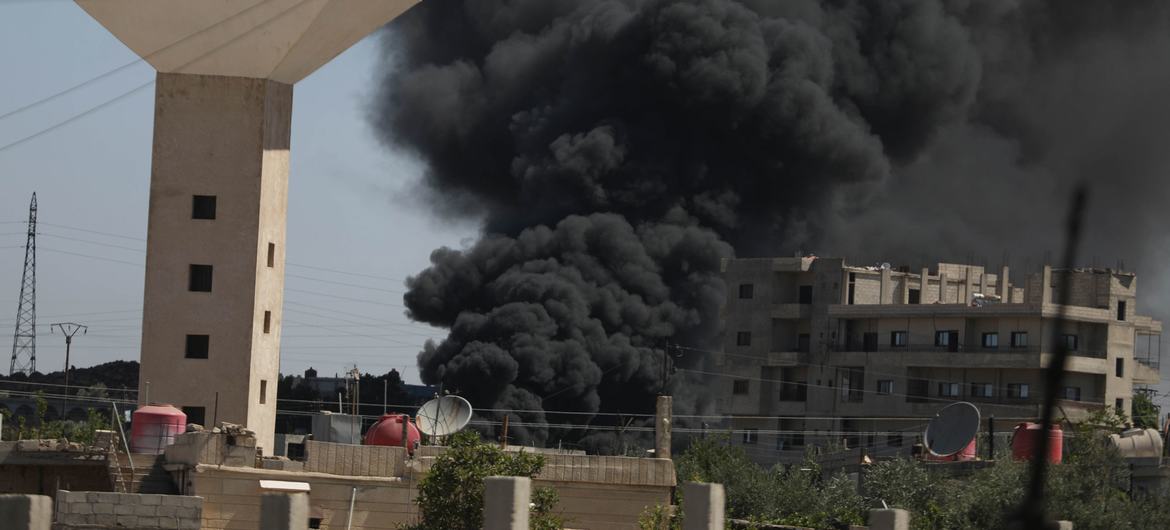
© UNOCHA/Ali Haj Suleiman

Hostilities erupt in Sweida in July 2025. (file)

‘Signs of violence everywhere’

Signs of violence were everywhere. The streets were eerily quiet in Sweida. No traffic. None of the hustle and bustle you’d expect in a city that once had a population of over 70,000.

Burnt out buildings, wrecked cars and a pervading sense of tension dominated the landscape. 

We visited three areas where internally displaced people have found shelter, either within host communities or in communal centres. People have opened their homes to those forced to flee. But, the lack of electricity, water, and the blocked main road are straining resources, making everything more difficult despite the goodwill and humanitarian spirit of ordinary citizens.

‘People are still in shock’

The need for humanitarian assistance is clear, from what we saw and what we heard. People are still in shock. We spoke to individuals who have lost so much: homes, families, possessions, livelihoods.

Our DTM (displacement tracking matrix) teams are on the ground conducting regular surveys. The needs are basic yet essential: food, cash, hygiene items, clothing, cooking sets, fuel and shelter materials.

We are a vital part of humanitarian community, advocating for and supporting those displaced by the conflict. We will continue working to keep access open and improve it, ensuring people get what they need.”

Source link

Security Council voices deep concern over deadly escalation in Syria’s Sweida region

Unrest began on 12 July when mutual kidnappings escalated into armed conflict between Druze groups and Bedouin tribes, drawing in Syrian security forces.

The violence spiralled, with reports of extrajudicial executions, desecration of corpses and looting. Footage circulated widely on social media fanned sectarian tensions and disinformation.

Nearly 200,000 displaced

In a presidential statement adopted on Sunday, ambassadors said they were “deeply concerned” by the recent fighting, which has included “mass killings” and led to the internal displacement of some 192,000 people.

The Council “strongly condemns the violence perpetrated against civilians…and calls on all parties to adhere to the ceasefire arrangement and to ensure the protection of the civilian population.”

The 15-member body reminded all sides of their obligations under human rights and international humanitarian law, stressing in particular the duty to “respect and protect” all medical and humanitarian personnel.

Council members urged all parties to allow “full, safe, rapid and unhindered humanitarian access” to affected communities in the heavily-Druze Sweida area and across Syria, in line with the principles of humanity, neutrality, impartiality and independence.

They also underscored the need to ensure the humane treatment of all combatants, including those who have surrendered, are wounded, detained, or have laid down their arms.

Protection for all

The statement called on the Syrian interim authorities to protect all Syrians “regardless of ethnicity or religion” and warned that “there can be no meaningful recovery in Syria without genuine safety and protection for all Syrians.”

The Council welcomed the interim authorities’ condemnation of the violence and their commitment to investigate those responsible, but urged them to ensure “credible, swift, transparent, impartial, and comprehensive investigations… in line with international standards.”

Reaffirming resolutions including 2254 (2015), the Council reiterated its “strong commitment to the sovereignty, independence, unity, and territorial integrity of the Syrian Arab Republic” and called on all States to avoid “negative or destructive interference” that could further destabilise the country.

The statement also recalled the 1974 Disengagement Agreement and the mandate of the UN Disengagement Observer Force (UNDOF) tmonitoring and patrolling the contested Golan on the Syria-Israel border, urging all parties to abide by its terms to maintain calm.

On the threat of terrorism, the Council cited the latest report of its Analytical Support and Sanctions Monitoring Team, voicing “grave concern over the acute threat posed by foreign terrorist fighters” in Syria. It urged the country to take decisive measures against ISIL (Da’esh) and Al-Qaida, in line with relevant resolutions.

Looking ahead, the Council repeated its call for “an inclusive, Syrian-led and Syrian-owned political process” based on resolution 2254, to safeguard the rights of all Syrians and enable them to “peacefully, independently and democratically determine their futures.”

Source link

World News in Brief: First UN mission to Syria’s Sweida, fresh displacement in Haiti, new lightning record

The team went to Sweida City, as well as two districts – Shahba and Salkhad – where they met with local community representatives and partners, in addition to visiting displacement sites and reception centres. 

Members also conducted assessments in the three districts of the governorate, where hundreds of people have been killed, and some 175,000 people displaced, in recent sectarian violence amid Syria’s ongoing political transition since the fall of the Assad regime last December.

A senior UN official told the Security Council earlier this week that a fragile ceasefire is “largely holding”.

More aid delivered

OCHA said a fifth humanitarian aid convoy organized by the Syrian Arab Red Crescent also arrived in Sweida on Thursday. It was the largest so far, with 40 trucks.

The convoy, which included UN assistance, delivered medical supplies, flour, fuel, canned goods, hygiene kits and shelter materials, among other assistance. 

On Wednesday, the Syrian Arab Red Crescent also delivered four tankers carrying more than 120,000 litres of fuel.

Haiti: Armed groups expand activities

Armed groups in Haiti are expanding their presence and activities in the Artibonite region which has sparked waves of displacement, according to OCHA. 

Last Monday, violence linked to armed groups flared in the town of Liancourt, where a vehicle and several homes were set on fire. This followed a week of violent clashes.

As of 19 July, nearly 15,000 people have been displaced across four communes in Artibonite. They are staying with host families, many of whom were already finding it hard to meet basic needs.

OCHA said response efforts are underway, led by local humanitarian partners. They have distributed hygiene kits to more than 500 displaced households and host communities, as well as hundreds of hot meals.

2017 lightning flash in US Great Plains sets new world record

A lightning flash in a notorious storm hotspot in the United States nearly a decade ago has been certified as the longest on record, the World Meteorological Organization (WMO) announced on Thursday.

The megaflash – an incredible 829 kilometres long (515 miles) – occurred during a major storm in the Great Plains in October 2017 and was some 61 kilometres greater than the previous record, also set in the same region.

It extended from eastern Texas to near Kansas City, equivalent to the distance between Paris and Venice in Europe: a journey that would take roughly eight to nine hours by car, or at least 90 minutes by plane.

Value of early warning systems 

The flash was not identified in the original 2017 analysis of the storm but was discovered through re-examination. 

WMO’s Committee on Weather and Climate Extremes recognized the new record with the help of the latest satellite technologies and the findings were published in the Bulletin of the American Meteorological Society.

“Lightning is a source of wonder but also a major hazard that claims many lives around the world every year and is therefore one of the priorities for the international Early Warnings for All initiative,” said WMO Secretary-General Celeste Saulo.

Launched in 2022, the initiative aims to ensure that everyone on the planet is protected from hazardous weather, water, or climate events through early warning systems by the end of 2027. 

Source link