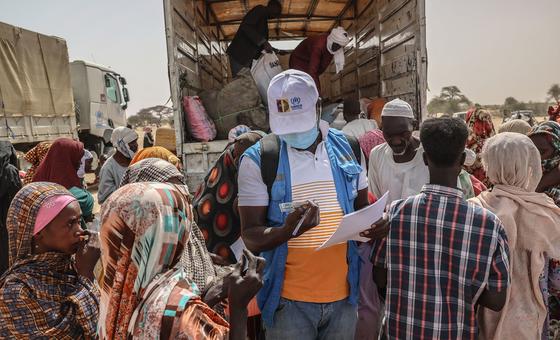
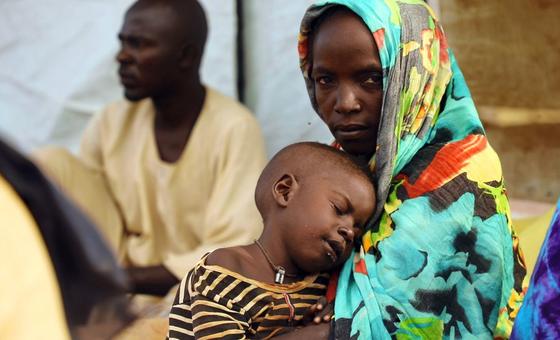
Chad: Africa’s refugee haven struggles with its own stark challenges

Here’s what you need to know:

Fighting and dire humanitarian conditions triggered by the conflict that erupted among rival militaries in Sudan in April 2023 have so far displaced 14 million people, spilling over to the country’s seven bordering neighbour nations, according to the UN.

Few places are feeling the effects of the ongoing war as acutely as Chad, which is now Africa’s largest refugee host per capita, according to the UN refugee agency, UNHCR.

“Chad’s generous welcome of refugees is a powerful act of solidarity,” said UN High Commissioner for Refugees Barham Salih

But, as landlocked Chad has welcomed more than 900,000 Sudanese refugees across its eastern border since the start of the conflict, 40 per cent of its own population already needs humanitarian assistance.

Why it matters  

Often called the “Babel Tower of the world”, reflecting its more than 200 ethnic groups and 100 languages, Chad’s challenges are multifaceted.

With over 42 per cent of the population living below poverty, the country is among the poorest in the world. 

Now hosting over 1.5 million refugees, Chad continues to keep its borders with Sudan open while also battling climate and security shocks.

Floods and food insecurity 

The word Chad translates in a local language as “large body of water,” and reflects the cultural importance of Lake Chad, which gives the country its name. 

As the lake continues to shrink due to climate change and other issues, the country has endured large floods that have devasted its food security. 

In 2024 alone, floods destroyed more than 432,000 hectares of crops, equivalent to over 600,000 football fields, affected nearly two million people and exposed gaps in water and sanitation infrastructure, with cholera outbreaks reported in July last year. 

With a rapidly growing population, Chad far exceeds its resource capacity at a time when malnutrition rates are alarmingly high.

An estimated two million Chadian children aged six to 59 months are suffering or expected to suffer acute malnutrition between October 2025 and September 2026, including nearly 484,000 children expected to suffer severe acute malnutrition, according to the global hunger monitor – the Integrated Food Security Phase Classification.

Security pressures

The security landscape is equally concerning. 

Violent extremist groups, including Boko Haram and its affiliates, have continued to drive insecurity in the Lake Chad Basin, displacing over 250,000 people

Security forces patrol in Adré in Chad.

In the north, trafficking networks and illegal coal mining overlap with gender-based violence and exploitative child labour.

With 87 per cent of the total refugee population in Chad being women and children, these concerns continue to increase. 

What the UN is doing

Since April 2023, Chad’s Government and UNHCR assisted 67 per cent of those fleeing war-torn Sudan to relocate to extended and newly established settlements, where refugees and host communities benefit from the services delivered by humanitarian teams.

UN agencies and partners continue to respond to provide humanitarian assistance, including in Chad and war-torn Sudan.

On 19 February, the UN Security Council will convene to discuss the ongoing crisis in Sudan, focusing on the need to end the fighting and alleviate suffering, particularly concerning the widespread violence against women and girls in the country.

As for needs, the UN emergency relief agency, OCHA, released its Humanitarian Action Plan 2026, which shows that the number of people in need in Chad decreased by 42 per cent, but continues to remain high.

The Action Plan calls for $986 million and aims to help 3.4 million people, including $540million dedicated to refugees alone. The UN Spokesperson, Stéphane Dujarric said on Wednesday, “We and our partners will focus our efforts on the most impacted regions including in the east, the Lake Province and parts of the south.” 

Radwa Abdelkarim, a 37-year-old mother of six, fled to Chad in June 2023 after “the war took everything.” 

“We lost our money, our relatives and neighbours,” she said. “Some were killed, others disappeared and are still missing.” 

Safely out of Sudan, Ms. Abdelkarim combined her entrepreneurial skills with cash assistance from UNHCR to start baking and selling bread from her home in Farchana refugee settlement, and has since opened two grocery stores, a restaurant, and employs 12 other refugees.

“I support [refugee women] so that we can grow together and no one is left behind,” she said. “It is important to stand with our brothers and sisters, to help them heal.”

Source link

Amid Sudan’s humanitarian crisis, Chad shows ‘act of solidarity’


That’s according to UN human rights chief Volker Türk, who had discussions with over 40 leaders of Sudanese civil society in Northern State’s capital, Dongola, this week.

“But these representatives have also found the solution,” Mr. Türk said in a video on X. “There needs to be an all-out effort, both within Sudan and by the international community to help them, to facilitate their work.”

The conflict in Sudan which erupted in 2023 between the Sudanese Armed Forces (SAF) and the armed group Rapid Support Forces (RSF) has uprooted some 9.3 million people and has brought about one of the world’s largest hunger crises.

Mr. Türk began his visit on Wednesday and is meeting with Sudanese authorities, civil society, humanitarian partners and people displaced by the conflict in Darfur and Kordofan. He will be holding two press conferences at the end of his visit on 18 January.

Chad shows ‘act of solidarity’ 

Since April 2023, more than 900,000 Sudanese refugees have arrived in eastern Chad, with new arrivals every day, the UN refugee agency (UNHCR) said on Friday.

The newly-appointed UN High Commissioner for Refugees Barham Salih visited Chad this week for the first time in this capacity, where he met with Sudanese refugee families and local authorities.

Many of the refugees he met had been displaced multiple times since the conflict began. They described years of violent attacks and human rights abuses.

“What is unfolding in Sudan is a humanitarian calamity of overwhelming scale. Chad’s generous welcome of refugees is a powerful act of solidarity,” Mr. Salih said.

From displacement to solutions 

Mr. Salih also acknowledged the host communities that have welcomed refugees despite economic hardship and environmental pressure.

He reiterated UNHCR’s readiness to work with the Government and others to facilitate economic opportunity and provide services for both refugees and the host communities.

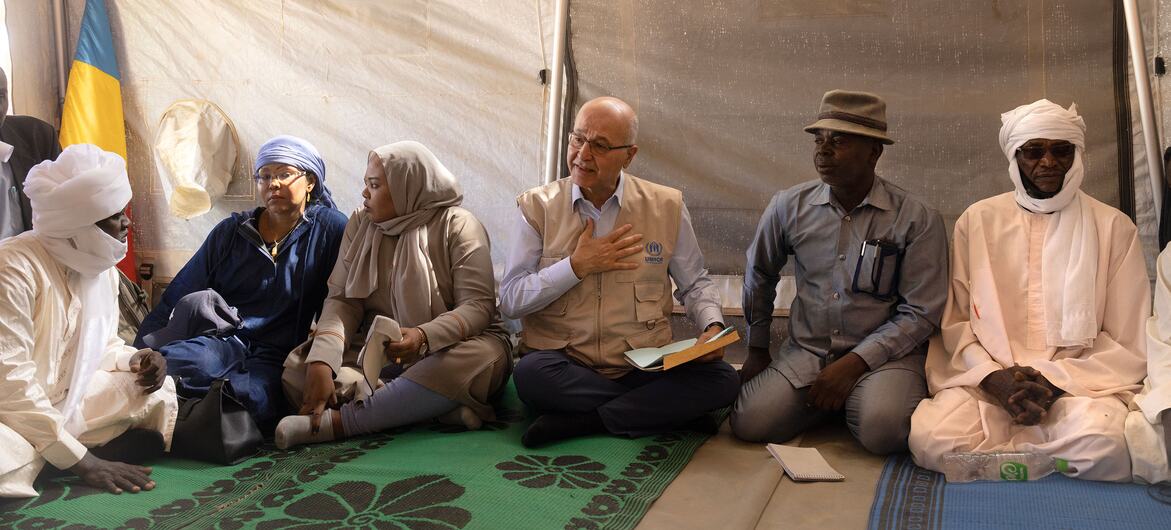
The UN Refugees chief, Barham Salih (centre), speaks with Sudanese refugees at a women’s centre in Farchana, Chad.

“Visiting Chad and Kenya this last week, both countries clearly demonstrate how, with sustained international support, inclusive policies can move us from responding to displacement emergencies towards providing solutions,” Mr. Salih emphasised.

“When refugees are protected and included, they can rebuild their lives and contribute to the societies that host them. This is what I am seeing here, and this is the direction in which we must travel.”

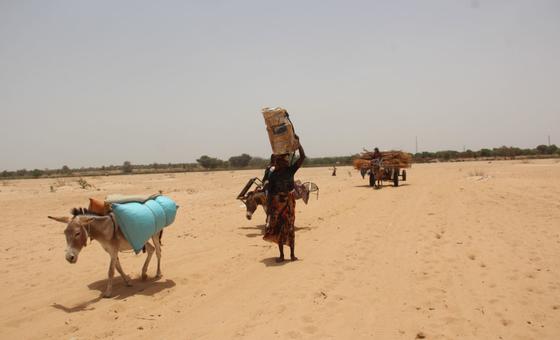
 

Bearing the brunt of war: UNICEF chief meets some of Sudan’s 700,000 child refugees crossing into Chad

In neighbouring Chad, children make up 61 per cent of the 860,000 Sudanese refugees and a staggering 68 per cent of the 274,000 Chadian returnees – that’s over 700,000 young lives uprooted by violence.

Chad, already one of the world’s poorest countries, has the fourth-highest child mortality rate in the world, despite significant progress in recent years.

The Government of Chad and humanitarian partners have been providing support, but the migration crisis remains overwhelming: measles and malnutrition are spreading, the risk of Sudan’s cholera outbreak spilling into Chad remains high.

Only one in three children are enrolled in school and essential services are stretched to the brink.

Horrific memories 

UN Children’s Fund (UNICEF) Executive Director Catherine Russell concluded a three-day visit to Chad on Monday, where she met with refugee children and families displaced by the fighting and chaos across the Sudanese border.

Hundreds of thousands of the most vulnerable children are bearing the brunt of both the war in Sudan and the lack of essential services for those who have fled to Chad,” Russell said.

In eastern Chad, Ms. Russell “met women and children who arrived with little but the horrific memories they carry” and heard their stories of killings, mass rapes and homes burned to the ground.

She visited families newly arrived in Adré, an overwhelmed border town now hosting six refugees for every resident.

Russell also met President Mahamat Idriss Déby Itno to reaffirm UNICEF’s long-term commitment to Chad and discuss support for the country’s newly launched National Development Plan 2030.

The people of Chad have shown extraordinary generosity,” she said. “But they cannot face this crisis alone. We must stand in solidarity with them – and with the children of Sudan – by strengthening national systems and communities on the frontlines.”

Ramping up response

In Adré and surrounding areas, UNICEF-supported teams have vaccinated thousands of children, provided safe drinking water to tens of thousands, established child-friendly spaces and set up services for survivors of gender-based violence.

The agency is also working closely with Chadian authorities to scale up system-wide investments in health, including polio vaccination campaigns, as well as education and social protection.

But urgent funding gaps remain. Of the $114 million required for UNICEF’s 2025 humanitarian response in Chad, only 34 per cent has been secured.

Source link

World News in Brief: Rights abuses in Haiti, Sudan war sees exodus to Chad, food trade optimism

Between 1 January and 30 May, at least 2,680 people – including 54 children – were killed, 957 injured, 316 kidnapped for ransom, and many more subjected to sexual violence and child gang recruitment.

“Alarming as they are, numbers cannot express the horrors Haitians are being forced to endure daily,” said Mr. Türk.

Conflicts on all sides

In recent months, gangs have attacked Mirebalais in the centre of the country, looting police stations, destroying property and freeing over 500 inmates from the local prison.

Meanwhile, so-called self-defence groups have targeted individuals they suspect of gang affiliation. On 20 May, at least 25 people were killed and 10 injured by a group accusing them of supporting gangs.

Law enforcement has ramped up operations against them. Since January, police have killed at least 1,448 people, including 65 during extrajudicial executions.

Mr. Türk called on the international community to take decisive action to end the violence, including renewed support for the Security Council-backed Multinational Security Support (MSS) mission and full enforcement of the council’s arms embargo.

He also reiterated his call for States to not forcibly return anyone to Haiti.  

“The coming months will be crucial and will test the international community’s ability to take stronger, more coordinated action – action that will help determine the future stability of Haiti and the wider region,” Mr. Türk added.

Outlook for food trade ‘relatively optimistic’, FAO says

The Food and Agriculture Organization (FAO) released their annual Food Outlook report Thursday which provides a “relatively optimistic” look at international food markets.  

According to the report, production is expected to increase across almost all categories, with grain production expected to reach record levels. And while prices do remain higher this year than last, between April and May there was an overall decrease of almost one per cent. 

The report noted, however, that global trends — including rising geopolitical tensions, climate shocks and trade uncertainties — may still negatively impact production.  

“While agricultural production trends appear solid, drivers that could negatively impact global food security are increasing,” said FAO Chief Economist Máximo Torero.

Fowl, fish fraud and fertilizer flows

The report noted that outbreaks of avian influenza have become more persistent and constitute “one of the most significant biological threats to the global poultry sector.” Nevertheless, poultry exports have largely remained largely resilient so far.  

The issue of fish fraud – the misrepresentation of the location or manner of the catch – was also discussed, with FAO warning that risks are growing.  

Additionally, the report examined fertilizer flows, noting Russia’s growing exports and the decrease in fertilizer prices since the COVID pandemic.  

Overall, the report noted, the cost of imports worldwide has increased by 3.6 percent or nearly $2.1 trillion.  

Eastern Chad ‘reaching a breaking point’ as Sudan war refugees continue to arrive  

Aid teams in eastern Chad warn on Friday that host communities are reaching breaking point because of climate shocks and the pressure of hosting war refugees from neighbouring Sudan.

In an alert, the UN’s top aid official in Chad, François Batalingaya, warned that a humanitarian catastrophe is unfolding almost unnoticed by the world’s media.

“Right now, nearly 300,000 people are stranded at the border, waiting to be relocated inland,” he noted.  

“Tens of thousands, mostly women and children, are sleeping in the open without shelter, clean water and health care. These are survivors of war. They arrive traumatized, hungry, and with nothing. They recount stories of mass killings, sexual violence and entire communities destroyed.” 

Major exodus

Since the outbreak of war in Sudan in April 2023, more than 850,000 Sudanese refugees have crossed into Chad. They’ve joined the 400,000 existing Sudanese refugees who have arrived over the last 15 years.

The UN aid official explained that even before the latest Sudanese arrivals, nearly one million people in eastern Chad were in urgent need of help.  

Today, “they are sharing what little they have – food, water, and space – with those fleeing the war,” Mr. Batalingaya said.

In an appeal for international assistance, he warned that clinics are overwhelmed, malnutrition is rising and basic services are buckling.  

Sudan: Rise in people fleeing to Chad as violence surges

Overall, some 1.2 million Sudanese have found shelter in eastern Chad, mostly after fleeing intensifying violence in their country. 

More than 844,000 crossed the border after war broke out in Sudan in April 2023. Prior to this, Chad was hosting roughly 409,000 Sudanese refugees who had fled earlier conflict in Darfur.

‘A crisis of humanity’

The situation is “a crisis of humanity”, said UNHCR’s Principal Situation Coordinator in Chad, Dossou Patrice Ahouansou.

The latest wave of displacement began in April following attacks by armed groups in North Darfur. Violence has surged since war erupted in Sudan in April 2023 between the Sudanese Armed Forces (SAF) and the paramilitary Rapid Support Forces (RSF).

Camps for people uprooted by the most recent violence have been attacked including Zamzam and Abu Shouk, along with the town of El Fasher, killing more than 300 civilians. 

Last Thursday, the UN World Food Programme’s facility in El Fasher was repeatedly shelled, according to a report from UN aid coordination office OCHA.

A day later, Eldaman International Hospital in Al Obeid was struck by a drone attack, killing at least six health workers and injuring more than 15 others.

Both attacks were reportedly carried out by the RSF.

Exodus and arrival

In just over a month, 68,556 refugees have crossed into Chad’s Wadi Fira and Ennedi Est provinces, at an average of 1,400 new arrivals per day.

More than seven in 10 “report serious human rights violations — physical and sexual violence, arbitrary detention, forced recruitment”, said Mr. Ahouansou.

Based on interviews with 6,810 newly arrived refugees, he said that six out of 10 reported being separated from their family members.

Horrendous testimonies

Mr. Ahouansou spoke of seven-year-old Hawa, whose family home in Zamzam was bombed. After her mother was killed, she fled to the Zamzam camp for internally displaced people. 

“There again had been bombing” and this time it killed Hawa’s father and two brothers, he said. 

With only her 18-year-old sister remaining, Hawa escaped to Chad. She was severely injured and had to have a leg amputated.

“It’s difficult to hear, but this is the reality,” said Mr. Ahouansou, emphasizing that there were thousands facing similar situations.

The UNHCR official also recounted chilling testimonies of forced labour along the perilous journeys, where many reportedly die because of the heat and lack of water.

“When armed groups see you leaving, they decide to let the donkey or the horse go. And you, as a human being, as a man… they will use you as a horse and ask you now to draw all your family members,” he said.

Funding shortfalls

Despite efforts by humanitarian actors and local authorities, the emergency response remains severely underfunded.

Just 14 per cent of shelter needs have been met and refugees receive only five litres of water per person per day — far below the 15–20 litre international standard. Around 239,000 refugees remain stranded at the border.

“The lives and futures of millions of innocent civilians hang in the balance,” said UNHCR spokesperson Eujin Byun, who stressed that this was also a “crisis of women and children” as they make up to nine out of 10 refugees crossing the border.

“Without a significant increase in funding, life-saving assistance cannot be delivered at the scale and at the speed that is required,” Mr. Ahouansou said. 

Source link

Exhausted Sudanese flee into Chad as fighting escalates

Nearly 20,000 people – mainly traumatized women and children – have reached Chad in the past two weeks, according to the UN refugee agency, UNCHR.

Most arrived in Chad with nothing – no food, money or identification,” said Magatte Guisse, UNHCR Representative in Chad. “Several wounded individuals, including children and elderly women, reportedly fell from vehicles during the chaotic escape.”

Chad is one of the poorest countries in the world and already hosts 1.3 million refugees.

This includes nearly 800,000 people from Sudan since war broke out between the Sudanese Armed Forces and paramilitary Rapid Support Forces in April 2023, after a breakdown in transition to civilian rule.  

Heavy fighting in Sudan has devastated much of the country, likely killed tens of thousands and displaced almost nine million people, UN agencies say.

No food, no money

In Chad, the Tine border crossing in Wadi Fira Province has seen the sharpest spike in new arrivals, with more than 6,000 people in just two days,

Sudanese refugees are exposed to robbery and extortion at checkpoints – and many have also witnessed men being killed, women and girls sexually abused, and homes burned to the ground.

The refugee agency reported that armed groups have extorted, robbed or sexually assaulted around 76 per cent of the newly arrived refugees.

A nation of 19 million people where resources are already strained, Chad is overstretched and needs “increased solidarity and immediate funding, to ensure these vulnerable populations receive the protection and assistance they need, now”.

Renewed attacks on Port Sudan 

In a related development, a third day of drone strikes hit the international airport and a power station in Port Sudan, the UN’s humanitarian hub for coordinating aid operations across Sudan.

The city is the current seat of government and until this weekend had been largely spared from the violence that is ongoing in Khartoum, Darfur and elsewhere. Thousands of people fleeing the war have also sought shelter in Port Sudan.

Port Sudan airport is a lifeline for humanitarian operations, serving as the primary entry point for aid personnel, medical supplies and other lifesaving relief that is coming into Sudan,” said Jens Laerke, spokesperson for the UN aid coordination office, OCHA. The airport is “immensely important”, he told journalists in Geneva.

According to reports, the Red Sea city suffered a complete power outage after drone strikes hit a large power station on Tuesday. Other strikes reportedly hit an army base in the city centre, a fuel depot and a hotel close to the airport, which is located near to the presidential palace.

These attacks have increased the “already severe” lack of aid access and delivery challenges facing humanitarian teams across the country, explained Mr. Laerke, adding that such violence is prohibited under international humanitarian law. 

It is widely believed that the paramilitary Rapid Support Forces are responsible for the attacks. No UN facilities or operations have been impacted but UN Humanitarian Air Service flights in and out of the city have been paused.

Source link