
Amid Sudan’s humanitarian crisis, Chad shows ‘act of solidarity’


That’s according to UN human rights chief Volker Türk, who had discussions with over 40 leaders of Sudanese civil society in Northern State’s capital, Dongola, this week.

“But these representatives have also found the solution,” Mr. Türk said in a video on X. “There needs to be an all-out effort, both within Sudan and by the international community to help them, to facilitate their work.”

The conflict in Sudan which erupted in 2023 between the Sudanese Armed Forces (SAF) and the armed group Rapid Support Forces (RSF) has uprooted some 9.3 million people and has brought about one of the world’s largest hunger crises.

Mr. Türk began his visit on Wednesday and is meeting with Sudanese authorities, civil society, humanitarian partners and people displaced by the conflict in Darfur and Kordofan. He will be holding two press conferences at the end of his visit on 18 January.

Chad shows ‘act of solidarity’ 

Since April 2023, more than 900,000 Sudanese refugees have arrived in eastern Chad, with new arrivals every day, the UN refugee agency (UNHCR) said on Friday.

The newly-appointed UN High Commissioner for Refugees Barham Salih visited Chad this week for the first time in this capacity, where he met with Sudanese refugee families and local authorities.

Many of the refugees he met had been displaced multiple times since the conflict began. They described years of violent attacks and human rights abuses.

“What is unfolding in Sudan is a humanitarian calamity of overwhelming scale. Chad’s generous welcome of refugees is a powerful act of solidarity,” Mr. Salih said.

From displacement to solutions 

Mr. Salih also acknowledged the host communities that have welcomed refugees despite economic hardship and environmental pressure.

He reiterated UNHCR’s readiness to work with the Government and others to facilitate economic opportunity and provide services for both refugees and the host communities.

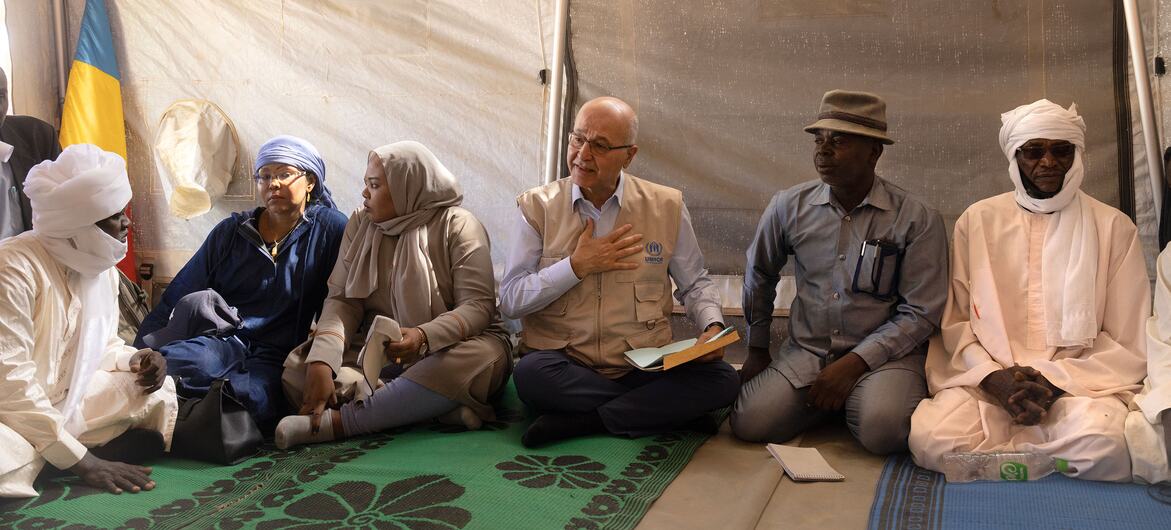
The UN Refugees chief, Barham Salih (centre), speaks with Sudanese refugees at a women’s centre in Farchana, Chad.

“Visiting Chad and Kenya this last week, both countries clearly demonstrate how, with sustained international support, inclusive policies can move us from responding to displacement emergencies towards providing solutions,” Mr. Salih emphasised.

“When refugees are protected and included, they can rebuild their lives and contribute to the societies that host them. This is what I am seeing here, and this is the direction in which we must travel.”
 

Salvaging SDGs still possible, but countries must act now: Guterres

Addressing ministers at UN Headquarters in New York, he called for urgent action to rescue lagging Sustainable Development Goals (SDGs) amid war, inequality and fiscal strain.

Transformation is not only necessary – it is possible,” he declared, highlighting landmark commitments adopted in recent months: the Pandemic Agreement at the World Health Assembly in Geneva, pledges to expand marine protected areas at the third UN Ocean Conference in Nice, and the new vision for global finance agreed in Sevilla at the fourth International Financing for Development Conference.

These are not isolated wins, they are signs of momentum and signs that multilateralism can deliver.

The remarks opened the ministerial segment of the High-level Political Forum on Sustainable Development (HLPF), the UN’s central platform for reviewing the 2030 Agenda and its 17 SDGs.

Get back on track

Mr. Guterres warned that the world remains far off track to meet the 2030 targets.

“Only 35 per cent of SDG targets are on track or making moderate progress. Nearly half are moving too slowly. And 18 per cent are going backwards,” he said.

He urged governments to act with urgency and ambition.

The Sustainable Development Goals are not a dream. They are a plan – a plan to keep our promises to the most vulnerable people, to each other, and to future generations.

Citing gains since 2015, including expanded social protection, declining child marriage and growing women’s representation, he said the SDGs remain “within reach” if world leaders channel resources and political will.

The Secretary-General also linked development and peace, noting ongoing violence in Gaza, Sudan, Myanmar, Ukraine and elsewhere.

At every step, we know sustainable peace requires sustainable development,” he said, calling for immediate ceasefires and renewed commitment to diplomacy.

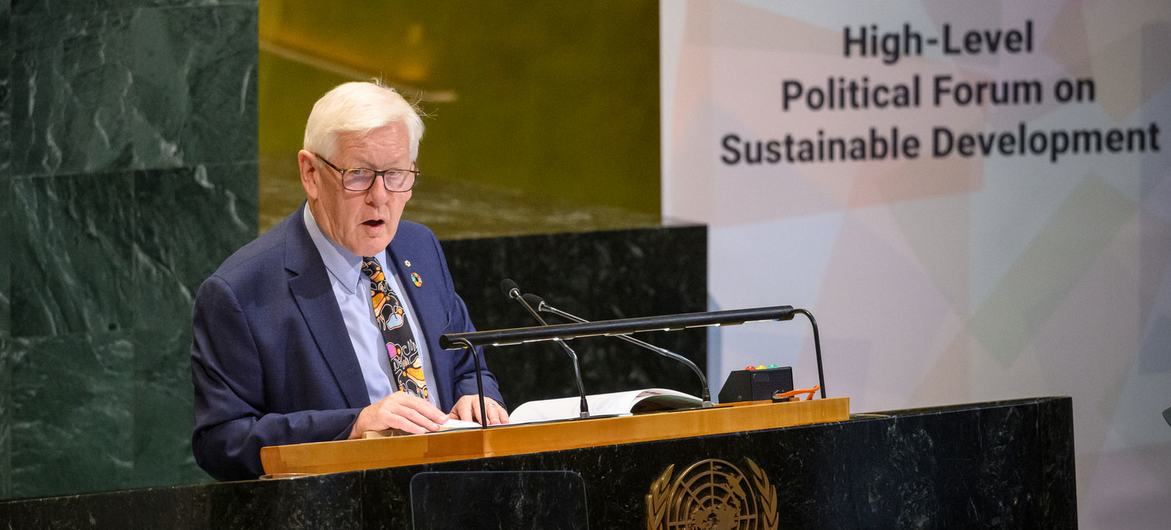
ECOSOC President Bob Rae addresses the ministerial segment of the HLPF.

Double down on multilateralism

Bob Rae, President of the Economic and Social Council, echoed the Secretary‑General’s call, warning that global disruption – from climate change to economic disarray – requires deeper solidarity.

The SDGs are not optional ideals, but rather essential commitments,” he said.

Now is not the time for us to abandon our ideals…it is now actually the time to double down on our multilateral obligations to one another.”

Mr. Rae cautioned that shrinking national budgets and rising nationalist politics are undermining progress but insisted that “multilateralism delivers real, tangible benefits for people at every level of society.”

He called for closer partnerships with civil society, local governments, and the private sector, stressing that SDGs must be “integrated into budgets and policies around the world, not as at odds, but as the core of how governments should serve their people.”

Match ambition and delivery

Philémon Yang, President of the General Assembly, emphasized aligning political commitments with concrete action.

He praised the Compromiso de Sevilla and last year’s Pact for the Future, which aim to reform global financial systems, scale up climate finance, and strengthen international tax cooperation.

The gap between ambition and delivery can only be closed through solidarity, resources and political will,” he said.

“The deadlines for the 2030 Agenda are fast approaching,” he warned. “Whether we like it or not. And while progress is lagging, we have the tools and ambition to deliver.”

Accountability and partnership

The HLPF, established at the landmark Rio+20 UN Conference on Sustainable Development in 2012, serves as the primary UN platform for monitoring SDG progress, including through Voluntary National Reviews (VNRs).

This year’s forum, convened under the auspices of the ECOSOC, runs until 23 July with a focus on five goals: health, gender equality, decent work, life below water, and global partnerships.

More than 150 countries have presented VNRs – with 36 reporting this year – showcasing national efforts and challenges in implementing the 2030 Agenda.

Mr. Guterres praised the reviews as “acts of accountability” and “templates for other countries to follow and learn from.”

With just five years left to meet the global goals, he urged ministers to “transform these sparks of transformation into a blaze of progress – for all countries.

Source link