South Sudan: ‘All the conditions for a human catastrophe are present’

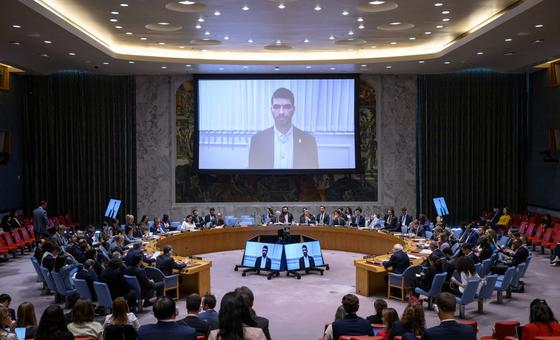
Briefing journalists based at UN Headquarters in New York on Friday, Anita Kiki Gbeho, Officer in Charge of the UN Mission in South Sudan (UNMISS), said Jonglei has become a ‘flashpoint’ for fighting, with civilians caught in the crossfire.

With over 200,000 people displaced by the conflict this month, the senior official – who also serves as Resident Coordinator – warned of a ‘sharp surge’ in cholera cases. 

Over 500 were reported nationwide this month whilst treatment centres are ‘overwhelmed’ and ‘critically short’ of supplies. 

Aid delivery difficulties

Although aid efforts are continuing with government support, access continues to be ‘severely challenged’ by road and river restrictions that are preventing aid distribution and medical evacuations. 

The world’s youngest nation gained independence in 2011 but soon slid into civil war with fighting between forces loyal to the national army under President Salva Kiir and those supporting main opposition leader Riek Machar, who is currently on trial facing serious charges, including murder, which he denies. 

Check out our explainer on the long running conflict, here.

A Government offensive got underway this week in three counties of Jonglei following opposition gains. All civilians and aid workers were urged to evacuate.

Humanitarian facilities ‘looted’ 

Ms. Gbeho told reporters that “humanitarian facilities are being looted and damaged (including at least seven [sites] in Jonglei), assets are being confiscated, and aid workers intimidated,” while the UN peacekeeping force is facing “similar challenges”. 

The disruptions to aid and peacebuilding efforts are having an “intolerable impact on people,” with the mission warning that “all the conditions for a human catastrophe are present.”

Speaking online from South Sudan, Ms. Gbeho underscored that despite the release of $10 million to support the humanitarian response from the Central Emergency Relief Fund, “more support is needed.” 

Restore peace 

Despite the shortages of supplies, Ms. Gbeho stated that the priority is “to stop the fighting, protect civilians and preserve the peace process” and to work with the African Union and the IGAD bloc of nations in the region to “restore adherence to the [2018] peace agreement.” 

Echoing the remarks of the Secretary-General on Thursday, Ms. Gbeho reiterated that “the solution to the current crisis is political, not military”, calling on the country’s leaders to take “urgent, immediate action to cease hostilities, de-escalate tensions through inclusive dialogue, and return to consensus-based decision-making”. 

‘A defining moment’

To conclude, Ms. Gbeho emphasised that “the power to make positive change rests with the South Sudanese themselves.” 

She described the juncture as “a defining moment – a critical junction for South Sudan. The decisions it makes now could either lead them on a path towards peace or to further conflict.” 

Source link

Gaza ceasefire improves aid access, but children still face deadly conditions

That’s the assessment of two senior officials from the UN Children’s Fund (UNICEF) and the World Food Programme (WFP), speaking on Monday to journalists in New York following a week-long visit to the enclave and the occupied West Bank.

The two agencies have brought more than 10,000 trucks of aid into Gaza since the 10 October truce between Israel and Hamas, representing some 80 per cent of all humanitarian cargo.

Three months later, “the food security situation has improved and famine has been reversed,” said Ted Chaiban, UNICEF Deputy Executive Director, Humanitarian Action and Supply Operations.

Carl Skau, WFP Deputy Executive Director, added that most families he met “were eating at least once a day” – sometimes twice.

Commercial goods have reappeared in Gaza’s markets, including vegetables, fruits, chicken and eggs. Recreational kits to help children heal from the stress and trauma of two years of war are now in their hands.

‘These gains matter’

UNICEF and partners have provided more than 1.6 million people with clean drinking water and distributed blankets and winter clothes to 700,000.  They have also restored essential life-saving paediatric intensive care services at embattled Al Shifa Hospital in Gaza City.

The second round of a Gaza-wide “catch-up campaign” for routine childhood vaccinations is currently underway, while another 72 UNICEF-supported nutrition facilities have been established, bringing the total to 196.

“These gains matter,” said Mr. Chaiban. “They show what is possible when the fighting pauses, political commitments are sustained and humanitarian access opens.”

Hot meals and school snacks

WFP has also scaled up massively over the past 100 days, said Mr. Skau, speaking from Rome. Teams have reached more than a million people every month with full rations for the first time since the war began.

They are “serving 400,000 hot meals every day and delivering school snacks to some 230,000 children in 250 temporary learning centres,” in addition to operating hundreds of distribution points and some 20 warehouses.

Other humanitarian organizations are bringing in tents, blankets, mattresses and other essentials thanks to WFP’s shared logistics services.

The agency is also helping to facilitate more regular aid convoys and is expanding common storage facilities so that more aid can be positioned closer to the population. It has also ramped up cash support to roughly 60,000 households.

Although more aid is entering Gaza, quantities are not yet sufficient to meet the immense needs. Furthermore, “the situation also remains extremely precarious and deadly for many children,” said Mr. Chaiban.

“More than 100 children have been reported killed in Gaza since the ceasefire of early October.    Despite the progress with food security,100,000 children remain acutely malnourished and require long term care.  1.3 million people, many of them children, are in urgent need of proper shelter.”

Families are shivering in fabric tents and bombed-out buildings amid freezing temperatures that have killed at least 10 children this winter season.

Mr. Sklau met a young woman with a 10-day-old baby who “was sitting on a wet mattress in this cold tent on the beach,” describing their plight as “just absolutely brutal.”

Hopes for a brighter future

Yet hope blossoms in the Gaza Strip. UNICEF and partners are supporting over 250,000 children to resume learning – a critical element to mental health and psychosocial support for more than 700,000 students who have been out of school for two years.

Mr. Skau recalled a conversation with young girls at a temporary learning space who “were happy to be back learning and eating more regularly,” he said.  “They could see a future again as nurses or engineers or restaurant owners, and they seemed impressively confident and determined to build a future for themselves.”

Humanitarians need essential items – such as water and sanitation provision, as well as educational supplies – to be allowed to enter Gaza which can help jump start recovery and reconstruction.

Mr. Chaiban said WFP and UNICEF are ready to scale up operations.

“The children of Gaza and the State of Palestine including the West Bank, which is also experiencing a wave of violence do not need sympathy. They need decisions now that give them warmth, safety, food, education, and a future,” he said.   “We have an opportunity, a window, to change the trajectory for these children. We can’t waste it.”

WHO sounds alarm as mental health conditions soar past one billion worldwide

Disorders such as anxiety and depression are exacting a heavy toll on individuals, families and economies, yet most countries are failing to provide adequate support.

Mental health problems are widespread across every society and age group and remain the second leading cause of long-term disability. They drive up healthcare costs for families and governments while costing the global economy an estimated $1 trillion each year in lost productivity, UN health experts said.

Way off track

The findings are detailed in two new reports: World mental health today and the Mental Health Atlas 2024.

Together, they show that while there has been some progress since 2020, the world is still far off track in tackling the scale of the crisis. The reports will help to inform debate at a UN high-level meeting on noncommunicable diseases and mental health, to be held late this month in New York.

Transforming mental health services is one of the most pressing public health challenges,” said WHO Director-General Dr Tedros Adhanom Ghebreyesus.

Investing in mental health means investing in people, communities and economies, an investment no country can afford to neglect. Every leader has a responsibility to act urgently and to ensure mental health care is treated not as a privilege, but as a basic right.”

Troubling gaps, uneven progress

The reports highlight several stark findings:

  • Women are disproportionately affected by mental health conditions, with anxiety and depression most common among both sexes.
  • Suicide claimed an estimated 727,000 lives in 2021 and is a leading cause of death among young people. On current trends, the world will fall far short of the UN target to reduce suicide deaths by a third by 2030, managing only a 12 per cent reduction.
  • Median government spending on mental health remains at just two per cent of health budgets, unchanged since 2017. While high-income countries spend up to $65 per person on mental health, low-income countries spend as little as four cents.
  • The mental health workforce is dangerously thin in many regions. There are just 13 mental health workers for every 100,000 people worldwide.
  • Fewer than one in 10 countries has fully moved to community-based care, with most still relying heavily on psychiatric hospitals. Almost half of inpatient admissions are involuntary, and more than one in five patients remain hospitalised for over a year.

Despite these challenges, there have been some positive developments. More countries are integrating mental health into primary healthcare and expanding early intervention programmes in schools and communities.

Over 80 per cent of countries now include mental health and psychosocial support in emergency response, up from less than 40 per cent in 2020. Telehealth services are also becoming more widely available, though access is still uneven.

Call for systemic change

WHO is urging governments to step up investment and reform, warning that the current pace of progress is too slow to meet global goals. Key priorities include:

  • Fairer financing of mental health services
  • Stronger legal protection and rights-based legislation
  • Greater investment in the mental health workforce
  • Accelerated shift towards community-based, person-centred care

The UN health agency stresses that mental health should be treated as a fundamental human right. Without urgent action, millions will continue to suffer without support, and societies will bear rising social and economic costs.

For more information on how the UN overall is advocating for more resources to support mental health and wellbeing, check out this story from our colleagues at www.un.org

Gaza: Security Council meets on hostage crisis amid ‘unbearable’ conditions facing Palestinian civilians

Assistant Secretary-General Miroslav Jenča briefed a Security Council meeting on Tuesday called by Israel to discuss the plight of hostages still being held in the war-ravaged enclave.

It comes after Hamas and Palestinian Islamic Jihad released images and videos of two emaciated hostages, Evaytar David and Rom Braslavsky, sparking outrage and condemnation. 

‘An affront to humanity itself’

The scenes of Evaytar apparently being forced to dig his own grave are appalling,” he said.

“These images, and their own accounts of their treatment, have horrified us all. They are an affront to humanity itself.”

Mr. Jenča acknowledged the presence of Mr. David’s brother, Ilay, who participated in the meeting via videoconference, saying the UN recognises “the profound pain and hardship endured by the families and loved ones of those who remain in captivity.”

He recalled that this week the Jewish community commemorated Tisha B’Av, a day of mourning and remembrance of tragedies endured throughout its history.

“I pay tribute to your courage and determination, and I share your dearest wish: for your brother, and all hostages held in Gaza, to be immediately and unconditionally released,” he said.

A war crime

Currently, 50 hostages continue to be held by Hamas and other Palestinian armed groups in horrific conditions and 28 are thought to be deceased, while freed hostages “have relayed distressing accounts of deprivation, ill-treatment, and abuse.”

Since the conflict began, Hamas and other armed groups have circulated dozens of videos of hostages, including statements made under duress and while clearly suffering, including the most recent footage of the two men.

“International law is clear,” said Mr. Jenča.  “Hostage-taking is prohibited – it is a war crime.”

He stressed that people deprived of their liberty must be treated humanely and with dignity and allowed to be visited by the International Committee of the Red Cross (ICRC). 

“They must never be subject to ill-treatment, abuse, or humiliation, as these would also constitute violations of relevant rules of international law,” he added, before reiterating UN Secretary-General António Guterres’s call on Hamas and other Palestinian armed groups for the immediate and unconditional release of all hostages. 

Gaza situation ‘unbearable’

Meanwhile, “the situation in Gaza is horrifying – it is unbearable,” he continued, noting that “Palestinians are subjected to squalid, inhumane conditions on a daily basis.”

More than 60,000 Palestinians have been killed since the conflict began, according to local health authorities.

Since the end of May, over 1,200 Palestinians have been killed and over 8,100 injured while trying to access food supplies, including in the vicinity of militarized aid distribution sites,” said Mr. Jenča.

“The deaths and injuries continue to mount, day by day, with no end in sight to the suffering.”

This is happening as Israel continues to severely restrict humanitarian assistance entering Gaza, while the aid that is allowed to enter “is grossly inadequate.”

‘Hunger is everywhere’

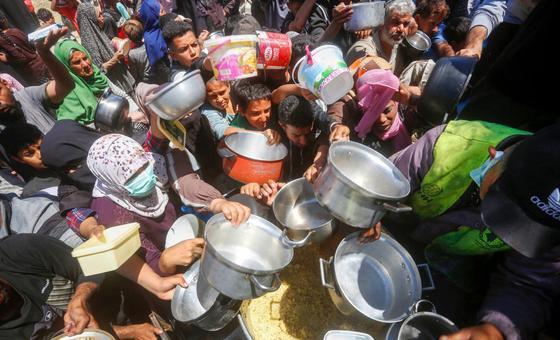
He told the Council that “hunger is everywhere in Gaza, visible in the faces of children and in the desperation of parents risking their lives to access the most basic supplies.”

Here, he echoed the Secretary-General’s condemnation of the ongoing violence in Gaza, including the shooting, killing, and injuring of people trying to get food. 

“International law is clear. Civilians must be respected, protected and never targeted or deliberately deprived of food or access to other lifesaving aid – doing so is a war crime,” he said.

“Israel must immediately allow and facilitate rapid and unimpeded passage of sufficient amounts of humanitarian relief for civilians in need, to avert further suffering and loss of life.”

Potential military expansion ‘deeply alarming’

Mr. Jenča also addressed latest reports regarding Israeli Prime Minister Benjamin Netanyahu’s possible decision to expand military operations through the entire Gaza Strip.

If true, they are “deeply alarming,” he said, as “this would risk catastrophic consequences for millions of Palestinians and could further endanger the lives of the remaining hostages in Gaza.”

He again turned to international law, which is clear that Gaza is and must remain an integral part of a future Palestinian State.

He cited the July 2024 Advisory Opinion by the International Court of Justice (ICJ) which declared that Israel is under an obligation to immediately cease all new settlement activities, evacuate all settlers from the Occupied Palestinian Territory, and to bring an end to its unlawful presence there as rapidly as possible.

No military solution

Mr. Jenča concluded his briefing by underlining the UN’s position that the only way to end the violence and humanitarian catastrophe in Gaza is through a full and permanent ceasefire, the immediate and unconditional release of all hostages and allowing aid to enter at scale and without obstruction.  

Civilians also must be guaranteed safe, unhindered access to assistance.

He stressed that there is no military solution to the conflict in Gaza or the broader Israel-Palestine conflict. 

“We must establish political and security frameworks that can relieve the humanitarian catastrophe in Gaza, start early recovery and reconstruction, address the legitimate security concerns of Israelis and Palestinians, and secure an end to Israel’s unlawful occupation and achieve a sustainable two-State solution,” he said.

This would mean “Israel and a fully independent, democratic, contiguous, viable and sovereign Palestinian State, of which Gaza is an integral part – living side by side in peace and security within secure and recognized borders, on the basis of the pre-1967 lines, with Jerusalem as the capital of both States.” 

Source link

Gaza Strip: Humanitarians warn of worsening famine conditions, attacks on civilians

Of the 154 malnutrition-related deaths since October 2023 (including 89 children) reported by Gazan health authorities, the World Health Organization (WHO) said 63 occurred in July alone.

These deaths follow a steep drop in food consumption: 81 per cent of households reported poor food consumption in July (up from 33 per cent in April), and 24 per cent experienced severe hunger (up from 4 per cent), crossing the famine threshold, according to the humanitarian update issued by the UN Office for the Coordination of Humanitarian Affairs (OCHA) on Wednesday.

Acute malnutrition rates also surpassed famine thresholds in Khan Younis, Deir al Balah and Gaza City.

Given these recent figures, IPC food security experts warned that the worst-case famine scenario is unfolding. However, they added that while the third famine threshold of starvation-related deaths is rising, collecting data remains a challenge. 

UN agencies caution that time is running out for a full-scale humanitarian response. 22 per cent of the analyzed population is facing “catastrophic” level of food insecurity, and a further 54 per cent is at “emergency” level. 

At the same time, less than 15 per cent of essential nutrition services remain functional.

Attacks on civilians

Of the over 60,000 Palestinians reported killed since October 2023, nearly 9,000 died after hostilities reignited in March, and 640 between 23 and 30 July.

Civilian casualties while seeking food are also rising, with 1,239 killed and over 8,152 injured since 27 May.

OCHA further noted that displacement figures since 18 March have surpassed 767,800, though no new evacuation orders were issued by Israeli authorities since 20 July. The 20 July order affecting a humanitarian hub in Deir al Balah has since been rescinded.

Amid ongoing displacement, overcrowding in shelters, lack of privacy and worsening hunger has elevated the risk of gender-based violence (GBV) for women and girls.  

The conditions are especially dire in southern Gaza, where there are no longer any safe shelters for GBV survivors.

Humanitarian measures

Between 23 and 29 July, only 47 per cent of 92 coordinated aid movements were fully facilitated by Israeli authorities. About 16 per cent were denied, 26 per cent impeded after initial approval and 11 per cent withdrawn by organizers.

The Israeli military announced a daily 10-hour pause in military activity, beginning 27 July, in Al Mawasi, Deir al Balah and Gaza City “to increase the scale of humanitarian aid entering Gaza.”

They also announced measures including airdrops of flour, sugar and canned food; the reconnection of the power line from Israel to the southern Gaza desalination plant; the removal of customs barriers on food, medicine, and fuel from Egypt; and the designation of secure routes for UN humanitarian convoys.

However, humanitarian partners warned that airdrops could endanger civilians, lead to unequal distribution and fall short of needs.

Working with limited funding

In addition, lack of sufficient funding is also hampering response efforts.

As of 30 July, only about 21 per cent of the $4 billion requested for the 2025 urgent humanitarian appeal for the region has been secured, leaving critical gaps. 

Source link

Gaza: Guterres condemns killing of people seeking food as humanitarian conditions deteriorate

Stéphane Dujarric was speaking to reporters at UN Headquarters in New York a day after dozens of Palestinians were killed seeking food aid.

He said the Secretary-General deplored the growing reports of both children and adults suffering from malnutrition and strongly condemned the ongoing violence, including the shooting, killing and injuring of people attempting to get food.

Not a target

Civilians must be protected and respected, and they must never be targeted,” said Mr. Dujarric, noting that the population in Gaza remains gravely undersupplied with the basic necessities of life.

He stressed that “Israel has the obligation to allow and facilitate by all the means at its disposal the humanitarian relief provided by the United Nations and other humanitarian organizations.” 

Mr. Dujarric said the Secretary-General noted that the recent intensification of hostilities comes as the humanitarian system in Gaza is being impeded, undermined and endangered.

New evacuation orders

He pointed to a new evacuation order issued for parts of Deir Al-Balah, which is pushing people into more desperate conditions and sparking further displacement, while restricting the UN’s ability to deliver aid.

He reported that two UN guesthouses in Deir Al-Balah were struck, despite the parties being informed about their locations. 

“They suffered damage,” he said, responding a reporter’s question. “The UN staff inside was, to say the least, rattled.”

Mr. Dujarric underscored that the UN intends to remain in Deir Al-Balah.

Ceasefire now

The Secretary-General reiterated his urgent call for the protection of civilians, including humanitarian personnel, and for the provision of essential resources to ensure their survival.

He once again called for the immediate and unconditional release of all hostages.

Mr. Dujarric said the UN stands ready to significantly scale up its humanitarian operations in Gaza, adding “the time for a ceasefire is now.” 

People dying from malnutrition 

Amid the ongoing shelling, displacement and destruction in Gaza, humanitarians continue to receive reports of severely malnourished people arriving at medical points and hospitals in extremely poor health. 

More than a dozen people, including children, have reportedly died from hunger in the last 24 hours, according to the Gaza health agencies. 

The UN Office for the Coordination of Humanitarian Affairs (OCHA) recalled that roughly 88 per cent of Gaza is now under displacement orders or within displacement zones. 

Shelter and fuel 

Gaza’s population is some 2.1 million and about 1.35 million need shelter and household items.  However, no shelter supplies have been allowed to enter for more than four months.   

The dire fuel crisis also continues, with humanitarians continuing to warn that the limited quantities that have been allowed to enter in recent days are hardly sufficient. 

Traditional aid systems critical: UN official 

Meanwhile the new UN Humanitarian Coordinator for the Occupied Palestinian Territory, Ramiz Alakbarov, has met with the Prime Minister of the State of Palestine, Mohammad Mustafa, in Ramallah.  

At a press conference, Dr. Alakbarov called for an immediate and permanent ceasefire, the unconditional release of the hostages, and the lifting of all restrictions on access to people in Gaza.         

He said to address immediate needs, humanitarian organizations must be able to use the traditional systems of aid delivery. 

He noted that these systems are currently undermined by violence, including armed looting and recurrent shootings at civilians seeking aid. which he said must be independently investigated.   

Gaza war: UN officials warn of unspeakable conditions as children bear the brunt

Tom Fletcher, the UN Emergency Relief Coordinator, said there was no “vocabulary” left to adequately describe conditions on the ground.

Food is running out. Those seeking it risk being shot. People are dying trying to feed their families. Field hospitals receive dead bodies, and medical workers hear stories firsthand from the injured – day after day after day,” he said.

Starvation rates among children reached their highest levels in June, with more than 5,800 girls and boys diagnosed as acutely malnourished.

“Last week, amid this hunger crisis, children and women were killed in a strike while waiting for the food supplements to keep them alive.”

UN Emergency Relief Coordinator Tom Fletcher briefs the Security Council

A classroom full of children, lost every day

UNICEF’s Executive Director Catherine Russell told ambassadors that an average of 28 children are killed in Gaza every day – “the equivalent of an entire classroom.”

Over the past 21 months, more than 17,000 children have been killed and 33,000 injured across Gaza.

Many of those children, she said, were struck “as they line up for lifesaving humanitarian aid – further proof that there is no safe place for civilians anywhere in Gaza.”

Children are not political actors. They do not start conflicts, and they are powerless to stop them. But they suffer greatly, and they wonder why the world has failed them,” she added.

“And make no mistake, we have failed them.”

Critical infrastructure collapse

Gaza’s health system “is shattered,” Mr. Fletcher reported – only 17 of 36 hospitals and 63 of 170 primary health centres are even partially functioning; shortages mean up to five babies share one incubator.

Seventy per cent of essential medicines are out of stock, half of all medical equipment is damaged, pregnant women are giving birth without care, women and girls manage their periods without basic supplies.

Meanwhile, water production capacity has plummeted leaving the entire enclave (95 per cent) facing water insecurity.

With clean water increasingly difficult to access, children have little choice but to drink contaminated water,” Ms. Russell said, noting that this is increasing the risk of disease outbreaks.

UNICEF Executive Director Catherine Russell briefs the Security Council

Aid impeded, fuel at trickle levels

Mr. Fletcher further described the scale of challenges to moving something as simple as a bag of flour into Gaza.

He noted multiple layers of approvals that Israel requires, scanning, re‑loading, multiple handoffs, damaged roads, delays at holding points, insecurity and desperate civilians grabbing supplies off trucks.

Last week – after almost 130 days – some fuel entered Gaza, as Israeli authorities agreed to allow two trucks in per day, five days a week. However, petrol – fuel for ambulances and other critical services – has not been permitted.

Between 19 May and 14 July, just 1,633 aid trucks – about 62 per cent of loads submitted for clearance – entered Gaza, far below the average of 630 daily truckloads moved during the previous ceasefire, Mr. Fletcher said.

Appeals to Israel, Hamas – and the Council

Both officials pressed for immediate, safe, sustained, demilitarised humanitarian access through all available crossings, consistent fuel flows, protection of civilians at distribution points, and restoration of the UN‑led aid pipeline that briefly functioned during earlier pauses in fighting.

They also reiterated the UN’s call for the immediate and unconditional release of all hostages held in Gaza and called on all parties – including Hamas and other armed groups – to respect international humanitarian law.

Mr. Fletcher asked the Security Council to assess whether Israel, as the occupying power, is meeting its obligations to ensure food and medical supplies reach civilians.

“We hold all parties to the standards of international law in this conflict. We don’t have to choose – and in fact, we must not choose – between demanding the end to the starvation of civilians in Gaza and demanding the unconditional release of all the hostages,” he said.

“We must reject antisemitism – we must fight it with every fibre of our DNA. But we must also hold Israel to the same principles and laws as all other States.”

First Person: Myanmar aid workers brave conflict and harsh conditions to bring aid to earthquake victims

Thein Zaw Win, Communications and Advocacy Analyst in the Yangon Office of the UN sexual and reproductive health agency (UNFPA) saw the devastating consequences of the quake during a week-long visit to the Mandalay region, one of the regions most severely affected by the disaster.

Thein Zaw Win, Communications and Advocacy Analy​st at UNFPA’s Yangon Office, speaks with​ a woman impacted by the recent earthquake in Mandalay, Myanmar.

“I was in Yangon when the earthquake struck. In the aftermath, news reports gradually began indicating that many cities had suffered significant casualties. Buildings, roads, homes, schools, and hospitals were reduced to rubble and people were trapped beneath the debris.

Communication systems were down, so I decided to travel to the affected areas and support the relief efforts.

Women and girls needed lifesaving support, including sexual and reproductive health services and maternal care, dignity kits, hygiene items, and other essential supplies as soon as possible.

Within 72 hours, the UNFPA country office had deployed a Rapid Response Team to deliver essential services to the affected population, working with partners on the ground.

The journey from Yangon to Mandalay usually takes about eight hours, but we struggled to get through, due to damaged roads and collapsed bridges. We had to find alternate routes and, at times, even navigate through the rugged fields beside the main road.

Now that the rainy season has started, the roads are even worse, and travelling has become increasingly difficult. It took us more than 10 hours to reach Mandalay.

A woman affected by earthquake receives relief items including UNFPA’s dignity kits during UN joint distribution in Sagaing, Myanmar.

In some areas of the city, debris blocked the roads. Tower blocks had collapsed and many areas had been reduced to complete rubble. Desperate families sought refuge in temporary shelters, on the streets, or in front of their damaged homes.

Tremors continued for several days. Frequent power outages during the night mean that some affected areas were plunged into darkness, making it unsafe to go anywhere. Reaching those affected and delivering aid under these conditions remains a considerable challenge.

My responsibility is to engage with communities affected by the disaster, and share their stories to a broader audience. It is also vital to raise awareness of the realities and needs on the ground so that we can secure support for emergency assistance. This is my mission.

I met a woman in Mandalay who visited our mobile clinic. She had lived in the city all her life but had never seen such devastation. Everything collapsed in a matter of seconds. She was deeply worried about the damage to healthcare facilities, as well as her ability to access medical care.

© UNOCHA/Myaa Aung Thein Kyaw

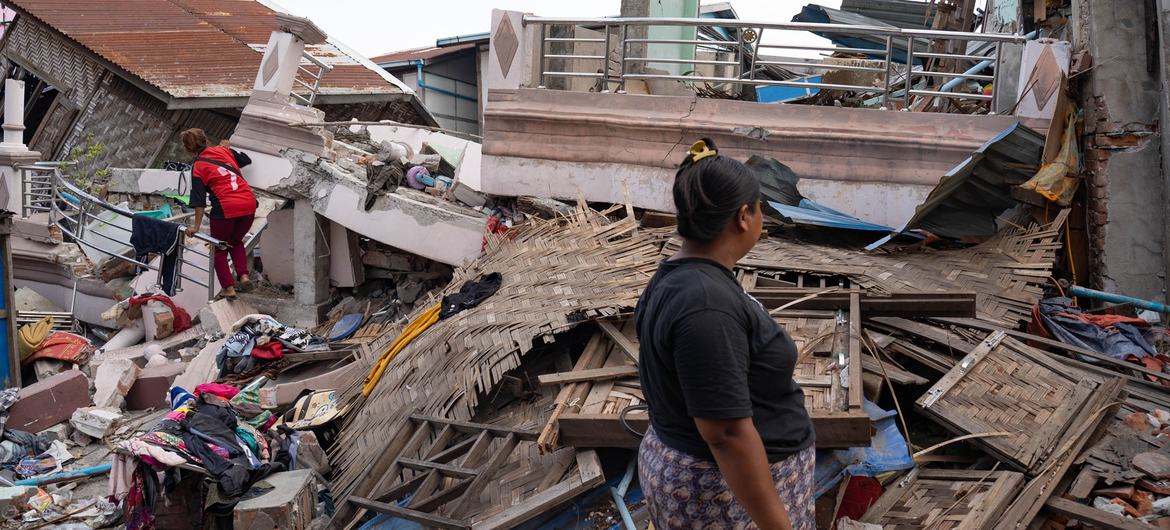
A woman in Mandalay, Myanmar, looks on at the devastation caused by the earthquake.

Amidst this crisis, the UNFPA team has provided services ranging from hygiene supplies, protection from gender-based violence, and mental health support for women and girls. They also support maternal and newborn care services. I saw for myself the unwavering resilience of humanitarian workers, and the way that UN agencies, civil society organizations, and NGOs work together.

Myanmar was already suffering from political instability and now it has been further devastated by this destructive earthquake. It is extremely difficult to deliver aid to communities in Sagaing and Mandalay, where armed conflict is ongoing.

In the present context, with monsoon conditions imminent, people are terrified of what this season may bring.

The country is also experiencing the impact of the decline in global aid funding.

UNFPA, like other UN agencies and humanitarian organizations, is dealing with constraints on resources, and we have issued an appeal for emergency assistance to support populations in critical need.

The suffering of women and children affected by the earthquake is profoundly distressing, and we need all of our strength and resilience to help them.

It is a heartbreaking experience to witness the despair in people’s eyes and to listen to their stories of loss, but we are trying to give them the dignity and hope they rightfully deserve in these difficult times.”