Facing rising risks, landlocked nations launch climate alliance at UN summit

Operating within the UN Framework Convention on Climate Change (UNFCCC), the group aims to amplify their voices in global climate talks, where their distinct vulnerabilities have long been overlooked.

Disproportionate climate risks

Although LLDCs account for approximately 12 per cent of the world’s land surface, they have experienced nearly 20 per cent of the world’s droughts and landslides over the past decade – underscoring their disproportionate exposure to climate-related disasters.

Lacking access to the sea, these countries rely heavily on neighboring transit states, which further increases their vulnerability to climate-induced disruptions.

The Awaza Programme of Action is not the first global framework to address the development needs of LLDCs, but for the first time, such an action plan includes a strong focus on adaptation to climate-related disasters.

A call for resilience and preparedness

Natalia Alonso Cano, Chief of the UN Office for Disaster Risk Reduction (UNDRR) Regional Office for Europe and Central Asia, emphasized this in an interview with UN News.

LLDCs, she said, face overlapping risks: over half of their territory is classified as dryland; many are in mountainous regions; and some sit in seismically active zones.

“Landlocked countries in general, they suffer about three times the economic losses compared to the global average,” she said. “Also, the mortality rates [when disasters strike these countries] much higher than the global average. Such big difference explained by a combination of this vulnerability, but also a combination of exacerbating impacts.”

Limited capacity, growing challenges

Landlocked developing countries often struggle to respond to climate challenges due to limited financial capacity, dependence on undiversified, commodity-based economies, and weak governance. In 2024, one-third of LLDCs were either in conflict or considered unstable.

The new 10-year UN action plan aims to support LLDCs in climate adaptation, sustainable development, and disaster risk reduction.

“We know that early warning saves lives. It’s a fact,” Ms. Alonso Cano explained. “When you can communicate to the communities affected that something is going to happen and they need to prepare – to evacuate, for example – they need to do certain things. If they know what they need to do, that’s part of the early warning system. Obviously, it saves lives, and it saves livelihoods as well.”

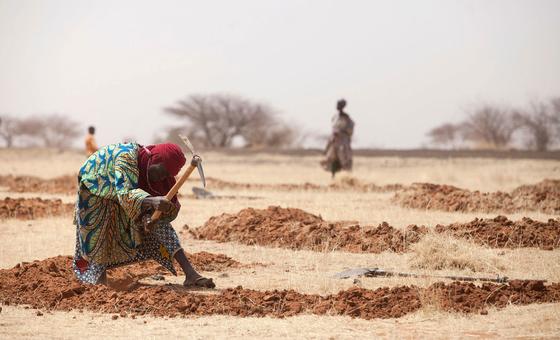
She gave an example of drought preparedness: “If there [is] a systemic drought in an area, you work in the preparedness with the communities, they can, for example, take certain measures, reduce maybe the amount of cattle in the case of that, they can congregate towards points of water, etc. There are a number of measures to address that.”

Ms. Alonso Cano stressed the need for long-term planning: “We need to take into account what is going to happen in 10, 20, 30 years. And climate change will become more extreme – we know this for sure.”

Women and girls at the forefront

Within LLDCs, women and girls are particularly at risk, making gender a key concern at Thursday’s events at LLDC3 in Awaza. One highlight was a Women Leaders’ Forum, opened by UN Under Secretary-General Rabab Fatima, who emphasized that sustainable development cannot be achieved without the full participation of women and girls.

Ms. Fatima, the High Representative for the Least Developed Countries, Landlocked Developing Countries and Small Island Developing States, noted progress over the last 25 years: women now occupy one-third of parliamentary seats in LLDCs, compared to just 7.8 per cent in 2000.

“This is higher than the global average,” she said, adding that 11 of the world’s 54 female speakers of parliament come from LLDCs.

Persistent gender gaps

Yet challenges remain. “Progress is uneven and far too slow. One in four women in LLDCs live in extreme poverty – that is nearly 75 million women; and nearly half – about 150 million – face food insecurity.”

Employment statistics show wide gender disparities. While 80 per cent of women in LLDCs work informally, without contracts or protections, the global average is 56 percent. One in three girls in LLDCs marries early – nearly twice the global rate – and only one in three completes secondary education. In addition, just 36 per cent of women in these countries have access to the internet.

“That is why gender-responsive industrial and development policies are so important,” Ms. Fatima stressed. “These policies must be tailored to national contexts, and industrial development in rural areas, business support, formalization of employment, and strengthened partnerships must be priorities.”

Digital inclusion for women and girls

She also called for improved internet access and education for women and girls.

The International Telecommunication Union (ITU), a UN specialized agency, is addressing these challenges.

Dr. Cosmas Luckysin Zavazava, Director of the ITU Telecommunication Development Bureau, told UN News that while some regions such as the CIS have achieved gender parity in internet access, LLDCs still face major barriers.

“That’s why we’ve developed special programmes for women and girls in this region,” he said. “It’s not just about access, but also about building coding skills and introducing girls to fields like robotics. Our programmes aim to motivate young women and girls to pursue careers in STEM sectors.”

Turning point for action

As the Awaza conference nears its conclusion, participants are expected on Friday to reaffirm their political commitment to the Awaza Programme of Action, which was adopted by the UN General Assembly in 2024.

The time has come for implementation – or as High Representative Rabab Fatima put it, “Let this forum be a turning point.
Source link

Gaza: Security Council meets on hostage crisis amid ‘unbearable’ conditions facing Palestinian civilians

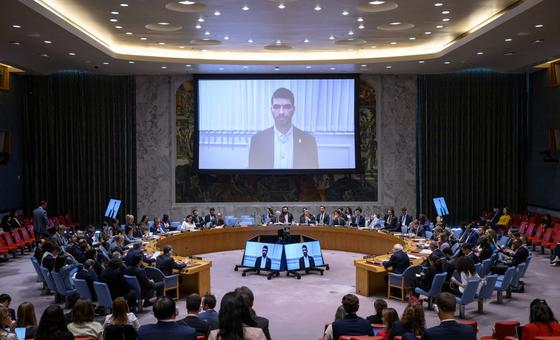
Assistant Secretary-General Miroslav Jenča briefed a Security Council meeting on Tuesday called by Israel to discuss the plight of hostages still being held in the war-ravaged enclave.

It comes after Hamas and Palestinian Islamic Jihad released images and videos of two emaciated hostages, Evaytar David and Rom Braslavsky, sparking outrage and condemnation. 

‘An affront to humanity itself’

The scenes of Evaytar apparently being forced to dig his own grave are appalling,” he said.

“These images, and their own accounts of their treatment, have horrified us all. They are an affront to humanity itself.”

Mr. Jenča acknowledged the presence of Mr. David’s brother, Ilay, who participated in the meeting via videoconference, saying the UN recognises “the profound pain and hardship endured by the families and loved ones of those who remain in captivity.”

He recalled that this week the Jewish community commemorated Tisha B’Av, a day of mourning and remembrance of tragedies endured throughout its history.

“I pay tribute to your courage and determination, and I share your dearest wish: for your brother, and all hostages held in Gaza, to be immediately and unconditionally released,” he said.

A war crime

Currently, 50 hostages continue to be held by Hamas and other Palestinian armed groups in horrific conditions and 28 are thought to be deceased, while freed hostages “have relayed distressing accounts of deprivation, ill-treatment, and abuse.”

Since the conflict began, Hamas and other armed groups have circulated dozens of videos of hostages, including statements made under duress and while clearly suffering, including the most recent footage of the two men.

“International law is clear,” said Mr. Jenča.  “Hostage-taking is prohibited – it is a war crime.”

He stressed that people deprived of their liberty must be treated humanely and with dignity and allowed to be visited by the International Committee of the Red Cross (ICRC). 

“They must never be subject to ill-treatment, abuse, or humiliation, as these would also constitute violations of relevant rules of international law,” he added, before reiterating UN Secretary-General António Guterres’s call on Hamas and other Palestinian armed groups for the immediate and unconditional release of all hostages. 

Gaza situation ‘unbearable’

Meanwhile, “the situation in Gaza is horrifying – it is unbearable,” he continued, noting that “Palestinians are subjected to squalid, inhumane conditions on a daily basis.”

More than 60,000 Palestinians have been killed since the conflict began, according to local health authorities.

Since the end of May, over 1,200 Palestinians have been killed and over 8,100 injured while trying to access food supplies, including in the vicinity of militarized aid distribution sites,” said Mr. Jenča.

“The deaths and injuries continue to mount, day by day, with no end in sight to the suffering.”

This is happening as Israel continues to severely restrict humanitarian assistance entering Gaza, while the aid that is allowed to enter “is grossly inadequate.”

‘Hunger is everywhere’

He told the Council that “hunger is everywhere in Gaza, visible in the faces of children and in the desperation of parents risking their lives to access the most basic supplies.”

Here, he echoed the Secretary-General’s condemnation of the ongoing violence in Gaza, including the shooting, killing, and injuring of people trying to get food. 

“International law is clear. Civilians must be respected, protected and never targeted or deliberately deprived of food or access to other lifesaving aid – doing so is a war crime,” he said.

“Israel must immediately allow and facilitate rapid and unimpeded passage of sufficient amounts of humanitarian relief for civilians in need, to avert further suffering and loss of life.”

Potential military expansion ‘deeply alarming’

Mr. Jenča also addressed latest reports regarding Israeli Prime Minister Benjamin Netanyahu’s possible decision to expand military operations through the entire Gaza Strip.

If true, they are “deeply alarming,” he said, as “this would risk catastrophic consequences for millions of Palestinians and could further endanger the lives of the remaining hostages in Gaza.”

He again turned to international law, which is clear that Gaza is and must remain an integral part of a future Palestinian State.

He cited the July 2024 Advisory Opinion by the International Court of Justice (ICJ) which declared that Israel is under an obligation to immediately cease all new settlement activities, evacuate all settlers from the Occupied Palestinian Territory, and to bring an end to its unlawful presence there as rapidly as possible.

No military solution

Mr. Jenča concluded his briefing by underlining the UN’s position that the only way to end the violence and humanitarian catastrophe in Gaza is through a full and permanent ceasefire, the immediate and unconditional release of all hostages and allowing aid to enter at scale and without obstruction.  

Civilians also must be guaranteed safe, unhindered access to assistance.

He stressed that there is no military solution to the conflict in Gaza or the broader Israel-Palestine conflict. 

“We must establish political and security frameworks that can relieve the humanitarian catastrophe in Gaza, start early recovery and reconstruction, address the legitimate security concerns of Israelis and Palestinians, and secure an end to Israel’s unlawful occupation and achieve a sustainable two-State solution,” he said.

This would mean “Israel and a fully independent, democratic, contiguous, viable and sovereign Palestinian State, of which Gaza is an integral part – living side by side in peace and security within secure and recognized borders, on the basis of the pre-1967 lines, with Jerusalem as the capital of both States.” 

Source link

Yemen: Nearly half the population facing acute food insecurity in some southern areas

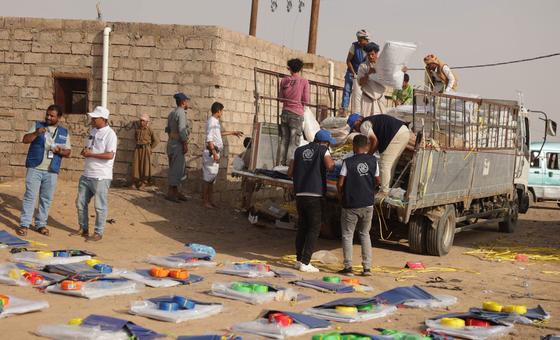
Yemen remains trapped in a prolonged political, humanitarian and development crisis, after enduring years of conflict between government forces and Houthi rebels, with populations in the south of the country now facing a growing food insecurity crisis.

partial update released Monday by the UN-backed Integrated Food Security Phase Classification (IPC) system – which ranks food insecurity from Phase 1 to famine conditions, or Phase 5 – paints a grim picture.

Starting in May 2025, around 4.95 million people have been facing crisis-level food insecurity or worse (Phase 3+), including 1.5 million facing emergency-level food insecurity (Phase 4).

These numbers mark an increase of 370,000 people suffering from severe food insecurity compared to the period from November 2024 to February 2025.

Further deterioration

The UN World Food Programme (WFPwarned that “looking ahead, the situation [was] expected to deteriorate further,” with 420,000 people potentially falling into crisis-level food insecurity or worse.

This would bring the total number of severely food-insecure people in southern governorate areas to 5.38 million – more than half the population.

Multiple compounded crises – such as sustained economic decline, currency depreciation in southern governorates, conflict, and increasingly severe weather – are driving food insecurity in Yemen.

High-risk areas

Amid Yemen’s growing food crisis, humanitarian agencies including WFP, the UN Children’s Fund (UNICEF), and the Food and Agriculture Organization (FAO) are reorienting their efforts towards high-risk areas, delivering integrated support across food security, nutrition, sanitation, health, and protection to maximise life-saving impact.

“The fact that more and more people in Yemen don’t know where their next meal will come from is extremely concerning at a time when we are experiencing unprecedented funding challenges,” said Siemon Hollema, Deputy Country Director of WFP in Yemen.

Immediate support needed

WFP, UNICEF and FAO are urgently calling for sustained and large-scale humanitarian and livelihood assistance to prevent communities from falling deeper into food insecurity, and to ensure that the UN “can continue to serve the most vulnerable families that have nowhere else to turn,” he said.

Internally displaced persons, low-income rural households, and vulnerable children are particularly affected, and are now facing increased vulnerability, as approximately 2.4 million children under the age of five and 1.5 million pregnant and lactating women are currently suffering from acute malnutrition.

The situation is dire, but with urgent support, “we can revitalise local food production, safeguard livelihoods, and move from crisis to resilience building, ensuring efficiency and impact,” said FAO Representative in Yemen, Dr. Hussain Gadain.

Source link

Kenya: Refugees facing ‘lowest ever’ emergency food rations amid funding crisis

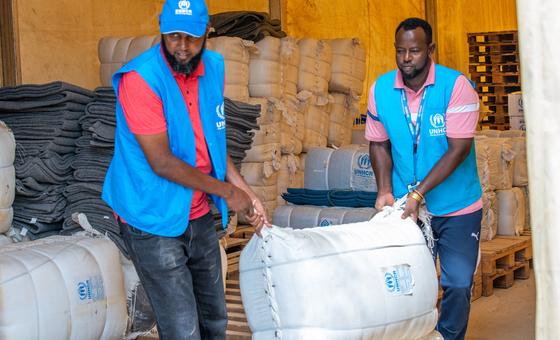
Over the past five years, the refugee population in Kenya has surged by more than 70 per cent – from approximately 500,000 to 843,000 – driven largely by conflict and drought in neighbouring Sudan and Somalia. Of these, around 720,000 people are sheltering in the Dadaab and Kakuma camps, as well as the Kalobeyei settlement.

In Sudan, the civil war that erupted in April 2023 has killed over 18,000 people, displaced 13 million, and left 30.4 million in need of assistance, according to the UN.

WFP provides emergency food and nutrition support to 2.3 million Sudanese as violence and the collapse of essential infrastructure deepen the crisis. 

In Somalia, severe drought has placed 3.4 million people – including 1.7 million children – at risk of acute malnutrition.

At the weekend, Secretary-General António Guterres recommended that the Security Council ensure financing for the African Union’s Support and Stabilisation Mission there (UNSOM), as the country continues to battle insecurity and attacks from Al-Shabaab militants.

Shrinking rations, rising need 

Previously, a monthly WFP ration for a refugee in the camps included 8.1 kilogrammes of rice, 1.5 kg of lentils, 1.1 litres of oil, and cash for purchasing essentials. That support has now been halved, and cash payments have stopped entirely.

Without emergency funding, food rations could drop to just 28 per cent of their original level. WFP is appealing for $44 million to restore full food and cash assistance through August.

Cuts compound existing crises

Although cuts to foreign aid by many developed nations this year has further constrained operations, WFP began reducing services for Kenya’s refugee population in 2024.

Many of the families arriving are already food insecure, and Global Acute Malnutrition (GAM) rates among children and pregnant or breastfeeding women exceed 13 per cent – three percent above the emergency threshold. Targeted nutrition programmes ended in late 2024 due to lack of resources.

Source link

Journalism facing new threats from AI and censorship

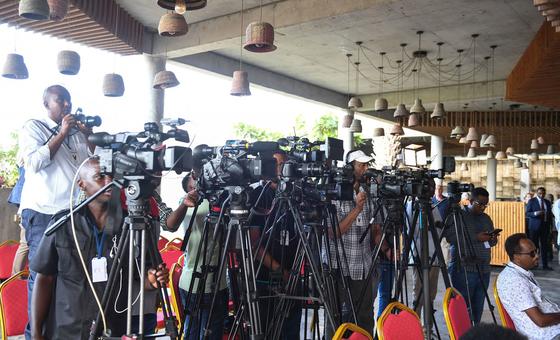
Amidst spiraling conflict, climate chaos, growing divisions, and a rapidly changing digital landscape, a free press is more vital than ever,” said Volker Türk.

Furthermore, “the media help us understand the world around us and encourage critical thinking and dialogue.”

Threats and deaths

Free and independent media are the best antidote to disinformation but press freedom is under threat in every region of the world, he warned.

States harass, detain, torture and even kill media workers, simply for doing their jobs” while “in some conflict zones, warring parties restrict or deny access to journalists.”

He noted that since January, at least 20 people who work in media have been killed and impunity for crimes against journalists remains widespread, with more than 80 per cent of killings going unpunished.

AI rewards…and risks

Mr. Türk said this year’s observance of press freedom is a reminder that media repression is increasing while artificial intelligence (AI) is entirely overhauling how information is produced, distributed, and consumed.

Although AI can be a useful tool for journalists, it also carries significant risks for press freedom, he warned.

AI-based algorithms often dictate what we see, shaping our opinions and perceptions of reality. Politicians use AI to weaponize disinformation and advance their own agendas,” he said.

“States are also using AI tools to monitor journalists and their sources online, violating their right to privacy. This has a chilling effect on media workers everywhere. And women journalists are disproportionately targeted.”

Concentration of power

Furthermore, “a small group of corporations and individuals have almost total control over AI technology and influence on the global media landscape.”

UN Secretary-General António Guterres also highlighted the opportunities and risks posed by AI in his message on press freedom.

Biased algorithms, outright lies, and hate speech are landmines on the information superhighway.  Accurate, verifiable, fact-based information is the best tool to defuse them,” he said.

He pointed to the Global Digital Compact adopted last year by UN Member States, which includes “concrete steps to strengthen international cooperation to promote information integrity, tolerance and respect in the digital space.”

Change course now

Mr. Türk said World Press Freedom Day is an opportunity for everyone to urgently commit to changing course now, starting with States.

They must ensure that journalists are safe from attacks, hate campaigns and surveillance, as well as physical and legal harassment.

It is crucial to have more transparency in how data is used, how content is curated, and how algorithms are designed.”

Media concentration laws – that is, legislation around ownership of mass media outlets – also must be updated to reflect the power of AI and tech platforms and promote a diverse media landscape that secures space for independent journalism.

Meanwhile, tech companies have a crucial role. In this regard, Mr. Turk announced that his Office and UN educational and cultural agency UNESCO are offering guidance to help tech companies assess the risks their tools pose to journalists and civil society.

 “A free, independent, and diverse media can help to heal the divisions in our societies. We must do everything in our power to protect it and allow it to flourish,” he said. 

Source link