Intensifying ISIL threat highlights need to step up counter-terrorism measures

Alexandre Zouev, Acting Under-Secretary-General at the UN Office of Counter-Terrorism (UNOCT), presented its latest report which highlights the group’s intensifying presence in Africa, the Middle East and beyond. 

He said the threat posed by ISIL, also known by its Arabic acronym, Da’esh, has “increased steadily” since the previous report issued in August, “remaining multipolar and increasingly complex.” 

Instability in West Africa  

ISIL and its affiliates have continued to recruit foreign fighters, enhance their use of new and emerging technologies, and maintain access to funding – including through measures such as unlawful taxation and kidnapping for ransom. 

The terrorists have also continued to expand their presence in parts of Africa. 

“Their efforts and demonstrated capacity to control territory are deepening regional instability and further weakening the capacity of national authorities to address interconnected security, human rights, and development challenges,” he said. 

The situation in West Africa and the Sahel remains especially urgent, where the ISIL affiliate in the Lake Chad Basin region “has further expanded its prominence.” 

Attacks in Iraq and Syria 

Da’esh also remains active in Iraq and Syria “with continued attacks and renewed efforts to destabilise local authorities.” 

Syria is undergoing political transition following the overthrow of the Assad regime in December 2024. “The security situation remains fragile, with Da’esh continuing to exploit governance vacuums and incite sectarian tensions,” he said. 

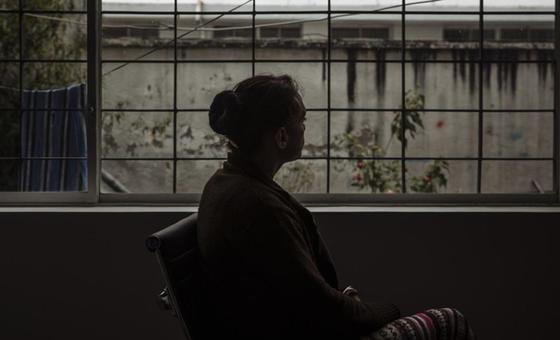
Mr. Zouev also highlighted the situation in the country’s northeast, where tens of thousands of people with alleged ties to the group – mainly women and children – remain in camps in dire conditions. 

The withdrawal of the Kurdish-led Syrian Democratic Forces from notorious Al Hol last month “has also introduced new operational and humanitarian challenges,” he added. 

Meanwhile, ISIL-Khorasan in Afghanistan “continues to pose one of the most serious threats to the region and beyond.”   

The group was behind the “heinous terrorist attack” in the capital, Kabul, on 19 January which killed seven people and injured several others, including a child. 

Use of AI in recruitment  

Mr. Zouev said progress in countering terrorism financing has led Da’esh and other groups to further exploit digital platforms and new technologies, with expanded use of crypto-currencies, drones and other tools. 

Artificial Intelligence is increasingly used by terrorist groups particularly for the radicalisation and recruitment of people, with youth and children among those deliberately targeted,” he said. 

In the face of the intensifying threat posed by Da’esh, the counter-terrorism chief underlined three central calls made by the UN SecretaryGeneral in the report. 

© UNOCHA/Ali Haj Suleiman

Women and children walk through the Al Hol Camp in Syria, a displacement site housing over 30,000 people.

Areas for action 

He urged countries to step up efforts to repatriate people from the camps and detention facilities in northeast Syria. 

As the situation in parts of Africa – particularly the Sahel, West Africa and the Lake Chad Basin – remains deeply concerning, “Member States must exercise political ownership and forge unified, coherent, and joint responses.”  

Mr. Zouev stressed that lasting progress requires comprehensive approaches by both the government and society that are firmly rooted in the rule of law and in full accordance with international human rights norms, 

Therefore, “nationally owned and inclusive prevention” must remain at the heart of international counter-terrorism efforts. 

“The intensification of the threat posed by Da’esh and its affiliates, despite significant national and international efforts, underscores how imperative it is to sustain global cooperation on counter-terrorism,” he said. 

Technical assistance to countries 

Nathalia Gherman, Executive Director of the Counter-Terrorism Committee Executive Directorate (CTED) – the secretariat for the Council’s own Counter-Terrorism Committee (CTC) – also briefed ambassadors. 

She said the last six months have demonstrated that “Da’esh continues to perpetrate and inspire terrorist attacks globally,” with devastating impacts.   

CTED has conducted assessment visits to Austria, Cameroon, Chad, Hungary, Malta, Norway and Somalia over the past year, 

“We work closely with each Member State that we visit to provide tailored recommendations and identify technical assistance needs,” she explained. 

UN counter-terrorism efforts ‘critical’ 

Ms. Gherman gave the example of CTED’s support for a project to address the use of the internet, social media and video games by Da’esh and Al Shabaab in Somalia and the broader region. 

The initiative brought together 70 representatives from national authorities in Somalia, Djibouti, Ethiopia, Kenya, and Uganda, as well as participants from civil society, academia and the private sector. 

The efforts of the United Nations to address the Da’esh threat are critical,” she said, 

“These efforts require adequate resources and the cooperation of all Member States to achieve our shared goal: a world free from terrorism.” 

Source link

Human trafficking depends on corruption at every step

A Chilean police officer stationed at the border collaborated on the scheme, enabling the crime.

Were it not for border guards, public officials and other entities who look the other way in exchange for money or sexual favours – or are themselves being extorted – human trafficking could not occur on a large scale, according to a new report from the UN Office on Drugs and Crime (UNODC) published on Monday. 

It analyses more than 120 cases involving almost 80 countries – based on consultations with policymakers, prosecutors, investigators and independent experts from more than 30 countries – to expose the ‘hidden links’ between human trafficking and corruption. 

Cloak of corruption

Human trafficking can include sexual exploitation, forced labour, forced begging, organ removal and even illegal adoption, among other forms of exploitation.

The report demonstrates how corruption permeates and facilitates every stage of human trafficking.

During recruitment and transport, corrupt officials provide documentation, overlook irregularities and collude with fraudulent recruitment agencies and organised criminal groups. 

At border crossings, bribes and papers obtained through corruption allow persons to be moved across jurisdictions.

Asking for help can appear difficult or impossible once a person is exploited. Corruption shields operations in industries such as agriculture, construction, fisheries and domestic work, and helps keep victims of trafficking in situations of forced labour, sexual exploitation and forced criminality. 

Finally, corruption obstructs anti-trafficking efforts, from police investigations and prosecutions to judicial decisions and assistance to victims.

Breaking the cycle

UNODC supports countries in breaking the cycle of corruption and human trafficking, including by ensuring national legislation applies stronger penalties when public officials are involved in trafficking and establishing safe reporting mechanisms for victims.

Other UN agencies are also supporting the effort. Backed by the International Organization for Migration (IOM), Moldova announced last week that it is strengthening its ability to identify and stop cross-border crimes, including human trafficking, through the new headquarters of its Passenger Information Unit (PIU).

The PIU is equipped with advanced UN software that improves passenger data collection, analysis and rapid response. Moldova is the seventh country to adopt this system, following in the footsteps of Norway, Luxembourg, Botswana, Georgia, the Philippines and Mongolia.

Source link

Doha agreement brings DR Congo government and M23 rebels a step closer to peace

In a statement released on 19 July, MONUSCO said that the Declaration of Principles, signed in Doha under the mediation of Qatar, “reflects the parties’ resolve to prioritise peaceful means, establish a ceasefire, and set up a joint mechanism to define its practical implementation.”

“This important declaration marks a shift towards easing tensions and protecting civilians seriously affected by the conflict,” declared Mr. Bruno Lemarquis, Deputy Special Representative of the UN Secretary-General in the DRC and Acting Head of MONUSCO. “We commend the commitments made and call for their timely and good-faith implementation.”

These commitments include measures to facilitate the voluntary, safe, and dignified return of internally displaced persons and refugees to their places or countries of origin, and the encouragement of inclusive dialogue, seen as vital to addressing the root causes of the conflict and achieving lasting peace.

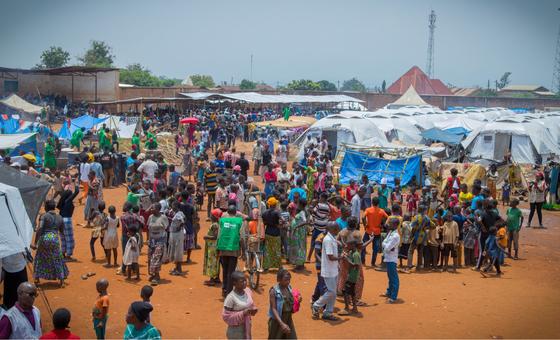
Earlier this year, the M23 launched an offensive in North and South Kivu provinces, capturing cities and villages, including provincial capitals Goma and Bukavu. Thousands of civilians were killed, hundreds of thousands more were displaced, and serious human rights violations were committed.

The Declaration of Principles comes less than a month after a peace agreement signed by Congo and Rwanda, long accused by the Congolese Government of supporting the M23.

The Mission’s statement highlighted the Declaration’s emphasis on civilian protection and support for the ceasefire, with assistance from MONUSCO and other partners, and reaffirmed its readiness to support the cessation of hostilities, particularly through the establishment of a credible and jointly agreed verification mechanism.

MONUSCO’s statement concluded by urging all parties to honour their commitments, act in good faith throughout the process, and prioritise human rights, security, and the aspirations of the Congolese people in all decisions. 

Source link

The Sevilla Commitment: A vital step to rebuild trust in global cooperation

Activists, many from the Global South, attending the talks in Spain, are calling for greater leadership and commitment from wealthier nations to help address long-standing structural inequalities.

The 4th International Conference on Financing for Development (FFD4) carries strong symbolic weight, reflected in the agreed priorities of the Sevilla Commitment.

Courtesy of Paula Sevilla

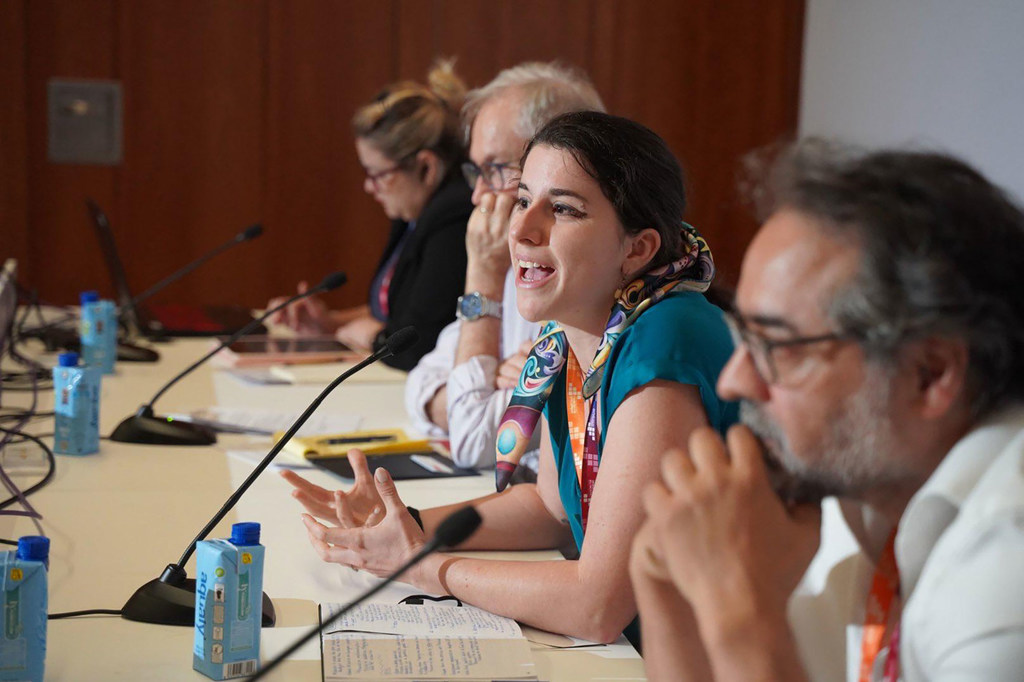
Paula Sevilla, International Institute for Environment and Development.

However, organizations warn that there is still a long way to go before promises translate into tangible action.

Good timing

That is the message from Paula Sevilla, a representative of the International Institute for Environment and Development (IIED) – a London-based research centre – who has worked for decades on sustainability and climate justice in Latin America, Africa, and Asia.

“This summit has come at a crucial time to try to restore faith in international cooperation, especially after the pandemic, which exposed a lack of global solidarity,” she stated.

One of IIED’s main goals in Sevilla has been to ensure that the announced financial commitments actually reach local communities at the forefront of the climate crisis.

To that end, the organization emphasizes the need to address issues such as external debt – draining public budgets – and to support innovative mechanisms like blended finance to direct resources to those who need them most.

“We’re seeing countries spend more on debt payments than on healthcare or education, while inequalities are deepening,” the expert warned, speaking shortly after a respectful but forceful protest inside the conference centre.

A place to call home

Housing solutions linked to sustainable development are notably absent from the summit’s final document.

“It’s regrettable that it’s not even mentioned, at a time when we are facing a global cost-of-living crisis – not only in the Global South but also here in Spain. Housing is a source of anguish and distrust among citizens, and it has been completely ignored,” Ms. Sevilla said.

Despite this, her organization is working to leverage the Sevilla outcome to find ways to channel funding into providing more affordable homes.

Commenting on the initiative led by Spain and Brazil to work towards fair taxation and push back against tax avoidance by the world’s richest – promoting more transparency and accountability – the IIED representative said it could be a useful path toward correcting structural inequalities.

Tax for development

We need leadership from the Global North, where many of the world’s major tax-avoiding corporations are based. Without their commitment, we won’t move forward,” she stated.

She also criticized the absence of the United States from the summit – not  only as a diplomatic setback but also as a worrying precedent following the dismantling of its international development agency, USAID.

“We’re talking about people counting their pills to figure out how many days of life they have left. This is dramatic,” she emphasised.

With just five years remaining to meet the Sustainable Development Goals, Ms. Sevilla warned that time is running out – and that the Sevilla Commitment will be meaningless without real change.

We need political leadership, a will to cooperate, and a commitment to protect democratic space. In the end, it’s organized people who keep hope alive and hold leaders accountable,” Sevilla concluded.

The Sevilla Commitment in brief:

  • The Sevilla Commitment sets out a new global roadmap to raise the trillions of dollars needed each year to achieve sustainable development, building on previous international agreements
  • It calls for fairer tax systems, cracking down on tax evasion and illicit financial flows, and strengthening public development banks to support national priorities
  • The agreement highlights the need for new tools to ease debt pressures on vulnerable countries, including debt-swap schemes, options to pause payments during crises, and better transparency
  • Countries committed to boosting the capacity of multilateral development banks, increasing the use of special drawing rights, and attracting more private investment to support development
  • It also aims to make the global financial system more inclusive and accountable, with improved coordination, stronger data systems, and broader participation from civil society and others

The Commitment launches the Sevilla Platform for Action, which includes over 130 initiatives already underway to turn the pledges into real-world results.

Source link

‘Step back from the brink’, Guterres urges India and Pakistan

Addressing journalists outside the Security Council at UN Headquarters in New York, Mr. Guterres expressed deep concern over deteriorating relations between the two South Asian neighbours, saying they had reached “their highest in years.”

He reiterated his condemnation of the 22 April terror attack in the Pahalgam area of Jammu and Kashmir, which killed at least 26 civilians and injured many more.

Targeting civilians is unacceptable – and those responsible must be brought to justice through credible and lawful means,” Mr. Guterres said.

It is also essential – especially at this critical hour – to avoid a military confrontation that could easily spin out of control.

The Security Council is due to meet behind closed doors later on Monday to discuss the rising tensions between the two nations.

UN ready to help de-escalate

He offered his good offices to both governments to help defuse tensions and promote diplomacy, stressing that “a military solution is no solution.

“Now is the time for maximum restraint and stepping back from the brink,” he said.

Mr. Guterres also praised both countries for their long-standing contributions to UN peacekeeping operations and expressed hope that their shared history of cooperation could form the basis for renewed dialogue.

“The United Nations stands ready to support any initiative that promotes de-escalation, diplomacy, and a renewed commitment to peace,” he said.

Source link

Ukraine: Ceasefire a critical first step on the road to durable peace

Under-Secretary-General Rosemary DiCarlo addressed ambassadors alongside UN deputy relief chief, Joyce Msuya, who updated on the dire humanitarian situation in the country amid ongoing Russian attacks.

Ms. DiCarlo said the meeting was taking place at a potential inflection point in the three-year war, as the past few weeks have seen intensified shuttle diplomacy towards a possible peace deal. 

‘Glimmer of hope’

These initiatives offer a glimmer of hope for progress towards a ceasefire and an eventual peaceful settlement,” she said.

“At the same time, we continue to witness relentless attacks on Ukrainian cities and towns.”

Russian forces have carried out recent deadly strikes, such as the massive, combined missile and drone attack last week on several regions, including the capital Kyiv.  

Multiple residential buildings in the city were hit. At least 12 people were reported killed and more than 70 others injured, including children, making it the deadliest attack on the capital in nine months. 

This followed several other deadly strikes, including one in Sumy city on Palm Sunday that reportedly killed 35 people.  Another in Kryvyi Rih killed 18, including nine children – the deadliest single strike against children since the start of the full-scale Russian invasion.

The UN human rights office, OHCHR, verified that as of 24 April, 151 civilians have been killed, and 697, injured so far this month in Ukraine. 

Verification is ongoing, but numbers are expected to surpass the March figures, which were already 50 per cent higher than in February.

She also noted recent media reports quoting local Russian authorities that indicate civilian casualties in the Kursk, Bryansk and Belgorod regions in Russia, including alleged Ukrainian strikes on 23 and 24 April that reportedly killed three people in the Belgorod region.

“We condemn all attacks against civilians and civilian infrastructure, wherever they occur,” she said.

Diplomatic efforts encouraged

Ms. DiCarlo noted that the UN Secretary-General has repeatedly called for de-escalation and a durable ceasefire in Ukraine.

“In this regard, we are encouraged by the diplomatic efforts underway,” she said.

“We take note of yesterday’s announcement by the Russian Federation of a 72-hour truce planned for the period from 8 to 10 May.”

It follows a similar Russian announcement on 19 April of a 30-hour Easter truce, “and Ukrainian authorities reportedly agreed to mirror any such steps, reiterating their earlier support for a 30-day ceasefire proposed by the United States,” she said.

“Regrettably, hostilities continued during Holy Week, with both sides accusing each other of violations.”

She recalled that a month earlier, the Secretary-General welcomed separate announcements by the US, Russia and Ukraine regarding a 30-day moratorium on strikes against energy infrastructure and the resumption of negotiations on the safety of navigation in the Black Sea.

Despite these commitments, however, attacks against energy infrastructure persisted,” she said. 

Political will valuable

Ms. DiCarlo said the continued exchange of prisoner of war by both sides – including the largest to date, when 500 people were swapped on 20 April – “shows that with political will, diplomacy can yield tangible results even in the most difficult circumstances.”

She concluded her remarks by pointing to the forthcoming 80th anniversary of the Second World War, which serves as a reminder “with even greater urgency” of the centrality of the UN Charter and international law in safeguarding peace and security.

“The Russian Federation’s full-scale invasion of Ukraine stands as an egregious challenge to these fundamental principles, jeopardizing stability in Europe and threatening the broader international order,” she said.

“What is needed now is a full, immediate and unconditional ceasefire as a critical first step towards ending the violence and creating the conditions for a just, comprehensive and sustainable peace.”

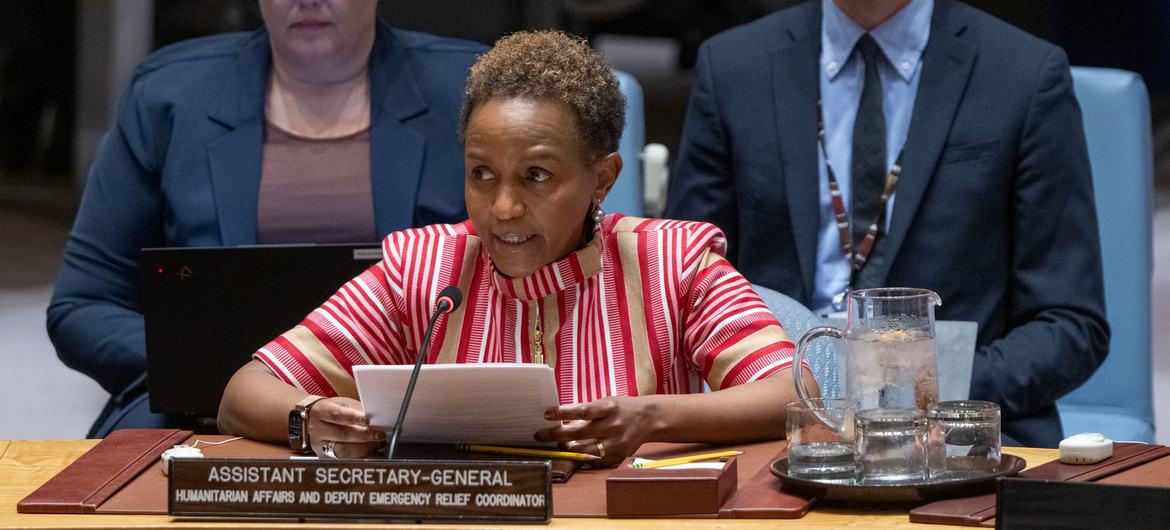
Joyce Msuya, UN Deputy Emergency Relief Coordinator, briefs the Security Council meeting on maintenance of peace and security of Ukraine.

Millions in need

Ms. Msuya reported that the humanitarian situation in Ukraine has worsened despite ceasefire opportunities. Overall, nearly 13 million people need assistance.

“So far this year, not a single day has passed without civilians being killed or injured in attacks,” she said. 

The operating environment also remains highly dangerous for humanitarians. 

Aid workers under attack

“From 1 January to 23 April, there were 38 verified security incidents impacting humanitarian staff within 20 kilometers of the frontline. This has left three aid workers dead and 21 injured while delivering life-saving assistance,” she said.

Ms. Msuya reiterated earlier calls for the Council to take urgent, collective action on Ukraine in three areas.

She urged ambassadors to ensure the protection of civilians – including humanitarian and health workers – and critical infrastructure. 

Her second point stressed the need to increase financial support for humanitarian operations as underfunding is forcing critical programmes to scale down. 

Finally, she called for a just peace: “Every effort, whether aimed at a temporary pause or a lasting agreement, must prioritize the protection and needs of civilians.” 

Source link