UN forum affirms stronger commitment to achieve sustainable development

At the end of the conference, Member States adopted a Ministerial Declaration by a vote of 154-2-2, with the United States and Israel voting against the document and Paraguay and Iran abstaining.  

“We strongly reaffirm our commitment to effectively implement the 2030 Agenda [which]… remains our overarching roadmap for achieving sustainable development and overcoming the multiple crises we face,” the declaration said.  

15 years of HLPF

The HLPF has happened on an annual basis since 2010 and is convened by the Economic and Social Council (ECOSOC) to discuss the progress, or lack thereof, on the 17 Sustainable Development Goals (SDGs), which were adopted in 2015 as part of the 2030 Agenda and aspire to create a more equitable and inclusive world.

This year, the forum focused on five of these goals: good health and wellbeing, gender equality, decent work and economic growth, life below water and partnerships.

Negotiations regarding the ministerial document were led by representatives from Czechia and St. Vincent and the Grenadines, who highlighted the significance of the proceedings.  

“This year’s deliberations have held particular significance. Ten years after the adoption of the 2030 Agenda, a range of interlinked and persistent challenges continues to jeopardise the full realisation of the SDGs,” said Jakub Kulhánek, permanent representative of Czechia and one of the two lead facilitators of the declaration.  

The clock is ticking

In the ministerial declaration, Member States said that time is running out to achieve the SDGs, which remain severely off track.  

According to the Secretary-General’s report on the Goals, which was released on the first day of the HLPF, only 18 per cent of the SDGs are on track to be achieved by 2030, with over half making progress that is too slow.  

While the ministerial declaration addressed each of the five SDGs in the spotlight at the forum, Member States particularly emphasised the role of poverty in impeding sustainable development and the worsening climate crisis that is threatening all aspects of the development agenda.  

The declaration called both of these issues some of the “greatest global challenges” that the world faces.

In keeping with SDG 16, which underlines the role that institutions like governments must play in promoting peace, Member States also affirmed that strong governance and partnership is essential to realising peace as a prerequisite for development.

“We recognise that sustainable development cannot be realised without peace and security, and peace and security will be at risk without sustainable development,” it stated.

Plan of Action

In the midst of challenges to multilateralism, Member States said that the declaration was an affirmation of the UN’s commitment to multilateralism, which is celebrating its 80th anniversary this year.

“At a time when serious doubts about the future of multilateralism persist, your steadfast commitment has been both reassuring and inspiring,” said Mr. Kulhánek.

Member States, in the declaration, affirmed a commitment to urgently working towards the SDGs in order to achieve a better world.  

“We will act with urgency to realise its vision as a plan of action for people, planet, prosperity, peace and partnership, leaving no one behind.” 

Source link

The Sevilla Commitment: A vital step to rebuild trust in global cooperation

Activists, many from the Global South, attending the talks in Spain, are calling for greater leadership and commitment from wealthier nations to help address long-standing structural inequalities.

The 4th International Conference on Financing for Development (FFD4) carries strong symbolic weight, reflected in the agreed priorities of the Sevilla Commitment.

Courtesy of Paula Sevilla

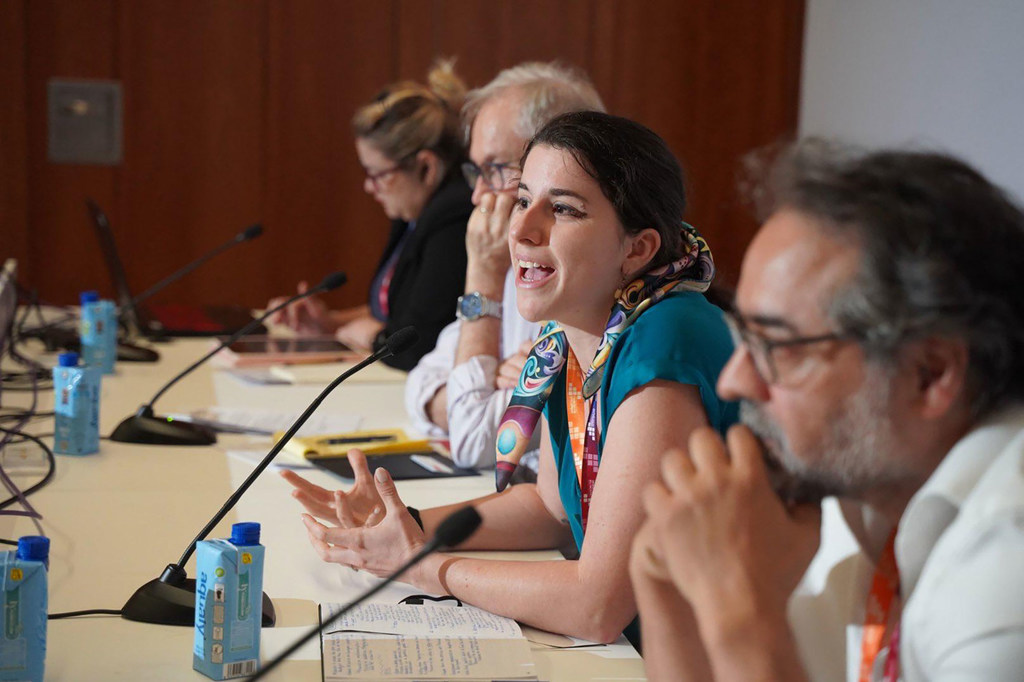
Paula Sevilla, International Institute for Environment and Development.

However, organizations warn that there is still a long way to go before promises translate into tangible action.

Good timing

That is the message from Paula Sevilla, a representative of the International Institute for Environment and Development (IIED) – a London-based research centre – who has worked for decades on sustainability and climate justice in Latin America, Africa, and Asia.

“This summit has come at a crucial time to try to restore faith in international cooperation, especially after the pandemic, which exposed a lack of global solidarity,” she stated.

One of IIED’s main goals in Sevilla has been to ensure that the announced financial commitments actually reach local communities at the forefront of the climate crisis.

To that end, the organization emphasizes the need to address issues such as external debt – draining public budgets – and to support innovative mechanisms like blended finance to direct resources to those who need them most.

“We’re seeing countries spend more on debt payments than on healthcare or education, while inequalities are deepening,” the expert warned, speaking shortly after a respectful but forceful protest inside the conference centre.

A place to call home

Housing solutions linked to sustainable development are notably absent from the summit’s final document.

“It’s regrettable that it’s not even mentioned, at a time when we are facing a global cost-of-living crisis – not only in the Global South but also here in Spain. Housing is a source of anguish and distrust among citizens, and it has been completely ignored,” Ms. Sevilla said.

Despite this, her organization is working to leverage the Sevilla outcome to find ways to channel funding into providing more affordable homes.

Commenting on the initiative led by Spain and Brazil to work towards fair taxation and push back against tax avoidance by the world’s richest – promoting more transparency and accountability – the IIED representative said it could be a useful path toward correcting structural inequalities.

Tax for development

We need leadership from the Global North, where many of the world’s major tax-avoiding corporations are based. Without their commitment, we won’t move forward,” she stated.

She also criticized the absence of the United States from the summit – not  only as a diplomatic setback but also as a worrying precedent following the dismantling of its international development agency, USAID.

“We’re talking about people counting their pills to figure out how many days of life they have left. This is dramatic,” she emphasised.

With just five years remaining to meet the Sustainable Development Goals, Ms. Sevilla warned that time is running out – and that the Sevilla Commitment will be meaningless without real change.

We need political leadership, a will to cooperate, and a commitment to protect democratic space. In the end, it’s organized people who keep hope alive and hold leaders accountable,” Sevilla concluded.

The Sevilla Commitment in brief:

  • The Sevilla Commitment sets out a new global roadmap to raise the trillions of dollars needed each year to achieve sustainable development, building on previous international agreements
  • It calls for fairer tax systems, cracking down on tax evasion and illicit financial flows, and strengthening public development banks to support national priorities
  • The agreement highlights the need for new tools to ease debt pressures on vulnerable countries, including debt-swap schemes, options to pause payments during crises, and better transparency
  • Countries committed to boosting the capacity of multilateral development banks, increasing the use of special drawing rights, and attracting more private investment to support development
  • It also aims to make the global financial system more inclusive and accountable, with improved coordination, stronger data systems, and broader participation from civil society and others

The Commitment launches the Sevilla Platform for Action, which includes over 130 initiatives already underway to turn the pledges into real-world results.

Source link