Communities struggle to rebuild following Pakistan’s worst floods

As communities struggle to rebuild, many have little time to grieve the immense losses they have suffered.  

Since June, over six million people in Pakistan have been affected by what have been described as “unusually heavy monsoon rains” which have claimed nearly 1,000 lives, including about 250 children.

Residents are still recovering from flash floods that turned streams into roaring rivers of mud, with many displaced still sheltering in Government-run camps or with host families who are already stretched to their limit.

In the Buner district of northern Pakistan, dozens perished in Bishnoi village under boulders and debris when flash floods came crashing down the slopes, sweeping away homes and lives in a matter of minutes.

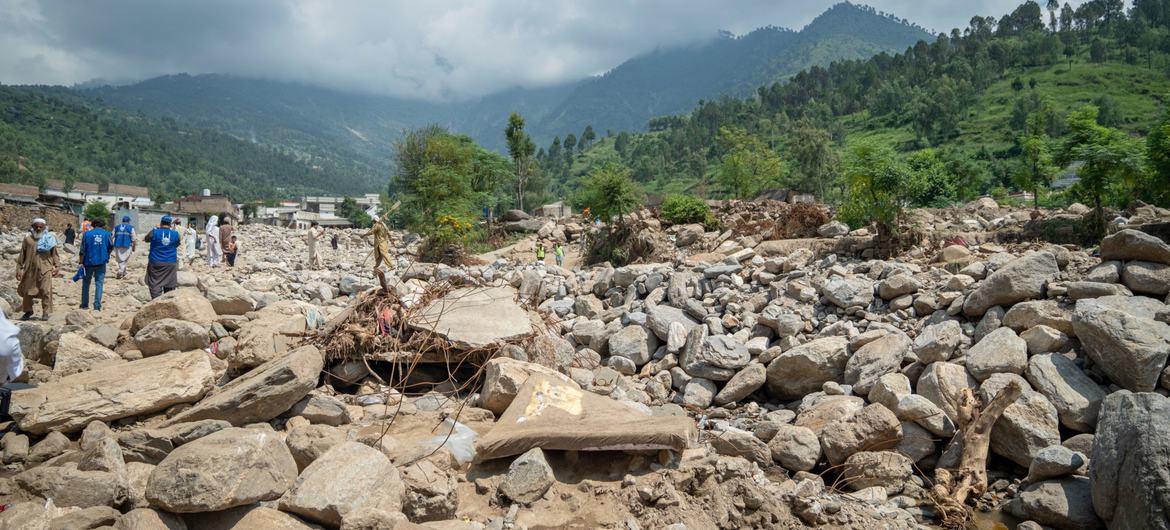
In Buner, northern Pakistan, flash floods turned mountain streams into fields of boulders, with iron rods protruding like rusted crops.

“We had never seen anything like this,” said 35-year-old Habib-un-Nabi, a teacher from Bishnoi village.  

His simple words carry the weight of grief and disbelief. Habib lost eighteen family members in a single day, including his parents and brother.

Those who survived barely had time to mourn. “We were too busy trying to dig out others, to help whoever we could,” recalled Habib.  

IOM support  

The International Organization for Migration (IOM) in Pakistan began humanitarian operations in the northern flood-affected areas, where hundreds of lives were lost and thousands were left homeless.  

In Punjab – Pakistan’s most populous province and the hardest hit in terms of infrastructure damage during the 2025 floods – IOM worked with partners and through the Common Pipeline, a shared humanitarian logistics system that stores and delivers emergency goods.  

Between August and September 2025, the UN migration agency distributed nearly 14,000 family relief kits tailored to local needs across all four provinces under a single project.

These interventions are part of broader efforts to help communities adapt to a climate crisis that is increasingly human-driven, fuelled by deforestation, rapid urbanisation, and the degradation of natural drainage systems.  

In Naseer Khan Lolai, a village in Kashmore, 65-year-old Ali Gohar has lived through many floods, yet none has been as devastating as this one.  

Entire homes collapsed, cattle were swept away, and the land – owned by local landlords – left farmers like him with little control over their recovery.  

As floods and heatwaves intensify across Pakistan, communities are showing that adaptation is not only possible but essential, turning the human cost of climate change into a call for shared responsibility and stronger action.  

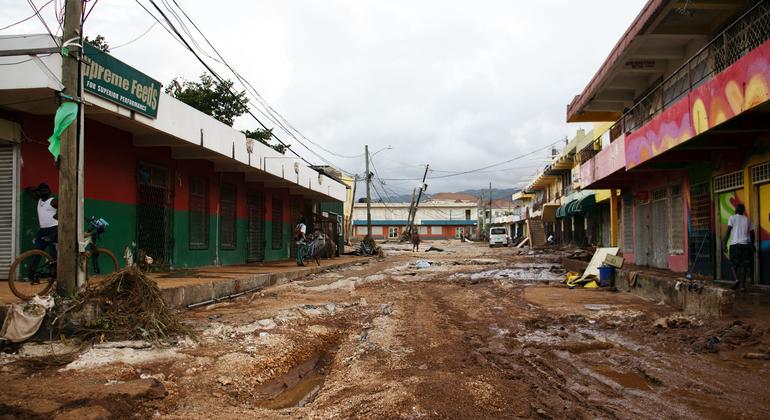
Fifty days on, Jamaica struggles to rebuild after Hurricane Melissa’s unprecedented destruction

Current estimates place the total damage and loss between $8 billion and $15 billion – nearly a quarter of Jamaica’s gross domestic product (GDP), said Dennis Zulu, UN Resident Coordinator for Jamaica, the Bahamas, Bermuda, the Cayman Islands, and Turks and Caicos.

The hurricane affected more than 626,000 people and claimed 45 lives, underscoring its profound human toll.

Despite notable progress in recovery efforts, 90 emergency shelters are still up and running, accommodating nearly 950 people who have yet to return home.

Communities left exposed

Entire communities are still fully exposed, with at least 120,000 buildings – most of them in southwestern Jamaica – having lost their roofs, reported Mr. Zulu.

Hurricane Melissa triggered “prolonged” and “cascading” disruptions to essential services, added the resident coordinator.

“Western parishes were left without electricity for weeks on end.”

In addition, many children remain out of school due to extensive damage to educational facilities.

Approximately 450 schools, nearly two-thirds of all institutions nationwide, have reported significant impacts, including roof loss, structural failure, and other damages.

Unprecedented scale of destruction

The tourism industry and agricultural production – once the cornerstones of Jamaica’s economy and major sources of employment – have suffered extensive damage, putting thousands of jobs and livelihoods at risk, adding further strain.

This scale of destruction has not only been unprecedented, but it has also really reversed hard-won development gains in a country that was firmly on a positive social and economic trajectory,” emphasised M. Zulu.

Despite these challenges, the United Nations continues to work closely with the Government of Jamaica, national institutions, civil society, and international partners, delivering life-saving aid to the most vulnerable communities.

Immediate priorities for recovery:

  • Restore health services to safe and fully functional operating levels.
  • Support the education sector, particularly as schools prepare to reopen.
  • Assist in restoring essential community services for areas still without access.
  • Contribute to the repair and reconstruction of homes, roads, and critical infrastructure.
  • Restore livelihoods through targeted support to small farmers, fishers, and micro and small enterprises
  • Strengthen the agriculture sector to enhance food production, food security, and rural employment.
  • Support the tourism sector as a key employer and source of foreign exchange to safeguard jobs and accelerate recovery.
  • Ensure recovery efforts are inclusive, climate-resilient, and risk-informed, enabling Jamaica to rebuild stronger and better than before.

The Sevilla Commitment: A vital step to rebuild trust in global cooperation

Activists, many from the Global South, attending the talks in Spain, are calling for greater leadership and commitment from wealthier nations to help address long-standing structural inequalities.

The 4th International Conference on Financing for Development (FFD4) carries strong symbolic weight, reflected in the agreed priorities of the Sevilla Commitment.

Courtesy of Paula Sevilla

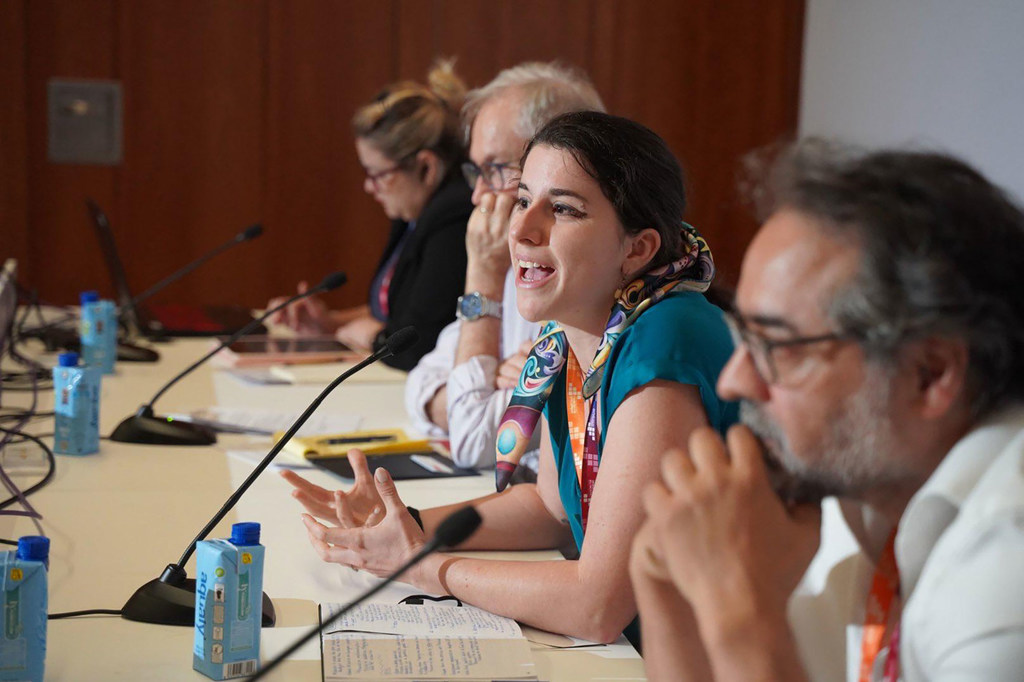
Paula Sevilla, International Institute for Environment and Development.

However, organizations warn that there is still a long way to go before promises translate into tangible action.

Good timing

That is the message from Paula Sevilla, a representative of the International Institute for Environment and Development (IIED) – a London-based research centre – who has worked for decades on sustainability and climate justice in Latin America, Africa, and Asia.

“This summit has come at a crucial time to try to restore faith in international cooperation, especially after the pandemic, which exposed a lack of global solidarity,” she stated.

One of IIED’s main goals in Sevilla has been to ensure that the announced financial commitments actually reach local communities at the forefront of the climate crisis.

To that end, the organization emphasizes the need to address issues such as external debt – draining public budgets – and to support innovative mechanisms like blended finance to direct resources to those who need them most.

“We’re seeing countries spend more on debt payments than on healthcare or education, while inequalities are deepening,” the expert warned, speaking shortly after a respectful but forceful protest inside the conference centre.

A place to call home

Housing solutions linked to sustainable development are notably absent from the summit’s final document.

“It’s regrettable that it’s not even mentioned, at a time when we are facing a global cost-of-living crisis – not only in the Global South but also here in Spain. Housing is a source of anguish and distrust among citizens, and it has been completely ignored,” Ms. Sevilla said.

Despite this, her organization is working to leverage the Sevilla outcome to find ways to channel funding into providing more affordable homes.

Commenting on the initiative led by Spain and Brazil to work towards fair taxation and push back against tax avoidance by the world’s richest – promoting more transparency and accountability – the IIED representative said it could be a useful path toward correcting structural inequalities.

Tax for development

We need leadership from the Global North, where many of the world’s major tax-avoiding corporations are based. Without their commitment, we won’t move forward,” she stated.

She also criticized the absence of the United States from the summit – not  only as a diplomatic setback but also as a worrying precedent following the dismantling of its international development agency, USAID.

“We’re talking about people counting their pills to figure out how many days of life they have left. This is dramatic,” she emphasised.

With just five years remaining to meet the Sustainable Development Goals, Ms. Sevilla warned that time is running out – and that the Sevilla Commitment will be meaningless without real change.

We need political leadership, a will to cooperate, and a commitment to protect democratic space. In the end, it’s organized people who keep hope alive and hold leaders accountable,” Sevilla concluded.

The Sevilla Commitment in brief:

  • The Sevilla Commitment sets out a new global roadmap to raise the trillions of dollars needed each year to achieve sustainable development, building on previous international agreements
  • It calls for fairer tax systems, cracking down on tax evasion and illicit financial flows, and strengthening public development banks to support national priorities
  • The agreement highlights the need for new tools to ease debt pressures on vulnerable countries, including debt-swap schemes, options to pause payments during crises, and better transparency
  • Countries committed to boosting the capacity of multilateral development banks, increasing the use of special drawing rights, and attracting more private investment to support development
  • It also aims to make the global financial system more inclusive and accountable, with improved coordination, stronger data systems, and broader participation from civil society and others

The Commitment launches the Sevilla Platform for Action, which includes over 130 initiatives already underway to turn the pledges into real-world results.

Source link