UN forum affirms stronger commitment to achieve sustainable development

At the end of the conference, Member States adopted a Ministerial Declaration by a vote of 154-2-2, with the United States and Israel voting against the document and Paraguay and Iran abstaining.  

“We strongly reaffirm our commitment to effectively implement the 2030 Agenda [which]… remains our overarching roadmap for achieving sustainable development and overcoming the multiple crises we face,” the declaration said.  

15 years of HLPF

The HLPF has happened on an annual basis since 2010 and is convened by the Economic and Social Council (ECOSOC) to discuss the progress, or lack thereof, on the 17 Sustainable Development Goals (SDGs), which were adopted in 2015 as part of the 2030 Agenda and aspire to create a more equitable and inclusive world.

This year, the forum focused on five of these goals: good health and wellbeing, gender equality, decent work and economic growth, life below water and partnerships.

Negotiations regarding the ministerial document were led by representatives from Czechia and St. Vincent and the Grenadines, who highlighted the significance of the proceedings.  

“This year’s deliberations have held particular significance. Ten years after the adoption of the 2030 Agenda, a range of interlinked and persistent challenges continues to jeopardise the full realisation of the SDGs,” said Jakub Kulhánek, permanent representative of Czechia and one of the two lead facilitators of the declaration.  

The clock is ticking

In the ministerial declaration, Member States said that time is running out to achieve the SDGs, which remain severely off track.  

According to the Secretary-General’s report on the Goals, which was released on the first day of the HLPF, only 18 per cent of the SDGs are on track to be achieved by 2030, with over half making progress that is too slow.  

While the ministerial declaration addressed each of the five SDGs in the spotlight at the forum, Member States particularly emphasised the role of poverty in impeding sustainable development and the worsening climate crisis that is threatening all aspects of the development agenda.  

The declaration called both of these issues some of the “greatest global challenges” that the world faces.

In keeping with SDG 16, which underlines the role that institutions like governments must play in promoting peace, Member States also affirmed that strong governance and partnership is essential to realising peace as a prerequisite for development.

“We recognise that sustainable development cannot be realised without peace and security, and peace and security will be at risk without sustainable development,” it stated.

Plan of Action

In the midst of challenges to multilateralism, Member States said that the declaration was an affirmation of the UN’s commitment to multilateralism, which is celebrating its 80th anniversary this year.

“At a time when serious doubts about the future of multilateralism persist, your steadfast commitment has been both reassuring and inspiring,” said Mr. Kulhánek.

Member States, in the declaration, affirmed a commitment to urgently working towards the SDGs in order to achieve a better world.  

“We will act with urgency to realise its vision as a plan of action for people, planet, prosperity, peace and partnership, leaving no one behind.” 

Source link

In Baghdad, Guterres affirms UN will never forget staff killed in Canal Hotel attack

António Guterres was speaking during a wreath-laying ceremony at a memorial in Baghdad to honour the victims of the 19 August 2003 Canal Hotel bombing – the worst terrorist attack in UN history.

Twenty-two people were killed, including the then UN Special Representative for Iraq, Sergio Vieira de Mello.  More than 100 others were injured, and several survivors attended the ceremony.

Families still mourning

Mr. Guterres told the audience that “22 years is a long time, but we will never forget the colleagues who were killed that day in the bombing at the Canal Hotel.”

These staff members “were sons, daughters, mothers, fathers and friends who are, to this day, mourned by those they knew and loved,” he said.

“We will always remember their leader, Sergio Vieira de Mello, who was also killed in the attack. We will stand with the survivors whose lives were changed forever,” he added.

“And we will remember the courageous colleagues and others who rushed to help on that terrible day, and in the days and weeks after — showing us the very best of the humanitarian spirit.”

A tribute and reminder

Mr. Guterres said the memorial stands as a tribute to their lives and their contributions to the people of Iraq.  It also serves as a reminder of how far the country has come since 2003.

He noted that the women and men of the United Nations have worked tirelessly together with the brave and resilient people of Iraq to support their quest for stability, development and peace.

He stressed that above all, the memorial is “a clear reminder of the vital work that our organization does around the world — and the dangers our people face in carrying out that work.”

Remembering humanitarians worldwide

Five years after the attack the UN General Assembly adopted a resolution designating 19 August as World Humanitarian Day.

This date “has been forever transformed from a day of unimaginable horror and tragedy here in Iraq into a global day of solemn remembrance for all humanitarians — inside and outside the organization,” Mr. Guterres said.

“Their bravery, dedication, and belief that a better future is possible will always inspire us. And like those whose lives were lost on 19 August 2003, their sacrifices and contributions to our world — and to our vital cause of peace — will never be forgotten.”

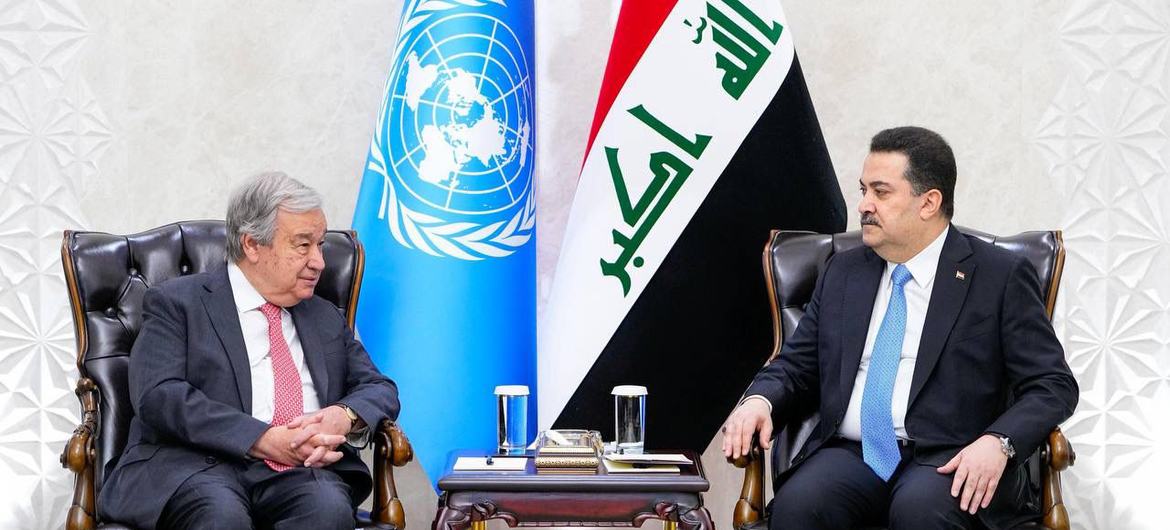
The UN Secretary-General meets with H.E. Mr. Mohammed Shia’ Al Sudani, Prime Minister of the Republic of Iraq.

Meeting with Iraqi Prime Minister

The Secretary-General was in Baghdad to attend the League of Arab States Summit. He also met with senior Iraqi officials, including Prime Minister Mohammed Shia Al-Sudani.

During talks on Sunday, they discussed developments in Iraq and the region, as well as the remaining period of the UN Assistance Mission for Iraq (UNAMI).

The Secretary-General reaffirmed that the UN remains fully committed to continuing to support the Government and people of Iraq following the mission’s departure.

UNAMI has been in the country since 2003 and is working to conclude its mandate by the end of the year.

Source link