
On the road in war-torn Gaza

Moving around Gaza has become ever more difficult amid the ongoing 21-month-long war.

Mr. Saad, who was displaced from the town of Beit Lahia in the northern Gaza Strip, was waiting for the vehicle pulling the cart he was sitting in to move.

“Transportation is very difficult and unsafe,” he told UN News. “The roads are exhausting. We pray to God to grant us patience and to return home.”

This was on Rashid Street, west of the city, which connects the north and south of the Strip. It is crowded with carts, cars and three-wheeled motorcycles that have also been converted into means of transportation.

The area is interspersed with tents of displaced people, all surrounded by the rubble of buildings destroyed by war on both sides of the road.

War and evacuation orders have left many in Gaza scrambling for transportation to safety.

A luxury not for everyone

“People can barely find enough to eat, so how will they pay for transportation?” Umm Haytham Al-Kulak asked while waiting in a passenger compartment attached behind a motorcycle,

“We walk mostly; we can’t take public transportation,” she said.

“May God help the drivers. Fuel prices are high, and all the people are exhausted and overwhelmed.”

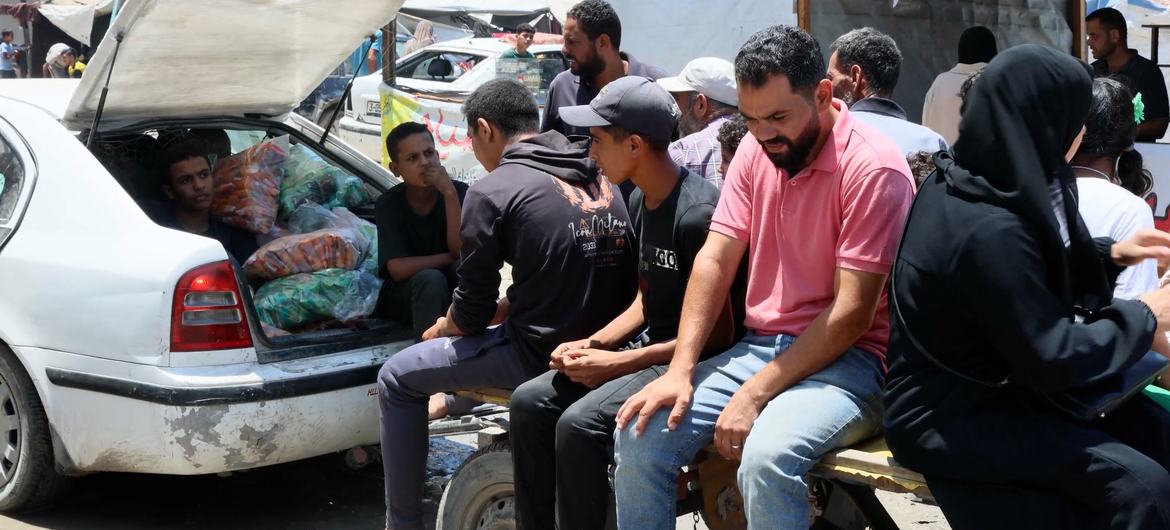
In Gaza, many people have no choice but to use risky ways to get around during the ongoing war.

Sky high fuel costs

Drivers are paying skyrocketing prices for fuel, which is a heavy burden, Abdel Karim Abu Asi said as he waited for his car to be fully loaded with passengers.

“The price of a litre of diesel has reached 100 shekels [around $27],” he said. “What should we do? We’re trying to use locally produced fuel, but it causes significant damage to cars and a lot of problems.”

This isn’t the only problem facing drivers. Mr. Abu Asi said the prices of spare parts are very high. A part that used to cost around 100 shekels now sells for around 2,000 shekels, or around $560.

“We also suffer from the destruction of the streets, and no matter how hard the municipalities try to repair them, the problem is not solved because they require a large number of bulldozers to clear them,” he said.

“People must be helped with transportation costs and many other aspects.”
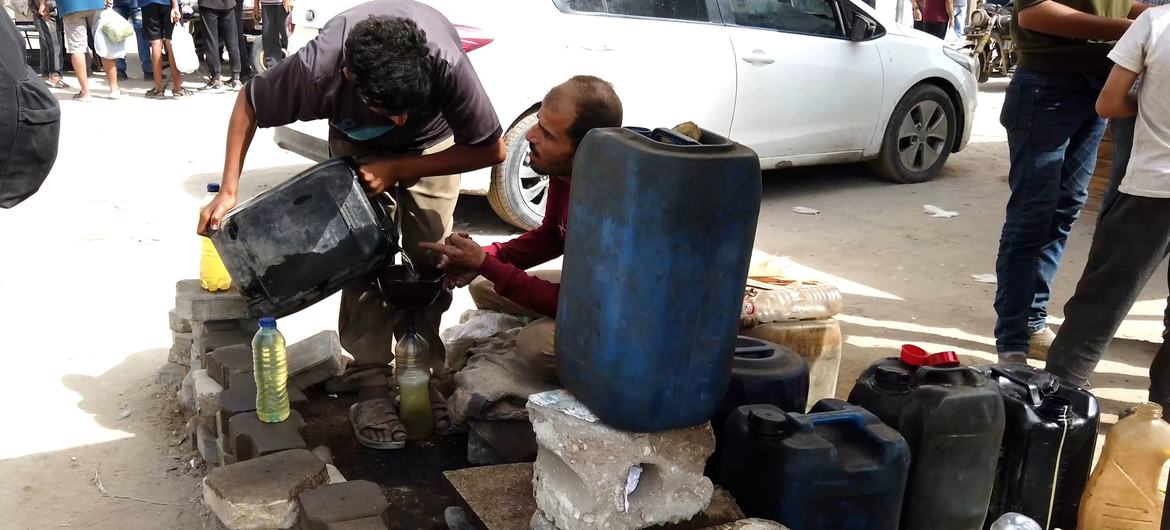
Fuel vendors sell their products at sharply inflated prices, with a litre of fuel reaching around 100 shekels.

Only option

Despite all the challenges, people there continue to go about their daily lives, even if it takes all day to get from one place to another. That’s what happened to Hussein Al-Hamarneh, who was waiting in a car to travel to the southern Gaza Strip.

Mr. Al-Hamarneh believes that most of these means of transportation are “uncomfortable, such as tuk-tuks [three-wheeled motorcycles] and carts pulled by cars, which are primarily designed to transport goods or animals, not people”.

“This is the only option for those who do not own cars,” he said.

Tayseer Abu Asr, who arranges for passengers to board a cart pulled by a car, stood on the section of the road.

“We’re trying to help people get around,” he said. “These carts have become our only means of transportation after the destruction of buses and taxis.”

On top of these challenges during the ongoing war, the Gaza Strip is facing a fuel crisis.

UN agencies warned earlier this week that the fuel shortage in Gaza has reached critical levels. They said if supplies run out, it will place an unbearable new burden on the population.
Ukraine: Ceasefire a critical first step on the road to durable peace

Under-Secretary-General Rosemary DiCarlo addressed ambassadors alongside UN deputy relief chief, Joyce Msuya, who updated on the dire humanitarian situation in the country amid ongoing Russian attacks.

Ms. DiCarlo said the meeting was taking place at a potential inflection point in the three-year war, as the past few weeks have seen intensified shuttle diplomacy towards a possible peace deal. 

‘Glimmer of hope’

These initiatives offer a glimmer of hope for progress towards a ceasefire and an eventual peaceful settlement,” she said.

“At the same time, we continue to witness relentless attacks on Ukrainian cities and towns.”

Russian forces have carried out recent deadly strikes, such as the massive, combined missile and drone attack last week on several regions, including the capital Kyiv.  

Multiple residential buildings in the city were hit. At least 12 people were reported killed and more than 70 others injured, including children, making it the deadliest attack on the capital in nine months. 

This followed several other deadly strikes, including one in Sumy city on Palm Sunday that reportedly killed 35 people.  Another in Kryvyi Rih killed 18, including nine children – the deadliest single strike against children since the start of the full-scale Russian invasion.

The UN human rights office, OHCHR, verified that as of 24 April, 151 civilians have been killed, and 697, injured so far this month in Ukraine. 

Verification is ongoing, but numbers are expected to surpass the March figures, which were already 50 per cent higher than in February.

She also noted recent media reports quoting local Russian authorities that indicate civilian casualties in the Kursk, Bryansk and Belgorod regions in Russia, including alleged Ukrainian strikes on 23 and 24 April that reportedly killed three people in the Belgorod region.

“We condemn all attacks against civilians and civilian infrastructure, wherever they occur,” she said.

Diplomatic efforts encouraged

Ms. DiCarlo noted that the UN Secretary-General has repeatedly called for de-escalation and a durable ceasefire in Ukraine.

“In this regard, we are encouraged by the diplomatic efforts underway,” she said.

“We take note of yesterday’s announcement by the Russian Federation of a 72-hour truce planned for the period from 8 to 10 May.”

It follows a similar Russian announcement on 19 April of a 30-hour Easter truce, “and Ukrainian authorities reportedly agreed to mirror any such steps, reiterating their earlier support for a 30-day ceasefire proposed by the United States,” she said.

“Regrettably, hostilities continued during Holy Week, with both sides accusing each other of violations.”

She recalled that a month earlier, the Secretary-General welcomed separate announcements by the US, Russia and Ukraine regarding a 30-day moratorium on strikes against energy infrastructure and the resumption of negotiations on the safety of navigation in the Black Sea.

Despite these commitments, however, attacks against energy infrastructure persisted,” she said. 

Political will valuable

Ms. DiCarlo said the continued exchange of prisoner of war by both sides – including the largest to date, when 500 people were swapped on 20 April – “shows that with political will, diplomacy can yield tangible results even in the most difficult circumstances.”

She concluded her remarks by pointing to the forthcoming 80th anniversary of the Second World War, which serves as a reminder “with even greater urgency” of the centrality of the UN Charter and international law in safeguarding peace and security.

“The Russian Federation’s full-scale invasion of Ukraine stands as an egregious challenge to these fundamental principles, jeopardizing stability in Europe and threatening the broader international order,” she said.

“What is needed now is a full, immediate and unconditional ceasefire as a critical first step towards ending the violence and creating the conditions for a just, comprehensive and sustainable peace.”

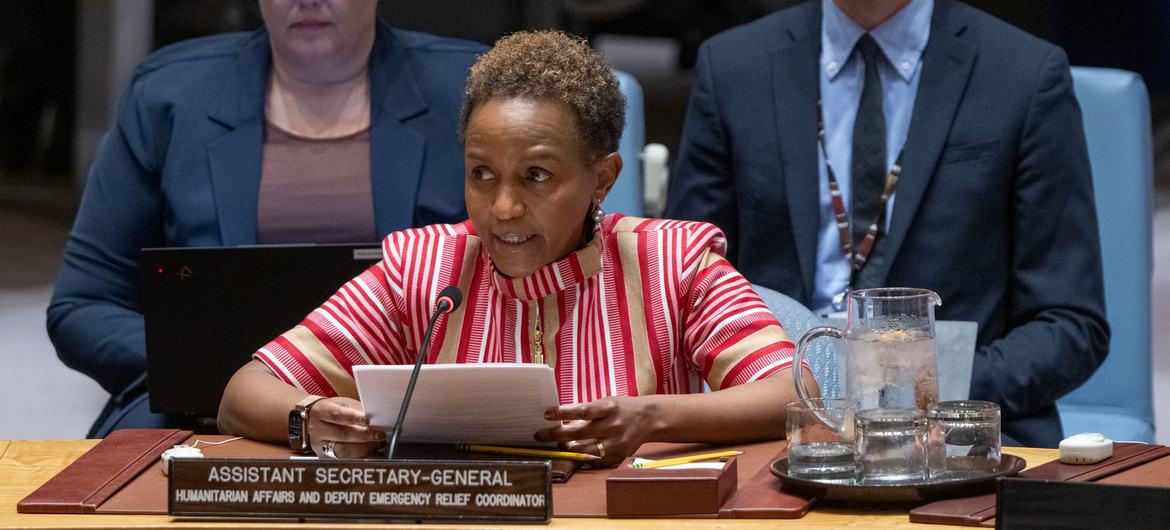
Joyce Msuya, UN Deputy Emergency Relief Coordinator, briefs the Security Council meeting on maintenance of peace and security of Ukraine.

Millions in need

Ms. Msuya reported that the humanitarian situation in Ukraine has worsened despite ceasefire opportunities. Overall, nearly 13 million people need assistance.

“So far this year, not a single day has passed without civilians being killed or injured in attacks,” she said. 

The operating environment also remains highly dangerous for humanitarians. 

Aid workers under attack

“From 1 January to 23 April, there were 38 verified security incidents impacting humanitarian staff within 20 kilometers of the frontline. This has left three aid workers dead and 21 injured while delivering life-saving assistance,” she said.

Ms. Msuya reiterated earlier calls for the Council to take urgent, collective action on Ukraine in three areas.

She urged ambassadors to ensure the protection of civilians – including humanitarian and health workers – and critical infrastructure. 

Her second point stressed the need to increase financial support for humanitarian operations as underfunding is forcing critical programmes to scale down. 

Finally, she called for a just peace: “Every effort, whether aimed at a temporary pause or a lasting agreement, must prioritize the protection and needs of civilians.” 

Source link