UN rights chief decries US treatment of migrants, as deaths in ICE custody rise

In a news release on Friday, High Commissioner Volker Türk said individuals suspected of being undocumented migrants are being surveilled, arrested and detained – sometimes violently – in locations ranging from hospitals and places of worship to courthouses, schools, markets and private homes.

The UN rights chief said he was “astounded by the now-routine abuse and denigration of migrants and refugees.

He warned that fear generated by such federal operations is rippling through communities, with children missing school and medical appointments, out of concern that their parents may not return.

Those who dare to speak up or protest peacefully against heavy-handed immigration raids are vilified and threatened by officials, and on occasion subjected to arbitrary violence themselves,” Mr. Türk said.

He said numerous migration policies now being implemented by US authorities are resulting in arbitrary and unlawful arrests and detentions, as well as flawed removal decisions. He expressed concern that enforcement actions often lacked sufficient individualised assessments.

Due process

US immigration enforcement is primarily carried out by the Immigration and Customs Enforcement (ICE), a federal agency responsible for identifying, arresting, detaining and removing non-citizens deemed to be in violation of immigration law.

Mr. Türk stressed that while national governments have the authority to establish and enforce migration policies, those powers must be exercised in full accordance with the law. Failure to respect due process, he said, risks eroding public trust, weakening institutional legitimacy and violating individuals’ rights.

He also deplored Washington’s use of large-scale enforcement operations, raising concerns that force has at times appeared unnecessary or disproportionate.

On 7 January 2026, a woman was fatally shot in Minnesota’s largest city, Minneapolis, during an operation involving federal officers.

Under international law, the intentional use of lethal force is only permissible as a measure of last resort against an individual representing an imminent threat to life,” Mr. Türk said.

Families torn apart

The UN rights chief highlighted the human cost of these practices, particularly for families.

Mr. Türk cited cases in which parents were detained or transferred between facilities without adequate information being provided about their whereabouts or access to legal counsel, making it difficult to maintain family contact or pursue legal remedies.

“I call on the administration to end practices that are tearing apart families,” said the High Commissioner. He also called for independent and transparent investigations into a reported rise in the number of deaths in ICE custody.

At least 30 deaths were reported last year, with six more so far this year.

‘Xenophobic hostility’

Mr. Türk also expressed deep concern over what he described as “dehumanising narratives” used by some Government officials to portray migrants and refugees.

I call on leaders at all levels in the US to halt the use of scapegoating tactics that seek to distract and divide, and which increase the exposure of migrants and refugees to xenophobic hostility and abuse,” he said.

He also recognised the efforts of a wide range of public officials, community groups and civil society representatives across the US, who are working to uphold dignity, fairness and accountability in the treatment of migrants and their communities.

Net benefits of migration

He highlighted that the US’ history has been “shaped profoundly” by the contributions that migrants, from all parts of the world, have made and continue to make.

“Demonising migrants and refugees collectively as criminals, threats, or burdens on society – based on their origin, nationality or migration status – is inhuman, wrong, and it goes against the very fabric and foundations of the nation,” he warned.

Source link

‘This is not just ice’: Glaciers support human livelihoods, UN deputy chief says

Located in north-central Tajikistan, the glacier is a vital water source for many communities in Central Asia, feeding rivers and helping to sustain millions of lives and livelihoods.

But due to climate change, it is melting. Quickly. Over the past 80 years, it lost the equivalent of 6.4 million Olympic sized pools of water.

The International Conference on Glaciers Preservation, held 29 May – 1 June in Tajikistan’s capital Dushanbe, is highlighting the ways in which glacier retreat threatens lives and livelihoods worldwide.

“This is not just ice. This is food, water and security for generations to come,” said Ms. Mohammed.

‘Our glaciers are dying’

Glaciers, along with ice sheets, store approximately 70 per cent of the world’s freshwater, making them essential for human survival and economies. But five of the past six years have witnessed the most rapid glacier retreat on record.

“Our glaciers are dying,” said Celeste Saulo, Secretary-General of the World Meteorological Organization (WMO), a co-organizer of the conference.

“The death of a glacier means much more than the loss of ice. It is a mortal blow to our ecosystems, economies, and social fabric.”

Melting glaciers increase the likelihood and severity of floods and mudslides, in addition to impacting various industries such as agriculture and forestry.  

Bridging science and action 

Ms. Mohammad said that the rate of glacier retreat means that the international community must take immediate action. 

“The time to act is now for our people and our planet,” she said.  

The conference in Dushanbe has worked to elevate glacier preservation to the top of the worldwide climate agenda ahead of the UN COP30 climate change conference in Brazil this November.

Ms. Saulo emphasized that strengthening glacier monitoring and improving warning systems for glacier collapse will help “bridge science and services.” She also said that this must all translate into concrete action to slow glacier retreat.  

In Tajikistan specifically, Parvathy Ramaswami — the UN Resident Coordinator in the country — said that they have focused on supporting farmers through training and knowledge transfer for local communities.  

“[The training] means that more children are safe from disasters, they can go to school, learn and grow,” she explained. “Families and communities become resilient and prosper.” 

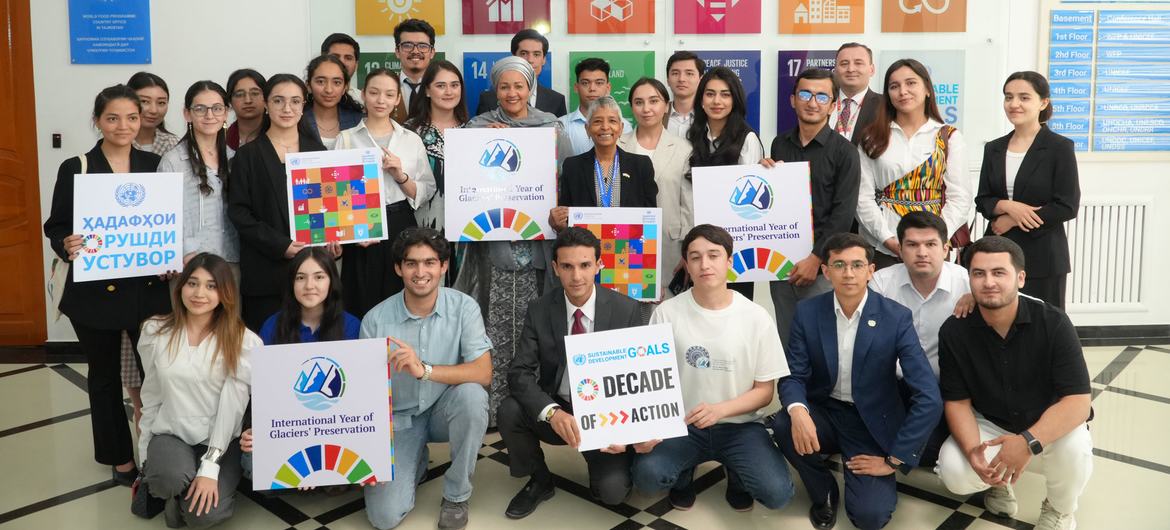
Deputy Secretary-General Amina Mohammed (centre) with Model UN youths and Ambassador for a Day in Tajikistan.

Intergenerational conversations

In Tajikistan, the Deputy Secretary-General met with many youth climate activists. She emphasized that actions to address glacier retreat must be intergenerational, much like the conversations which the conference encouraged. 

“The global decisions we are shaping today will affect [young people’s] lives. So to think that we can begin to shape a person’s future without them, really doesn’t bode well for the rights that they have to determine their future, their aspirations,” she said.

In giving advice to younger generations, she expressed hope that young activists would continue to advocate for their vision of the future. 

“They should continue to raise their voices, they should continue to have their courage of conviction, they should remember that this is about a life journey and they need to make every step count.” 

‘On thin ice’: UN chief sounds alarm over rapid Himalayan glacier melt

António Guterres issued the warning in a video message to the inaugural Sagarmatha Sambaad, or “Everest Dialogue,” convened by the Government of Nepal in Kathmandu.

Record temperatures have meant record glacier melt,” he said.

“Nepal today is on thin ice – losing close to one-third of its ice in just over thirty years. And your glaciers have melted 65 per cent faster in the last decade than in the one before.”

Named after Mount Everest (Sagarmatha in Nepali), the international platform convened ministers, parliamentarians, climate experts, and civil society to focus on climate change, mountain ecosystems, and sustainability.

Secretary-General’s video message.

Two billion futures at stake

Glaciers in the region have served for centuries as vital freshwater reservoirs. Their accelerated melt now threatens not only local communities but vast populations downstream who rely on Himalayan-fed rivers.

Reduced water flow in river systems such as the Ganges, Brahmaputra and Indus threatens not only water but also food production for nearly two billion people across South Asia.

Combined with saltwater intrusion, this could trigger collapsing deltas and mass displacement, the UN chief warned.

“We would see low-lying countries and communities erased forever,” he said.

Children raise their voices

Ahead of the summit, Nepal’s children and youth stepped into the spotlight with their own call to action.

In a declaration submitted to the dialogue, over 100 children and young people demanded urgent and inclusive climate action that recognizes them as rights-holders and climate actors – not just passive victims.

Among their key demands: ensuring child participation in climate decisions, supporting youth-led programmes, and promoting their innovations and climate action.

The climate crisis is a child rights crisis – disproportionately impacting their health, nutrition, education and well-being,” said Alice Akunga, head of the UN Children’s Fund (UNICEF) in Nepal, which supported the deliberations.

“Listening to the voices of the ‘future of humanity’ is critical to designing and implementing meaningful and lasting solutions to address the adverse effects of climate change on children and youth.”

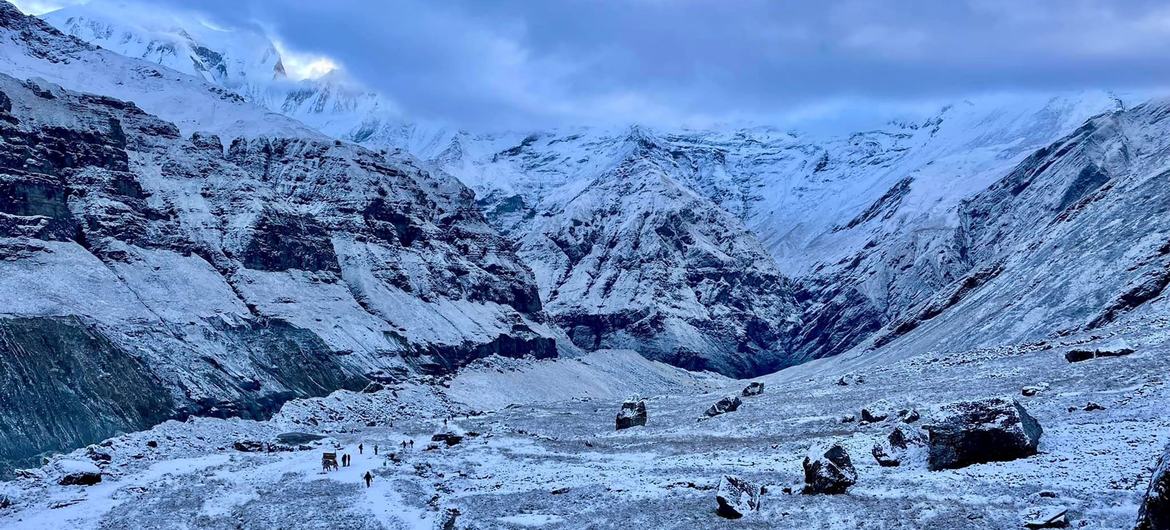
Glaciers in the high Himalayas, like those in Nepal’s Langtang region (pictured), feed major South Asian river systems sustaining tens of millions of lives and livelihoods downstream

Stop the madness

In his message, Mr. Guterres reiterated his call on the world to “stop the madness” of fossil fuel-driven global warming, a warning he made during his previous visit to the Everest region in 2023.

At the time, he stood amid glacial basins in the Himalayas, warning that the “rooftops of the world” were rapidly vanishing.

“And that is why you are gathered together focused on Sambaad – dialogue,” the UN chief said on Friday, applauding Nepal’s climate leadership, including reforestation programmes, early warning systems and its goal to achieve net-zero emissions by 2045.

Act now

The world must act without delay to limit global temperature rise to 1.5°C, he continued – the target set by the Paris Agreement on climate change – with the biggest emitters leading the way.

This includes investing in renewable energy, fulfilling the $1.3 trillion climate finance goal agreed at COP29, doubling adaptation finance to at least $40 billion this year as pledged by developed countries, and providing robust, sustained support to the Loss and Damage Fund.

Achieving these goals demands bold collaboration,” Mr. Guterres concluded. “The United Nations is your ally in this essential task.”