Game-changing international marine protection treaty comes into force

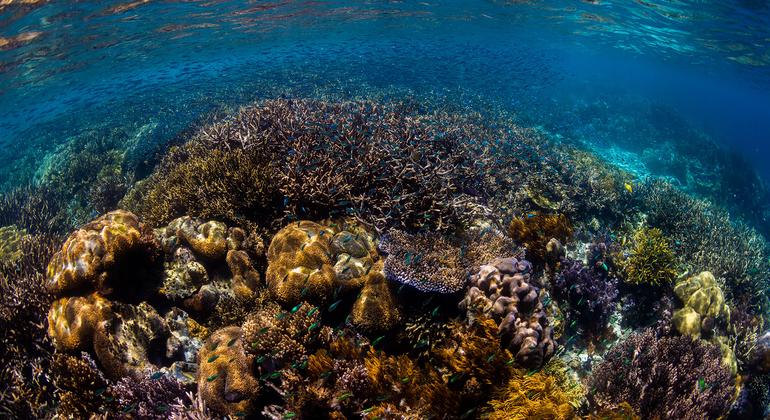
Officially known as the Biodiversity Beyond National Jurisdiction (BBNJ) Agreement, the legally binding UN treaty covers the ocean zones that lie beyond national waters (the “high seas”) and the international seabed area. 

These regions make up over two-thirds of the ocean’s surface, representing over 90 per cent of Earth’s habitat by volume. This is because the ocean is deep, and most living space on Earth is underwater.

Here are some of the key things to know: 

Why it matters

The BBNJ is designed to transform the “high seas” and international seabed into an environment to be managed sustainably for the benefit of all humanity. 

It is also the first legally binding ocean instrument to provide for inclusive ocean governance, with provisions on the engagement of Indigenous Peoples and local communities and on gender balance.

It is hoped that, once it is fully implemented, the Agreement will make a vital contribution to addressing the so-called “triple planetary crisis” of climate change, biodiversity loss and pollution.

Speaking to UN News, Tanzanian diplomat Mzee Ali Haji, who led his country’s negotiation team during BBNJ discussions, said that the agreement marks a major step in the protection of international waters. 

© The Ocean Story/Vincent Kneefel

Everyone should bear in mind that there is now control of the activity in the high seas. For instance, when you pollute, you are responsible for your acts”.

The BBNJ strengthens the current international legal framework: it builds on the UN Convention on the Law of the Sea – in effect the “constitution for the oceans” – which has set the rules for maritime and seabed exploitation and marine protection since it came into force in 1994.

The agreement addresses gaps in the Convention, includes more detail on how to manage biodiversity and aligns ocean governance with modern challenges like climate change and the 2030 Agenda for Sustainable Development (the UN-brokered blueprint for solving the world’s most intractable challenges).

What does ‘entry into force’ mean?

After the entry into force, it becomes legally binding for the 81 nations that have ratified it so far, meaning that they agree to incorporate it into their national legislation.

The treaty specifies that it enters into force this Saturday: 120 days after it was ratified – accepted as legally by binding – by at least 60 countries.

Who’s signed up, and who hasn’t?

Many major economies have ratified the BBNJ, notably China, Germany, Japan, France and Brazil

China has a particularly important impact on industries connected to the ocean (such as shipbuilding, aquaculture, fisheries and offshore oil and gas), exporting some $155 billion of ocean-related goods in 2023, according to UN trade agency figures.
The holdouts include the United States, India, the UK and Russia.

The US, the world’s biggest economy, is one of the top five ranked ocean-related goods exporters ($61 billion). Although the country adopted the treaty in 2023, it is not yet ratified, and the Senate has not acted on it.

India, one of the top developing-economy exporters ($19 billion), adopted the treaty in 2024 but domestic legislation on ratification is still pending. While the UK did introduce legislation on the matter in 2025, parliament is still to ratify it.

Russia remains one of the minority of nations that has neither adopted nor ratified the treatyciting its wish to preserve existing governance frameworks, and ensure that freedom of navigation and shipping in international waters is guaranteed.

Is this a big setback for the treaty?

Despite the reluctance of some major economies to commit fully by ratifying, Mr. Haji is positive about the impact that the BBNJ, in its current state, will have.

 “Developing countries and small island countries need support,” he says. “We expect that, in the future, they will accept this agreement, because it will help them. The protection of the high seas is the responsibility of all of us.”

What happens next?

The door remains open for more countries to ratify, which will make it more effective. 

“When you negotiate something, you can’t get 100 percent people to ratify it or to accept it in one term,” says Mr. Haji. “Some just observe and then, when they see the advantages, they join. I believe that, in the future others will join”.

Apart from universal participation, the key to making the BBNJ work will be implementation – in other words, acting against those who break the rules. 

According to the text of the agreement, the first meeting to monitor progress on both these fronts will take place no later than one year after the Agreement’s entry into force.

UN ‘high seas’ treaty clears ratification threshold, to enter into force in January

Morocco and Sierra Leone joined the list of States ratifying on Friday, becoming the 60th and 61st parties to the pact.

The treaty, formally known as the Agreement under the United Nations Convention on the Law of the Sea on the Conservation and Sustainable Use of Marine Biological Diversity of Areas beyond National Jurisdiction (BBNJ agreement), was adopted by UN Member States in June 2023 after nearly two decades of negotiations.

Secretary-General António Guterres welcomed the development, calling it a “historic achievement for the ocean and for multilateralism…  In two years, States have turned commitment into action – proving what is possible when nations unite for the common good,” he said in a statement.

“As we confront the triple planetary crisis of climate change, biodiversity loss, and pollution, this agreement is a lifeline for the ocean and humanity.”

The pact, also called the “high seas treaty,” covers two-thirds of the world’s ocean area that lies beyond national boundaries. It establishes legally binding rules to conserve and sustainably use marine biodiversity, share benefits from marine genetic resources more fairly, create protected areas, and strengthen scientific cooperation and capacity building.

UN Environment Programme (UNEP) Executive Director Inger Andersen also hailed the milestone. “Our ocean is the foundation of our very existence. Today we took an important step forward to save our ocean, and to save our future,” she said in a post on social media.

Safeguarding humanity’s future

The BBNJ agreement builds on the UN Convention on the Law of the Sea, regarded as the “constitution for the oceans.”

Once the high seas treaty enters into force on 17 January 2026, it will provide a global framework to help achieve international biodiversity targets, including the pledge to protect 30 per cent of land and sea areas by 2030 under the Kunming-Montreal Global Biodiversity Framework.

Mr. Guterres urged all remaining UN Member States to join the treaty without delay and called on partners to support its swift and full implementation. “The ocean’s health is humanity’s health,” he said.

ALSO READ: London’s Far-Right Rally Sends Shockwaves Through South Asian Communities

‘Peace is the most powerful force for a better future’: Guterres

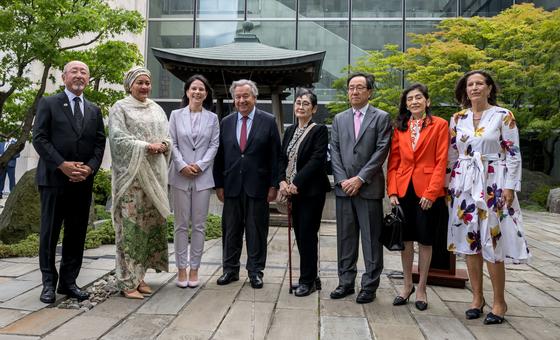
António Guterres issued the call during the annual ceremony on the grounds of UN Headquarters in New York to ring the Peace Bell.

Pursuing the cause of peace is “the beating heart” of the Organization, “but today, peace is under siege,” he said.

“Conflicts are multiplying. Civilians are suffering. Human rights and international law are being trampled – leaving scenes that disgrace our common humanity.” 

Peace requires action

The ceremony comes ahead of the International Day of Peace on 21 September, and the theme this year is “Act Now for a Peaceful World”.

“We know that peace doesn’t happen by accident,” the Secretary-General said. “It is forged – through courage, compromise, and above all, action.”

He called for action “to silence the guns”, amplify diplomacy, protect civilians and uphold the UN Charter.

“We must act – to tackle the root causes of conflict – from inequality and exclusion, to hate speech, and climate chaos. We must act – to invest in prevention, dialogue and trust,” he continued.

“And we must act to support the peacebuilders – especially women and young people – who are on the frontlines of hope.”

Don’t give up: General Assembly President

The President of the UN General Assembly, Annalena Baerbock, also addressed the gathering.

Amid numerous conflicts worldwide, she questioned whether there would be less war without the United Nations, responding firmly that “definitely not.”

“This is not the moment to give up,” she said.  “It’s a moment to try even harder.”

‘Let peace ring’

The Secretary-General said that “peace is the most powerful force for a better future,” insisting that “it is within our grasp – if we choose it.”

This is the message of the Peace Bell, he added, cast in 1952 from coins and medals donated by people from all the over the world, “united in their yearning for peace”.

“This Peace Bell reminds us that even the smallest contributions can forge something enduring,” he said.

“Even in a fractured world, we can come together to let peace ring. Let’s answer that call.”

About the Peace Bell

The Japanese Peace Bell was presented as a gift to the United Nations from the UN Association of Japan on 8 June 1954.

On its side are eight Japanese characters that say, “Long live absolute world peace.”  

It is housed in a wooden structure resembling a traditional Shinto shrine.

The bell is rung twice a year on the first day of Spring, at the vernal equinox, and to commemorate the International Day of Peace.   

Source link

At least eight drown in Red Sea as smugglers force migrants overboard

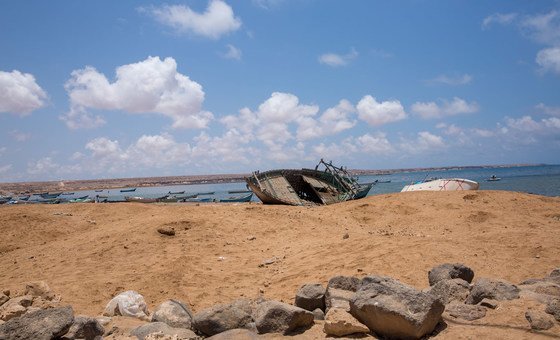
At least eight people are feared dead and 22 others are missing after smugglers stopped a boat carrying around 150 passengers likely bound for Yemen on 5 June.

“These young people were forced into impossible choices by smugglers who show no regard for human life,” said Celestine Frantz, the UN migration agency’s Regional Director for the East, Horn and Southern Africa. “We are doing everything we can to support the survivors and prevent further loss along this deadly route.”

Rescue mission

Search and rescue operations supported by the International Organization for Migration, IOM, have recovered five bodies from the sea near Moulhoulé in northern Djibouti. The confirmed death toll stands at eight but this is expected to rise as search efforts continue.

IOM said that in the days following the incident, many of those rescued were found in the desert by the UN agency’s mobile patrols. They are now receiving urgent medical care at a local hospital and psychosocial support at the IOM-run Migrant Response Center in Obock, Djibouti.

Thousands of migrants from the Horn of Africa risk their lives every year to reach the Gulf States via Yemen where they hope to find work.

So far this year, 272 people have been confirmed dead on the Eastern Mediterranean migrant route which includes the Djibouti to Yemen leg. This includes both land and sea routes, according to IOM data.

“This latest tragedy is part of a series of fatal maritime incidents off the coast of Djibouti, underscoring the urgent need for stronger protection mechanisms for migrants along the migration route between the Horn of Africa and Yemen,” IOM said.
Warning that this latest deadly incident is part of a growing crisis, the UN agency has called for increased international support to strengthen search and rescue operations and expand access to safe migration pathways.

Libya focus

In a related development, IOM reported on Tuesday that the bodies of 10 migrants had washed ashore near Marsa Matrouh in Egypt.

The dead are believed to have set sail from the Libyan coast which is often used by people smugglers to traffic migrants across the Mediterranean Sea to Europe.

More than 32,000 people are known to have drowned in the Mediterranean Sea since 2014 “with an unknown number still missing”, IOM’s Missing Migrants Project said.

Source link

Gaza: New displacement orders force thousands to flee as famine looms

In addition to ongoing bombardment, Israel issued another three displacement orders over the past two days, covering seven per cent of the total area of the territory. 

Overall, some 71 per cent of the Gaza Strip is under displacement orders or in Israeli-militarized zones, where the Israeli authorities require humanitarian teams to coordinate their movements. 

These displacement orders come as populations across Gaza are at risk of famine and one in every five people faces starvation,” the agency said.

Thousands uprooted

Evacuation orders announced on Thursday have impacted thousands of residents in 10 neighbourhoods in Deir Al-Balah and Khan Younis, OCHA reported.

Initial assessment indicates that the affected area includes eight wells, five reservoirs, seven humanitarian warehouses, three health clinics and other critical facilities. 

Furthermore, displacement orders issued on Wednesday for six neighbourhoods in North Gaza governorate overlap with parts of zones covered under orders issued the previous day.

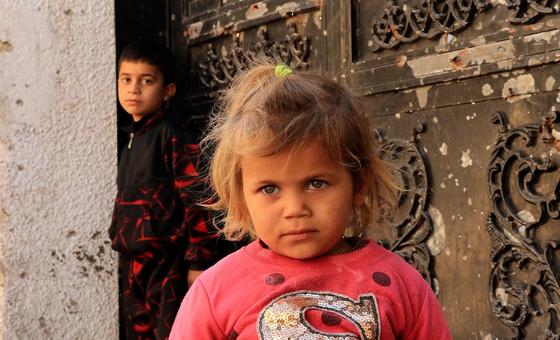
“According to preliminary estimates, the newly impacted area is home to approximately 100,000 people,” OCHA said. 

Some 30 sites for internally displaced people, six temporary learning spaces serving approximately 700 students, and several water and sanitation facilities have been affected.

Fleeing families return

Humanitarian partners report that several hundred families fled parts of the designated areas on Wednesday, however dozens have since returned due to lack of space and shelter.  

Another displacement order was also issued that same day for parts of the Rimal area of Gaza City.

OCHA further reported that Israeli forces hit another school-turned-shelter run by the UN agency that assists Palestine refugees, UNRWA, in the Nuseirat area of Deir Al-Balah on Wednesday.  No injuries were reported.

Humanitarians committed to deliver

Meanwhile, the UN and partners on the ground are committed to stay and deliver in the Gaza Strip despite the mounting challenges. 

On Wednesday, the World Health Organization (WHO) evacuated 284 patients and their companions from the European Gaza Hospital in Khan Younis to Europe and the United Arab Emirates. Israeli forces hit the hospital premises twice one day prior to the scheduled evacuation. 

European Gaza Hospital is no longer functional following the attack, WHO Director-General Tedros Adhanom Ghebreyesus said in a tweet on Thursday.

“The hospital’s closure has cut off vital services including neurosurgery, cardiac care, and cancer treatment—all unavailable elsewhere in Gaza,” he said.

He added that another strike near the Indonesian Hospital “spread fear, disrupted access, and raised the risk of closure.” 

Tedros underlined that “hospitals must be protected”, saying “they must never be militarized or targeted.”

Time is of the essence

More than two months have passed since Israel implemented a full blanket ban on the entry of cargo into the Gaza Strip, including aid and other life-saving supplies, which continues to drive hunger and deprivation.  

UN teams report that the number of hot meals provided by community kitchens has fallen from one million to just 249,000 a day.

OCHA Spokesperson Olga Cherevko told UN News that the situation will continue to worsen as supplies run down, forcing more kitchens to close.

People are terrified and are telling me every day that they don’t know how they will survive,” she said.

“I have passed several kitchens in the past few days where crowds of people were standing with empty pots and despair in their faces, and these people were being told to go home because all the food had run out for that day.”

The UN and partners have 9,000 truckloads of vital supplies ready to move into Gaza, including food assistance to feed millions for months. Thousands more trucks full of aid are on standby.

OCHA reiterated that as long as the full blockade is not immediately lifted, the already limited assistance available will shrink even further, warning “time is of essence to prevent further death.” 

Source link