
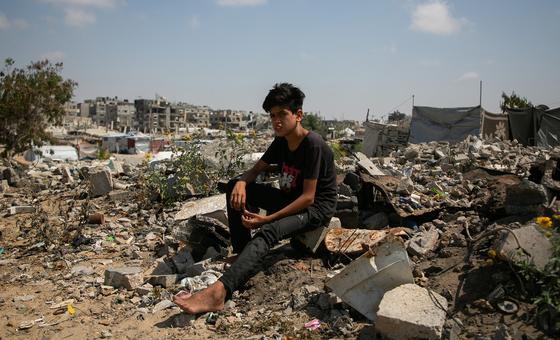
Gaza: More misery as new evacuation orders impact tens of thousands

Those impacted by the orders have been told to relocate to the “already overcrowded” coastal strip at Al Mawasi, according to the UN Office for the Coordination of Humanitarian Affairs (OCHA), late Tuesday.

Al Mawasi near Khan Younis lacks “the basics for survival”, the UN agency insisted. It has also seen nearly two dozen strikes on displaced Gazans sheltering in tents there between 18 March and 11 April, the UN human rights office said

As the war drags on well into its 21st month, Gaza’s most vulnerable people continue to struggle to survive.

Dialysis emergency

They include Musbah Zaqqout, 70, one of 230 patients receiving lifesaving dialysis at Al-Shifa Hospital in Gaza City. His treatment has been disrupted by persistent supply shortages that reduced sessions from three to two per week at the end of last month, the UN World Health Organization (WHO) warned on Tuesday.

“He suffered a lot when dialysis was not available,” said Mr. Zaqqout’s wife, Saadia. “He was suffocating and was frequently admitted to the hospital, to the point where he fell into a coma, lost focus and didn’t recognize anyone.”

With support from partner organization KS Relief, WHO delivered dialysis supplies and fuel for Al-Shifa Hospital, so that it could resume dialysis treatment and other lifesaving services.

“Thank God, after restarting dialysis, his condition improved,” Mrs. Zaqqout said, while the UN health agency reiterated its calls for sustained entry of food, fuel, and health aid at scale through all possible routes.

“Critical shortages of fuel and medical supplies persist across Gaza,” WHO warned. “Without urgent and sustained replenishment, health care services risk coming to a grinding halt.”

Child malnutrition tragedy

Echoing those concerns, the UN agency for Palestinians, UNRWA, warned on Wednesday that it is increasingly difficult to help Gazans. Already, one in 10 of the children brought to its clinics suffers from malnutrition. The condition was unheard of in the enclave before the war, but it more than doubled in children under five between March and June, amid the near-total Israeli siege.

“It’s becoming more and more difficult for us to continue providing services,” said UNRWA’s Louise Wateridge. “At least 188 UNRWA installations – over half of all our installations in the Gaza Strip – are located within the Israeli-militarized zone, under displacement orders, or where these overlap.”

In an update, Ms. Wateridge said that only six UNRWA health centres and 22 of the agency’s medical points remain operational today, in addition to 22 mobile medical points inside and outside shelters.

Nearly 60 per cent of essential medical supplies are now out of stock, according to the UN agency. “Children are dying before our eyes, because we do not have the medical supplies or sustained food to treat them,” it said.

Key medicines run out

As a direct result of the Israeli blockade on Gaza which began on 2 March, UNRWA said that it has “now run out of” medicines for high blood pressure, antiparasitic and antifungal medicine, medicine for eye infections and inflammation, all skin treatments and oral antibiotics for adults.

Providing clean water to the war-shattered enclave remains a massive challenge and only two UNRWA main water wells still function. Ten were operational before the war. Another 41 smaller wells are operational in UNRWA shelters.

For the past two months in north Gaza, UNRWA has been forced to stop providing water and sanitation services for around 25,000 displaced people in shelters, owing to displacement orders issued by Israeli forces.

“The restrictions on the entry of fuel continues placing life-saving services at a severe risk,” the UN agency said. “Critical water services are at risk of shutting down if sustained fuel supplies are not permitted entry.”
Source link

Gaza: New displacement orders force thousands to flee as famine looms

In addition to ongoing bombardment, Israel issued another three displacement orders over the past two days, covering seven per cent of the total area of the territory. 

Overall, some 71 per cent of the Gaza Strip is under displacement orders or in Israeli-militarized zones, where the Israeli authorities require humanitarian teams to coordinate their movements. 

These displacement orders come as populations across Gaza are at risk of famine and one in every five people faces starvation,” the agency said.

Thousands uprooted

Evacuation orders announced on Thursday have impacted thousands of residents in 10 neighbourhoods in Deir Al-Balah and Khan Younis, OCHA reported.

Initial assessment indicates that the affected area includes eight wells, five reservoirs, seven humanitarian warehouses, three health clinics and other critical facilities. 

Furthermore, displacement orders issued on Wednesday for six neighbourhoods in North Gaza governorate overlap with parts of zones covered under orders issued the previous day.

“According to preliminary estimates, the newly impacted area is home to approximately 100,000 people,” OCHA said. 

Some 30 sites for internally displaced people, six temporary learning spaces serving approximately 700 students, and several water and sanitation facilities have been affected.

Fleeing families return

Humanitarian partners report that several hundred families fled parts of the designated areas on Wednesday, however dozens have since returned due to lack of space and shelter.  

Another displacement order was also issued that same day for parts of the Rimal area of Gaza City.

OCHA further reported that Israeli forces hit another school-turned-shelter run by the UN agency that assists Palestine refugees, UNRWA, in the Nuseirat area of Deir Al-Balah on Wednesday.  No injuries were reported.

Humanitarians committed to deliver

Meanwhile, the UN and partners on the ground are committed to stay and deliver in the Gaza Strip despite the mounting challenges. 

On Wednesday, the World Health Organization (WHO) evacuated 284 patients and their companions from the European Gaza Hospital in Khan Younis to Europe and the United Arab Emirates. Israeli forces hit the hospital premises twice one day prior to the scheduled evacuation. 

European Gaza Hospital is no longer functional following the attack, WHO Director-General Tedros Adhanom Ghebreyesus said in a tweet on Thursday.

“The hospital’s closure has cut off vital services including neurosurgery, cardiac care, and cancer treatment—all unavailable elsewhere in Gaza,” he said.

He added that another strike near the Indonesian Hospital “spread fear, disrupted access, and raised the risk of closure.” 

Tedros underlined that “hospitals must be protected”, saying “they must never be militarized or targeted.”

Time is of the essence

More than two months have passed since Israel implemented a full blanket ban on the entry of cargo into the Gaza Strip, including aid and other life-saving supplies, which continues to drive hunger and deprivation.  

UN teams report that the number of hot meals provided by community kitchens has fallen from one million to just 249,000 a day.

OCHA Spokesperson Olga Cherevko told UN News that the situation will continue to worsen as supplies run down, forcing more kitchens to close.

People are terrified and are telling me every day that they don’t know how they will survive,” she said.

“I have passed several kitchens in the past few days where crowds of people were standing with empty pots and despair in their faces, and these people were being told to go home because all the food had run out for that day.”

The UN and partners have 9,000 truckloads of vital supplies ready to move into Gaza, including food assistance to feed millions for months. Thousands more trucks full of aid are on standby.

OCHA reiterated that as long as the full blockade is not immediately lifted, the already limited assistance available will shrink even further, warning “time is of essence to prevent further death.” 

Source link