Thirsty and starving, Gazans face ‘inhumane’ evacuation; UNICEF

The development followed reports that the Israeli military has stepped up its ground offensive in Gaza City, ordering residents to leave the area.

Speaking from the south of the enclave, UNICEF’s Tess Ingram described the forced mass displacement of families as a “deadly threat for the most vulnerable”.

It is inhumane to expect nearly half a million children battered and traumatized by over 700 days of unrelenting conflict to flee one hellscape to end up in another,” she insisted.

150,000 go south in a month

According to the UN’s humanitarian affairs coordination office, OCHA, over the past few days, partners monitoring the movement of people in Gaza counted almost 70,000 displacements heading south, and about 150,000 over the past month. The only available route, Al Rashid Road, was “very busy” when Ms. Ingram was there on Monday, she said.

The UNICEF spokesperson described meeting a mother who had walked for more than six hours from Gaza City to the South with her five children, “all dirty, thirsty and starving”, two of them with no shoes.

They are being pushed along with tens of thousands of others to “a so-called humanitarian zone” encompassing Al-Mawasi and surrounding areas, she said.

Sea of despair

Ms. Ingram described their destination as “a sea of makeshift tents, human despair” and services which are “insufficient” to support the hundreds of thousands already living there.

Child malnutrition in Gaza is “spiralling”, Ms. Ingram continued, pointing out that according to UNICEF estimates, some 26,000 children in the enclave currently require treatment for acute malnutrition – more than 10,000 in Gaza City alone.

Famine was confirmed late last month in Gaza City by UN-backed food insecurity experts.

Feeding centres closed

UNICEF’s Ms. Ingram said that owing to evacuation orders and military escalation more nutrition centres in Gaza City have been forced to shut this week, “cutting off children from a third of the remaining treatment sites that can save their lives”.

While humanitarians remain on site and continue responding to the crisis, “it is becoming harder with every bombardment and every denial”, she stressed.

According to OCHA, last Sunday out of 17 missions that humanitarian teams coordinated with the Israeli authorities, only four were facilitated, while seven missions were denied and others were impeded on the ground or had to be cancelled.

Ms. Ingram spoke of the dilemma desperate Gazans face: “stay in danger or flee to a place that they also know is dangerous.” She recalled that Al-Mawasi came under attack some two weeks ago, when eight children were killed while lining up for water; the youngest victim was three years old.

More to follow…

Gaza: More misery as new evacuation orders impact tens of thousands

Those impacted by the orders have been told to relocate to the “already overcrowded” coastal strip at Al Mawasi, according to the UN Office for the Coordination of Humanitarian Affairs (OCHA), late Tuesday.

Al Mawasi near Khan Younis lacks “the basics for survival”, the UN agency insisted. It has also seen nearly two dozen strikes on displaced Gazans sheltering in tents there between 18 March and 11 April, the UN human rights office said

As the war drags on well into its 21st month, Gaza’s most vulnerable people continue to struggle to survive.

Dialysis emergency

They include Musbah Zaqqout, 70, one of 230 patients receiving lifesaving dialysis at Al-Shifa Hospital in Gaza City. His treatment has been disrupted by persistent supply shortages that reduced sessions from three to two per week at the end of last month, the UN World Health Organization (WHO) warned on Tuesday.

“He suffered a lot when dialysis was not available,” said Mr. Zaqqout’s wife, Saadia. “He was suffocating and was frequently admitted to the hospital, to the point where he fell into a coma, lost focus and didn’t recognize anyone.”

With support from partner organization KS Relief, WHO delivered dialysis supplies and fuel for Al-Shifa Hospital, so that it could resume dialysis treatment and other lifesaving services.

“Thank God, after restarting dialysis, his condition improved,” Mrs. Zaqqout said, while the UN health agency reiterated its calls for sustained entry of food, fuel, and health aid at scale through all possible routes.

“Critical shortages of fuel and medical supplies persist across Gaza,” WHO warned. “Without urgent and sustained replenishment, health care services risk coming to a grinding halt.”

Child malnutrition tragedy

Echoing those concerns, the UN agency for Palestinians, UNRWA, warned on Wednesday that it is increasingly difficult to help Gazans. Already, one in 10 of the children brought to its clinics suffers from malnutrition. The condition was unheard of in the enclave before the war, but it more than doubled in children under five between March and June, amid the near-total Israeli siege.

“It’s becoming more and more difficult for us to continue providing services,” said UNRWA’s Louise Wateridge. “At least 188 UNRWA installations – over half of all our installations in the Gaza Strip – are located within the Israeli-militarized zone, under displacement orders, or where these overlap.”

In an update, Ms. Wateridge said that only six UNRWA health centres and 22 of the agency’s medical points remain operational today, in addition to 22 mobile medical points inside and outside shelters.

Nearly 60 per cent of essential medical supplies are now out of stock, according to the UN agency. “Children are dying before our eyes, because we do not have the medical supplies or sustained food to treat them,” it said.

Key medicines run out

As a direct result of the Israeli blockade on Gaza which began on 2 March, UNRWA said that it has “now run out of” medicines for high blood pressure, antiparasitic and antifungal medicine, medicine for eye infections and inflammation, all skin treatments and oral antibiotics for adults.

Providing clean water to the war-shattered enclave remains a massive challenge and only two UNRWA main water wells still function. Ten were operational before the war. Another 41 smaller wells are operational in UNRWA shelters.

For the past two months in north Gaza, UNRWA has been forced to stop providing water and sanitation services for around 25,000 displaced people in shelters, owing to displacement orders issued by Israeli forces.

“The restrictions on the entry of fuel continues placing life-saving services at a severe risk,” the UN agency said. “Critical water services are at risk of shutting down if sustained fuel supplies are not permitted entry.”

Source link

Styrene chemical leak turns worst nightmare for 5,000 villagers near Vizag, death toll at 11 so far

Eleven people were killed in Visakhapatnam (Vizag) styrene gas leak tragedy that shook the coastal city in Andhra Pradesh in India during the wee hours on Thursday between 02:30 to 03:00 AM. More than 1,000 people who live in villages surrounding the factory have been shifted to hospitals in the city of Vizag and a massive hunt is on for those still inside homes or died during sleep.

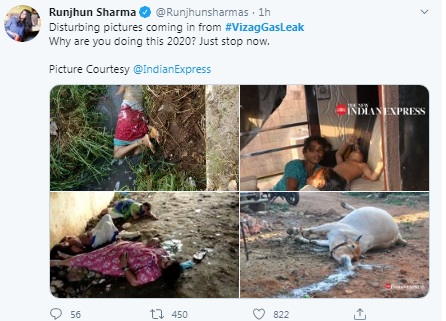
The deadly gas leaked from a closed LG polymers factory in Vepagunta village in Gopalapatnam near Vizag was identified as styrene gas, which is one of the most poisonous gases that affects lungs and nervous system initially and many vital organs over a period of two to three years. The gas leakage started at 3 pm in the night and many panic-stricken local villagers reportedly ran out of their homes towards Meghadrigedda nearby but further exposed to more gas and suffered on the roads and streets. The visuals of people falling down on roads and pavements filled the local TV screens.

While three people died after falling into a canal, five have been declared brought dead by the King George Hospital, where more than 180 people are currently being treated, said local reports. Many animals were seen already dead by morning or struggling to breathe in the open.

The leak reportedly occurred in Styrene gas chamber, that was shutdown for over a month due to the coronavirus lockdown. The doctors have warned that inhalation of this poisonous gas is dangerous with long-standing effect on lungs, liver and other vital organs of the body, besides affecting the nervous system of the human body.

Evacuation

Vizag District collector V Vinay Chand said the tragedy occurred while the plant was being recommissioned after the COVID lockdown without giving more details on how the mishap took place in the night. People from all villages around the plant have been shifted to safer places nearby and people are advised to put wet cloth on their faces covering eyes, he said.

Ambulances and RTC buses are arranged to evacuate local villages from the affected area.  “Initial attempts to control the gas by spraying did not yield any result. It will take another two hours to bring the gas leak under control,” said the collector soon after the accident.

The chief minister of Andhra Pradesh, Mr Jagan Mohan Reddy announced Rs. 1 crore ($145,000) in compensation to each affected family with a death. Local leaders blamed the LG polymers, of the Korean conglomerate, which was built in 1997 at RR Venkatapuram near Gopalapatnam village in an area of 200 acres. It has a capacity of producing 400 tonnes of polystyrene daily using styrene, a highly inflammable liquid. As the area was a green zone under Covid-19 measures, the lock-down was eased earlier this week prompting the factory to resume production.

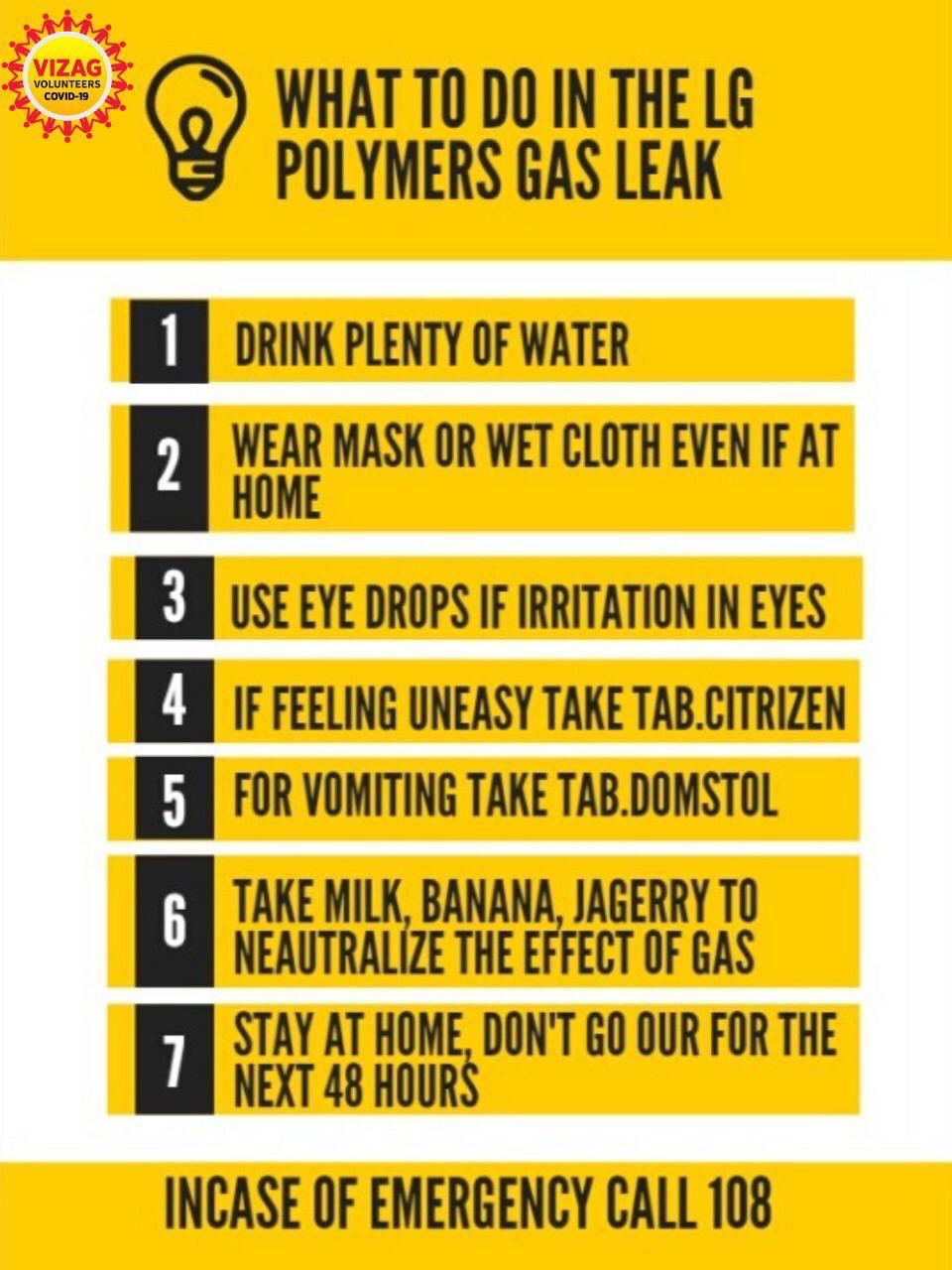
Medical doctors have advised those who are likely to have inhaled the gas up to five kilometers in radius to follow some quick precautions such as:

— Drinking more water
— Using a wet cloth mask
–Use eye-drops if there is any irritation in eyes
–Stay at home instead of going out and getting exposed to the gas, and
— Consult doctor immediately for treatment.

What is Styrene Gas?

Styrene gas was first isolated in 1839 by a German apothecary, Eduard Simon, from the resin called storax or styrax of the American sweetgum tree and named the liquid “styrol”, which eventually came to be known as styrene and in 1866 the French chemist Marcelin Berthelot stated that “metastyrol” was a polymer of styrene or polystyrene. It is used in making rubber, plastic, insulation tapes, fiberglass, pipes, automobile and boat parts, food containers and carpet backing.

Styrene is a “known carcinogen”, especially in case of eye contact, skin contact and of inhalation, as styrene oxide is considered toxic and mutagenic. Exposure to styrene causes cancer, according to some studies. The US National Toxicology Program of the U.S. Department of Health and Human Services has determined that styrene is “reasonably anticipated to be a human carcinogen.”