Guterres hails Papua New Guinea as an example of diversity, dialogue and climate action

António Guterres is the first serving UN Secretary-General to visit the country, which is celebrating 50 years of independence.

He praised its tremendous diversity, with over 800 languages spoken and countless traditions.

Commitment to peace, dignity and progress

“And yet, you have a shared commitment to speak with one voice – to having ‘one talk’ – for peace, for dignity and for progress,” he said.

“You are champions of multilateralism and international solutions. And that spirit is urgently needed in our world today.”

He said that “Papua New Guinea offers a number of powerful lessons to the world”, with the first being forging consensus through dialogue.

The country has spent the past half century working to build “a single nation out of many traditions, many islands, many tongues”, which has not been easy.

Last Saturday, 30 August, marked 24 years since the signing of the Bougainville Peace Agreement. The accord between the Government and separatists ended a decade of conflict and established the autonomous Bougainville region.

Mr. Guterres said that while the conflict left deep scars, Papua New Guinea and Bougainville have stayed the course of peace for more than two decades.

“You have shown the world the path of healing through dialogue, perseverance and mutual respect,” he said, adding that people in Bougainville will go to the polls on Thursday in the fifth autonomous election since the agreement.

Leadership in climate action

Another lesson from Papua New Guinea has been bold climate action.

This was the Secretary-General’s first visit to the Pacific region since the International Court of Justice (ICJ), the UN’s highest judicial body, issued a landmark advisory opinion affirming that addressing the climate crisis is a legal obligation under international law.

As Pacific countries played a central role, the advisory opinion “is a testament to the leadership of Papua New Guinea, Melanesia and the wider Pacific region, particularly your young people, who make up 60 per cent of your population”, he said.

A crucial voice

“Your voice will be integral again during the annual UN climate conference in Belem, Brazil,” he said, warning that efforts to limit global temperature rise to 1.5 degrees Celsius are in jeopardy.

He urged countries to submit new national climate plans that align with this goal, cover all emissions across their economies and accelerate the transition from fossil fuels.

Mr. Guterres also called for action on climate finance, including stepping up contributions to the loss and damage fund, while richer countries must honour their promise to double adaptation finance and deliver $300 billion each year over the next decade.

Furthermore, as many developing countries are “drowning in unsustainable debt”, reform of the current international financial architecture is needed to make it fairer and more representative. The same applies to the UN Security Council and other international institutions.

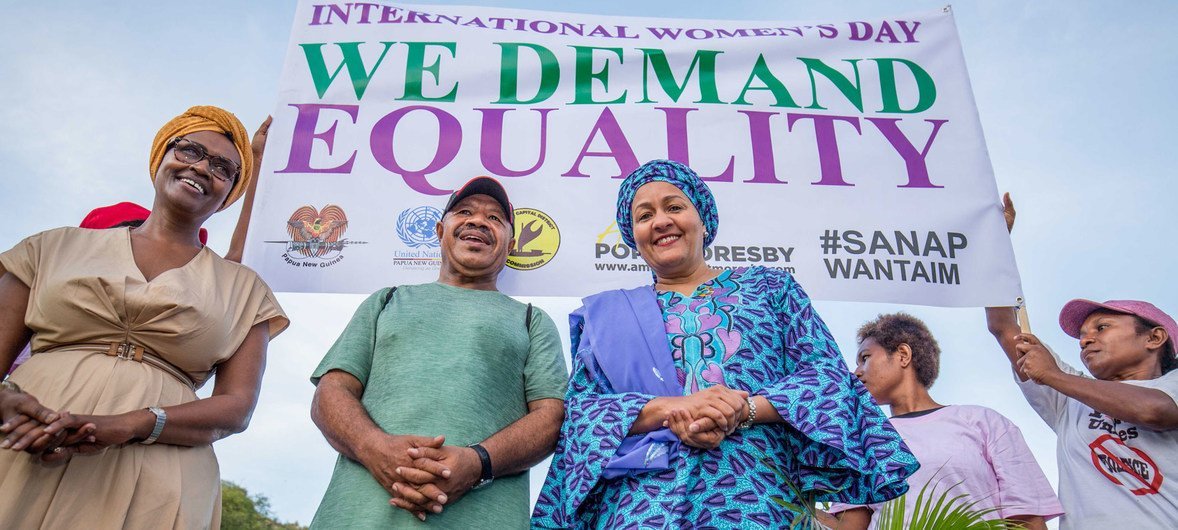
The UN Deputy Secretary-General, Amina Mohammed (centre right) joined a march in support of International Women’s Day in Port Moresby, Papua New Guinea, in March 2020.

Representation of women

The UN chief noted that Papua New Guinea once hosted peacekeepers, but today is a champion of peacebuilding and sustainable development.

He stressed, however, that “no story of peace or progress is complete without fully including half of the population”, highlighting another area where the country can set an example.

He recalled that UN Deputy Secretary-General Amina Mohammed was there five years ago for the national launch of the Spotlight Initiative — part of the world’s largest effort to end all forms of violence against women and girls, a challenge that exists in all societies.

In March, parliament devoted an entire day to testimonies on gender-based violence, marking a vital step.

“Ensuring greater voice and representation of women is not only a matter of justice — it is a matter of national strength,” he said.

“Families thrive. Communities grow stronger. And institutions become more responsive when we uphold the rights of all.”  

Ministry of Environment, Forest and Climate Change organises National Conference on Sustainable Coastal Management

Union Minister of Environment, Forest and Climate Change, Shri Bhupender Yadav inaugurated the first National Conference on Sustainable Coastal Management in India in Bhubaneswar today.

This conference is being organized by the Green Climate Fund supported project – Enhancing Climate Resilience of India’s Coastal Communities.

The objective of the conference is to bring officials from all 13 coastal states of India under one roof to focus on the three interrelated themes :

  1. Coastal and marine biodiversity,
  2. Climate mitigation and adaptation and
  3. Coastal pollution.

This endeavour is aimed at creating a vibrant network of stakeholders who will continue to engage with each other on the topics but also on cross-cutting themes such as coastal governance, technologies and innovation as well as domestic and international finance.

“The Indian coastline is of immense strategic, economic and social importance to the country.

  • Indian coastline spans 7,500 kilometres, seventh longest in the world,
  • home to 20 percent of the country’s population,
  • Three of our four metropolitan cities lie on the coast,
  • supports more than 17,000 species of plants and animals.

There is a great diversity of ecosystems within our coastal regions that support more than 17,000 species of plants and animals.  With the changing climate, we need to build the resilience of communities living in coastal areas.” said Shri Bhupender Yadav, Union Minister of Environment, Forest and Climate Change.

Sustainable Coastal Management in India

“This conference comes at an important time as India has submitted its revised NDCs and seeks to create multi-sectoral partnerships to meet these targets” he added.

Speaking on the occasion, Shri. Ashwini Kumar Choubey, Minister of State for Environment, Forest & Climate Change, said: “Such conferences are important to bring the conversations of resilience and sustainability to our country’s coastal areas.  This was also envisioned in the Honourable Prime Minister’s LiFE movement.”

Sustainable Coastal Management in India

Sustainable coastal management is recognised as need of the hour. Data-driven policies and management frameworks, participatory conservation models, and convergence between stakeholders are the key pillars for effective coastal management.

A programme on Enhancing Climate Resilience of Coastal Communities is being implemented in partnership with UNDP in the states of Odisha, Andhra Pradesh and Tamil Nadu. Supported by the Green Climate Fund (GCF), the initiative is integrating ecosystem and community-based approaches to adaptation into coastal management and planning.

AXA Call to Action puts Spotlight on Diversity & Inclusion for 2020 Workforce

Bangalore November 23, 2017: AXA Business Services hosted its second AXA Call to Action event focused on Diversity and Inclusion (D&I), a very topical area of focus for all corporates today. The event saw industry experts deliberate on the current practices and emerging aspects of D&I that organisations need to be cognizant of to manage the expectations of the 2020 workforce.

According to Marie-Louise Elhabre, Chief Executive Officer, AXA Business Services, “Diversity and Inclusion is an important part of our business andis infact a strong lever for business growth. It fosters innovation in an organization as diverse people bring their perspectives to the tableaiding a 360-degree approach and helping organisations proactively meet customer and partner needs better. As we prepare for 2020, it is important to connect with the industry to see how readywe are to implement the new diversity framework and to move towards 100% inclusion. Indeed, while diversity is in nature, Inclusion is a choice. Our AXA Call to Action event seeks to address this need and share back with the industry best practices from the panel discussion.”
The event saw a powerful line-up of panelists:Jaya Virwani, D&I Head, Talent Team, Global Delivery Services, E&Y; Padmapriya S., Head, Business Development, GSC&EBS, SocieteGenerale; Dr. Pradip K Dutta, Group VP – Synopsys Inc. and MD – Synopsys India; Archana Vohra, Director, Seller Enablement, Amazon; Jessie Paul, Founder and CEO, Paul Writer; and Srikrishna Madhavan, Head, Finance Operations CoE, AXA Business Services. The panel was moderated by Prashant Sankaran, Director, Interweave Consulting.

Key topics discussed were:
• Focus on Inclusion: Empowerment, engagement and growth
• Gender Diversity: Beyond empowering and establishing a culture that is gender neutral
• Generational Diversity: Focusing on how to deepen the collaboration between tech-savvy young workforce and senior employees

According to Nagarajan V., Head – HR, Communication, D&I and CR, AXA Business Services,
“The industry has moved away from affirmative action/managing diversity towards holistic diversity and enabling inclusion. Enabling inclusion would require organisations to focus on the twin pillars of addressing subconscious/unconscious bias as well as making the business impactvery apparent.”

About AXA Business Services

AXA Business Services is a 100% subsidiary of AXA, the number 1 insurance organization globally by brand. We are well positioned as a strategic innovation hub to leverage the value proposition that India as a market place presents to provide sustained value to our global partners and employees. We are at the forefront of driving transformation across all of AXA’s business lines: life savings and health, property & casualty, and asset management. We see ourselves as change agents for radical innovations spanning big data, risk modeling, robotic automation, and process and people transformation. Our employees are at the heart of our business and together we move forward in a culture of trust, such that our employees are in charge of the future.