Sudan: Guterres calls for ceasefire in El Fasher, deplores ‘relentless’ militia attacks

António Guterres said he was “appalled by the relentless attacks” by the Rapid Support Forces (RSF) militia on the North Darfur state capital, UN Spokesperson Stéphane Dujarric said in a statement.

The paramilitary group and the Sudanese Armed Forces (SAF) have been battling for control of devastated country since April 2023 and El Fasher has been the epicentre of fighting for more than 500 days.

Shelling, incursions and summary executions

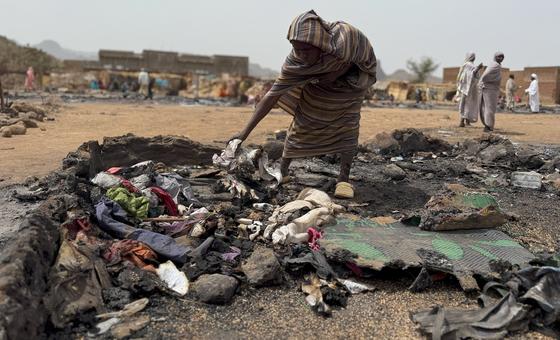
Recent weeks have seen near-continuous shelling in the city and repeated deadly incursions into the adjoining Abu Shouk displacement camp, where famine conditions were identified last December.

Since 11 August, the UN has documented the killing of at least 125 civilians in the El Fasher area, including summary executions – although the actual number is likely to be higher.

“The Secretary-General is alarmed at the grave risks of serious violations of international humanitarian law as well as violations and abuses of international human rights law, including ethnically motivated ones,” said Mr. Dujarric.

Aid awaiting entry

Meanwhile, supplies are pre-positioned near El Fasher, but the UN and partners continue to face obstacles in moving them into the city.  

Some 70 trucks of humanitarian assistance are currently waiting in Nyala, South Darfur, a top official with the UN aid coordination office OCHA said on Thursday in New York.

Mr. Dujarric also noted that repeated attacks on humanitarian personnel and assets in North Darfur have occurred over recent months.

Ceasefire and a lasting peace

“The Secretary-General calls for an immediate ceasefire in and around the El Fasher area,” he said.

Furthermore, the UN chief “insists that immediate steps must be taken to protect civilians and enable the safe, unhindered and sustained delivery of humanitarian assistance into the area, and to allow any civilians seeking to leave the area voluntarily to do so safely.” 

 In the interim, the Secretary-General’s Personal Envoy for Sudan, Ramtane Lamamra, continues to engage the warring parties and “stands ready to support genuine efforts to halt the violence and establish an inclusive political process that the people of Sudan demand.” 

Source link

DR Congo: UN deplores deadly attacks in the east of the country

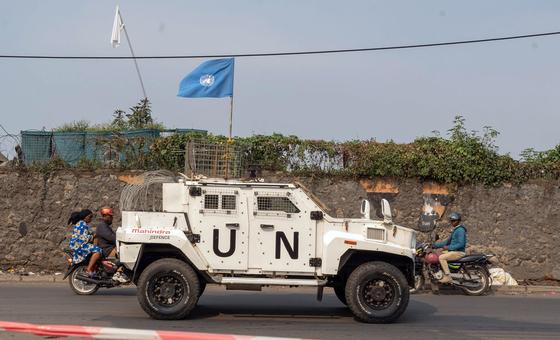
The attacks, which took place between 9 and 16 August in the localities of Beni and Lubero territories, claimed the lives of at least 52 civilians, including eight women and two children, but peacekeepers on the ground say the death toll may very well rise.  

“These attacks targeting civilians, which add to the atrocities committed during the night of 26 to 27 July in Komanda (Ituri territory, Ituri), are intolerable and constitute serious violations of international humanitarian law and human rights,” said Binto Keita, Head of the UN Mission in the DRC, known as MONUSCO.  

Appeal to armed groups

The violent attacks were accompanied by abductions, looting, and the burning of homes, vehicles, and motorcycles, as well as the destruction of property belonging to the population already facing dire humanitarian conditions.  

MONUSCO issued a statement calling for foreign armed groups, such as the ADF, to lay down their arms unconditionally and return to their countries of origin.  

The Mission also urged “the Congolese authorities to conduct thorough investigations to identify those responsible for the massacre of civilians and bring them to justice.”  

Stronger military presence

In response to this new wave of violence, the peacekeeping mission reinforced its military presence and support to Congolese authorities.

For instance, on 13 and 14 August during incidents in Mayi-Moya in North Kivu, MONUSCO provided physical protection to 206 civilians, including 93 children and 70 women, who had sought refuge at the mission’s military base.  

“MONUSCO remains fully committed to supporting Congolese authorities and local communities in preventing further violence, protecting civilians, reducing tensions and contributing to the stabilisation of areas affected by armed conflict,” it said.   

Source link

Guterres deplores Israeli strike on Gaza church

Three people were killed and at least 10 others were injured in the bombing of the Holy Family Church in Gaza City, according to media reports.

Stephanie Tremblay, a spokesperson for the Secretary-General, noted that the church was both a place of worship and a sanctuary for civilians.

“Attacks on places of worship are unacceptable. People seeking shelter must be respected and protected, not hit by strikes,” she said during the daily media briefing from New York.

“Too many lives have already been lost,” she added, before stressing the urgent need for an immediate ceasefire and the immediate and unconditional release of all hostages.

Strikes continue amid widespread displacement 

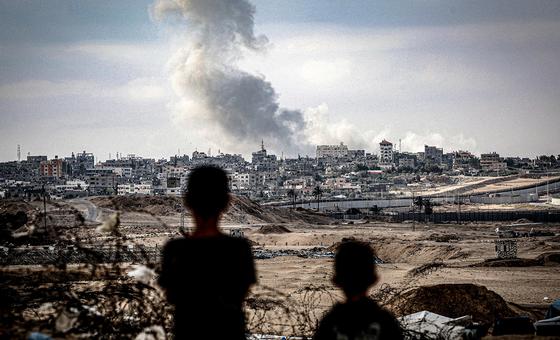
Meanwhile, Israeli strikes over the past 24 hours have hit sites hosting displaced Palestinians, some of whom were injured and killed.

The UN Office for the Coordination of Humanitarian Affairs (OCHA) reported that more than 11,500 people in Gaza were newly displaced between 8-15 July.

Overall, more than 737,000 people have been uprooted since the latest escalation of hostilities on 18 March, or roughly 35 per cent of the population

Furthermore, nearly everyone in Gaza has been displaced, in many cases multiple times, since the war began in October 2023.

Ms. Tremblay reminded journalists that most housing in Gaza is flattened or otherwise unhabitable and families are staying in the open because the UN has not been allowed to bring in tents and other shelter materials since early March.

Mediterranean swimming ban

She also highlighted a “worrying development” as humanitarians report that many displaced people are wary of bathing in the Mediterranean Sea after Israeli reinstated a ban prohibiting swimming and fishing.

“OCHA says that for many, the sea has been their only option to wash, as there is barely any functioning water infrastructure and almost no fuel to pump water, a much-needed outlet in the hot weather in Gaza,” she explained. 

More fuel needed

Humanitarians also continue to report that the amount of fuel Israel is allowing into Gaza is still nowhere enough to keep life-saving services operating and shutdowns are a real risk. 

Ms. Tremblay mentioned “a small but important step” that occurred on Thursday, as the UN was finally allowed to bring in some benzene – used to power ambulances and other critical services – for the first time in more than 135 days.

“That’s in addition to the limited amounts of diesel allowed over the past week. But it’s not enough,” she said.

“We are calling for more fuel – both benzene and diesel – to come in regularly. And the ban on shelter materials needs to be lifted immediately. Lives depend on both.” 

Source link

UNICEF deplores ‘unconscionable’ killing of families lining up for aid in Gaza

Catherine Russell said she was appalled by the reported killing of 15 Palestinians, including nine children and four women, who were waiting in line for nutritional supplements provided by Project Hope, a UNICEF partner organization.

The incident occurred in Deir Al-Balah. An additional 30 people were injured, including 19 children. News reports indicate that it resulted from an Israel strike. 

‘Mothers seeking a lifeline’

“The killing of families trying to access life-saving aid is unconscionable,” she said in a statement.

These were mothers seeking a lifeline for their children after months of hunger and desperation.”

They included Donia, whose one-year-old son, Mohammed, was killed. She reported that the boy had spoken his first words to her just hours earlier.

“Donia now lies in a hospital bed, critically injured by the blast, clutching Mohammed’s tiny shoe,” said Ms. Russell.  “No parent should have to face such tragedy.”

A ‘cruel reality’

For the UNICEF chief, “this is the cruel reality confronting many in Gaza today after months of insufficient aid being allowed into the territory, and parties to the conflict failing to uphold basic responsibilities to protect civilians.”

She explained that “the lack of aid means children are facing starvation while the risk of famine grows,” warning that “the number of malnourished children will continue to rise until life-saving aid and services are resumed at full scale.”

“International law is clear: all parties to the conflict have an obligation to protect civilians and ensure the safe and unimpeded delivery of humanitarian assistance,” she said.

“We call on Israel to urgently review its rules of engagement to ensure full compliance with international humanitarian law, notably the protection of civilians including children, and to conduct a thorough and independent investigation of this incident and all allegations of violations.”

UN condemns killings

The UN yet again condemned the killing of civilians in Gaza, Spokesperson Stéphane Dujarric told journalists in New York.

Furthermore, the UN humanitarian affairs office OCHA “stresses that parties are bound by international humanitarian law to prevent such excessive death and injury of civilians in the midst of war,” he added.

OCHA reported that another strike on Thursday reportedly hit the office of a humanitarian partner in Gaza City. Three staff there were killed. 

Fuel running out

Mr. Dujarric also updated journalists on the dire fuel situation in Gaza, which impacts both the population and humanitarians.

A UN team managed to bring roughly 75,000 litres of fuel from Israel into the beleaguered enclave on Wednesday, marking the first such provision in 130 days.

He warned, however, that fuel is still running out and services will shut down if greater volumes do not enter immediately.

Water services at risk

We and our humanitarian partners need hundreds of thousands of litres of fuel each day to keep essential lifesaving and life-sustaining operations going, meaning the amount entered yesterday isn’t sufficient to cover even one day of energy requirements,” he said.

One aid partner reported that fuel shortages could soon cut off supplies of clean drinking water to about 44,000 children, he added, which would further increase the risk of cholera, diarrhoea, dysentery and other waterborne illnesses. 

Meanwhile, UN partners providing education services said that between October 2023 and this June, 626 temporary learning spaces have been established in Gaza, with 240,000 students enrolled, roughly half of them girls. 

However, only 299 spaces are currently operational due to the ongoing displacement orders, funding shortfalls and other challenges.

Aid workers also going hungry

Humanitarian partners in Gaza – who include first responders, health workers, and aid workers – “continue to deliver food and other assistance under intolerable conditions, and they themselves are facing hunger,” said Mr. Dujarric.

“A number of our own colleagues are also facing hunger. They also face water scarcity and threats to their personal safety, just like everyone else in Gaza,” he added.

The Spokesperson reiterated the UN’s long-standing message that “this catastrophic situation must end.”  He stressed that “a ceasefire is not only urgent, it is long overdue,” while also calling for the unconditional and immediate release of all hostages. 

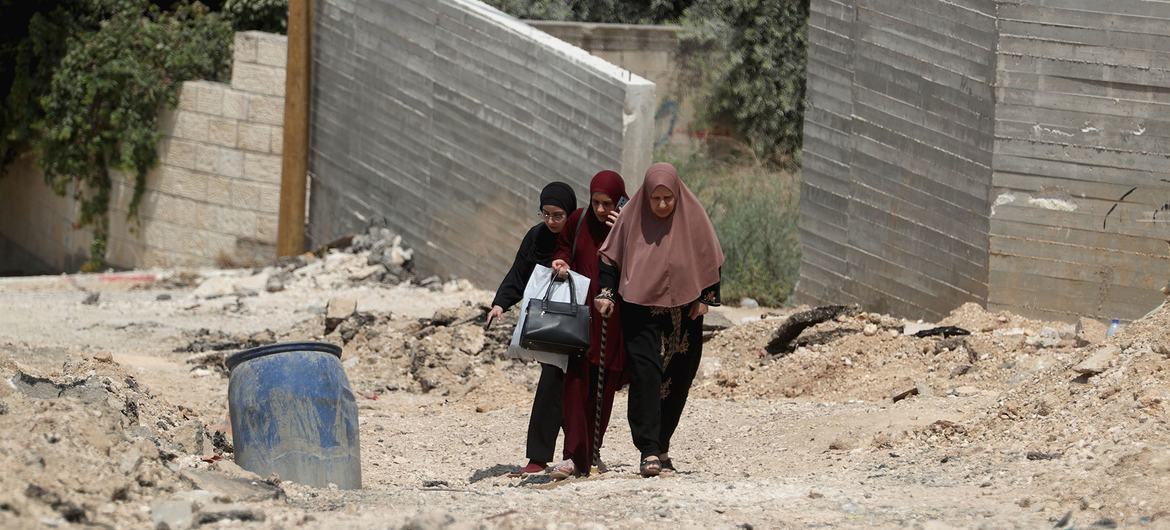
Some Palestinians have been forced to flee their homes in the West Bank.

West Bank operations

Mr. Dujarric also addressed the situation in the West Bank, where humanitarians report and continue to warn of the intensification of Israeli operations in the northern areas.

These operations are causing massive destruction, driving further humanitarian needs and dampening hopes of thousands of displaced families that they will eventually be able to go back home,” he said.

“Meanwhile, attacks, harassment and intimidation by Israeli settlers against Palestinians have become a daily reality.”

He cited a settler attack on 3 July that led to the displacement of the Mu’arrajat East Bedouin community in the central West Bank. 

“This is the ninth community to be fully displaced in the Ramallah and Jericho areas since January 2023 following the recurrent attacks by Israeli settlers.” 

Source link

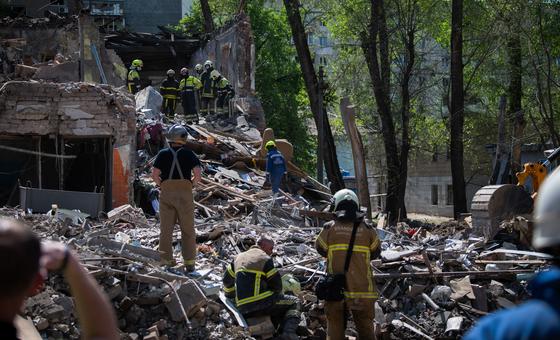
UN rights mission deplores deadly Russian strikes in Ukraine

According to the UN mission, the overnight assault from Saturday into Sunday – one of the largest of its kind since Russia’s full-scale invasion in February 2022 – resulted in civilian casualties and damage to homes and infrastructure across 10 regions of Ukraine, including the capital, Kyiv.

At least three children were among those killed and nine children were reported injured. The mission is currently working to verify the full extent of the casualties and the broader impact of the attack.

“With at least 78 people reported killed or injured across the country, last night’s attack tragically demonstrates the persistent deadly risk to civilians of using powerful weapons in urban areas, including those far away from the frontline,” Danielle Bell, HRMMU Head, said in a news release on Sunday.

“It is yet another addition to the staggering human toll this war continues to inflict on civilians, with more families across the country now grieving their losses.”

No place is safe

Matthias Schmale, the UN Humanitarian Coordinator for Ukraine, also voiced deep concern over the civilian suffering.

“I am horrified that yet again civilians – among them children – were killed in last night’s massive attacks,” he said in a statement posted on the social media platform X.

“Across Ukraine, no place is safe. Homes and civilian infrastructure were hit. Grateful to humanitarian NGOs and state services who are immediately supporting affected people. Civilians must never be a target.”

Use of long-range weapons

Ukrainian authorities reported that the Russian armed forces launched at least 367 missiles and loitering munitions during the night, in a coordinated attack with air, sea and land-based systems.

The strike followed a similar assault the previous night, which had mainly targeted the Kyiv region.

HRMMU noted that the use of long-range weapons in urban areas has been a major driver of civilian casualties in March and April. While the number of casualties in May had been somewhat lower than April before the latest attack, the toll from this weekend’s strikes will add to the monthly figures.

Source link