More than 60 people have reportedly been killed in the continuing series of attacks since early September “in circumstances that find no justification in international law,” Volker Türk said in a statement.
He urged the US to halt its “unacceptable” operations and take measures to prevent the “extrajudicial killing of people aboard these boats, whatever the criminal conduct alleged against them.”
Beyond the law
The United States has defended the operations as part of its ongoing efforts to combat drug trafficking and terrorism, asserting that they fall within the framework of international humanitarian law.
Mr. Türk rejected that argument, stressing that countering illicit drug trafficking is a law-enforcement matter, governed by careful limits on lethal force set out in international human rights law.
He emphasised that the intentional use of lethal force is lawful only as a last resort when individuals pose an imminent threat to life.
Call for investigations
“Based on the very sparse information provided publicly by the US authorities, none of the individuals on the targeted boats appeared to pose an imminent threat to the lives of others or otherwise justified the use of lethal armed force against them under international law,” Mr. Türk said.
The High Commissioner called for prompt, independent and transparent investigations into the reported attacks.
While acknowledging the serious challenges posed by drug trafficking, Mr. Türk urged the US to ensure that all counter-narcotics operations respect international law, including the treaties to which it is party.
“The United States should investigate and, if necessary, prosecute and punish individuals accused of serious crimes in accordance with the fundamental rule-of-law principles of due process and fair trial, for which the US has long stood,” he concluded.
The hurricane caused widespread damage to homes, infrastructure and crops, leaving thousands displaced.
However, extensive storm preparation by governments, assisted by UN agencies and other NGOs, appears to have helped lessen the impact and saved lives in many areas.
In Cuba, the hurricane struck the province of Santiago de Cuba with winds exceeding 200 km/h per hour and six hours of torrential rain. “Melissa is one of the three most powerful hurricanes ever recorded in Cuba and the strongest worldwide this year,” said Francisco Pichon, UN Resident Coordinator for Cuba, during a press briefing via videoconference in New York.
“More than three million people were exposed to life-threatening conditions, and nearly 240 communities are cut off due to flooding and landslides”, he added speaking via video.
Existing vulnerabilities
The storm compounded existing vulnerabilities. Many affected areas had already suffered from last year’s Hurricane Oscar and earthquakes – while drought, rising viral diseases, and energy shortages caused further strain.
Despite these challenges, Cuba’s civil defence system helped evacuate over 77,000 people to protection centres, including schools temporarily repurposed as shelters.
Mr. Pichon highlighted the UN’s anticipatory action framework, which pre-positioned relief supplies and personnel before the storm hit. “This mechanism allowed us to respond quickly and ensure that essential goods reached the people who needed them most,” he said.
Plans are underway to reach two million people in the coming days, including food security, health, education, shelter, water and sanitation, and logistics.
Early preparedness saves lives
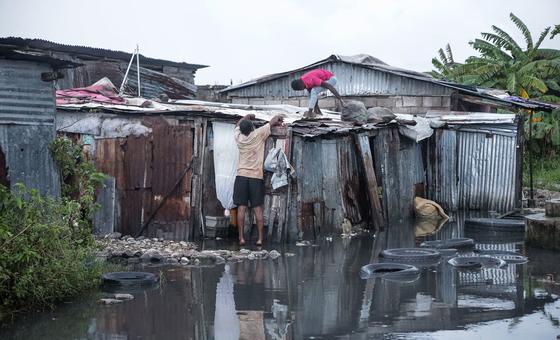
In Haiti, the storm’s slow movement brought flash floods, landslides, and severe damage to crops, said Gregoire Goodstein, the UN’s interim Humanitarian Coordinator.
“At least 24 people have died, 17 were injured, and 18 remain missing,” he reported. Around 15,000 people are currently sheltering in over 120 temporary facilities.
Early preparedness helped save lives. “We deployed emergency stocks, set up evacuation shelters, and sent out 3.5 million early warning messages,” Mr. Goodstein told journalists. “Rapid response teams worked alongside national authorities to ensure communities could evacuate safely,” he added.
Haiti faces the storm amid an ongoing humanitarian crisis, with 1.4 million people displaced, widespread hunger affecting half the population, and cholera outbreaks in some areas.
Mr. Goodstein noted that the UN’s Humanitarian Response Plan is currently 87 per cent underfunded, putting life-saving operations at risk.
“Humanitarian needs remain immense, and international cooperation is crucial.”
The UN continues to coordinate assistance across the Caribbean, supporting both immediate relief and longer-term recovery efforts in the wake of Hurricane Melissa.
Even worse, the number could triple if countries do not meet their commitments to reduce greenhouse gas (GHG) emissions and to ensure that climate financing prioritises social and climate resilience services for children.
The finding comes in a report by the UN Economic Commission for Latin America and the Caribbean (ECLAC) and the UN Children’s Fund (UNICEF), published on Thursday in Panama.
Bearing the brunt
The report examines the potential effects of extreme weather events on increasing poverty levels among children and youth, along with national efforts to reduce GHG emissions as well as strategies to adapt and reduce losses and damage caused by climate change.
The 5.9 million figure represents the most optimistic scenario. However, if governments are slow in implementing actions to address mitigation and adaptation, as well as loss and damage, the number could reach 17.9 million.
Roberto Benes, UNICEF Regional Director for Latin America and the Caribbean, said that children and adolescents bear the greatest burden of climate change.
Their developing bodies are more vulnerable to cyclones, heatwaves and other extreme phenomena which at the same time disrupt their families’ livelihoods and their education.
“If children and young people don’t have the resources to meet their basic needs and develop their potential, and if adequate social protection systems are not in place, the region’s inequalities will only be perpetuated,” he said.
Protect children and youth
Yet despite their vulnerability, climate finance does not prioritise the resilient services for health, nutrition, education, water and sanitation that children and young people need, to ensure their optimal cognitive and physical development.
In Latin America and the Caribbean, only 3.4 per cent of all multilateral climate finance is dedicated to children, according to the report. This is happening at a time of funding cuts and reduced development aid amid unprecedented needs.
The report recommends that regional governments take action, including by strengthening the climate resilience of social services and critical infrastructure to better protect children and youth, with a particular focus on the first 1,000 days of life.
Authorities are urged to increase child-sensitive climate policy financing, with actions that specifically target the needs of children at different ages.
They also must promote greater climate awareness, education, empowerment and participation of children and youth. Additionally, environmental and climate education should be included in school curricula and educational programmes.
The report further recommends that countries promote adaptive social protection and emergency response policies that account for the specific needs of children and adolescents.
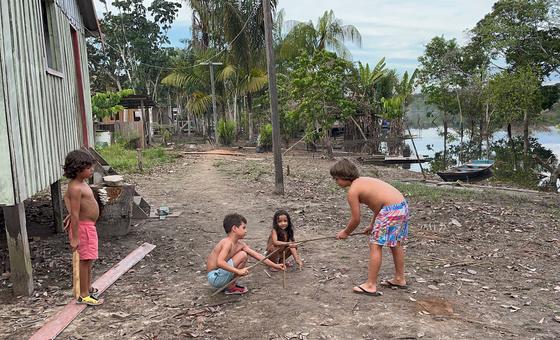
Across the region, nations face food-related challenges notably due to geographical remoteness, lack of local available resources and exposure to climate change.
“The Caribbean is particularly vulnerable to natural hazards and supply chain disruptions, which can cause increases in food prices,” said, Brian Bogart. head of WFP for the region.
“It’s deeply concerning that many people are struggling to afford the food they need,” he said.
Supply chain challenges
Rising food prices are a major concern for the region, with food inflation consistently outpacing overall inflation rates, with local production efforts challenged by increasing operational costs.
In 2025, 30 per cent of Caribbean people reported eating less than usual, a trend notably triggered by increased food costs and global geopolitical factors.
As the region significantly relies on imported agricultural inputs, “strengthening and diversifying supply chains and trade routes across the region is essential,” said Mr. Bogart.
He added that in a region particularly impacted by climate disasters, “these efforts will help make food more accessible and affordable while supporting faster recovery in times of crisis.”
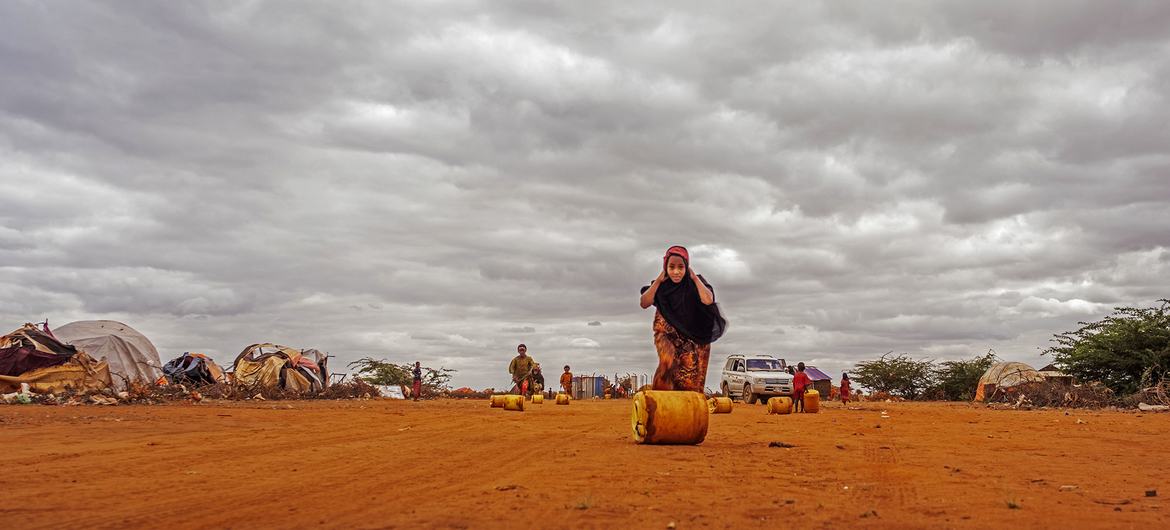
A girl moves a container full of water at a site for displaced people in Dolow, Somalia. (file)
UN migration agency highlights deepening climate and displacement crisis in Somalia
Climate shocks and mass displacement caused by conflict have uprooted some 3.6 million people in Somalia, according to the International Organization for Migration (IOM).
Almost half the population has been impacted by the climate crisis, the UN agency added.
IOM Deputy Director General Ugochi Daniels concluded a four-day visit to Somalia this week where she expressed solidarity for communities who continue to endure relentless droughts, floods and conflict.
Ms. Daniels also noted that communities are finding solutions to withstand the worst impacts of the climate crisis, but they need international support from the Green Climate Fund urgently.
IOM is active across Somalia in displacement sites and in rural and other fragile areas. Its work includes promoting land restoration and so-called “environmental peacebuilding”, which aims to reduce tensions over shared resources.
Another IOM initiative encourages Somalis to invest in their own development by providing additional funding.
Last year, communities contributed more than half a million dollars toward projects such as solar energy, clean water access and small-scale farming – investments all matched by more than $2 million from IOM.
World Breastfeeding Week: Invest in health systems and policies to benefit mums and babies
This Friday (1 August) marks the start of World Breastfeeding Week and this year’s theme calls for investing in health systems as well as policies, laws and programmes that prioritize women, babies and breastfeeding.
The World Health Organization (WHO) said investing in breastfeeding support is one of the most powerful tools policy-makers have to improve public health, strengthen economies, and secure the well-being of future generations.
The UN agency explained that breastfeeding protects child health and improves survival, especially in the first months of life. For infants, breastmilk is more than food: it also provides protection against many common illnesses like diarrhoea, pneumonia and infections.
Mothers also benefit as breastfeeding reduces the risk of postpartum haemorrhage, as well as breast and ovarian cancers, heart disease, and type 2 diabetes.
WHO urges governments to allocate dedicated funding for breastfeeding support, including for when new mums come home, along with maternity protections like paid leave after giving birth.
In September 2017, Primrose Thomas was at her home on Barbuda, when disaster struck: two Category 5 hurricanes, Irma and Maria, swept over the islands of the eastern Caribbean, wreaking chaos and destruction.
“The first time I came back, I didn’t know where to go. I couldn’t recognize anywhere. I had to ask for directions to my own house.”
Thousands of people in the region found themselves in the same situation as Primrose, and the UN played a major role in helping affected communities get back on their feet.
Click here for more first-hand accounts of the hurricane. UNDP November 2017
In this two-part report – one year on from the hurricanes – we look at the ways in which the Organisation provides aid to those in need and, in a world increasingly affected by the effects of climate change, is finding ways to make the region better able to withstand such events in the years to come.
Part 1: “A paradise turned into Hell”
This is how the UN Secretary-General, António Guterres, described Barbuda in the aftermath of the storms: “I have never seen anywhere else in the world a forest completely decimated without one single leaf on any tree…In every community, most of the buildings are destroyed or heavily damaged.”
Irma and Maria were “Category 5” hurricanes, described by the US Government’s National Hurricane Center Website, as winds reaching 157 miles per hour or higher, during which “catastrophic damage will occur”. Irma reached record-breaking sustained speeds of over 183 mph, longer than any other Atlantic hurricane on record.
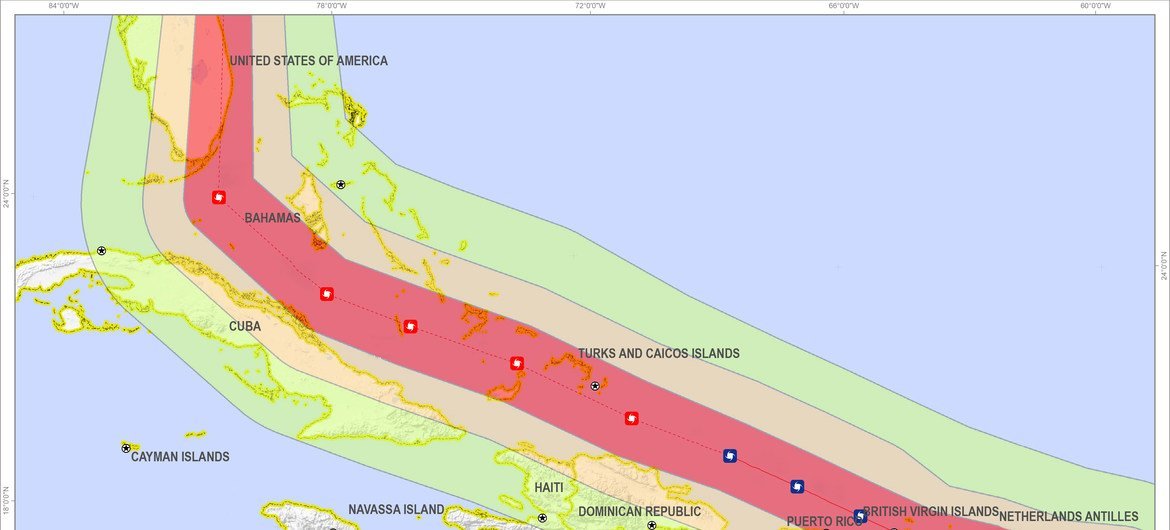
The most severely affected nations were the two-island State of Antigua and Barbuda, and Dominica; but many other Caribbean islands suffered damage, including Anguilla, the British Virgin Islands, The Bahamas, and Turks and Caicos Islands.
Two category 5 hurricanes swept east to west across the Caribbean in September 2017. The most intense wind speeds were found in the red-highlighted zone.
Haiti and St. Kitts and Nevis; St. Maarten as well as Cuba; the Dominican Republic and Puerto Rico, were also impacted.
On 6 September 2017, Antigua and Barbuda was battered by Irma, the first of the two mammoth Atlantic hurricanes tearing westward along Hurricane Alley, the name for the body of warm water that stretches from the west coast of northern Africa to the east coast of Central America and the Gulf Coast of the United States.
For the first time in its history, the entire population of Barbuda, some 1,600 people, was evacuated to the larger island of Antigua. Ninety per cent of homes and buildings in Barbuda were affected, 40 per cent of the roads were damaged, and the entire energy distribution network was destroyed.
Dominica also saw 90 per cent of buildings destroyed by the storms, affecting over 70,000 people.
Hurricanes: Dominica Rebuilds (One year on from Irma and Maria)
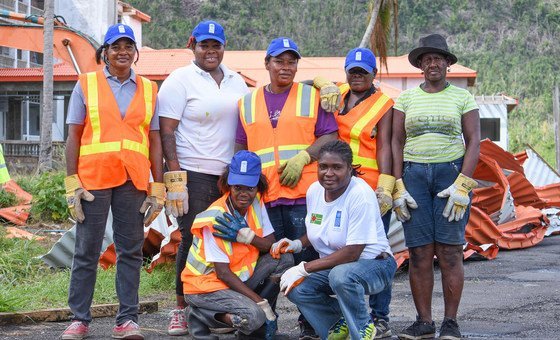
In the aftermath of Irma and Maria, a UN-wide Crisis Management Unit sent waste management and debris removal experts into the affected areas, opening up roads, collecting garbage, and restoring the water and power networks. Emergency work programmes created temporary jobs and training for affected women and men, quickly injecting cash into communities.
Small businesses were given grants to help them to recover: On the Turks and Caicos Islands, the large majority of MSMEs (Medium, Small and Micro Enterprises) were severely impacted by the hurricanes, and the UN supported a wide range of businesses, from pest controllers and farmers, to taxi drivers and people renting out holiday homes.
Like 70 per cent of the inhabitants of South Caicos, Henry Handfield relies on fishing for a living. One of the 40 MSME owners selected for a hurricane relief grant, he says that the $550 received made an impact: “(My boat) was flipped upside down and one portion of it was broken off. The top of the engine was smashed up, the roof was destroyed…all I had was the hull of this boat.” Handfield recalls. “The help I got from UNDP (the UN Development Programme) was very helpful. I was able to take that and put with some other monies to remodel this boat.”
Many families in Dominica were given cash handouts to help them through the period after the hurricanes. UNDPLAC
Financial support also came in the form of an innovative direct cash transfer scheme, which puts money directly in the hands of affected families. Run by the Government of Dominica, the programme is supported by UNICEF and the World Food Programme and funded by the Swedish International Development Cooperation Agency. Between December and February 2017, it provided 8,000 of the most vulnerable families affected by Maria with monthly payments ranging between $90 and $239, depending on the number of children in the household.
Yvonne Hill Williams lives in Roseau, Dominica. A shopkeeper and foster carer who also looks after her five grandchildren, Yvonne lost all of her merchandise when the nearby river overflowed during Hurricane Maria. She found that the cash initiative came in handy during a difficult time: “We bought clothes, shoes, and a little shopping and groceries. You feel that you can buy certain things in town. It’s a good feeling…I appreciate it very much.”
In Dominica, the priority for women farmers was to be able to get back on their feet as soon as possible. UN Women facilitated this by providing seeds, labour and equipment to bring their farms back into production as soon as possible.
Eileen Lloyd, of the Bellevue Chopin Farmers Group in Dominica, is one of the beneficiaries. She described the support provided by UN Women as a blessing: “After Maria, it was very difficult to get seeds, and then we were promised some seeds and tools from UN Women and we appreciate them handing them over to us,” she said.
The organisation also worked closely with the UN Population Fund to provide displaced Barbudan women and girls with sanitary items not easily found in relief packages. They distributed “dignity kits”, containing basic health and hygiene products such as soap and sanitary towels.
Women in Dominica were given additional support, including access to cash-for-work programmes, following the devastation caused by the 2017 hurricane season. UNDP/Zaimis Olmos
One year on, the most vulnerable people affected – those with no income or insurance, single people and those with disabilities – risk getting lost in the system. The International Organization for Migration (IOM), has focused on helping the most at-risk communities.
IOM has helped hundreds in Dominica by reconstructing their homes. Wyzell Philogene, a single mother, spent almost a month sharing a space at a friend’s house, along with around 15 others. Her roof was ripped off, and she lost nearly all her belongings. Wyzelle qualified for IOM humanitarian assistance and, a week later, a brand-new roof was erected at no cost to her. She is now able to focus on making a living, through a landscaping job made available through the National Employment Programme, and she is making sure that she is prepared for the next hurricane season.
Wyzell is not alone in thinking about how to survive in the future: the UN’s longer-term planning and development teams have been working closely with emergency humanitarian workers from the very beginning of the crisis.
In part 2 of this special report, we will look more closely at the efforts underway to make the region more resilient, in the face of climate change and the likelihood of more frequent, and more extreme, natural disasters.