
Government enacted Sexual Harassment of Women at Workplace Act, 2013, aiming to provide safe,secure working environment for women

The Union government has reaffirmed the expansive scope of the Sexual Harassment of Women at Workplace (Prevention, Prohibition and Redressal) Act, 2013, stating that the law applies to all women regardless of age, employment status, or sector of work. The clarification was provided in the Rajya Sabha by Minister of State for Women and Child Development Savitri Thakur in response to a parliamentary query.

The Act, commonly referred to as the Sexual Harassment (SH) Act, was enacted to ensure safe and secure working conditions for women and to uphold constitutional guarantees of equality, dignity, and the right to livelihood.

Sexual harassment at the workplace, the government noted, constitutes a violation of fundamental rights under Articles 14, 15, and 21 of the Constitution of India, as well as the right to practice any profession under Article 19(1)(g). Such conduct creates unsafe work environments and can limit women’s participation in economic activity, affecting broader goals of inclusive growth.

Sexual harassment law definition of aggrieved woman and employee scope

A key clarification highlighted by the government concerns the definition of an “aggrieved woman” under Section 2(a) of the Act. The provision defines an aggrieved woman as any woman, of any age, whether employed or not, who alleges sexual harassment at a workplace. This ensures that protection is not limited to formally employed individuals.

Officials said this broad definition reflects legislative intent to extend protection to all women present in a workplace environment, including visitors or those indirectly associated with the workplace.

The Act also adopts an expansive definition of “employee” under Section 2(f). It includes individuals employed on regular, temporary, ad hoc, or daily wage terms, as well as those engaged through agents. The definition explicitly covers contractual workers, apprentices, trainees, consultants, volunteers, and unpaid interns.

This provision ensures that formal employment or economic dependence on an employer is not a prerequisite for protection under the law.

Workplace and employer definition under Sexual Harassment Act explained

The term “employer” under Section 2(g) is defined to include heads of government departments, organizations, and institutions, as well as individuals responsible for management, supervision, and control in private workplaces. The definition also extends to those fulfilling contractual obligations and, in the case of domestic workers, households employing such workers.

The Act further defines “workplace” in broad terms under Section 2(o), covering government bodies, private enterprises, non-governmental organizations, and institutions engaged in commercial, professional, educational, industrial, or health-related activities.

The definition includes both organized and unorganized sectors and extends to home-based workers, field assignments, and situations where women are in transit for work.

The government described the legislation as inclusive and intersectional in design, aimed at addressing workplace realities across diverse sectors and employment arrangements.

Judicial interpretation has reinforced this wide scope. In the 2013 case of Jaya Kodate v. Rashtrasant Tukdoji Maharaj Nagpur University, the Bombay High Court observed that the definition of workplace was deliberately kept broad to ensure no instance of sexual harassment goes unaddressed.

The clarification in Parliament comes as workplace safety continues to be a central issue in discussions on women’s workforce participation and economic empowerment.

The government maintained that the law’s framework is intended to ensure that no woman, irrespective of her role or employment status, is excluded from protection against sexual harassment in any workplace setting.

Yemen deserves hope and dignity, Security Council hears

For over a decade, Yemen has endured conflict between Houthi rebels and government forces. Millions of lives and livelihoods remain at risk, and the conflict shows no sign of ending.

The appetite for a military escalation remains,” Hans Grundberg, UN Special Envoy for Yemen, told ambassadors.

While violence remains an immediate threat, he noted that the economy has now become the “most active frontline” of the conflict: the national currency in free fall and purchasing power rapidly declining, poverty is a daily threat.

The little money people do have in their pockets is either falling in value or literally falling apart,” he said.

Currently, 17 million people face food insecurity – a number that could rise to 18 million by September without swift and expanded humanitarian aid.  More than one million children under the age of five are suffering from life-threatening malnutrition, putting them at risk of permanent physical and cognitive harm.

“We haven’t seen this level of deprivation since before the UN-brokered truce in early 2022,” said Tom Fletcher, UN Under-Secretary-General for Humanitarian Affairs.

Regional instability deepens the crisis

Broader instability in the Middle East has further worsened Yemen’s situation, Mr. Grundberg said, pointing to recent attacks by Ansar Allah (as the Houthi rebels are formally called) on commercial ships in the Red Sea and retaliatory strikes by Israel on key Yemeni infrastructure, including ports and a power station.

Yemen must not be drawn deeper into the regional crisis that threatens to unravel the already extremely fragile situation in the country. The stakes for Yemen are simply too high,” he said.

Nevertheless, he noted that the ceasefire between Iran and Israel did spark hope that momentum for negotiations in Yemen might resume.

Still, he stressed that Yemen’s peace process must solely depend on regional dynamics.

“Yemen must advance regardless, moving from simply managing shocks and volatility to developing practical steps that lay the groundwork for lasting solutions,” he said.

Negotiations must prevail

Without meaningful peace negotiations, Yemen’s humanitarian crisis will only deepen, Mr. Grundberg warned.

A military solution remains a dangerous solution that risks deepening Yemen’s suffering,” he said.

He highlighted recent progress in Taiz governorate, where both parties agreed to jointly manage water supplies – a move that will provide safe drinking water to over 600,000 people.

This agreement also promotes sustainable water access, reducing reliance on humanitarian aid.

“While negotiations may not be easy, they offer the best hope for addressing, in a sustainable and long-term manner, the complexity of the conflict,” Mr. Grundberg said.

Call for international support

Mr. Grundberg called on the Security Council to continue prioritizing Yemen.

He also reiterated UN calls for all detained humanitarians, including UN staff, and called on donors to ensure sufficient funding to sustain aid organizations on the ground.

Yemen’s future depends on our collective resolve to shield it from further suffering and to give its people the hope and dignity they so deeply deserve,” Mr. Grundberg said.

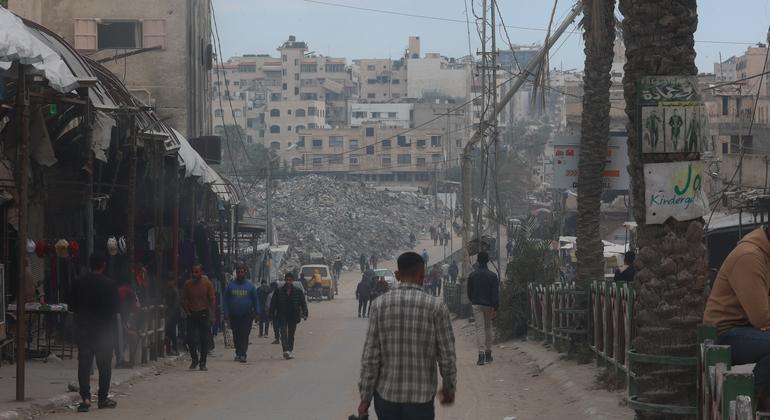
Gaza: UN official warns of ‘assault on dignity’ as blockade cripples humanitarian response

Speaking to journalists in Gaza City, Jonathan Whittall, OCHA‘s local Head of Office, painted a dire picture of life under what he called a “total and complete blockade” now approaching its third month.

“The coming days in Gaza are going to be critical. Today people are not surviving in Gaza, those that aren’t being killed with bombs and bullets are slowly dying,” he said.

Whittall stressed that humanitarian agencies are unable to meet the soaring needs of civilians due to the collapse of supply lines. Hospitals are overwhelmed, but medicines and equipment are running out. People are going hungry, but food warehouses are empty and bakeries are closing. Clean water is desperately needed, but water wells are inaccessible.

He noted that solid waste is piling up in the streets with no equipment to remove it, and that rescue efforts after airstrikes are impossible without fuel and machinery. Displaced families are forced to live in rubble without shelter materials, and fishermen are being shot at sea, while humanitarian organisations lack the resources to assist them. “Nowhere in Gaza today is safe”, he said.

He added that children need to learn, but schools have been destroyed or are inaccessible, and that education supplies are not available. Prices of the remaining goods in Gaza continue to rise, but there is no cash available. There is no cooking gas or fuel, forcing families to burn trash to generate some energy.

“This is not only about humanitarian needs, but it’s about dignity. There is an assault on people’s dignity in Gaza today,” he warned.

“We also know that humanitarian workers, first responders, you as journalists, should be protected, like all civilians, but we’re being killed in a war that appears to be fought without any limits,” he added.

Whittall emphasised that the situation in Gaza does not even resemble a war. “People in Gaza are telling me that they feel like it’s the deliberate dismantling of Palestinian life in plain sight, for all to see, documented every day by you as journalists,” he said.

He described the devastation witnessed daily — including children’s bodies thrown by explosions, families burnt alive, and colleagues killed — as part of what he termed “everyday atrocities.”

“As humanitarians we can see that aid is being weaponised through its denial,” he warned. “There’s no justification for the denial of humanitarian assistance. And humanitarian aid should never be weaponised.”

Despite the catastrophic conditions, he stressed that humanitarian organisations are continuing to operate where possible, but “we have less and less and less supplies and less and less capacity to be able to meet the growing and growing needs that are intensifying across Gaza.”

“Lives depend on the blockade being lifted, on aid being allowed to enter into Gaza, on the ceasefire being reinstated,” he said, calling for real accountability rather than waiting for history to judge the international community’s response.

Hunger and malnutrition surging

In a separate statement, OCHA warned of a “severe decline” in food availability across Gaza, as malnutrition rates escalate rapidly, particularly among children.

A UN partner organisation recently screened around 1,300 children in northern Gaza and identified over 80 cases of acute malnutrition, representing more than double the rate recorded in previous weeks.

“Nutrition partners report a critical shortage of supplies due to the obstruction of aid entry and challenges in transporting essential materials within Gaza,” OCHA said. Access to key facilities, including UNICEF’s main warehouse in Rafah, remains heavily restricted.

Journalists who visited the United Nations Relief and Works Agency for Palestine Refugees (UNRWA) main warehouses this week found them largely empty of food supplies, including flour.

Call for accountability and action

“Nothing can justify the collective punishment of the Palestinian people,” UNRWA said in a separate statement, stressing that international law prohibits indiscriminate attacks, the obstruction of humanitarian assistance, and the destruction of vital civilian infrastructure.

The agency reiterated its call for a renewed ceasefire, the dignified release of all hostages, and the immediate, unhindered flow of humanitarian aid and commercial goods into Gaza.

Source link