Iran Sticks to 2-Day Hormuz Open Offer, Rubio Calls It ‘Ridiculous’

Iran said on Monday it could reopen the Strait of Hormuz within two days if Washington lifted its naval blockade and met other conditions, as US President Donald Trump prepared to meet Qatar’s prime minister. Oil prices fell despite new reports of damage to ships near the waterway.

Foreign Ministry spokesman Esmaeil Baghaei said Tehran wanted an end to hostilities, the release of frozen Iranian assets and relief from sanctions imposed in recent months. Iran gave Washington a seven-day plan through mediators in September. Its shorter timetable would see shipping restrictions eased before talks on Iran’s nuclear programme, which Washington wants addressed from the outset.

Rubio calls it ridiculous

US Secretary of State Marco Rubio called some of Tehran’s conditions “outrageous and ridiculous” on Sunday and said a breakthrough was unlikely soon. Baghaei defended the offer at his weekly briefing in Tehran, calling the two-day plan “a demonstration of the utmost goodwill” and saying the next move lay with Washington.

Trump told CNN on Sunday that further US strikes were “highly unlikely” if negotiations made progress. “It depends on whether or not they sign a very strong agreement,” he said. He also said US forces had identified 38 bridges they could destroy within an hour if fighting resumed.

Qatar’s prime minister, Sheikh Mohammed bin Abdulrahman Al-Thani, was due to meet Trump and Vice President JD Vance in Washington after visiting Tehran last week. Qatar has been passing proposals between the two sides. Its foreign ministry said Sheikh Mohammed discussed maritime navigation and efforts to reach a broader agreement with Iranian Foreign Minister Abbas Araghchi on Thursday.

Oil slides despite fresh reports of ship damage

At sea, the US military said it had disabled a commercial vessel in the Gulf of Oman as it tried to breach the blockade. Iran’s Revolutionary Guards Navy said two tankers caught fire after hitting mines in the strait. Reuters could not verify those accounts. Britain’s maritime trade monitor separately reported an incident involving a bulk carrier and military forces off the United Arab Emirates.

Brent crude fell 3.6% to $94.83 a barrel by 1219 GMT on Monday, while US West Texas Intermediate dropped 2.9% to $88.17. “Oil continues to trade lower on hopes of a US-Iran peace deal rather than concrete signs of progress,” Saxo Bank analyst Ole Hansen told Reuters.

Iraq is seeking to keep its exports moving while the talks drag on. Foreign Minister Fuad Hussein said Baghdad had reached understandings with Washington to ship oil through a lane near Oman. He put Iraq’s losses from the war and export disruptions at $60 billion. Iraqi energy officials said exports rose to about 3.5 million barrels a day in October, from 2.65 million in September.

Before the war, the strait carried an average of 20.9 million barrels of oil a day in the first half of 2025, equivalent to about a fifth of global petroleum liquids consumption, according to the US Energy Information Administration. China, India, Japan and South Korea together received 74% of the crude oil and condensate that passed through it during that period.


Who Is Hakeem Jeffries? Brooklyn-Born Democrat Poised to Make US History as First Black House Speaker

Hakeem Jeffries is preparing for the biggest political transition of his career. After leading Democrats through four years in the opposition, the New York congressman is poised to become the first Black Speaker of the US House of Representatives following his party’s sweeping victory in the November 2026 midterm elections.

The 56-year-old Democratic leader emerged at the centre of the party’s celebrations on November 4, describing the result as an “American tsunami” rather than merely a blue wave.

“The American people have chosen common sense over corruption, chaos and cruelty,” Jeffries said, as Democrats celebrated victories that handed them control of both chambers of Congress.

His elevation, expected when the new Congress convenes in January 2027, would represent a historic moment in American political leadership. The Speaker controls the House legislative agenda, influences committee assignments and stands second in the presidential line of succession, after the vice president.

But Jeffries faces a challenge beyond making history: demonstrating that Democrats can convert electoral success into tangible improvements in the lives of Americans.

From Brooklyn’s Neighbourhoods to the Halls of Congress

Born in Brooklyn, New York, on August 4, 1970, Jeffries grew up in Crown Heights, a neighbourhood that helped shape his political outlook.

He is the son of a social worker and an Air Force veteran. Growing up during the crack cocaine epidemic in New York exposed him to the economic and social difficulties confronting working-class communities.

Jeffries has spoken about how those experiences shaped his interest in public service and his determination to improve conditions for ordinary Americans.

He attended New York City public schools before graduating from Midwood High School. His academic journey took him to the State University of New York at Binghamton, where he earned a bachelor’s degree in political science.

He subsequently obtained a master’s degree in public policy from Georgetown University and graduated magna cum laude from New York University School of Law.

Before entering electoral politics, Jeffries worked as a corporate lawyer. His professional experience included positions at the law firm Paul, Weiss, Rifkind, Wharton & Garrison and legal work associated with Viacom and CBS.

The combination of legal training, public policy education and experience in New York’s political landscape became central to his rise within the Democratic Party.

The Political Journey: From New York Assembly to Democratic Leader

Jeffries began his electoral career in New York state politics. He served in the New York State Assembly from 2007 to 2012, representing a Brooklyn constituency.

During his time in the state legislature, he worked on criminal justice reform and civil liberties issues.

One of his notable legislative efforts involved reforming the New York Police Department’s controversial stop-and-frisk practices. His legislation restricted the retention of personal information about people stopped and questioned by police but not charged with an offence.

In 2012, Jeffries entered the race for the US House of Representatives, challenging long-serving Democratic Congressman Edolphus Towns in a primary.

He won the Democratic nomination and subsequently secured the congressional seat representing New York’s Eighth Congressional District.

He entered Congress in January 2013 and gradually established himself as an influential figure among House Democrats.

His rise accelerated through leadership positions. He served as chair of the House Democratic Caucus and became a prominent member of the Congressional Black Caucus.

In November 2022, Democratic lawmakers unanimously elected him as their House leader, making him the first Black politician to lead a major party caucus in either chamber of the US Congress.

He retained the position in 2024, becoming the central figure in the party’s strategy against Republican control of Washington.

A Different Leadership Style After Nancy Pelosi

Jeffries inherited the Democratic leadership following Nancy Pelosi’s decision to step aside after the party lost control of the House in the 2022 elections.

Pelosi had dominated Democratic House politics for years, serving as the first woman to become Speaker and overseeing major legislative battles during the Obama and Biden administrations.

Jeffries represents a generational transition in Democratic leadership.

His leadership team includes Katherine Clark of Massachusetts and Pete Aguilar of California. Clark is expected to become House majority leader and Aguilar the majority whip if Democrats complete their transition into majority control.

Jeffries has developed a reputation for a measured public style, carefully chosen language and an ability to maintain communication across different sections of the Democratic caucus.

He is also known for incorporating references to old-school hip-hop into political speeches, reflecting his Brooklyn background.

His approach has attracted praise from colleagues who value consensus-building. However, critics have questioned whether his cautious style can deliver sufficiently rapid responses during periods of political confrontation.

The new congressional majority will test whether he can balance those competing expectations.

What Jeffries Wants to Do With Democratic Control

Jeffries has placed affordability at the centre of his post-election agenda.

Democrats campaigned on reducing the cost of groceries, petrol, housing and healthcare, arguing that household expenses had become a major source of economic pressure for American families.

Following the election, Jeffries promised a “relentless effort to make life more affordable for everyday Americans”.

He has also identified government accountability as a priority, signalling investigations into the Trump administration and its decisions.

The Democratic leader has emphasised that his party should focus on delivering results rather than pursuing political retaliation.

However, winning control of Congress does not automatically give Democrats the power to implement their entire legislative programme.

The Senate filibuster means most major legislation requires 60 votes to advance, while Trump retains presidential veto powers. Democrats will therefore need Republican support for several legislative initiatives.

Their majority will nevertheless give them control of House committees, greater oversight powers and the ability to shape congressional investigations.

The new leadership will also have to manage competing priorities within the Democratic Party, including disagreements between moderates and progressives over economic policy, immigration and foreign affairs.

Jeffries and Trump’s Political Confrontation

Jeffries’ rise comes amid an increasingly confrontational relationship with President Donald Trump.

Trump has repeatedly criticised the Democratic leader, while Jeffries has challenged the administration over immigration enforcement, tariffs, healthcare and executive authority.

The two political figures represent competing approaches to the country’s direction, and their relationship will become particularly important when Jeffries takes control of the House agenda.

Trump has already threatened to veto legislation he opposes, making the relationship between the White House and the new congressional leadership central to Washington’s political calculations.

Jeffries has said Democrats will pursue investigations based on facts and the law, rather than treating congressional oversight as an instrument of revenge.

His party’s victory gives him greater institutional authority to challenge the administration, but also makes him directly accountable for whether Democrats can govern effectively.

Why His Speakership Would Be Historic

If elected Speaker when the new Congress convenes on January 3, 2027, Jeffries would become the first Black American to hold the position.

The significance extends beyond party politics. The Speaker’s office occupies a central place in the constitutional structure of the United States and has traditionally been dominated by white men.

Jeffries would take the position more than 150 years after Joseph Rainey became the first Black American elected to the House of Representatives during the Reconstruction era following the Civil War.

His potential elevation would mark another milestone in the long struggle for Black political representation in the United States.

Yet the historic distinction will come with immediate political responsibilities. Jeffries will have to unite Democrats, manage a diverse congressional majority, negotiate legislation and oversee an increasingly contentious relationship with the White House.

For a politician who built his career in Brooklyn before becoming the highest-ranking Democrat in the House, the next phase could define his legacy.

The challenge is no longer simply leading the opposition. It is proving that Democrats can govern, deliver on affordability and exercise congressional power while confronting a Republican president.

Operation Economic Outcast: US Sanctions Chandigarh Couple Over Alleged Iran Oil Network, Targets Nine Indian Entities

A maritime services network operating out of Chandigarh has become the focus of a major US sanctions action against businesses and individuals accused of helping Iran move oil through international shipping routes.

The US Treasury Department on November 4 announced sanctions against Indian businessman Suniel Kumar Sharma, his wife Jaspreet Preeti Shahid, two other Indian nationals and nine associated entities, alleging that they helped Iran’s so-called shadow fleet circumvent restrictions on petroleum exports.

The action also targeted a Turkish aviation services company accused of providing ground handling facilities to US-sanctioned Iranian airlines, extending Washington’s enforcement campaign from oil transportation to the aviation sector.

The sanctions form part of President Donald Trump’s Operation Economic Outcast, launched in August to restrict Iran’s oil revenues and financial channels supporting its government.

Treasury Secretary Scott Bessent warned that Washington would pursue individuals and companies assisting Tehran regardless of where they operate.

“We know where you are, and we will sanction those who continue supporting the Iranian regime, whether by land, sea or air,” Bessent said.

How a Chandigarh Network Allegedly Helped Iran’s Shadow Fleet

According to the Treasury Department, Sharma and Shahid operated a network of purported maritime regulatory organisations that claimed to represent countries including Guyana, Eswatini and Laos.

The alleged operation involved websites and business entities offering vessel registration, flagging, seafarer training, maritime certification and classification services without proper authorisation from the governments concerned.

The department traced the activities to at least 2014, when the couple allegedly attempted to impersonate Dominica’s maritime flagging authority.

In 2023, Sharma established Singapore-based Eswatini Maritime Affairs and International Ship Registry PTE Ltd. Treasury said the company continued providing registration services to vessels transporting Iranian petroleum despite Eswatini authorities publicly disavowing it.

The US identified several sanctioned tankers allegedly connected to the network, including PING SHUN, LATTAFA, BINARY STAR and VERA.

It also cited the case of MAJESTIC X, formerly known as PHONIX, which US forces seized on April 22, 2026, while it was carrying Iranian oil under a false Guyana flag.

Treasury alleged that Sharma used Oceaniek Technologies India to establish questionable flag registries purporting to represent Aruba, Nicaragua and Sint Maarten.

The department said the network also included India-based businesses managed by Shahid and other associates.

Two additional Indian nationals, Ashwani Kumar Dhiman and Ishwinder Singh, were designated over their alleged roles in the couple’s business network.

The nine designated entities are:

  • Oceaniek Technologies India
  • Aryavart Ship Management Private Limited
  • Eswatini Maritime Affairs and International Ship Registry PTE Ltd
  • Precept Trends Private Limited
  • Polynesia Maritime Private Limited
  • Alexarya Finserv Private Limited
  • Alexarya Media and Entertainment Private Limited
  • Viharaboating Private Limited
  • Aryavart Maritime and Educational Trust

The sanctions represent a significant escalation because Washington is targeting not only vessels carrying Iranian petroleum but also the intermediaries allegedly providing the documentation and regulatory cover that allow such ships to operate.

Why False Ship Registrations Matter to International Shipping

A vessel’s flag determines the country responsible for its registration and regulatory oversight. Flag states are expected to ensure compliance with international maritime safety and environmental standards.

Fraudulent registration can allow ships to conceal their ownership, avoid regulatory scrutiny and continue operating despite sanctions.

The insurance implications are particularly significant. Treasury warned that falsely flagged vessels may not possess valid protection and indemnity insurance, potentially exposing coastal countries to enormous financial liabilities if an accident or oil spill occurs.

The US Office of Foreign Assets Control simultaneously issued an industry alert warning maritime companies about the risks of dealing with potentially falsely flagged vessels.

The action puts shipping operators, maritime insurers, banks, vessel classification organisations and other service providers under greater pressure to verify registration documents and the legitimacy of flagging authorities.

The case also has a wider international dimension. A Financial Times investigation published earlier had examined Sharma’s involvement in questionable ship registries across several jurisdictions. Sharma had disputed allegations of knowingly facilitating criminal activity, maintaining that some of his ventures initially had official approval and that he had left the industry.

The latest US designation is a sanctions action based on Treasury’s findings, not by itself a criminal conviction.

Turkish Aviation Company Also Comes Under US Sanctions

Washington’s action was not restricted to maritime operations.

The Treasury Department designated Turkey-based Fugo Ground Services Inc, accusing it of continuing to provide ground handling and other services to sanctioned Iranian airlines operating in Turkey.

The carriers identified by Treasury include Iran Air Tour, Saha Airlines, Sepehran Airlines, Varesh Airlines, Taban Airlines and Ata Airlines Company.

The company allegedly maintained direct service agreements with these airlines, including arrangements that began after several carriers were designated by the US in September 2026.

Washington has repeatedly warned that companies providing aircraft handling, cargo services and other aviation support to sanctioned Iranian carriers could face penalties.

What the Sanctions Mean for Indian Businesses

The designations were imposed under Executive Order 13902, which targets key sectors of Iran’s economy, including petroleum and aviation.

Assets belonging to designated individuals and entities under US jurisdiction, or held by US persons, must be blocked. US persons are generally prohibited from conducting transactions involving their property unless an applicable authorisation or exemption exists.

The restrictions also extend to entities owned 50% or more, directly or indirectly, by blocked persons.

Foreign businesses are not automatically prohibited from every transaction involving a designated person, but non-US entities can face sanctions exposure for certain dealings, particularly transactions involving US persons, the US financial system or conduct that evades or causes violations of US restrictions.

The latest action comes as Washington continues its economic campaign against Tehran amid the US-Iran conflict and disruptions to international energy trade.

For Indian businesses, the case highlights the growing importance of sanctions screening, beneficial ownership verification, maritime documentation and independent confirmation of vessel registrations.

Washington’s message is that companies facilitating Iranian oil and aviation operations can face consequences even when their operations are based outside the United States.

Iran Claims Victory in Defeating Trump on Homefront as Midterm Rout Proves Cost of War Is Dearer Than Expected

Iranian leaders are portraying the Democratic Party’s sweeping victory in the US midterm elections as evidence that President Donald Trump’s war against Tehran has begun to undermine his political standing at home.

Mohsen Rezai, Iran’s security chief, said Wednesday that Tehran had inflicted a strategic defeat on Trump on the battlefield and in the Strait of Hormuz, followed by a political defeat in Washington after Democrats captured both chambers of Congress.

“The Iranian nation handed Trump a strategic defeat on the battlefield and in the Hormuz — and a political defeat in Washington,” Rezai wrote on X.

He also argued that Americans were paying the financial price of the conflict, warning that any country confronting Iran would face consequences extending beyond the battlefield.

“Anyone who takes on Iran will pay the price — from the battlefield to their own doorstep,” he said.

The remarks came as Republicans suffered a major setback in the November 3 midterm elections, with Democrats winning control of the House of Representatives and the Senate, according to projected results.

Iran Sees Political Opportunity in Republican Defeat

Tehran has seized on the election outcome to reinforce its argument that Washington’s military campaign has carried significant domestic political costs.

The conflict, which began with US and Israeli strikes against Iran on February 28, has disrupted energy markets and shipping through the Strait of Hormuz, a critical route for global oil supplies.

The war has also contributed to rising fuel prices and economic uncertainty in the United States, issues that became central to the midterm campaign.

US Vice President JD Vance acknowledged the conflict’s role in the Republican defeat, writing on X that “the reason we lost is the war”.

Trump also conceded that the Iran conflict had contributed to the electoral setback, saying it had pushed gasoline prices higher in the short term.

Iranian officials have interpreted those remarks as an acknowledgment that the conflict has created political vulnerabilities for the US president.

However, Tehran’s declaration of victory remains a political assessment rather than an independently established military conclusion.

Tehran Warns Washington Against Expecting a Policy Shift

Despite celebrating the Democratic victory, Iran’s leadership has dismissed the possibility that a change in congressional control will fundamentally alter Washington’s approach toward Tehran.

Iran’s Supreme Leader Mojtaba Khamenei said those expecting a change in US hostility because of partisan shifts were mistaken.

He also warned that any renewed aggression against Iran could lead to a wider conflict.

The statement signals that Tehran does not regard the midterm outcome as a reason to soften its position in negotiations with Washington.

The election results could nevertheless complicate Trump’s domestic political calculations as his administration weighs its next steps in the conflict.

Democratic control of Congress could increase scrutiny of the administration’s military strategy, spending and diplomatic decisions. The extent of that pressure will depend on congressional priorities and the administration’s ability to sustain support for its policies.

For Iran, the election offers an opportunity to frame the conflict as a political liability for Trump while maintaining its own hard-line position.

The central question now is whether the change in congressional control will translate into meaningful pressure for a diplomatic settlement or leave the military confrontation largely unchanged.


Midterm Elections’ Outcome: Ukraine Seizes Opportunity, Seeks More US Aid

Ukrainian President Volodymyr Zelenskiy is looking to the Democrats’ sweeping victory in the US midterm elections for a possible change in Washington’s approach to the war with Russia, hoping a new congressional balance will translate into stronger military assistance and financial backing for Kyiv.

The Ukrainian leader said the election outcome could help restore a more predictable relationship between the United States and Europe, while increasing pressure on Russian President Vladimir Putin to reconsider his approach to the conflict.

The Democrats are expected to take control of both chambers of Congress in January, giving them greater influence over legislation, government spending and congressional oversight. For Ukraine, the shift offers a potential opening after months of uncertainty over US support under President Donald Trump.

Zelenskiy, speaking to Germany’s ZDF television, said Democrats had been more explicit about their commitment to helping Ukraine than Republicans.

“I am also grateful to the Republicans, but the Democrats speak very clearly about supporting Ukraine and providing assistance to Ukraine,” he said in remarks released by the broadcaster ahead of the interview.

The Ukrainian president added that Democrats had also spoken about renewing ties between Washington and European capitals.

“Therefore, there is hope that a balance of power will emerge and that we will receive more support,” he said.

Congressional shift could strengthen Kyiv’s negotiating position

The election has given Ukraine a potential source of leverage at a time when its relationship with the Trump administration has been marked by uncertainty over military assistance, sanctions against Russia and the future of US-led diplomacy.

Zelenskiy said stronger congressional support for Ukraine could send a direct signal to Moscow.

“If Congress now speaks of strong financial support or military assistance, as Europe is doing and demonstrating today, then that will be something positive that will have an impact on Putin,” ZDF quoted him as saying.

The Ukrainian president’s comments suggest Kyiv sees the incoming Congress not merely as a source of additional funding, but as a potential counterweight to the administration’s approach to the war.

However, the Democrats’ victory does not guarantee a resumption of military assistance on the scale Ukraine received under previous US administrations. Congressional control could influence spending and oversight, but Trump retains executive authority over foreign policy and can resist legislative efforts to redirect his administration’s priorities.

The change in Washington’s political balance therefore offers Ukraine an opportunity rather than a confirmed policy reversal.

Zelenskiy seeks to repair ties as Trump moves closer to Moscow

Zelenskiy has spent considerable political effort trying to stabilise relations with Trump, particularly after their contentious meeting in the Oval Office in February 2025.

During that encounter, the Ukrainian president was accused of being ungrateful for American assistance, exposing the fragility of Kyiv’s relationship with its most important military partner.

The relationship has remained difficult as Trump has pursued initiatives that Kyiv views as favourable to Russia.

In recent weeks, the US president has moved to import Russian diesel and ease sanctions on Moscow, raising concerns in Ukraine that Washington could reduce economic pressure on Putin even as the war continues.

The Ukrainian government has nevertheless maintained contact with Trump’s representatives, seeking to preserve a role for Washington in negotiations over the conflict.

The election result could complicate the president’s ability to pursue his preferred policies without congressional resistance, although it remains unclear how far Democrats will be able to influence decisions on sanctions, military assistance and negotiations.

For Kyiv, the central question is whether the new congressional majority can turn its stated support into concrete measures that strengthen Ukraine’s position on the battlefield and at the negotiating table.

Abu Dhabi talks put US policy under immediate scrutiny

The political shift in Washington comes as diplomatic efforts to end the war are expected to resume.

US presidential envoy Steve Witkoff said American officials would bring together delegations from Ukraine and Russia in Abu Dhabi on November 10 and 11.

The discussions are expected to address ending the war, post-war security arrangements and de-escalation. The talks would resume after a gap of several months in US-led trilateral diplomacy.

The timing places the incoming congressional majority’s position on Ukraine in sharper focus. Kyiv is seeking stronger security guarantees and continued military assistance, while Washington is attempting to bring the two sides into negotiations.

Zelenskiy’s comments indicate that Ukraine hopes the election outcome will strengthen its diplomatic position before those discussions begin.

But the immediate challenge remains whether the United States can maintain a consistent approach to the conflict while its domestic political landscape changes.

A stronger congressional commitment to Ukraine could increase pressure on Moscow. Yet the prospect of greater assistance remains uncertain until political support translates into funding, weapons and policy decisions.

Starlink remains a critical vulnerability for Ukraine

Zelenskiy also addressed Ukraine’s reliance on Starlink, the satellite internet system operated by Elon Musk’s SpaceX, which has played a significant role in maintaining communications during the war.

He expressed gratitude for the connectivity provided by the company, particularly during the early stages of Russia’s invasion, but criticised Musk’s position on the conflict.

“We are grateful to SpaceX for providing us with connectivity. That was very helpful at the beginning of the war,” Zelenskiy said.

“But we must be very clear about this: we certainly do not like his position on this war.”

The Ukrainian president said Starlink and its military-grade version, Starshield, had returned to operating levels seen before restrictions were introduced. The systems have been used for Ukrainian drone attack and air defence missions.

Trump denied involvement in the decision concerning the service slowdown.

The episode highlights a broader strategic concern for Kyiv: Ukraine’s military operations remain dependent on technology and services controlled by US companies, leaving critical capabilities vulnerable to decisions made outside the Ukrainian government.

The midterm outcome may offer Ukraine a more favourable political environment in Washington, but it does not eliminate those operational dependencies.


Trump’s Final Two Years Face New Threat as Democrats Seize Congress

Democrats are preparing to use their newly won congressional majorities to challenge President Donald Trump’s administration, setting up a confrontation that could reshape the final two years of his presidency.

The party’s sweeping victory in the November 3 midterm elections handed it control of both the House of Representatives and the Senate, ending Republican dominance of Congress and giving Democrats the power to block presidential nominations, launch investigations and demand concessions on legislation.

The result represents more than a routine midterm setback. It threatens to accelerate Trump’s transition into a lame-duck president while opening a new struggle over who will inherit the Republican Party’s political influence ahead of the 2028 presidential election.

Democrats made extraordinary gains in states that had long been considered Republican territory, including Texas, Kansas and South Carolina. The victories exposed the extent of voter dissatisfaction with Trump’s economic policies, his handling of the war with Iran and his administration’s stewardship of the country.

The new congressional balance will take effect in January, leaving Trump with a Democratic-controlled legislature for the first time during his presidency.

Democratic victories expose cracks in Trump’s political coalition

The scale of the Democratic advance suggests the party’s gains extended well beyond traditional battleground states.

In Kansas, Democrat Adam Hamilton won a Senate seat that Democrats had not captured since 1932. In Texas, James Talarico defeated Republican Ken Paxton, ending a decades-long Democratic losing streak in Senate elections in the state.

South Carolina also delivered a historic setback for Republicans. Democrat Annie Andrews defeated Republican Senator Darline Graham, marking the party’s first Senate victory in the state this century.

The results were particularly damaging for Trump because several defeated Republicans were candidates he had personally backed.

Paxton, who faced political and legal controversies, had secured Trump’s endorsement over incumbent Senator John Cornyn. Graham, meanwhile, had received the president’s support in a race Democrats had struggled to win for generations.

The defeats have renewed questions about Trump’s ability to translate personal loyalty into electoral success, particularly as Republican candidates increasingly find themselves defending his policies rather than campaigning on their own political records.

Democrats also made substantial gains in Hispanic-majority areas, challenging the Republican Party’s efforts to consolidate support among Latino voters.

In Hidalgo County, Texas, the Republican share of the vote fell by about 25 percentage points compared with Trump’s 2024 performance. In Miami-Dade County, Florida, the Republican share declined by 10 percentage points.

The results indicate that Trump’s electoral coalition has weakened across a broader range of communities than Republicans may have anticipated.

Congress becomes a battleground over Trump’s power

The incoming Democratic majority will have several avenues to challenge the president, even though Trump retains executive authority and the power to veto legislation.

In the Senate, Democrats will be able to block presidential nominations, including appointments to the federal judiciary. The chamber’s confirmation powers could become particularly consequential if a vacancy arises on the US Supreme Court.

Democrats are also expected to intensify congressional investigations into the administration, its policies and the president’s political allies.

The House majority will give the party control of committees, investigative agendas and subpoena powers, creating opportunities to scrutinise decisions that Republicans largely allowed to proceed during the first two years of Trump’s second term.

However, the new majority will face limits.

Trump can veto legislation passed by Congress, while Republicans retain influence through the executive branch and the remaining period of unified Republican control before the new Congress takes office.

The election therefore creates the prospect of prolonged political deadlock rather than an immediate reversal of the president’s agenda.

Democratic leaders have pledged to focus on affordability and accountability, but the party will also face pressure to demonstrate that its electoral gains can translate into tangible improvements in voters’ lives.

Senate Democratic leader Chuck Schumer said the election had produced a generational transformation of the Senate map, arguing that voters had demanded change and that Democrats now had to deliver.

Trump has indicated that he is prepared to work with Democrats on some issues, including immigration, while warning that he would veto legislation he considers unacceptable.

Iran war and rising costs become central to the election verdict

The Democratic victory was driven in large part by voters’ dissatisfaction with the economy and the consequences of the US war with Iran.

The conflict, which began in February, contributed to higher energy costs and intensified concerns about the cost of living.

Trump had returned to the White House in 2024 promising to tackle inflation and improve economic conditions. But the combination of tariffs, rising prices and the war created a political vulnerability that Democrats exploited during the midterm campaign.

Exit polling conducted by SSRS for a consortium of US media organisations found that nearly nine in 10 voters considered the cost of living a crucial or major factor in their decisions.

Nearly two-thirds of voters blamed Trump for high prices, while three-quarters said they were angry or dissatisfied with the direction of the country.

About half of voters said the election was an opportunity to rebuke the president, and 70% wanted Congress to provide stronger checks and balances on his administration.

The findings suggest that the election was not simply a rejection of individual Republican candidates. It was also a broader judgment on Trump’s leadership and the economic consequences of his policies.

The administration’s handling of the Iran conflict has emerged as a particularly significant factor, with Trump acknowledging that the war contributed to Republican losses.

Vice President JD Vance also attributed the defeat to the conflict, underscoring the political consequences of a foreign policy decision that has become increasingly unpopular among voters.

Republican leadership faces a succession struggle

The election has also opened a new phase of uncertainty within the Republican Party.

Trump is constitutionally barred from seeking a third presidential term, making the 2028 election a central concern for Republicans even as the president continues to exercise considerable influence over the party.

The congressional losses could accelerate the emergence of potential successors, intensify divisions over the party’s future direction and weaken Trump’s ability to determine which candidates receive Republican backing.

The defeat of several Trump-endorsed candidates has also raised questions about whether loyalty to the president remains an electoral advantage or has become a liability in competitive races.

Republicans now face the challenge of rebuilding their political standing while navigating a president whose influence remains substantial but whose electoral appeal has been damaged.

For Democrats, the victory provides an opportunity to establish themselves as a governing alternative rather than merely an opposition force.

The party will need to address the economic concerns that helped propel it to victory while managing expectations about what can be achieved under a president who retains veto power.

The midterm result has therefore created a new political equation in Washington: Democrats have gained the institutional power to constrain Trump, but the president retains the executive authority to resist them.

The struggle over congressional oversight, legislation and the Republican succession could define the final two years of Trump’s presidency.


Now That Democrats Win Congress, Microsoft, Amazon and Alphabet Face Growing Infra Scrutiny

The technology industry’s AI ambitions depend heavily on the rapid construction of data centres, which require enormous amounts of electricity, land, water and specialised equipment.

Microsoft, Amazon and Alphabet have committed substantial capital to expanding their computing infrastructure as demand for AI services increases.

The expansion has become a source of tension in communities where residents fear that data centres could increase electricity prices, strain local resources and deliver limited economic benefits relative to their environmental and infrastructure costs.

The political backlash is no longer confined to a small number of communities.

A Reuters/Ipsos poll released in October found that 69% of Democratic registered voters supported limits on data-centre construction, compared with 43% of Republican voters.

That divide could become increasingly consequential as Democrats gain influence over congressional investigations, federal legislation and the broader political debate surrounding AI development.

However, the issue is not exclusively partisan. Opposition to data centres has also emerged among Republican voters, making it difficult for technology companies to rely on political support from one party alone.

Meta and other AI companies face questions over corporate power

The election also raises questions about the political influence of technology executives who aligned themselves with Trump.

Elon Musk, who owns Tesla and SpaceX and has substantial interests in AI infrastructure, spent hundreds of millions of dollars supporting Republican candidates during the election cycle.

Musk’s political spending failed to prevent the Democratic victories, including James Talarico’s win in Texas.

Following the results, Musk posted on X: “Data centers in space looking pretty appealing right now.”

The remark highlighted the growing political sensitivity surrounding data-centre construction, particularly in Texas, where the election results could affect future infrastructure projects.

The broader technology industry could face a more difficult political environment as congressional Democrats examine the relationship between corporate influence, AI development and government policy.

Meta, Microsoft, Amazon and Alphabet have all benefited from the expansion of AI infrastructure. However, the election results do not establish that these companies have been targeted by a specific investigation or that their existing projects will be halted.

The potential exposure is broader: greater scrutiny of the industry could affect the political and regulatory conditions under which these companies operate.

Why a Democratic Congress may not stop the AI boom

Despite the potential risks, a Democratic takeover of Congress does not automatically mean that AI infrastructure development will slow dramatically.

The AI industry has become central to US economic growth, corporate earnings and competition with China.

Both Democrats and Republicans have incentives to support continued investment in computing infrastructure, particularly as AI becomes increasingly important to national security and technological competitiveness.

Reuters reported before the election that analysts did not expect a Democratic congressional majority to produce legislation that would significantly halt data-centre construction.

The more immediate concern is the possibility of additional hearings, investigations and regulatory uncertainty.

Such scrutiny could affect the timing and cost of infrastructure projects even if Congress does not enact sweeping restrictions.

The consequences may also be more pronounced at the state and local levels, where authorities have significant influence over land use, electricity infrastructure and construction approvals.

For technology companies, the election has therefore created a more complicated operating environment rather than an immediate end to the AI investment boom.

The industry must now contend with a political debate increasingly focused on who pays for the infrastructure supporting artificial intelligence, who benefits from its expansion and how much power technology companies should exercise over public policy.


US Midterms 2026: Democrats Flip Red States, Put Trump’s Congress at Risk

Democrats have made substantial gains in the 2026 US midterm elections, winning Senate seats in traditionally Republican states, defeating GOP incumbents and moving closer to taking control of both chambers of Congress in a significant setback for President Donald Trump.

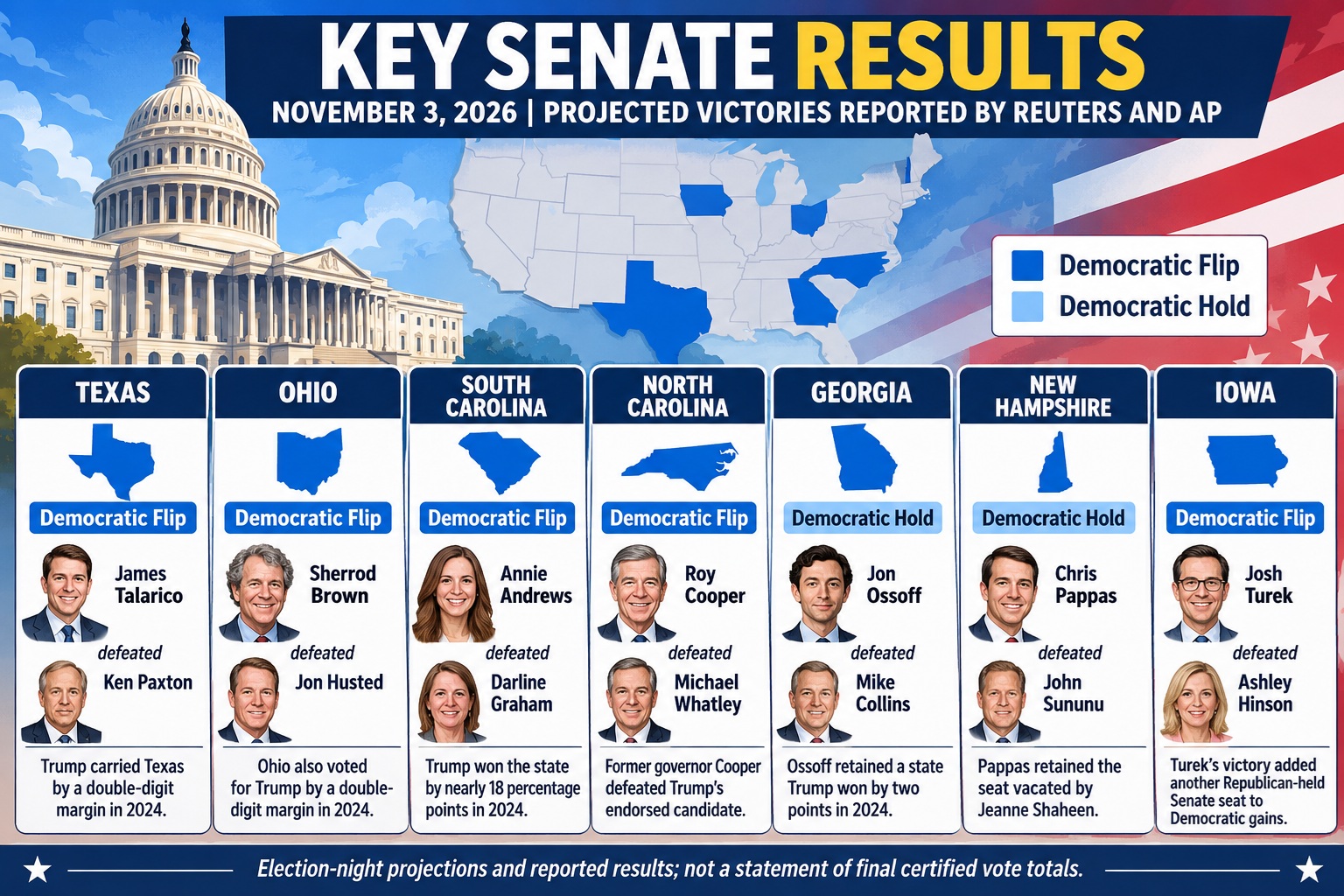
The results go beyond the expected midterm losses for a party controlling the White House. Democrats have secured victories in Texas, Ohio, South Carolina and North Carolina, states that supported Trump in the 2024 presidential election. The Associated Press also reported further Democratic Senate gains, including Iowa, taking the party’s pickups to five in its latest election-night assessment.

In the House of Representatives, Democrats defeated Republican incumbents and captured open seats, putting them within reach of the three-seat net gain required to secure a majority.

The geographical spread of the results is particularly important. Democratic victories in Texas, Ohio and South Carolina indicate that the party’s gains have extended into states where Republicans had entered the election with substantial advantages.

The results also raise questions about whether Trump’s 2024 electoral coalition, which included significant gains among younger, Black and Latino voters, has remained intact.

Texas, Ohio and South Carolina: Where the Republican Map Shifted

The Senate results offer the clearest indication of the scale of the Democratic gains.


Election-night projections and reported results; not a statement of final certified vote totals.

The Texas result is particularly consequential. Democrat James Talarico defeated Republican Ken Paxton, delivering the party a Senate victory in a state that has not voted for a Democratic presidential candidate since 1976. Democrats also secured the Senate seat in Ohio, where former senator Sherrod Brown defeated Republican incumbent Jon Husted.

In South Carolina, paediatrician Annie Andrews defeated Republican Darline Graham, who had been appointed to the seat following the death of her brother, Senator Lindsey Graham.

The outcomes also exposed the importance of candidate selection. Trump backed Paxton and Graham despite controversies surrounding their candidacies. Paxton faced a history of legal and political controversies, including his 2023 impeachment by the Texas House, while Graham’s limited electoral experience attracted scrutiny.

North Carolina added another Republican-held seat to the Democratic column. Former governor Roy Cooper defeated Michael Whatley, the former Republican National Committee chairman backed by Trump.

Democrats also defended seats in Georgia and New Hampshire. Jon Ossoff defeated Republican Mike Collins, while Chris Pappas won the New Hampshire contest against former senator John Sununu.

The results are significant when compared with the Senate’s starting position. Republicans entered the election with 53 seats against 47 held by Democrats and independents who caucus with them. Democrats needed a net gain of four seats to secure control.

The Associated Press subsequently reported five Democratic Senate pickups, although the final chamber balance remained subject to outstanding contests and the status of all races.

Economic Dissatisfaction, Trump’s Approval and the House Battle

The election results also provide measurable evidence of voter dissatisfaction with the administration’s economic performance.

The AP Voter Poll found that approximately two-thirds of voters believed Trump’s policies had worsened economic conditions, while only around three in 10 said they had improved them.

Tariffs also faced considerable opposition. Roughly two-thirds of voters said Trump’s tariff policies had harmed the US economy.

The survey identified the following concerns:

Voter assessment Finding
Trump’s policies worsened economic conditions About 66%
Trump’s policies improved economic conditions About 30%
Disapprove of Trump’s presidency About 60%
Want more congressional checks on the president About 70%
Economy is the country’s most important issue About 40%
Democracy is the most important issue About 30%
Angry or dissatisfied with the country’s direction About 75%

The economy was therefore not simply another campaign issue. It was a central measure through which voters assessed the administration.

Higher fuel prices, inflation, tariffs and the cost of living featured prominently in the campaign. Trump’s decision to launch military action against Iran in February also became a domestic political issue as the conflict contributed to higher energy costs.

The findings suggest that Republican candidates faced a difficult combination of economic dissatisfaction and concerns about presidential accountability.

The House results reinforce that pattern. Republicans entered the election with 218 seats, alongside an independent who caucuses with them, against 214 Democrats and two vacancies, according to CBS News. Democrats needed a net gain of just three seats.

Reuters reported that Democrats had flipped at least eight Republican-held districts in states including Kentucky, New Jersey and North Carolina during its election-night update. Subsequent AP reporting placed Democrats within reach of the majority, with several races still being counted.

Florida offered another useful comparison. Republican Senator Ashley Moody defeated Democrat Angie Nixon, but her lead was only around three percentage points in a state Trump won by 13 points in 2024. Democrats also retained three Florida congressional districts that Republican lawmakers had redrawn, despite those constituencies having backed Trump by at least nine percentage points.

These results suggest that the Republican difficulties were not confined to a handful of Democratic strongholds.

The historical comparison is also important. The party of the sitting president has lost congressional ground in all but two midterm elections since World War Two. The 2026 results are consistent with that longer-term pattern, but the number of Republican-held states and districts changing hands gives this election a wider geographical dimension.

For Trump, losing control of the House would mean facing a Democratic-led chamber capable of launching investigations, issuing subpoenas and obstructing parts of his legislative agenda. A Democratic Senate majority would also give the opposition greater influence over presidential nominations and judicial appointments.

However, congressional control does not automatically translate into the ability to reverse presidential policies. Trump retains veto powers, and Democrats would need sufficient congressional support to overcome them.

The immediate political consequence is a more contested final two years of Trump’s presidency. The election has shifted the balance of congressional power towards Democrats, while the results in traditionally Republican states have raised questions about the durability of the coalition that returned Trump to the White House in 2024.

(With inputs from agencies)

US Midterm Elections 2026: Live – Trump’s midterm defeat exposes voter anger more on living costs than Iran war

The early results point to a major test of Republican control of Congress. Democrats have secured important Senate victories, while several battleground races remain unresolved. The outcome will determine how much room Trump has to advance his legislative agenda during the second half of his term. The following is the opening sequence for the rolling report. 

Nov. 4, 2026 | 14:10 IST :

Trump’s midterm defeat exposes voter anger over living costs

The 2026 US midterm elections have delivered a decisive verdict on President Donald Trump’s second-term agenda, with economic anxiety, dissatisfaction with the administration and opposition to the war with Iran emerging as major factors behind the Democratic sweep of Congress.

Exit polls indicate that the cost of living was a central concern for voters. A CNN exit poll found that approximately 90% of respondents considered living costs a crucial or major factor in their vote.

The findings suggest that household economic pressures have become a significant political liability for Republicans, even in states that supported Trump in the 2024 presidential election.

The Associated Press exit poll also found widespread concern about inflation, with approximately 80% of voters saying rising prices had caused moderate or severe financial hardship.

More than 80% expressed concern about the cost of groceries, gasoline, utilities and healthcare.

The results come as Democrats have won control of both the House and Senate, flipping seven Republican-held Senate seats and making substantial gains in the House.

Iran war becomes another political liability

The war with Iran also emerged as a major factor in the election.

According to the CNN exit poll, approximately 60% of voters believed the United States had made the wrong decision in attacking Iran. Around one-third said the conflict was a crucial factor in their congressional vote.

The findings point to a broader challenge for Trump: voters were not only concerned about domestic economic conditions but also about the administration’s foreign policy.

The Democratic victories in traditionally Republican states, including Texas, Kansas and South Carolina, indicate that the political impact extended beyond the party’s traditional strongholds.

Democratic control reshapes Washington

The Democratic takeover of Congress will give the party greater authority over legislative priorities and congressional oversight.

The new majority can block Republican legislation, challenge administration nominees and launch investigations into the Trump administration.

The election results also raise questions about the political direction of the country ahead of the 2028 presidential contest.

Trump has rejected the idea that the midterm results represent a judgment on his presidency, despite the scale of Republican losses.

The election, however, has substantially weakened the administration’s congressional position and given Democrats a stronger platform to challenge the president’s policies.

Nov. 4, 2026 | 13:20 IST :

Susan Collins loses Maine Senate seat as Democrats complete historic seven-seat sweep

Democrats have delivered another major blow to Republicans in the 2026 US midterm elections, defeating five-term Senator Susan Collins in Maine and completing a seven-seat sweep that has handed the party control of the US Senate.

Democratic candidate Troy Jackson defeated Collins, ending her nearly three-decade career in the Senate and eliminating one of the Republican Party’s most established political strongholds.

The Associated Press called the race for Jackson, confirming the latest Democratic pickup in an election that has dramatically altered the balance of power in Washington.

Democrats needed a net gain of four seats to reclaim the Senate. They have now secured control of the chamber, with 53 seats called for Democrats against 41 for Republicans in the latest reported tally. Remaining contests will determine the final composition.

Collins had been one of the most closely watched Republican incumbents of the election cycle. Her defeat is particularly significant because Maine has repeatedly returned her to the Senate despite its competitive political landscape.

The result completes a remarkable series of Democratic victories in traditionally Republican territory, including Texas, Kansas, Iowa, Ohio, North Carolina and South Carolina.

The Senate outcome also represents a direct political rejection of Trump’s campaign strategy. The president repeatedly intervened in competitive races, endorsed candidates and urged voters to treat the midterms as a referendum on his administration.

Democrats are now positioned to take control of Senate committees, influence legislative priorities and exercise greater oversight of the Trump administration.

The change in congressional power will have consequences extending beyond the immediate election. Trump’s ability to secure Senate approval for nominations and advance his legislative programme will become more complicated.

The Democratic victory in Maine also demonstrates the scale of the Republican losses. Collins had survived previous difficult elections, but the national political environment proved decisive this time.

Nov. 4, 2026 | 10:20 AM IST :

Sherrod Brown’s Ohio comeback deals another blow to Trump as Democrats close in on Senate control

Democrat Sherrod Brown has defeated Republican incumbent Jon Husted in Ohio, securing a dramatic return to the US Senate and delivering another setback to President Donald Trump’s Republican Party in the 2026 midterm elections.

Brown’s victory is particularly significant because Ohio has increasingly leaned Republican in recent presidential elections. He previously represented the state in the Senate for 18 years before losing his seat in 2024.

Husted was appointed to the Senate in 2025 after JD Vance became vice-president. The special election determined who would serve the remaining two years of Vance’s Senate term.

The contest became a major test of whether Democrats could rebuild support among working-class and rural voters who have increasingly moved towards Republicans.

Brown made the cost of living a central issue in his campaign, criticising Trump’s tariff policies, the administration’s war with Iran and the expansion of data centres.

The data-centre issue also emerged as a significant campaign flashpoint. Brown accused Husted of being closely associated with the industry, arguing that its expansion was contributing to higher electricity bills and placing additional pressure on communities.

Husted had supported legislation intended to protect electricity consumers from the costs associated with data-centre expansion, but Brown criticised the proposal as inadequate.

The Ohio result adds to a series of Democratic victories in the Senate, bringing the party closer to reclaiming control of the chamber.

Democrats entered the election needing a net gain of four Republican-held seats to secure an outright majority.

The broader results also suggest that economic concerns, particularly household expenses, energy costs and dissatisfaction with Trump’s policies, have become central factors in the midterm verdict.

The emerging Democratic gains could significantly constrain Trump’s legislative agenda if the party secures control of both chambers of Congress.

However, the final balance of power will depend on the remaining uncalled races.

Nov. 4, 2026 | 9:53 AM IST : Democrat James Talarico stuns Trump-backed Ken Paxton in Texas Senate race

Democrats have delivered one of the biggest shocks of the 2026 US midterm elections, with James Talarico defeating Republican Ken Paxton in Texas, a state that has not elected a Democrat to statewide office in more than three decades.

The victory marks a major setback for President Donald Trump, who backed Paxton in the closely watched Senate contest. Talarico’s win, alongside Democratic victories in North Carolina, Georgia and New Hampshire, has intensified the battle for control of Congress.

The Associated Press reported that Talarico’s victory makes him the first Democrat to win statewide office in Texas in more than 30 years.

The Texas race was among the most consequential Senate contests of the election, with Republicans defending their majority in the chamber. Democrats entered the election needing a net gain of four seats to take control of the Senate.

Talarico’s victory raises the possibility of a broader Democratic resurgence in traditionally Republican territory, potentially reshaping the political landscape ahead of the 2028 presidential election.

The result also adds to a difficult night for Trump-backed candidates. Republicans have faced setbacks in several competitive races as voters expressed concerns about inflation, the cost of living and the direction of the country.

In South Carolina, Democrat Annie Andrews defeated Republican Darline Graham, becoming the state’s first woman senator and its first Democratic senator in more than two decades, according to the Associated Press.

Democrats have also won Senate races in Georgia and New Hampshire, while making gains in competitive House contests.

The outcome of the midterms will determine whether Trump faces a Democratic-controlled chamber during the final two years of his presidency. A Democratic takeover would give the party greater power to investigate the administration, challenge legislation and shape congressional oversight.

However, control of the Senate and House remains dependent on the remaining unresolved races.

9:20 AM IST | Keisha Lance Bottoms wins Georgia governorship, makes US history

Democrat Keisha Lance Bottoms has won Georgia’s gubernatorial election, becoming the first Black woman elected governor in the United States.

Her victory marks a historic breakthrough in American electoral politics and adds to a strong series of Democratic results in Georgia.

The outcome comes as Democrats seek to translate voter dissatisfaction with the Trump administration into victories across federal and state-level contests.

The Georgia result also carries national significance as both parties assess the political landscape ahead of the 2028 presidential election.

The gubernatorial race was among 36 contests for state governors held during the 2026 midterm elections.

Bottoms’ victory is one of the most consequential state-level outcomes of election night, alongside the closely watched congressional races that will determine control of Washington.

9:00 AM IST | Democrats hold Georgia and New Hampshire Senate seats, block Republican gains

Democrats have held key Senate seats in Georgia and New Hampshire, strengthening their position in the battle for control of the chamber.

Senator Jon Ossoff has won re-election in Georgia, defeating Republican challenger Mike Collins. The victory prevents Republicans from making a major gain in a state that has emerged as a central battleground in national politics.

In New Hampshire, Democrat Chris Pappas defeated Republican John Sununu, blocking a potential Republican pickup in another closely contested race.

The results follow Democrat Roy Cooper’s victory in North Carolina, giving Democrats a series of important Senate outcomes as the midterm count continues.

The party still needs additional gains to secure a majority. Several competitive Senate races remain unresolved, leaving control of the chamber uncertain.

The results are also an early indication of the political environment facing Trump as voters assess his administration’s performance.

8:40 AM IST | Democrats flip North Carolina Senate seat as Roy Cooper defeats Republican

Democrats have scored a crucial victory in the US Senate, with former North Carolina Governor Roy Cooper defeating Republican Michael Whatley in a closely watched race that could reshape control of Congress.

Cooper’s victory marks a significant Democratic pickup in a state President Donald Trump carried in the 2024 presidential election. The result strengthens the party’s position as it attempts to reclaim the Senate majority.

The race was among the most closely watched contests of the 2026 midterm elections, with Democrats targeting Republican-held and open Senate seats across several states.

The Senate outcome remains unsettled, with multiple battleground contests still awaiting final results. Democrats need additional victories to take control of the chamber, while Republicans are fighting to preserve their majority.

The results will determine whether Trump faces a divided Congress during the second half of his presidency.


Democrats Flip North Carolina Senate Seat, Deal Blow to Trump

Democrats scored a major breakthrough in the US midterm elections, flipping a Republican-held Senate seat in North Carolina and winning key contests in Georgia and New Hampshire, as early results pointed to growing resistance to President Donald Trump’s leadership.

Former North Carolina Governor Roy Cooper defeated Trump-backed Republican Michael Whatley, securing a crucial seat for Democrats in their battle to regain control of the Senate. The victory marks a significant setback for Republicans in a state that backed Trump in the 2024 presidential election.

Democratic Senator Jon Ossoff also won re-election in Georgia, defeating Republican challenger Mike Collins, while Chris Pappas retained New Hampshire’s open Senate seat for the party by defeating former Senator John Sununu.

The results have strengthened Democratic hopes of breaking the Republican grip on Congress during the final two years of Trump’s presidency. However, control of both chambers remained uncertain as votes continued to be counted across several states.

The House of Representatives appeared increasingly favourable to Democrats, while the Senate contest remained closely fought.

Republicans entered the elections with a 53-47 Senate majority. Democrats need a net gain of four seats to take control of the chamber, while three additional seats would give them a House majority.

Republicans Face Unexpected Resistance in Florida

Florida delivered another surprise for Democrats, with the party holding three House constituencies that Republican lawmakers had redrawn earlier this year to improve their electoral prospects.

All three districts had supported Trump by at least nine percentage points in the 2024 presidential election.

Republican Senator Ashley Moody, however, defeated Democratic challenger Angie Nixon in the state’s Senate contest. Moody’s victory came despite a much narrower margin than Trump’s 13-point win in Florida two years ago.

The results suggested that Republicans were struggling to translate Trump’s previous electoral advantage into support for candidates in several key contests.

The election has turned into a crucial test of public opinion on Trump’s second presidency, with economic pressures, rising fuel prices and the administration’s policies emerging as major voter concerns.

Exit polls conducted by SSRS for a consortium of US media organisations, including major television networks and the Associated Press, showed widespread dissatisfaction with the country’s direction.

Around half of voters said they viewed the midterm elections as an opportunity to rebuke Trump. Three-quarters described themselves as angry or dissatisfied with the way the country was heading.

About 70% also said they wanted Congress to exercise greater checks and balances on the president.

The findings could provide Democrats with political momentum as they seek to challenge Trump’s legislative agenda and increase scrutiny of his administration.

Trump Faces Political Test as Democrats Seek Congressional Control

The results represent an early warning for Republicans, who have historically struggled to retain congressional seats during midterm elections.

Since World War Two, the party holding the White House has lost ground in Congress in all but two midterm elections.

Trump’s approval ratings have been hovering near their lowest levels, with voters expressing frustration over the war with Iran, higher energy costs, tariffs and broader affordability concerns.

Republicans, led by Trump, sought to portray Democratic candidates as radical and out of touch with American voters. Democrats rejected those accusations and focused their campaigns on the cost of living and the president’s performance.

Trump held more than two dozen campaign rallies since the beginning of October, largely in states he had comfortably won in 2024, underscoring the Republican effort to protect its electoral position.

The election also drew scrutiny over the federal government’s role in monitoring voting. The Justice Department said it had deployed 1,000 election monitors and observers across all 50 states, describing it as the largest Election Day monitoring exercise in US history.

Democrats criticised the deployment, warning that federal monitoring could intimidate voters. Officials in several states reported no major problems, although New Mexico authorities said they had received complaints about federal monitors asking unusual questions in one county.

Meanwhile, the Senate race in Alaska became embroiled in controversy following allegations that Democratic candidate Mary Peltola’s campaign helped recruit an independent candidate with the same first and last name as Republican incumbent Dan Sullivan.

Peltola denied involvement. The Justice Department opened a criminal investigation into the allegations and filed a lawsuit seeking to block certification of the results. A judge dismissed the lawsuit.

With several important contests still being counted, the final composition of Congress remained unclear. But the early victories in North Carolina, Georgia and New Hampshire have put Democrats in a stronger position and intensified pressure on Trump as he approaches the second half of his presidency.

Iran issues nuclear attack survival guide as US strikes Qeshm Island and tensions escalate

Iran has issued an unusually detailed public guide on surviving a nuclear explosion, advising residents to take shelter in basements, switch off air conditioners drawing outside air and remain indoors for at least 24 hours, as renewed US military strikes and warnings over a possible attack on its underground nuclear facilities intensify regional tensions.

The eight-minute educational video, published by Iran’s state news agency IRNA on October 29, outlines precautions against a nuclear blast, extreme heat, shock waves and radioactive fallout. The instructions were prepared by emergency services in Isfahan province, which houses the Natanz nuclear facility.

The advisory has gained attention as the United States carried out limited strikes on Iran’s Qeshm Island near the Strait of Hormuz on November 2. Washington described the operation as defensive, targeting Iranian forces and missile systems considered a threat to US assets. The strikes did not signal a return to major combat operations, according to US officials.

The timing has also renewed scrutiny of President Donald Trump’s repeated threats to target Pickaxe Mountain, a deeply buried nuclear-related facility near Natanz.

Trump said in an October 16 interview that the US might have to strike Pickaxe Mountain to prevent Iran from developing nuclear weapons. However, he explicitly ruled out using a nuclear weapon, saying: “I wouldn’t use nuclear. We don’t have to.”

The latest Iranian advisory does not establish that a nuclear attack is imminent. It was issued as part of the country’s annual Passive Defence Week, an initiative focused on preparing civilians for emergencies. But the detailed instructions have drawn attention because of the continuing military confrontation and uncertainty over Washington’s next move.

Shelter, switch off ACs and avoid radioactive fallout

The video identifies four major dangers from a nuclear explosion: intense light, blast waves, extreme heat and radioactive materials.

Ebrahim Adelzadeh, deputy director of education and research at the Isfahan Red Crescent Society, advised people to seek shelter in sturdy buildings, preferably in basements or central rooms away from windows.

“A basement or a room in the central part of a building, away from windows, can be a suitable shelter if it can be accessed safely,” Adelzadeh told IRNA.

Residents have been advised to close doors and windows and switch off air conditioners and ventilation systems that draw air from outside. Additional instructions recommend staying inside for at least 24 hours, using bottled water and packaged food, and avoiding vehicles as shelters.

People caught outdoors during an explosion have been told not to look directly at the flash. They should take cover behind a solid barrier, lie close to the ground and protect their heads and faces. Once the initial blast wave passes, they should enter the nearest sturdy building.

The advisory also warns against remaining outdoors to watch or photograph an explosion. If a shelter catches fire or faces the risk of collapse, people should move to another safe building.

Iran warns against self-medication with iodine tablets

Radioactive fallout is a central concern in the guidance. Airborne particles could travel beyond the immediate blast zone, exposing people who are not close to the explosion.

Adelzadeh urged residents far from a potential attack site to take official warnings seriously and follow instructions from emergency authorities.

People who may have been exposed to radioactive dust have been advised to remove outer clothing carefully, seal it in a bag and wash exposed skin and hair with soap and water. The guidance also recommends using packaged food and bottled water to reduce the risk of consuming contaminated supplies.

Abbas Abedi, spokesperson for Isfahan’s pre-hospital emergency services, cautioned against taking iodine tablets without medical advice.

“Stable iodine can, under certain conditions, reduce the absorption of radioactive iodine by the thyroid gland, but it does not provide protection against other radioactive materials or radiation resulting from an explosion,” he told IRNA.

The video also refers to Prussian Blue, a medicine used in certain cases of internal contamination involving radioactive caesium-137. Officials recommend keeping battery-powered radios because electromagnetic pulses could disrupt electronic equipment and communication systems.

Pickaxe Mountain remains a potential flashpoint

Pickaxe Mountain, located near Natanz in Isfahan province, has become a focus of US and Israeli concern because of its heavily fortified underground facilities. The complex is buried beneath a granite mountain, making it a difficult target for conventional weapons.

The precise activities inside the facility remain unclear. International inspectors have not been given access to the site, while allegations that Iran has moved centrifuges there have not been independently established.

The latest US strikes on Qeshm Island came amid continuing diplomatic efforts to prevent a wider conflict. Iranian Deputy Foreign Minister Kazem Gharibabadi said Tehran remained open to negotiations through Qatari mediation while retaining the right to defend itself.

Iran’s survival guide therefore comes at a moment of heightened military uncertainty. Its publication signals a public preparedness effort, but does not by itself confirm that either Washington or Tehran expects a nuclear strike.

US Strikes Iran’s Qeshm Island Hours Before Midterms as Trump Signals Peace Deal

The United States launched fresh military strikes on Iran’s strategically important Qeshm Island hours before Americans voted in the November 3 midterm elections, exposing a sharp contradiction between President Donald Trump’s public assurances about diplomatic progress and Washington’s continuing military operations against Tehran.

President Trump confirmed the attack on Tuesday, describing it as a minor operation against an Iranian anti-aircraft installation. “They built an anti-aircraft facility… As soon as it was completed, we hit it last night very nicely,” he told Fox News.

US officials characterised the November 2 operation as defensive and limited, saying American forces targeted Iranian military capabilities threatening US assets and commercial shipping around the Strait of Hormuz.

The strikes came just hours after Trump suggested that Iran wanted a negotiated settlement and Vice President JD Vance expressed optimism about the prospects for an agreement.

The timing is politically significant as Republicans fight to retain control of Congress in an election increasingly shaped by the economic and political consequences of the Iran conflict.

Why Did the US Attack Iran’s Qeshm Island?

Qeshm Island occupies a strategically important position near the Strait of Hormuz, the narrow maritime passage between Iran and Oman through which approximately one-fifth of the world’s oil supplies normally transit.

The island hosts Iranian military infrastructure, including missile facilities and naval installations. Its location makes it important to Iran’s ability to influence maritime movement through the Gulf.

According to US officials cited by multiple media outlets, the latest strikes targeted Iranian forces using surface-to-air missiles against American assets.

A US official told reporters that the operation was intended to prevent Iran from using those capabilities to threaten American forces and shipping.

Iranian state media reported five explosions on Qeshm Island in rapid succession on November 2. Residents reportedly saw two aircraft flying over the island.

The US military did not immediately provide a detailed public account of the targets or damage. The Pentagon referred questions to US Central Command.

Trump Confirms Strike After Suggesting Iran Deal Was Possible

Trump’s confirmation came after he had publicly indicated that Washington and Tehran were moving towards a possible diplomatic settlement.

“Iran wants a settlement, as soon as possible. It could happen!,” Trump wrote on his Truth Social platform.

Vance also expressed optimism, saying that he and Trump felt positive about the possibility of reaching an agreement.

The diplomatic effort has involved indirect negotiations through regional intermediaries.

Iranian Foreign Minister Abbas Araghchi confirmed that discussions were taking place through mediators, identifying Qatar and Pakistan as active participants.

“Given the sensitivity and gravity of the current situation, consultations and deliberations are very intensive,” Araghchi told Iranian state media.

“Qatar and Pakistan are playing a very active mediating role in these negotiations.”

However, the Qeshm strikes demonstrated that military pressure remained part of Washington’s approach even as diplomatic contacts continued.

Netanyahu Presses Trump for Fresh Military Action

The latest operation also comes amid reported pressure from Israeli Prime Minister Benjamin Netanyahu for another round of US military strikes against Iran.

According to regional officials cited by US media, Netanyahu has urged Trump to consider additional military action after the American midterm elections.

The discussions have unfolded alongside diplomatic efforts involving Qatar and Iran. Regional officials said Qatari mediators had held two rounds of discussions with Iranian representatives.

One proposed framework reportedly involves Iran stopping attacks in the Strait of Hormuz in exchange for Washington lifting its blockade of Iranian ports.

The diplomatic negotiations remain complicated by disagreements over Iran’s nuclear programme, maritime security and economic restrictions.

Strait of Hormuz Conflict Raises Global Oil Concerns

The military confrontation has placed the Strait of Hormuz at the centre of the dispute.

The waterway normally handles approximately 20% of global oil consumption, making disruptions particularly consequential for major energy importers, including India.

Attacks on commercial vessels and restrictions on shipping have already disrupted maritime traffic.

The UK Maritime Trade Operations organisation has reported several recent incidents involving commercial vessels in the region. One tanker, RITI, was struck by an unidentified projectile or mine near Oman’s Musandam Peninsula on October 30, triggering a fire and the evacuation of 25 crew members by the Omani navy.

Washington has increasingly described its military operations as efforts to protect shipping and prevent Iranian forces from threatening commercial vessels.

The latest Qeshm operation suggests that the United States is continuing to target Iranian military infrastructure along the strategic waterway.

Will the Iran War Resume After the US Midterms?

Trump had previously suggested that a broader military campaign against Iran could resume after the November 3 elections.

However, he subsequently softened his public rhetoric, describing the fighting as largely over and indicating that a negotiated settlement remained possible.

The administration has nevertheless maintained military pressure through limited strikes, economic restrictions and a naval blockade.

The Qeshm attack raises questions about whether the current approach represents a temporary military containment strategy or preparation for another phase of the conflict.

For India and other major energy-importing countries, the central concern remains whether the Strait of Hormuz can return to normal commercial operations.

A renewed escalation could threaten oil supplies, increase shipping and insurance costs and add pressure to energy-importing economies.

For now, Washington and Tehran are pursuing diplomatic contacts while military operations continue, leaving the prospects for a lasting settlement uncertain.


US Midterms 2026: 1,000 Election Monitors Deployed Across All 50 States

The 2026 US midterm elections opened Tuesday with Democrats seeking to wrest control of Congress from Republicans and establish the first major legislative check on President Donald Trump’s second term.

Around 1,000 election monitors have been deployed across all 50 states for the first time, according to the election report, as voters head to the polls in a contest widely viewed as a referendum on Trump’s presidency.

Democrats are seeking to capitalise on growing public frustration over rising living costs and the ongoing conflict with Iran. A victory in the House of Representatives would allow the party to block Trump’s legislative proposals and launch investigations into his administration.

All 435 seats in the House and 35 of the 100 Senate seats are being contested, alongside governorships in 36 states.

Democrats need to gain at least three House seats and secure a net gain of four Senate seats to take control of both chambers, according to the figures cited in the report.

US Midterms 2026: Voters Begin Casting Ballots in Maryland

Voters began arriving at polling stations in Gaithersburg, Maryland, as voting commenced on Tuesday, local time.

Several voters expressed hopes for political change and raised concerns about rising taxes and the country’s future.

Speaking to ANI, Maryland voter Heather Mullican said she was excited about the election and hoped it would bring significant changes to the country.

An early voter was also seen giving a thumbs-up after leaving a polling station, reflecting the early activity as Americans began casting ballots in the closely watched contest.

Why the 2026 Midterms Matter for Trump

The election could determine whether Trump retains Republican control of Congress during the remainder of his second term.

A Democratic takeover of the House would give the opposition party the power to block legislation and initiate congressional investigations into the administration.

The Senate contest is also critical. Democrats need a net gain of four seats to take control of the chamber, potentially reshaping the balance of power in Washington.

The election is unfolding amid voter concerns over the cost of living and the conflict with Iran, issues that have become central to the political debate.


US Midterms: Trump-Directed DOJ Lawsuit Seeks to Halt Alaska Senate Result in Narrow-Loss Scenario

The US Justice Department has filed an unusual lawsuit seeking to prevent Alaska from certifying its Senate election results under a specific scenario in which Republican incumbent Dan Sullivan narrowly loses to Democrat Mary Peltola, opening a legal battle over voter confusion, ballot secrecy and federal authority over state-run elections just days before the November 3 midterms.

President Donald Trump confirmed on Friday that he personally directed the Justice Department to pursue the legal challenge, which could affect the balance of power in the Senate if the Alaska contest proves decisive.

The lawsuit, filed in federal court on Thursday, targets the candidacy of Dan J. Sullivan Jr., a second Republican whose name closely resembles that of the incumbent, Senator Dan S. Sullivan. The Justice Department argues that the additional candidacy could confuse voters intending to support the sitting senator and divert votes that might otherwise determine the outcome.

The department has asked a federal judge to prevent Alaska from certifying the result if the incumbent loses by fewer votes than the total received by his same-named challenger. Under that scenario, the court would be asked to investigate whether voter confusion affected the outcome.

The legal action places the administration at the centre of a dispute over an election that has not yet taken place. It also raises a broader question for the 2026 midterms: under what circumstances can the federal government seek to intervene in a state’s election certification process?

Trump confirms personal direction as DOJ challenges Alaska election process

Trump acknowledged his role in the lawsuit while speaking to reporters in Florida on Friday.

“I’m the one that said do it,” he said, according to The Washington Post.

The president had criticised the second Sullivan’s candidacy on social media earlier in the week, describing it as a “SCAM” and indicating that his administration was considering legal options.

Justice Department officials have defended the intervention as an effort to protect electoral integrity. Associate Attorney General Stanley E. Woodward argued in the court filing that the second candidate’s presence could mislead voters and distort the electorate’s intentions.

The department’s case relies on the National Voter Registration Act, a federal law governing voter registration. Justice Department lawyers have invoked language in the statute concerning the protection of the integrity of the electoral process to justify federal involvement.

However, the legal theory has drawn criticism from election-law specialists, who question whether the statute provides a sufficient basis for blocking certification under the circumstances described in the lawsuit.

The Washington Post reported that legal experts also questioned how investigators could determine whether voters had confused the two candidates without compromising the secrecy of individual ballots.

The department has not established that the election result will be affected by the second candidacy. The lawsuit instead seeks a judicial mechanism to examine a potential outcome if the margin between the incumbent and Peltola is smaller than the votes received by Dan J. Sullivan Jr.

The distinction matters because the proposed intervention would be conditional on a future result. It is not evidence that voter confusion has already changed the outcome, nor does the lawsuit establish that the second candidate’s votes were cast by people who intended to support the incumbent.

Attorney General Todd Blanche sought to distance the department from any suggestion that it intended to interfere improperly with state certification procedures. Speaking on Thursday, he said the department did not intend to interfere with elections, while declining to rule out intervention in every possible circumstance.

A Justice Department spokesperson subsequently said the department was taking steps to ensure that what it described as a frivolous candidacy did not undermine the integrity of Alaska’s election.

Peltola’s campaign condemned the lawsuit, calling it a political threat and an attempt to suppress Alaskans’ votes. The campaign said it would fight to ensure that every eligible voter could participate.

The incumbent senator’s campaign said it was prepared to let the legal proceedings continue. It also defended Sullivan’s record in office.

The competing responses underline the political sensitivity of the case. A ruling that delays certification could affect the timing of the Senate result, while the ultimate legal outcome would depend on the court’s assessment of the department’s statutory arguments and the circumstances of the election.

Second Sullivan’s candidacy has faced legal challenges since June

The dispute predates the Justice Department’s intervention. Dan J. Sullivan Jr., a retired teacher and former member of the Alaska Independence Party, registered as a Republican shortly before entering the Senate race this year. He has denied attempting to mislead voters or coordinating with Democrats or Peltola’s campaign.

Alaska election officials moved in June to remove him from the ballot, agreeing with concerns that his candidacy could confuse voters. A state court subsequently ordered that he be reinstated, and the state’s Supreme Court later upheld that decision.

He advanced to the general election through Alaska’s August primary, which sends the top four candidates to the general election regardless of party affiliation. He received approximately 2.5% of the primary vote, according to The Washington Post.

Name confusion involving candidates is not unprecedented in Alaska. The newspaper reported that Senator Dan S. Sullivan was first elected in 2014, when another politician named Dan Sullivan, then Anchorage’s mayor, was running for lieutenant governor. An Alaska political consultant told the newspaper that confusion over the names may have contributed to the senator’s victory that year.

The present dispute, however, involves a distinct legal question: whether the possibility of voter confusion provides a sufficient basis for a federal court to stop certification if the eventual vote margin meets the condition outlined in the lawsuit.

Election-law experts quoted by The Washington Post criticised the department’s legal reasoning. University of Notre Dame law professor Derek T. Muller questioned its interpretation of the voter-registration statute, while David Becker, executive director of the Center for Election Innovation & Research, said he could not recall an administration attempting to stop certification so close to an election.

The lawsuit also leaves unresolved how an investigation into voter intent could be conducted without identifying individual ballot choices. That issue could become central if the court allows the case to proceed.

Why the Alaska case matters for control of the Senate

Alaska is one of six Republican-held Senate seats identified in Reuters’ midterm analysis as being in play, alongside Maine, North Carolina, Ohio, Iowa and Texas. Democrats need a net gain of four seats to take control of the Senate, while also defending competitive contests in Michigan and New Hampshire.

That arithmetic gives the Alaska lawsuit significance beyond the state itself. If the Senate’s balance ultimately depends on the result, a delay in certification could become part of a wider national dispute over which party controls the chamber.

Alaska’s use of ranked-choice voting and its comparatively lengthy tabulation process could also create additional opportunities for legal challenges, election-law specialists have warned, according to The Washington Post.

The lawsuit comes amid broader disputes between the Trump administration and state election authorities. The administration has sought greater federal involvement in election administration, challenged state voter-registration practices and pursued restrictions concerning mail ballots. Several of those efforts have encountered legal resistance.

The administration’s critics argue that attempts to intervene in state election processes risk undermining public confidence, particularly when action is directed at a race that could determine control of Congress. The Justice Department maintains that its intervention is intended to protect election integrity.

Those positions will ultimately be tested against the law, the evidence and the court’s decision. The existence of a same-named candidate, by itself, does not establish that voters have been misled or that an election result is invalid.

The Alaska case also highlights the difference between counting votes, determining whether election rules have been followed and certifying the official result. Certification is the formal process through which election authorities confirm the outcome after required procedures have been completed. A court order blocking certification would interrupt that process, but would not itself establish who won the election.

With Election Day approaching on November 3, the immediate question is whether the federal court will accept the Justice Department’s argument that the potential for confusion justifies conditional intervention in the certification process.

The broader stakes extend beyond one Senate contest. The case will test the boundaries of federal authority over state elections and how courts address allegations that a candidate’s name could influence voting behaviour. It will also provide a closely watched example of how election disputes may unfold if control of Congress depends on a narrow result.

For now, the lawsuit concerns a possible outcome, not a proven case of electoral interference. Whether it results in a certification delay will depend on the court’s ruling and the eventual vote count in Alaska.


Trump Ocean row: Did Sundar Pichai really stop Trump’s renaming plan?

US President Donald Trump has claimed that Google CEO Sundar Pichai rejected his proposal to rename the Atlantic Ocean the “Trump Ocean”, offering a rare account of an alleged disagreement between the president and one of the world’s most influential technology executives over geographical naming.

Speaking at a rally in South Carolina on Wednesday, October 21, Trump said he had approached Pichai about changing the ocean’s name, only to be told that the proposal was different from previous geographical renaming initiatives because oceans extend across multiple countries.

According to Trump’s account, Pichai declined to accommodate the request, explaining that oceans were different from geographical features that could be renamed within the United States.

Trump subsequently indicated that he would probably abandon the idea of renaming the Atlantic Ocean. However, neither Google nor Pichai has publicly confirmed the conversation, leaving the account dependent on the president’s version of events.

The episode raises questions about Trump’s continuing efforts to attach new names to prominent geographical features, Google’s role in implementing official naming changes and the limits of a US administration’s influence over internationally recognised geographical terminology.

Trump’s renaming campaign meets a different geographical challenge

The reported exchange follows Trump’s earlier remarks about renaming the Atlantic or Pacific Ocean, which he made during a rally in Tennessee earlier this month.

Trump floated names including “Trump Ocean” and “Ocean of the Americas”, suggesting that he wanted to rename one of the two major oceans bordering the United States before leaving office.

The proposal followed his administration’s efforts to change the name of the Gulf of Mexico to the Gulf of America. In February 2025, the US government updated its official geographical names database following Trump’s executive order, and Google subsequently introduced the new designation for users accessing Maps in the United States.

Google’s implementation, however, was not a universal replacement of the original name. The company explained that US users would see “Gulf of America”, users in Mexico would continue to see “Gulf of Mexico”, and users elsewhere would see both names.

The administration also pursued the renaming of Lake Ontario as Lake America in 2026, extending the political dispute over geographical names beyond the Gulf of Mexico.

These precedents help explain why Trump’s reported approach to Pichai is significant. Google has demonstrated that it can adapt its maps to changes in official US geographical records, but its documented policy does not establish that the company can unilaterally secure international acceptance for a new name.

An ocean, unlike a geographical feature renamed for domestic government use, involves a much broader international context. Different countries, mapping services and institutions may continue to use established names even when one government adopts a different designation.

What Google’s role reveals about political power over maps

The central question is not simply whether Pichai rejected Trump’s request, but how much power a technology company has over the names used to identify geographical features.

Google Maps is a major source of geographical information for users worldwide. Its labels can influence how people encounter place names in everyday navigation, travel planning, education and news consumption. That reach gives its naming decisions practical significance, particularly when governments introduce politically contentious changes.

Yet Google has previously explained that it follows official government naming sources when updating geographical labels in the United States. Its treatment of the Gulf of America illustrates how the company can apply different names according to the country from which users access the service.

This distinction is important because a change in a national database or on a digital map does not automatically establish universal acceptance of a geographical name. The Gulf of Mexico example shows how competing designations can coexist across national boundaries and mapping platforms.

If Trump’s account is accurate, Pichai’s reported response would illustrate the limits of extending that approach to a much larger international geographical feature. However, without confirmation from Google or independent evidence of the exchange, it would be premature to describe the episode as a verified personal confrontation or a formal rejection by the company.

Trump’s remarks also continue a broader political pattern in which geographical naming has become a tool for asserting national identity and presidential authority. The Gulf of America change demonstrated that the administration could alter official US usage and prompt digital platforms to reflect it. The proposed “Trump Ocean”, by contrast, remains an idea rather than an established geographical designation.

For now, the evidence supports a narrower conclusion: Trump says he approached Pichai about renaming the Atlantic Ocean, and he says the Google chief declined. Whether the conversation happened exactly as described remains unconfirmed.

The distinction matters. A president can propose a new name, a government can adopt it for domestic official use, and a mapping company can reflect that decision within its policies. None of those steps alone guarantees that the rest of the world will follow.

FAQs

1. Did Sundar Pichai reject Trump’s proposal to rename the Atlantic Ocean?

Trump claims that Pichai rejected the proposal, arguing that oceans span multiple countries. Google has not publicly confirmed the conversation.

2. Did Trump officially rename the Atlantic Ocean the Trump Ocean?

No. The “Trump Ocean” proposal has not been established as an official geographical name.

3. Why did Google change Gulf of Mexico to Gulf of America on Maps?

Google said it updated the label after the US Geographic Names Information System officially adopted “Gulf of America”. The company displays names according to users’ locations.

4. Would renaming the Atlantic Ocean in the United States change its name worldwide?

Not automatically. A US designation or a change on a particular mapping service would not, by itself, ensure international adoption of the name.

5. Has Google confirmed Trump’s account of his conversation with Pichai?

No public confirmation of the alleged conversation was available in the reporting reviewed for this article.

The Great American Dream Now Carries a Steep Price Tag

The American dream, long pursued by Indian engineers and graduates, has suddenly become costlier. A new proclamation by US President Donald Trump has imposed a $100,000 annual surcharge on H-1B visa applications, sending shockwaves through India’s education and technology sectors.

The fee hike strikes hardest at early-career professionals. With median salaries for computer science graduates in the US ranging between $65,000 and $80,000, employers say the surcharge makes it unviable to sponsor young hires. Immigration experts warn approvals may now be limited to senior, high-value executives.

“Effectively, this closes the door for younger engineers who once formed the backbone of US tech companies,” said a New Delhi-based consultant. “The future Satya Nadellas or Sundar Pichais may never get the chance to begin that journey.”

India Bears the Brunt

Nearly 70% of all H-1B approvals go to Indian nationals, far ahead of other countries. Estimates suggest about 442,000 Indians currently hold these visas, mainly in software, data, and AI roles. Lawyers say the new levy acts as a filter, concentrating approvals among elite profiles at multinationals while squeezing out recruits from mid-tier outsourcing firms.

Education consultants in India report growing anxiety among families weighing the cost of US degrees with uncertain career pathways. IT giants, traditionally the largest H-1B sponsors, are now recalibrating staffing strategies. “Expect a pivot to offshore delivery hubs in Bengaluru, Hyderabad, and even Mexico,” noted a Mumbai-based strategist.

A Gold Card for the Wealthy

In contrast, Trump has unveiled a “Gold Card” programme for wealthy foreigners. Those donating $1 million individually, or $2 million corporately, can secure expedited immigrant visas. Critics call it a system skewed toward the rich.

“This is meritocracy turned on its head,” said a Washington policy analyst. “The message is clear — the middle class faces barriers, while the wealthy can buy their way in.”

The administration defends the move citing job data. A Federal Reserve Bank of New York study showed unemployment rates of 6.1% among computer science graduates and 7.5% among computer engineering graduates aged 22–27 — double the rates in some non-technical fields. Underemployment, too, was high at over 16%.

Officials argue the US produces enough technical graduates and must prioritise domestic hiring. But industry leaders caution that layoffs and restructuring in 2023–24, coupled with AI-driven changes, have already reshaped demand. Companies still require talent but may now prefer to keep it offshore.

The H-1B pipeline has historically powered both corporate America and Indian aspirations. It gave US firms cost-efficient talent and helped create communities of Indian origin that flourished across industries. Analysts warn that shutting this route will choke the next generation of global leaders.

“A country that once opened its doors to talent is now signalling that opportunity is for the wealthy, not the aspiring,” said a senior Indian IT executive.

Viral Videos Today: Trump to MS Dhoni videos

Here are today’s viral videos and the one-year-old video of faceoff between Indian and Chinese troops along the Tawang border is trending. See them here:


https://youtube.com/shorts/6gE–usZAKY?feature=share


https://youtube.com/shorts/S5M8UVX4VOg?feature=share


https://youtube.com/shorts/5YWxh6oa8Xc?feature=share

Most Twitter users don’t follow political elites, but film stars: Researchers suggest

While social media platforms are the primary source of political information for a growing number of people, a majority of Twitter users do not follow either members of Congress, their president or news media, a new study suggests.

They are much more likely to follow Tom Hanks or Katie Perry than an elected official.

“Those users who do follow political accounts on Twitter, however, stick to insular online communities and mostly follow and share information from their political in-group,” said Magdalena Wojcieszak, lead author and professor of communication at the University of California, Davis, and the University of Amsterdam.

In other words, speaking to ongoing debates about so-called “echo chambers” on social media platforms, the small group of users who do follow political elites display clear political biases and engage with these elites in a very one-sided way.

The findings come after researchers from UC Davis and New York University analyzed four years’ worth of data from a sampling of 1.5 million Twitter users.

Twitter

Researchers concluded that even though the group of social media users who display political biases in their online behaviors is small, it is nevertheless consequential. These users are much more vocal, participatory and active online, thus amplifying the general perception of unprecedented polarization.

“In this project, we focus on national political elites due to their visibility and national-level influence on public opinion and the political process,” Wojcieszak said. Yet, despite the prominence and impact of presidents, congressmen, journalists, pundits and the news media, researchers found that only 40% of Twitter users follow one or more political “elites.” The remaining 60% follow no political actors at all.

“Given that we analyzed over 2,500 American political elite accounts including Donald Trump, Joe Biden, prominent pundits including Rachel Maddow and Sean Hannity, and the most popular media outlets such as MSNBC and Fox News, the fact that only 23% of the representative sample of over 1.5 million users follow three of more of such elite accounts is revealing,” Wojcieszak said.

The authors found that those users who do follow politicians, pundits and news media follow their political in-group at much higher rates than out-group elites (around 90% vs. 10%) and share tweets from in-group elites overwhelmingly more frequently than out-group tweets (at about a 13:1 ratio). And when users share out-group tweets, they tend to add negative comments to these reshares, further reinforcing ideological biases online.

The research also reveals important ideological asymmetries: conservative users are roughly twice as likely as liberals to share in-group versus out-group content, as well as to add negative commentary to out-group shares.

Social Media/Photo:indiainternationaltimes

Surprising findings

“Overall, the majority of American Twitter users are not sufficiently interested in politics to follow even a single political or media elite from our list,” Wojcieszak said. Researchers wrote that they found this surprising, since it is generally believed that Twitter users are more politically engaged than the general population.

Given a growing radicalization in America, decreasing support for democratic norms, and rising support for political violence, concerns about political biases on social media platforms are valid, no matter how small the groups displaying those biases may be.

“At the same time,” Wojcieszak said, “we have to remember that these political biases are far removed from the everyday online behaviors of most politically disinterested Americans, who simply don’t care and prefer to immerse themselves in entertainment or sports. Our findings should help us all keep in perspective the concerns about the so-called ‘echo chambers’ online.”


Trump-picked judge named special master in Mar-a-Lago raid case

Washington, Sep 16 (IANS) US district judge Aileen Cannon has rejected the Department of Justice’s (DOJ) request to revive the criminal probe against Donald Trump in the classified documents case and instead appointed a judge picked by the former President as special master to review the documents seized by the FBI on August 8 from his Mar-a-Lago residence in Florida.

Raymond Dearie, a Brooklyn-based federal judge, was selected on Thursday to serve as an independent arbiter to review the materials seized during the surprise search.

His name was put forward as a possible candidate for the special master’s role by Trump, CNN reported.

The special master will be a Senior Judge who had sued in court to obtain the review.

The DOJ also endorsed Dearie’s appointment.

Trump claims he declassified Mar-a-Lago docs, but his lawyers avoid making that assertion, CNN said.

Judge Cannon’s rejection of the DOJ’s bid to revive its criminal investigation into the classified has set the stage for the Department’s dispute with Trump over the search to move quickly to an appeals court and potentially the Supreme Court.

Cannon gave the special master a deadline of November 30 to complete his review.

The schedule puts the review ending after the mid-term congressional elections — essentially guaranteeing the Mar-a-Lago investigation will move slowly for the next two months, unless a higher court steps in, CNN said.

This means Trump gets a reprieve, unless blocked by a higher court, and enough time to campaign for his candidates for the midterms, a sort of victory for him.

Trump backed candidates initially won the primaries but, after President Joe Biden announced the inflation reduction act and signed an Executive Order on abortion rights, the former President’s candidates started losing the primaries in important states.

Judge Dearie, a Ronald Reagan appointee and picked by Trump now takes centre stage.

He sits on the district court for the Eastern District of Brooklyn, where he has taken senior status — meaning his workload has been lightened significantly as he nears the end of his time on the federal bench.

Dearie was appointed as a judge in 1986 and was for a time the chief judge of the Brooklyn-based district court. He also served a seven-year term, concluding in 2019, on the US Foreign Intelligence Surveillance Court (FISC), CNN said.

In his role as a FISC judge, Dearie was one of the judges who approved one of the DOJ’s requests to surveil former Trump campaign foreign policy adviser Carter Page, as part of the federal inquiry into Russia 2016 election interference.

Trumpeting ‘America First’ Theory Far-Fetched But Feasible

US President Donald Trump in his first Presidential address has put “America First”, setting the tone for an inward-looking diplomacy that might radically change the course of world events since the Pearl Harbor attack seven decades ago.

“We assembled here today are issuing a new decree to be heard in every city, in every foreign capital, and in every hall of power. From this day forward, a new vision will govern our land. From this day forward, it’s going to be only America first, America first,” he said in his first Presidential speech.

In domestic politics, what President Trump proclaimed was feasible but in international politics, diplomacy varies from capital to capital and region to region. Depending on where he stands, it changes.

To begin with, going westward, America of Trump may seek more from Japan where it has stationed its war fleet round the clock for a sum. Now this has to be a ransom to sustain what Trump wanted. Will Tokyo, stuck in a stagnated economy, tax its citizens more to pay Uncle Sam?

Australia and New Zealand, who fall in line every time an emergency struck the US in the past, may not benefit from America First policy directly but certainly they can look inward for a domestically centred economic push, instead of looking at Washington DC for succour.

Asia is as divided as ever. China may tremble under the pressure of a constant panic button by an erstwhile businessman who may want more concessions or threaten to replete the markets for ever. China may retaliate in many ways including selling its US dollar reserves which are in plenty. This may be an uphill task but once mooted, even the US economy will shake.

India, being a late entrant into the US-dominated international politics after the Cold War, will have to safeguard its Information Technology companies and contracts whether H1B visa is there or not. The time is for Indian honchos to give room to their US counterparts in office space to thwart any direct attack from Trump. It is going to be a roller-coaster ride for Indian IT companies for the next four years.

Pakistan, whose Prime Minister woke up to a sudden phone call from President-elect Trump, may cosy up to the fact that they have to rein in on Islamic leaders either willingly or unwillingly for the next four years. US troops in Afghan border will remain a direct answer to every word that Trump speaks from now onwards. How Taliban in Kabul outskirts reacts to Trump will shape the drone war in the vicinity of Hindukush mountains.

Middle East will remain the major beneficiary from the Trump Administration as long as the Arabs keep their oil wells in tact and hand over the IS agents in return for business considerations. One pointer is that oil prices will be given a push to touch $100 if diplomacy by business is what Trump means.

More of Israel than Iran in Middle East policy will gain currency again. To achieve this, United Kingdom will have to be roped in and NATO alliance has to remain in its place to keep Russia’s Putin in place. US future with Europe is so intertwined that no President can just distance the siblings here.

Africa in the backyard, as usual, with focus on warlords and military mafia who will resurrect terror and attract Trump’s attention eventually tasting his iron-handed approach. Unlike the previous Bush administration, Trump may be forced to involve more in African affairs, for a change now.

Back to borders with other American nations like Mexico, he may build a wall but how much of the cost will be footed by the Mexican drug mafia, if not the Mexican government, will be the major question. Other Latin Americans may wait in the wings for the next administration to take over in 2021.

All said and done, Trump’s slogan remains the same – “Yes, together, we will make America great again.”