New national climate plans unveiled at high-level summit ahead of COP30 conference

The game-changing summit was convened by Secretary-General António Guterres alongside President Luiz Inácio Lula Da Silva of Brazil, host of the COP30 conference which kicks off in November in the Amazonian city of Belém.

At the outset, leading climate scientists Johan Rockström and Katharine Hayhoe provided a stark assessment of global efforts so far to honour the Paris Agreement, the landmark 2015 treaty that seeks to limit global temperature rise to 1.5 degrees Celsius above pre-industrial levels.

‘A deep concern’

Ten years on, greenhouse gas emissions that cause global warming continue to rise, and annual global temperature change exceeded 1.5 degrees for the first time last year.

“This is a deep concern,” said Professor Rockström, chief scientist at Conservation International. “An even deeper concern is that warming appears to be accelerating, outpacing emissions.”

Yet it is still possible to meet the1.5-degree goal and the two experts highlighted solutions, including transitioning from fossil fuels to clean energy sources and transforming food systems to eliminate waste. 

We cannot prevent this catastrophe alone. But together, we can. By setting stronger targets, moving on faster timelines, and making deeper commitments,” said Professor Hayhoe, a winner of the 2019 UN Champions of the Earth Prize.

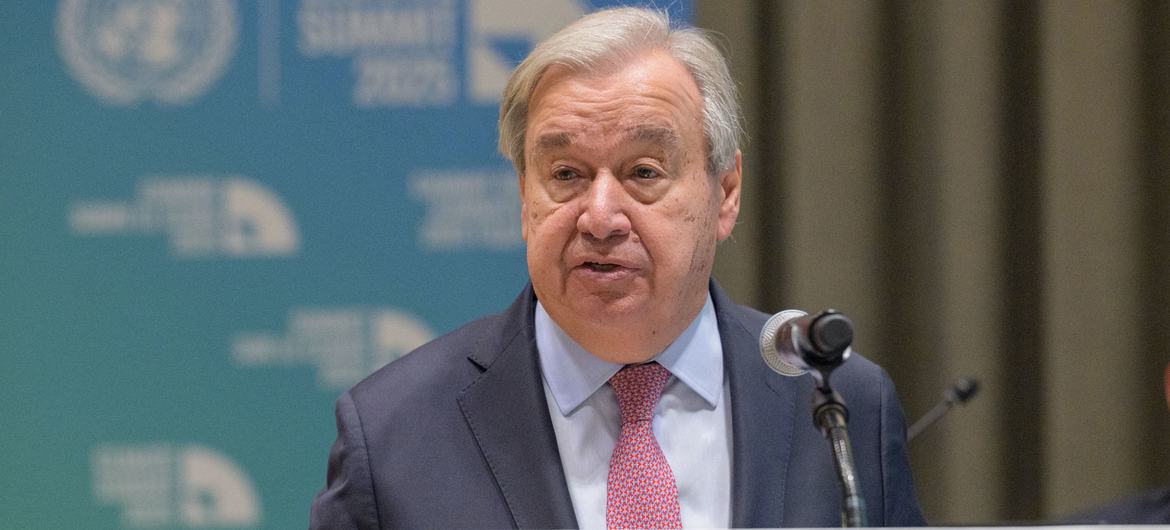
Secretary-General António Guterres addresses the Climate Summit 2025, a high-Level special event on Climate Action.

More action needed: Guterres

Under the Paris Agreement, governments are required to submit climate plans called Nationally Determined Contributions (NDCs) laying out bold action for the next decade.

The treaty has made a difference, the Secretary-General said, as projected global temperature rise dropped from four degrees to less than three over the past 10 years, if current plans are fully implemented.

“Now, we need new plans for 2035 that go much further, and much faster,” he said. “Delivering dramatic emissions cuts aligned with 1.5 degrees; covering all emissions and sectors; and accelerating a just energy transition globally.”

He stressed that COP30 “must conclude with a credible global response plan to get us on track” and outlined five crucial areas for action: accelerating the transition to clean energy, drastically cutting methane gas emissions, forest conservation, cutting emissions from heavy industry, and ensuring climate justice for developing nations.
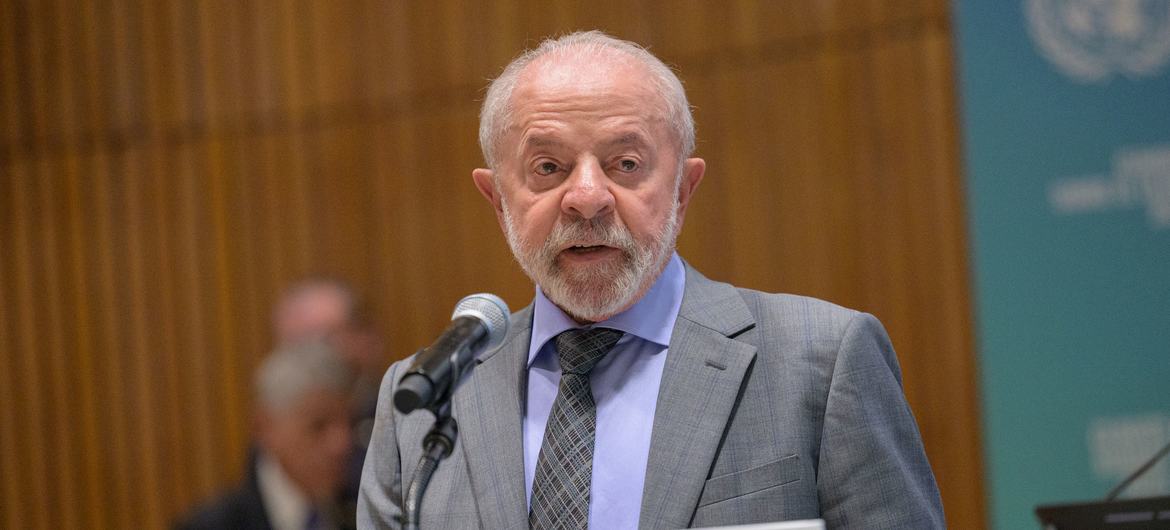
President Luiz Inácio Lula da Silva of Brazil addresses the Climate Summit 2025, a high-Level special event on Climate Action.

Do your ‘homework’, urges Lula

With just a few weeks until COP30, President Lula wondered “whether the world will arrive in Belém with its homework done.”

He said that “the energy transition opens the door to a productive and technological transformation comparable to the Industrial Revolution” and NDCs “are the road map that will guide each country through this change.”

For its part, Brazil has committed to reducing all greenhouse gas emissions between 59 per cent and 67 per cent, covering all sectors of the economy, he said, and continues efforts to end deforestation by 2030.

Commitment from China and Europe

At the meeting, President Xi Jinping of China announced that by 2035, the country will reduce economy-wide net greenhouse gas emissions by seven to 10 per cent from peak levels.  

The country will also increase the share of non-fossil fuels in total energy consumption to over 30 per cent, expand wind and solar power capacity sixfold compared to 2020 levels, and make “new energy vehicles” the mainstream in new vehicle sales, he said in a video message.

Meanwhile, “the clean transition is moving on” in the European Union, where emissions are down nearly 40 per cent since 1990, said European Commission President Ursula von der Leyen. 

European countries are also “doubling down on global partnerships” and will remain the world’s largest providers of climate finance, she said, while also mobilizing up to 300 billion Euros to support the clean energy transition worldwide.

Vulnerable nations ‘between hope and hardship’

For Belize, the 1.5-degree goal “is not an aspiration” but “a threshold between hope and hardship, between flourishing communities and forced displacement, between shared prosperity and irreversible loss,” said Prime Minister Johnny Briceño.

Its new NDC covers concrete actions, such as expanding renewable electricity generation to cover 80 per cent of domestic needs by 2035, restoring some 25,000 hectares of degraded forest, and planting a million trees over the next three years. 

“But let me be clear, ambition can only succeed if matched by support for small climate vulnerable nations like Belize. 

“This means scaled up, predictable finance; accessible technology and genuine partnerships,” he said, noting that “success depends on all of us acting with unprecedented urgency, solidarity and climate justice.” 


Libya: Security Council urged to back popular ‘yearning’ for national elections

Hannah Tetteh, who also heads the UN Mission in Libya (UNSMIL), briefed ambassadors in the wake of municipal council elections last week and outlined a proposed roadmap to general elections, which should have been held way back in 2021.

The Libyan people look to this esteemed Council for help, to ensure a solution to the crisis and support a political process that will result in elections and unified institutions not a succession of transitional governments,” she said.

Voting and disruptions

Nearly 15 years after the fall of former President Muammar Gaddafi, Libya remains split between two rival administrations:  the internationally recognised Government of National Unity, located in the western capital of Tripoli, and the rival Government of National Stability based in Benghazi in the east.

This past Saturday, 26 municipalities successfully held elections despite significant challenges.  Ms. Tetteh commended the electoral management body HNEC and urged all candidates to accept the results.

She regretted that not all municipalities that were expected to take part were able to do so, with the government in the east giving instructions to suspend electoral processes in 16 municipalities. Additionally, voting materials were withdrawn from centres across the region and the south.

Efforts to disrupt the vote also occurred in some municipalities in the west, where HNEC offices in three cities were set on fire or attacked, although the vote went ahead in two of them. 

‘A clear signal’

“By the end of polling day, voter turnout was 71 per cent. This is a clear signal that the Libyan people are yearning to elect their representatives. In some areas, this was the first time any elections have happened since 2014,” she said.

However, the suspension of elections in the east and south “is an equally clear sign that not all are committed to supporting Libya’s democratic development and there is an urgent need for a reset in the political process,” she added.

In February, UNSMIL established an Advisory Committee to provide recommendations for resolving outstanding issues that have prevented national elections from taking place.

A report was presented in May, and the Mission has been holding nationwide consultations on the outcomes. It has also conducted an online survey for people to share their opinions on the recommendations, with more than 22,500 responses. 

The message we clearly received was the desire to stop the cycles of repeated transitional periods; preserve and strengthen the unity of the country and its institutions; as well as to renew their legitimacy through presidential and legislative elections; and end what was frequently referenced as foreign interference,” Ms. Tetteh told the Council.

Roadmap to elections

Based on the Advisory Committee’s recommendations, the feedback from the population, and lessons learned from the failure to hold the 2021 elections, “we are convinced that the political process should focus on guaranteeing general elections and the unification of institutions through a sequenced approach,” she said.

Ms. Tetteh proposed a roadmap built around three core pillars: implementation of “a technically sound and politically viable electoral framework” towards holding the elections; unifying institutions through a new unified government, and a structured dialogue to address critical issues in order to create a conducive environment for the polls.

She estimated it would take 12 to 18 months to complete the roadmap, which will end in general elections and several “sequential steps”, including enhancing HNEC capacity as well as amending the legal and constitutional frameworks for holding full elections – legislative and presidential. 

“Following these two prior steps – which could be concluded over the next two months at most if there were the political will to do so – there should be agreement on a new unified government, capable of creating a conducive environment for credible elections while managing key governance functions effectively,” she said.

Security concerns

Ms. Tetteh reported on developments on other fronts, including the volatile security situation, with increasing militarisation of all sides.

She noted that the situation in Tripoli remains of great concern, following clashes in May.  While a fragile truce is holding, violations have occurred, though no escalations.

UNSMIL also documented 20 deaths in custody since March 2024, including political activist Abdel Munim Al-Maremi who died last month in Tripoli shortly after a release order had reportedly been issued. 

“These cases are the latest examples of a widespread and persistent pattern of grave violations perpetrated across the country with impunity, including against migrants and refugees, in some cases fueled by disinformation and hate speech,” she said.

Ms. Tetteh was also alarmed by the forced return of migrants to conflict zones, including Sudan. She noted that Sudanese refugees in Kufra exceeds the number of residents, urging donors to step up support. 

Source link