Trump’s $15 billion Clash With NYT Sets Off Another Legal Campaign For Newsrooms

When a sitting or former president elects to seek $15 billion in damages from a single news organisation, the action reads less like a conventional libel suit than like a strategic campaign play writ in legal form. On Sept. 15–16, 2025, Donald Trump announced and filed such a complaint against The New York Times, several Times journalists and associated publishers, saying the outlet had run a “decades-long campaign of lies” and calling it “one of the worst and most degenerate newspapers in the history of our country.”

He added that the paper had become a “virtual mouthpiece for the radical Left Democrat Party.” There are three discrete frames in which to judge this case: constitutional law, newsroom practice and political theatre. Each offers a different prediction about whether the suit is likely to prevail, and each suggests distinct consequences for the institutions at stake.

On paper, American defamation Law establishes a steep hill for public figures. Since New York Times Co. v. Sullivan (1964), plaintiffs who are public officials or public figures must prove “actual malice” — that the defendant published a falsehood knowing it was false, or with reckless disregard for the truth. That standard protects all but the most egregious reporting failures and demands evidence about a reporter’s state of mind at publication, not merely proof of factual error. Courts have repeatedly emphasised the difficulty of meeting that bar.

That legal wall is why suits by powerful plaintiffs often operate as instruments of leverage rather than purely as mechanisms to vindicate reputations. Consider the recent settlements Trump highlights: ABC agreed to make a $15 million contribution to a planned Trump library to resolve a dispute tied to inaccurate on-air comments, and Paramount/ CBS reached a $16 million settlement in another high-profile dispute.

Those outcomes do not equate to judicial findings of malice; they reflect the complex calculus that companies make when weighing the costs of protracted discovery, reputational risk, and the distraction of litigation. In the commercial realpolitik of media companies, settlement can be damage control rather than an admission of journalistic failure.

From a newsroom vantage, the stakes are stark. Big-budget investigative journalism depends on an institutional ability to accept legal risk, to check sources, document reporting decisions, and defend editorial judgement in court if necessary. The threat of repeated, high-value suits imposes a chilling tax: even if most claims fail, the process of discovery, private depositions, the cost of legal defence, the drain on editors’ time,  can incentivise self-censorship or encourage settlements that leave public records unexplored.

As one experienced newsroom lawyer put it in recent commentary about litigation pressure, the pattern of “rhetoric and actions” from political leaders can be mirrored across the information ecosystem, prompting smaller outlets to mimic defensive strategies long before a case reaches a judge.


NYT Building

Yet it would be a mistake to view this litigation as an empty bluff. Courts are not wholly captive to First Amendment concerns; they adjudicate harms and damages on the basis of evidence. The complaint against the Times, as reported, identifies specific articles and a book project and alleges that their claims were published with knowledge of falsity or reckless disregard.

If Trump’s legal team can produce contemporaneous internal communications, contradictory witness testimony, or other documentary proof that reporters knew key claims were false, the suit could survive early motions. But that is a high evidentiary bar, and historically judges have dismissed similar high-stakes suits at early procedural stages when plaintiffs fail to plead facts that plausibly demonstrate actual malice.

The litigation is also a political communication. Publicising a multi-billion dollar suit amplifies a message: that major institutions are corrupt, that the plaintiff is under siege, and that legal action is evidence of fighting back. This is a form of signalling to a base that prizes grievance and retribution. As one commentator put it in an earlier Trump-era legal contest, some suits are “cartoonishly vexatious,” — not because they cannot be argued, but because their primary utility is to shift the news cycle and impose costs on opponents.

The lesson is twofold: litigation can be weaponised by the powerful, and legal doctrine (even a robust Sullivan standard) does not eliminate the practical asymmetry that comes with litigation’s cost and duration. Two other practical anchors should guide readers watching this case. First, the forum selection, filing in Florida, and it matters. Plaintiffs sometimes choose jurisdictions they perceive as more favorable or predictable; venue can affect pretrial orders and scheduling. Second, discovery will be decisive.

If the Times shows meticulous sourcing, contemporaneous notes, and editorial review that produced its stories, it strengthens its defence. Conversely, if the plaintiff can point to internal inconsistencies at the Times or to documentary proof of knowing falsehoods, the case could survive motions to dismiss.

ALSO READ: Trump Slaps $15 Billion Suit on NYT, Calls Daily ‘Degenerative’

However, there are immediate consequences. If courts reject overreaching suits and insist on the actual-malice standard, that outcome will protect the breathing room journalists need to pursue investigations. Instead, if high-value suits proceed on amorphous proofs and culminate in settlements, the result will be a more cautionary press, especially among mid-sized outlets without the Times’ legal resources.

Finally, Mr. Trump’s Truth Social post supplies the rhetorical raw material for the complaint. “The New York Times has been allowed to freely lie, smear, and defame me for far too long,” he wrote in his social media platform but rhetoric does not equal evidence. The coming months of motions, discovery and possible appeals will test whether the complaint is primarily performative or backed by the documentary and testimonial proof that the American law requires.

For now, newsrooms should do what they have always done when under legal pressure: document rigorously, be transparent about sourcing where possible, and explain to readers how and why reporting decisions were made. Courts will determine whether a legal line has been crossed or not. Editors must defend the sturdier, day-to-day work of truth-seeking journey that makes their determination possible.

Trump Slaps $15 Billion Suit on NYT, Calls Daily ‘Degenerative’

US President Donald Trump has announced a sweeping $15 billion defamation and libel suit against The New York Times, accusing the paper of running a “decades-long campaign of lies” and smearing him, his family, businesses, and political movement.

Posting on his Truth Social platform, Trump branded the newspaper “one of the most degenerative” in American history, alleging it had effectively become a “mouthpiece for the radical Left Democrat Party.” He also claimed its coverage of Democratic rival Kamala Harris amounted to “the single largest illegal campaign contribution ever.”

Trump said the suit, filed in Florida, aims to hold The Times accountable in the same way he had “successfully litigated” against other outlets. He cited earlier settlements with ABC/Disney and CBS/Paramount, which reportedly paid multimillion-dollar sums to the Trump Library project following disputes over their coverage.

ALSO READ: London’s Far-Right Rally Sends Shockwaves Through South Asian Communities

This is not Trump’s first legal confrontation with the media. He has long branded critical coverage as “fake news,” but in recent years has escalated to high-value lawsuits. Earlier settlements, though not publicly verified by courts, have been presented by Trump as victories, strengthening his narrative of being unfairly targeted by mainstream outlets.

Legal experts, however, note that US defamation law sets a high bar for public figures, requiring proof of “actual malice.” Historically, similar suits, including Trump’s own 2020 case against The New York Times over Russia probe coverage, were dismissed. Analysts suggest the current lawsuit may be as much a political move to energize his base as a legal strategy.

Indian Context

Comparisons can be drawn to Indian political and media tussles, where defamation suits are also wielded as tools to counter negative coverage. In 2016, Delhi Chief Minister Arvind Kejriwal faced a string of defamation cases filed by political rivals, many of which were later withdrawn after publicised apologies, underscoring how such legal battles often play out more in the court of public opinion than in law.

As the US heads deeper into the election season, Trump’s litigation blitz against media outlets signals an aggressive campaign tactic — one that blurs the lines between courtroom strategy and political messaging.

United Nations Revises 2026 Budget, Pairing Cost Reductions With Reforms

UN Budget Cuts and Reform Proposals Sent to ACABQ for Review

The United Nations has submitted revised budget estimates to the Advisory Committee on Administrative and Budgetary Questions (ACABQ), proposing a 15.1 per cent reduction in resources and an 18.8 per cent cut in posts in the regular budget compared with 2025. The support account for peacekeeping operations, which underpins missions worldwide, would also see reductions in the 2025/26 period.

The ACABQ, a subsidiary body advising the General Assembly, will assess the proposals before forwarding its recommendations to the Fifth Committee, where all 193 Member States decide on administrative and budgetary matters.

Targeted Reductions

In a letter to Member States, Secretary-General António Guterres explained that the cuts followed an extensive review of mandate delivery and resource allocation. Stressing that reductions were “targeted, not across the board,” he said they had been carefully calibrated to maintain balance across the UN’s three pillars—peace and security, human rights, and sustainable development.

Programmes that directly support Member States—particularly least developed, landlocked, and small island developing States—along with Africa’s development advocacy, the Peacebuilding Fund, and the Resident Coordinator system, will be shielded from reductions. Regional economic commissions will see only modest adjustments, while the Regular Programme for Technical Cooperation will continue to expand to strengthen capacity-building for developing countries.

“Reductions of this magnitude will entail trade-offs,” Guterres wrote, noting possible impacts such as narrowed scope, longer timelines, or reduced frequency of outputs. Mitigation measures will include prioritising high-impact work, pooling expertise, and relying more on virtual platforms and automation.

Reform Measures Under the UN80 Initiative

The budget revision is closely tied to the UN80 Initiative, launched in March 2025 to strengthen the Organisation amid rising global political and financial uncertainty. Alongside the cuts, the revised estimates introduce the first set of proposals under Workstream 1, focused on management and operations.

Key measures include:

  • Establishing administrative hubs in New York and Bangkok.

  • Consolidating payroll into a single global team across New York, Entebbe, and Nairobi.

  • Relocating some functions from high-cost duty stations (New York and Geneva) to lower-cost locations.

  • Vacating two leased New York buildings by 2027, with projected annual savings from 2028.

Collectively, these reforms aim to cut duplication, enhance quality, and protect mandate delivery while improving efficiency.

Three Workstreams of Reform

The UN80 Initiative is structured around three workstreams:

  1. Efficiencies and management improvements – now reflected in the revised estimates, with further measures to come.

  2. Mandate Implementation Review – a report submitted in August is under review by a new Informal Ad Hoc Working Group, meeting on 16 September.

  3. System-wide realignments – proposals on structural and programmatic clusters will be presented later this week.

Together, the workstreams signal a major reorientation of UN operations, aimed at ensuring effectiveness, credibility, and sustainability.

Next Steps and Staff Engagement

The ACABQ will begin hearings this week before passing its recommendations to the Fifth Committee, with a final General Assembly decision expected by December. If approved, changes would be phased in starting 2026, with future budget cycles reflecting additional reforms from the UN80 workstreams.

In a separate letter to UN staff, Guterres acknowledged that the changes will affect daily work and professional life but pledged full support throughout the transition. “You will be fully engaged and supported throughout the process,” he assured, promising regular communication, consultation opportunities, and practical guidance.

Acknowledging the difficulty of the decisions, the Secretary-General emphasised accountability—beginning with him, but also extending to managers and staff. He urged that reforms be carried out with fairness, empathy, and professionalism, underscoring the shared responsibility of upholding UN values during the transition.


Deadly Attacks, Trembling Services Push Sudan Closer to Catastrophe

According to local reports, heavy shelling and assaults late last week in El Fasher, the capital of North Darfur state, killed at least six civilians and injured scores more, triggering fresh displacement from the already besieged city.

Sudan has been roiled in a brutal civil war between rival militaries – the Sudanese Armed Forces and the paramilitary Rapid Support Forces (RSF) and affiliated militias. Thousands of civilians have been killed, villages and farmlands destroyed, and nearly 12 million people driven from their homes – over four million as refugees into neighbouring countries.

The country also risks becoming the world’s largest hunger crisis in recent history as infrastructure, trade routes and supply chains lie in ruins. Famine has already been confirmed in the Zamzam camp, which once sheltered hundreds of thousands of civilians – and many more areas are at risk.

Humanitarians warn that essential services are breaking down. Water trucking to the only functioning hospital was suspended over the weekend and community kitchens shut down after running out of food.

Without urgent support, they warn that the most vulnerable people could face severe hunger within days. Across Darfur, hospitals remain under immense strain.

Nearly 100 wounded people, including women and children, were admitted to medical facilities in a single day last week, with several pronounced dead on arrival, according to reports from the medical charity Médecins Sans Frontières (MSF – Doctors Without Borders).

Survivors who managed to escape El Fasher described “unbearable” conditions in the city, which has endured more than a year of siege by the Rapid Support Forces (RSF) and allied groups.

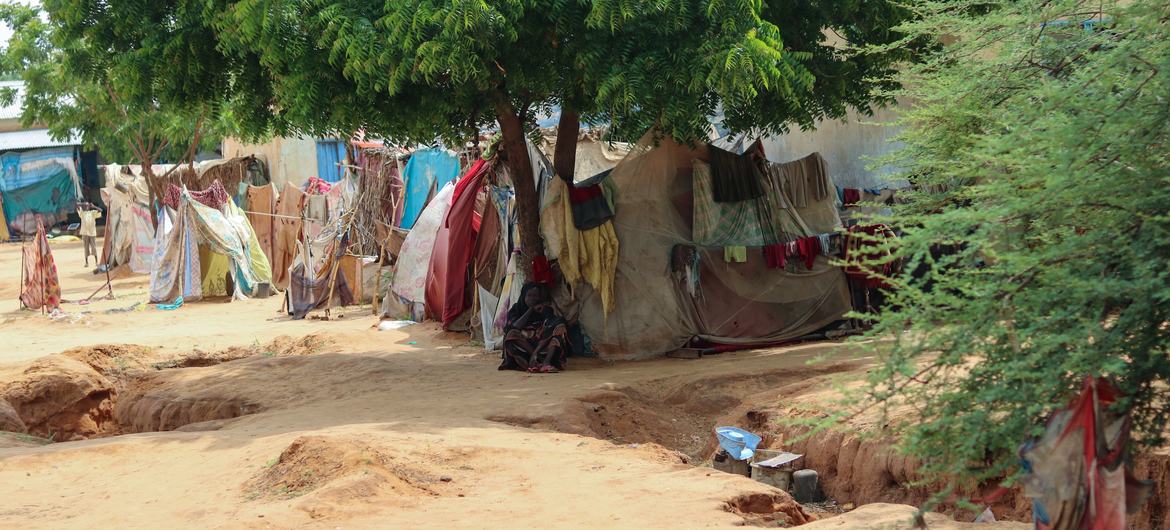
Children sit beside makeshift tents in El Fasher, North Darfur, where intensified fighting has left thousands trapped.

Drone strikes on 10 September hit multiple locations across Darfur, injuring scores. A strike landed just four kilometres (about 2.5 miles) from an MSF-supported hospital in Central Darfur, forcing staff to activate a mass casualty plan. The following day, two more strikes struck Nyala in South Darfur, reportedly killing at least four people, including a child.

The fighting is not confined to Darfur. In Khartoum, RSF airstrikes on 9 September damaged a power station, causing a blackout in parts of the capital and disrupting critical hospital equipment and services.

Disasters add to misery

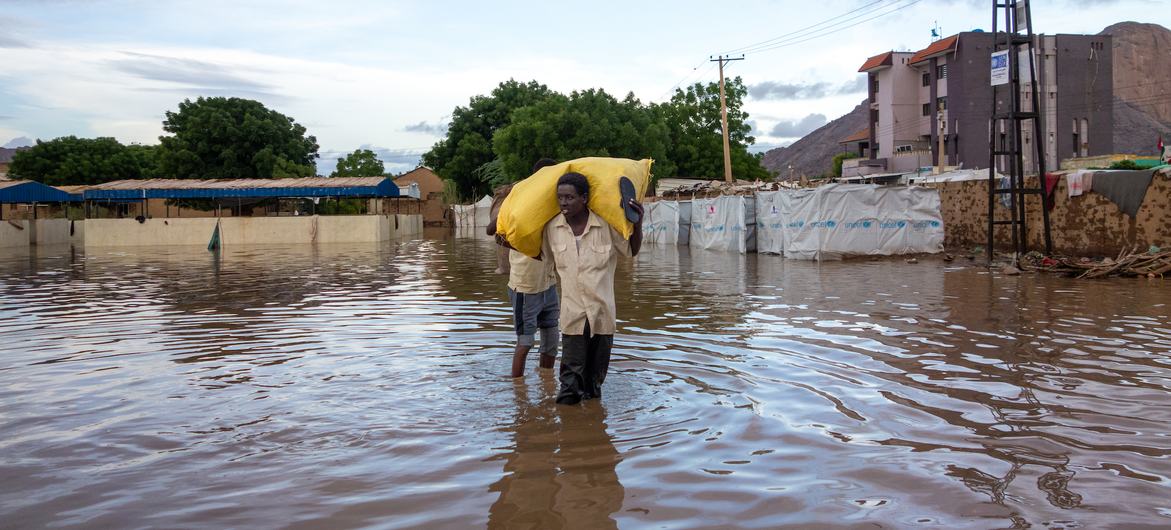
Meanwhile, Sudan is grappling with natural disasters on top of conflict. A landslide triggered by heavy rains on 31 August in Sharg Aj Jabal, near the Central and South Darfur border, killed an estimated 400 people, half of them children, according to local reports.

Furthermore, over 4,000 people were displaced and 550 homes destroyed in Aj Jazirah state in flash floods last week.

Every year, hundreds of thousands of people in Sudan are affected by heavy rains, flash floods and landslides.

The UN Office for the Coordination of Humanitarian Affairs (OCHA) stressed that civilians remain at the epicentre of the violence. “[We] once again call for an immediate cessation of hostilities, protection of civilians, safe and unimpeded humanitarian access, and increased international support to sustain life-saving operations across Sudan,” the Office said.

In Khartoum, OCHA reported some improvements in restoring basic services and security. Yet more than 800,000 people who have returned to the capital in recent months still urgently need assistance to rebuild their lives.

On the political front, the Secretary-General’s Personal Envoy for Sudan, Ramtane Lamamra, is currently in Port Sudan after concluding consultations in Nairobi.

According to UN Spokesperson Stéphane Dujarric, Mr. Lamamra has held “very constructive engagements” with Sudanese stakeholders across the spectrum as well as key international interlocutors.

“These discussions will help lay the groundwork necessary to support an inclusive process that can deliver a sustainable solution that preserves Sudan’s sovereignty, its unity and its territorial integrity,” Mr. Dujarric said.

He added that the UN also looks forward to working closely with regional partners, including the African Union, the east African regional bloc Intergovernmental Authority on Development (IGAD), and the League of Arab States, to restart efforts toward an intra-Sudanese dialogue.

World News in Brief: Pandemic Treaty Update, DR Congo Ebola Response, More Casualties in Ukraine

Pandemic Treaty

Tedros Adhanom Ghebreyesus called the world’s first pandemic trety “a generational accomplishment”, while speaking at the start of a meeting of the Intergovernmental Working Group on the WHO Pandemic Agreement, taking place in Geneva through Friday. It comes four months after countries adopted the pact.

Tedros said the next step “is to bring this historic achievement to fruition” by finalizing the Pathogen Access and Benefit-Sharing (PABS) system. He urged countries to use this week to pave the way to developing the platform, with the ultimate goal of adoption next year.

“It is in every country’s interest that this process is not delayed any further. Because, as we are all aware, the next pandemic or major global health emergency is not a question of if, but when,” he said.

DR Congo: UN and partners support Ebola response in Kasai province

The Democratic Republic of the Congo (DRC) is facing an Ebola outbreak in Kasai province, located in the southwest, with 35 confirmed cases including 27 deaths.

The UN and partners are supporting the Government in the response, the Spokesperson for the Secretary-General said on Monday in New York. Stéphane Dujarric told reporters that partners working in health have facilitated the delivery of over 350 doses of the Ebola vaccine to the Bulape health zone, the epicentre of the outbreak.

“We have also mobilized rapid response teams focusing on case detection and surveillance, clinical case management, infection and prevention control, and risk communication and community engagement,” he added.

Meanwhile, health partners are mobilizing to contain the outbreak. He warned, however, that gaps in medical supplies and logistical capacity are hindering the response, and urgent funding is needed.

Ukraine: Dozens of casualties reported in weekend hostilities

Hostilities continued over the weekend in Ukraine, with the Donetsk region particularly affected, the UN Office for the Coordination of Humanitarian Affairs (OCHA) reported on Monday.

Several civilians have been killed and 40 injured in the region since Friday, while local authorities also documented damage to nearly 190 civilian facilities, including homes, schools, a hospital and a pharmacy.

Other parts of Ukraine also experienced hostilities which damaged homes, farmland and other civilian infrastructure. Nearly 5,000 people remain without electricity in the Zaporizhzhia region.

OCHA said the continuing violence has forced more than 2,700 people, including roughly 340 children, to flee their homes between 12 and 14 September.

IAEA Chief Urges Countries to Recommit to Nuclear Non-Proliferation

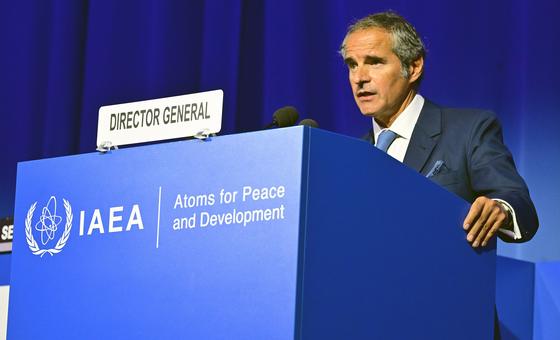
He stressed that their support for the non-proliferation regime, the Nuclear Non-proliferation Treaty (NPT), and the IAEA, is crucial.

“I urge Member States to recommit to a system that has been one of the most important foundations for international peace, even during the tensest decades of our generation,” he said.

He noted that the conference comes at a time when “acts of terrorism, multiple military conflicts, and the erosion of nuclear norms are all happening against a growing gap between poverty and prosperity.”

Mr. Grossi went on to speak about the ways in which the IAEA is working to stop the spread of nuclear weapons and is putting nuclear science to good use, including for cancer treatment, food security, plastic pollution monitoring, disease detection, and artificial intelligence.

Nuclear safety around the world

Earlier this year, Syria agreed to cooperate with the IAEA, and just last week, the agency reached an agreement with Iran to resume the implementation of nuclear safeguards – technical measures used by the IAEA to ensure that if countries make advancements in nuclear technology, they do so for peaceful purposes.

“When the IAEA confirms the peaceful use of a State’s nuclear material, confidence over nuclear activities is established,” said Mr. Grossi.

Meanwhile, in Ukraine, where nuclear power plants are at risk from conflict, the IAEA has sent over 200 missions and is “present on the ground at all the sites.”

But more challenges remain. The Democratic People’s Republic of Korea (DPRK) continues its nuclear weapons programme, while even countries abiding by the NPT, the landmark international agreement meant to abolish nuclear weapons, are debating adding them.

“Think for a minute about a world where instead of a few, we would have 20 or 25 countries armed with nuclear weapons,” he warned.

Peaceful uses of nuclear science

Three years ago, the IAEA launched its flagship programme, Rays of Hope, becoming a “catalyst for real, substantial progress in cancer care.” Through the initiative, concrete actions have been taken in 40 countries: hospitals have been built, radiotherapy machines procured, and physicists trained.

Additionally, the IAEA’s joint programme with the UN Food and Agriculture Organization (FAO), Atoms4Food, is helping boost food security and reduce the environmental strain arising from agriculture.

“In a world of abundance, 700 million people should not have to go to bed hungry every night,” he said.

Mr. Grossi highlighted more ways in which the agency is benefiting the people and the planet, including through its initiative supporting many countries in addressing plastic pollution and waste, and another on improving global preparedness for diseases.

An optimistic outlook

With powerful tools like artificial intelligence and machine learning, “the future is too exciting to miss.”

Nuclear energy can power artificial intelligence infrastructure, while artificial intelligence can improve nuclear technology. To further explore this mutually beneficial relationship, the IAEA will organise the first ever symposium dedicated to the topic in December this year.

Fusion energy, which has been progressing thanks to public and private capital, is another technological development soon expected to take off.

“Every challenge is an opportunity,” concluded Mr. Grossi. “Peace is not simply the absence of conflict. It is dynamic, hopeful striving that I see in what we do all around the world.”

The 69th IAEA General Conference will take place from 15-19 September in Vienna, Austria, where over 3,000 participants are registered to attend.

Source link

UN Condemns ‘Deadly Escalation’ of Fight in Gaza City

The situation “is having an appalling impact on civilians enduring suffering and starvation,” he told journalists in New York.

“The United Nations condemns the deadly escalation of the Israeli military offensive which took place over the weekend across Gaza City, with scores of people reportedly killed or injured,” he said.

“We reiterate our call for the protection of civilians and humanitarian personnel and full respect for international law.” 

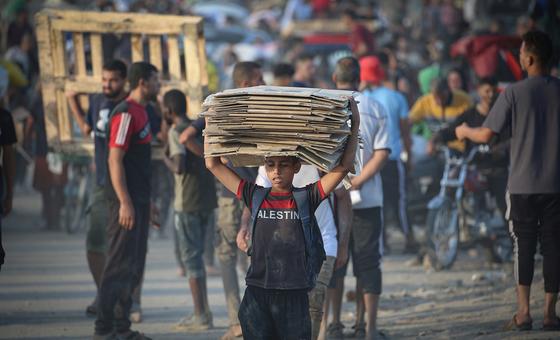
70,000 more uprooted

In a post on X on Sunday, the head of the UN agency for Palestine refugees, UNRWA, said that 10 of its buildings in Gaza City had been hit in the past four days alone, including seven schools and two clinics which were being used as shelters.

Almost 70,000 displaced people have headed south in the past few days, while UN partners counted 150,000 movements from north to south this past month.

Partners further reported that one third of malnutrition treatment facilities in Gaza City have shut down due to forced displacement orders, while the Ministry of Health today reported 425 deaths overall due to malnutrition and starvation in Gaza, about a third of which were children.

A call for ‘unimpeded humanitarian access’

Over the past few days, UN partners have managed to distribute 40,000 additional meals each day. As of Saturday, 558,000 daily meals were prepared and distributed by 20 UN partners to 116 kitchens.

“However, health services continue to be heavily constrained, since clinics have suspended their services due to insecurity and displacement orders,” warned Mr. Dujarric, adding that in Deir Al-Balah, only a few ambulances remain in order and are able to serve the thousands of people in need.

Additionally, 77 per cent of the road networks in Gaza have been damaged and according to UN aid coordination office OCHA, humanitarian aid continues to be obstructed.

On Sunday, only four of the 17 missions that the UN coordinated with the Israeli authorities were facilitated. Seven missions were denied, one of which was meant to deliver water tanks to the north, while another four were impeded in the field, and two were cancelled by the organisers.

Nevertheless, three humanitarian missions were accomplished, including the collection of fuel and food cargo from the Kerem Shalom/Karem Abu Salem crossing.

“Our humanitarian colleagues continue to call for unimpeded humanitarian access,” stressed Mr. Dujarric. “Aid should flow at scale through multiple crossings into and within Gaza, including the north.”

Source link

Gender Equality: UN Women Body Calls For Political Will and Accelerated Global Action

The world is retreating from gender equality, and the cost is being counted in lives, rights, and opportunities. Five years from the Sustainable Development Goals (SDGs) deadline in 2030, none of the gender equality targets are on track.

That’s according to this year’s SDG Gender Snapshot report launched on Monday by UN Women and the UN Department of Economic and Social Affairs, which draws on more than 100 data sources to track progress across all 17 Goals.

2025 marks three major milestones for women and girls: the 30th anniversary of the Beijing Declaration and Platform for Action, the 25th anniversary of United Nations Security Council resolution 1325 on women, peace and security, and the 80th anniversary of the United Nations, but with the new sobering data, it is urgent to accelerate action and investment.

Other findings in the report reveal that female poverty has barely shifted in half a decade, stuck at around 10 per cent since 2020. Most of those affected live in sub-Saharan Africa and Central and Southern Asia.

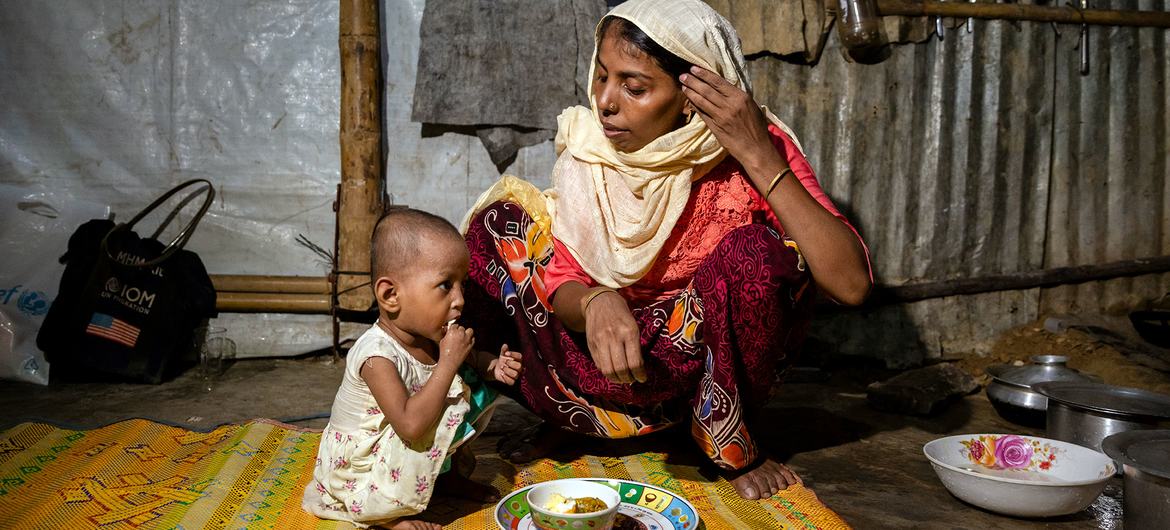
A two-year-old girl suffering from malnutrition is fed by her mother at their shelter in Cox’s Bazar, Bangladesh / © UNICEF/Ilvy Njiokiktjien

In 2024 alone, 676 million women and girls lived within reach of deadly conflict, the highest number since the 1990s. For those caught in war zones, the consequences extend far beyond displacement. Food insecurity, health risks, and violence rise sharply, the report notes.

Violence against women and girls remains one of the most pervasive threats. More than one in eight women worldwide experienced physical or sexual violence at the hands of a partner in the past year, while nearly one in five young women was married before the age of 18. Each year, an estimated four million girls undergo female genital mutilation, with over half cut before their fifth birthday.

Prioritizing gender equality

Yet, amid the grim statistics, the report highlights what is possible when countries prioritize gender equality. Maternal mortality has dropped nearly 40 per cent since 2000, and girls are now more likely than ever to finish school.

Speaking to UN News, Sarah Hendriks, Director of the Policy Division at UN Women, said that when she first moved to Zimbabwe in 1997, “giving birth was actually a matter of life and death”.

“Today, that’s no longer the reality. And that’s an incredible level of progress in a short 25, 30 years”, she added.

Technology, too, holds promise. Today, 70 per cent of men are online compared to 65 per cent of women. Closing that gap, the report estimates, could benefit 343.5 million women and girls by 2050, lifting 30 million out of poverty and adding $1.5 trillion to the global economy by 2030.

“Where gender equality has been prioritized, it has propelled societies and economies forward,” said Sima Bahous, Executive Director of UN Women. “Targeted investments in gender equality have the power to transform societies and economies.”

At the same time, an unprecedented backlash on women’s rights, shrinking civic space, and growing defunding of gender equality initiatives is threatening hard-won gains.

According to UN Women, without action women remain “invisible” in data and policymaking, with 25 per cent less gender data available now due to survey funding cuts.

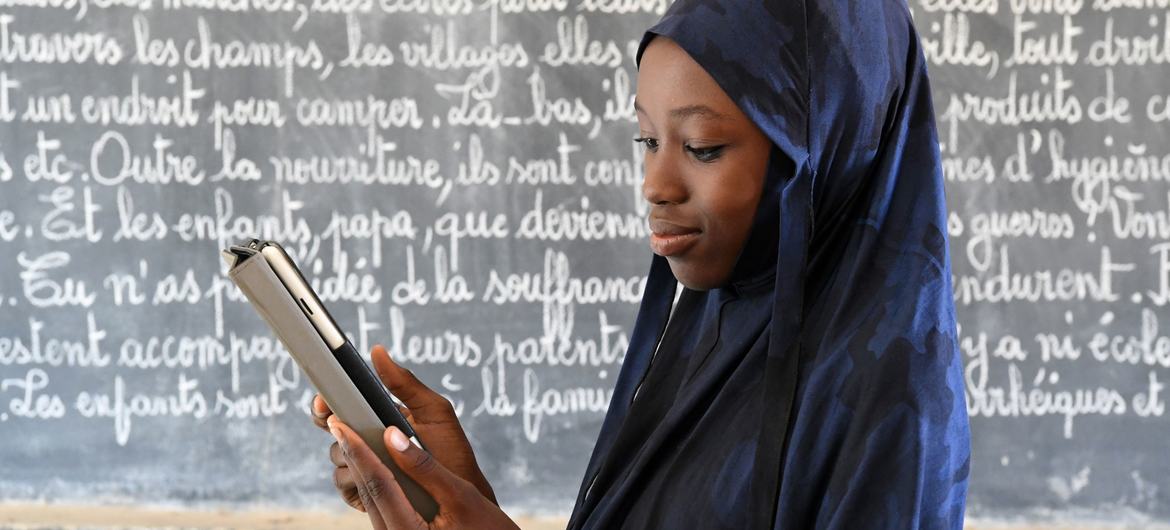
A girl uses a tablet during class at her school in Safi, South Niger.

“The Gender Snapshot 2025 shows that the costs of failure are immense but so are the gains from gender equality,” said Li Junhua, United Nations Under-Secretary-General for Economic and Social Affairs.

“Accelerated action and interventions focused on care, education, the green economy, labour markets and social protection could reduce the number of women and girls in extreme poverty by 110 million by 2050, unlocking an estimated $342 trillion in cumulative economic returns.”

But progress remains uneven, and often painfully slow.  Women hold just 27.2 per cent of parliamentary seats worldwide, and their representation in local governments has stalled at 35.5 per cent. In management, women occupy only 30 per cent of roles, and at this pace, true parity is nearly a century away.

Marking 30 years since the Beijing Platform for Action, the report frames 2025 as a moment of reckoning. “Gender equality is not an ideology,” it warns. “It is foundational for peace, development, and human rights.” Ahead of the UN high-level week, the Gender Snapshot report makes clear that the choice is urgent: invest in women and girls now, or risk losing another generation of progress.

Ms. Hendriks shared UN Women’s message for world leaders: “Change is absolutely possible, and a different pathway is before us, but it is not inevitable, and it requires the political will, as well as the determined resolve of governments right around the world to make gender equality, women’s rights and their empowerment a reality once and for all”.

Anchored in the Beijing+30 Action Agenda, the report identifies six priority areas where urgent, accelerated action is needed to achieve gender equality for all women and girls by 2030, which include a digital revolution, freedom from poverty, zero violence, full and equal decision-making power, peace and security and climate justice.


Yemen: UN Sounds Alarm as Famine, Fighting, Detentions Exacerbate Crisis

UN Special Envoy Hans Grundberg told the Security Council on Monday that the turmoil in Yemen cannot be seen in isolation.

“Yemen is both a mirror and a magnifier of the region’s volatility,” he said, noting that progress toward peace is hampered by regional rivalries, cross-border dynamics, and internal divisions.

Mr. Grundberg highlighted a dangerous escalation in hostilities, noting repeated attacks on civilians and critical infrastructure. Military clashes in Al Dhale’, Ma’rib, and Ta’iz underscore the risk that miscalculations could trigger a return to full-scale conflict.

The Houthis, also known as Ansar Allah, have been fighting Yemeni Government forces, backed by a Saudi-led coalition, for control of the country for over a decade.

Hans Grundberg, UN Special Envoy for Yemen, briefs the Security Council on the situation in Yemen. He warned that Yemen’s conflict is unravelling within an already volatile regional landscape.

© UNICEF/Ahmed Al-Basha A girl and her brother walk home after attending classes at a UNICEF-supported educational tent. Millions of children in Yemen are out of school due to displacement and conflict-damaged schools. (file photo)

“Against the backdrop of the war in Gaza, we are seeing an alarming and dangerous intensification of hostilities between Ansar Allah and Israel,” he said, noting that a number of civilians were reportedly killed and injured, and critical infrastructure struck.

The Special Envoy warned that the current cycle of violence is dragging Yemen further from a peace process that could deliver sustainable, long-term peace and economic growth.

“This escalatory cycle must end…we need to get the focus back on Yemen – focus on both its internal challenges and on unlocking its great potential,” he stressed.

Spiralling humanitarian situation

The humanitarian situation is equally dire. UN Emergency Relief Coordinator Tom Fletcher told the Council that Yemen remains the third most food-insecure country in the world, with 17 million people already struggling to eat and an additional one million expected to face extreme hunger before February next year.

“Seventy per cent of households do not have enough food to meet daily needs – this is the highest rate ever recorded,” he said.

Mr. Fletcher highlighted that one in five households goes a full day without any food, while two million women and girls have lost access to reproductive health services amid funding shortfalls.

Despite funding gaps and a challenging operating environment, humanitarians continue to deliver aid where possible. In Hajjah, Amran, and Ma’rib, organizations have provided food, water, health, and nutrition services to tens of thousands.

More than 172,000 people affected by flooding received non-food items, shelter, hygiene kits, and clean water.

But Mr. Fletcher warned that ongoing hostilities, infrastructure damage, and the detention of UN staff severely hamper operations.

Twenty-two UN personnel have been recently arbitrarily detained by Ansar Allah; though one staff member was released, over 40 remain in detention, including a colleague who died while in custody.

Both top UN officials emphasised the urgent need for dialogue and adherence to international law. Special Envoy Grundberg urged Yemeni leaders to step back from unilateral actions and pursue a nationwide ceasefire, economic reforms, and inclusive political engagement.

Mr. Fletcher called for the immediate release of all detained aid workers and a secure operating environment, warning that funding cuts and conflict-related obstacles are costing lives.

“Detaining humanitarian staff does not help the people of Yemen. It does not feed the hungry, heal the sick, nor protect those displaced by floods or fighting,” he said.

“The people of Yemen, wherever they may live, must receive the humanitarian aid that they need. They deserve a future of greater security, justice and opportunity.”

Ukraine Records Highest Toll From Cluster Munitions for Third Year Running

The latest Cluster Munitions Monitor reports that over 1,200 people have been killed or injured in Ukraine since Russia’s full-scale invasion in February 2022. The actual toll is likely far higher, but it may take years to establish, said Loren Persi, team lead for the report.

Drawing parallels with conflicts in Syria and Yemen, where casualty figures emerged only years later, Persi told journalists in Geneva that a similar pattern could unfold in Ukraine.

Lao legacy

Equally, in Lao People’s Democratic Republic, which Mr. Persi described as the most contaminated country by cluster munitions, “it took decades” before surveys confirmed estimates that many thousands of people had been killed or injured by strikes from cluster munitions, which are generally understood to be a container from which submunitions are scattered.

The civil society publication, backed by UN disarmament research agency UNIDIR, notes Israeli allegations that cluster munitions were used in a ballistic missile attack by Iran in June 2025, and of reported but unverified use of the weapons in Gaza and southern Lebanon.

The report’s other findings note that the de facto forces in Myanmar have used “domestically produced”, air-delivered cluster bombs since around 2022, amid the ongoing civil war.

“Schools have been among the targets in rebel-held areas,” said the Monitor research specialist Michael Hart, highlighting their use in Chin state, Rakhine state, the Saigon region and Kachin state, among others.

Mistaken for toys

Submunitions – or bomblets, as they are also known – cause casualties and damage through blast impact, their incendiary effect and fragmentation. According to UNIDIR, a single attack can involve thousands of individual explosive units which are usually spread over hundreds of square metres.

“These munitions can be air-delivered or surface-launched, and can be used against armour, materiel and personnel,” UNIDIR explained, although it is “very clear…that civilians continue to bear the brunt” of suffering from the cluster emission remnants, Mr. Persi insisted.

As in previous years, children accounted for a high proportion (42 per cent) of casualties from the weapons in 2024, “which they often find interesting, think are toys or come across in play or on the way to school or when working in fields”, Mr. Persi continued.

Funding cuts impact

Funding cuts for humanitarian work have had a negative impact on countries impacted by the explosive weapons.

These include Afghanistan, Iraq and Lebanon, which had “made good progress” in clearing contaminated land, but who now “really struggle with funding…to get the clearance done, hence they slow down”, said Katrin Atkins, senior researcher at Cluster Munitions Monitor.

“Whole programmes” supported by USAID in the past including one in Lau have been discontinued, Mr. Persi noted.

“For decades, [the programme] was essential in providing both first aid in remote areas where there are cluster mine victims, which was clearly there to address the legacy of the bombings of the 60s and 70s,” he explained. “But also, the entire rehabilitation programme, including prosthetics… that was cut and as far as we know, not reestablished in any way.”

In the last 15 years since the Convention on Cluster Munitions, just 10 countries have used the weapons and “all of those are States not party to the international accord”, the Cluster Munition Monitor states.

A total of 18 countries have now ceased production of cluster munitions. All former producers are now States Parties to the Convention, aside from Argentina.

The report notes that 17 countries still produce cluster munitions or reserve the right to do so and none is a State Party to the Convention. They are: Brazil, China, Egypt, Greece, India, Iran, Israel, Myanmar, North Korea, Pakistan, Poland, Romania, Russia, Singapore, South Korea, Türkiye and the United States.

SC Declines Blanket Stay on Waqf Amendment Act, Grants Limited Relief

The Supreme Court on Monday declined to impose a blanket stay on the Waqf (Amendment) Act, 2025, while granting limited interim relief on contentious provisions. A bench led by Chief Justice of India B.R. Gavai, along with Justice A.G. Masih, stressed that courts must exercise restraint when asked to suspend laws passed by Parliament.

“By now, it is a settled principle of law that the courts should be very slow in granting interim relief by way of staying the provisions of an enactment,” the bench observed, underlining that such orders can only be issued in “rare and exceptional cases.” The court, therefore, rejected the plea seeking a blanket stay on the Act’s implementation.

Limited Relief on Select Clauses

Among its interim directions, the court stayed the requirement that only a person “professing Islam for at least five years” could create a waqf, until state governments frame rules to determine the criteria. The bench also restricted the powers of designated officers under Section 3C, directing that no third-party rights can be created over disputed properties until their status is finally determined by tribunals.

On the issue of representation, the bench capped non-Muslim membership in the Central Waqf Council at four out of 22 members and in State Waqf Boards at three out of 11. It also advised, though without mandating, that Chief Executive Officers of Waqf Boards should, “as far as possible,” be appointed from within the Muslim community.

The court, however, refrained from intervening in the controversial deletion of the “waqf by user” provision, noting that custodians (mutawallis) who failed to register waqf properties for over a century cannot now demand exemptions. “If the legislature… finds that on account of the concept of ‘Waqf by User’, huge government properties have been encroached upon and to stop the said menace it takes steps for deletion, the said amendment prima facie cannot be said to be arbitrary,” the bench said.

Key Provisions Upheld

The Supreme Court also declined to stay Section 3D, which nullifies claims declaring protected monuments as waqf properties. The provision was enacted after the Archaeological Survey of India flagged difficulties in preserving monuments due to overlapping claims. The bench pointed out that the Ancient Monuments and Archaeological Sites and Remains Act, 1958, already safeguards customary religious practices at such monuments.

Similarly, Section 3E, which bars declaring land in Scheduled or Tribal areas as waqf property, was upheld. The bench said the provision has a “clear nexus” with its objective of safeguarding the interests of tribal communities, describing them as “one of the most marginalised and vulnerable sections of our country.”

The court clarified that its observations were made only for the limited purpose of deciding interim relief and will not prejudice final arguments on the Act’s constitutional validity.

Challenge to the Law

The petitions, filed by several organisations and individuals, had argued that the amendments were unconstitutional and violative of Articles 14, 15, 25, 26, 29 and 30, alleging that the law’s real intent was to “expropriate waqf properties” under the guise of regulation. The Union government, however, defended the amendments, insisting they were designed to prevent misuse, protect waqf assets, and bring greater transparency in management.

After hearing arguments over three sittings, the Supreme Court reserved its order before issuing Monday’s ruling, which marks a setback for petitioners seeking an immediate halt to the law.

Over 7 Crore ITRs Filed As Deadline Ends Mid-Night; I-T Dept Debunks Extension, Offers 24×7 Help

India’s Income Tax Department on Monday announced that over seven crore income tax returns (ITRs) have been filed for the Assessment Year 2025-26, as the deadline of September 15 drew to a close. Officials described the surge in filings as a reflection of growing compliance and the expanding taxpayer base.

In a post on X, the department thanked citizens and tax professionals for helping it reach the milestone. “More than 7 crore ITRs have been filed so far and still counting. We extend our gratitude to taxpayers and tax professionals for helping us reach this milestone, and urge all those who haven’t filed ITR for AY 2025-26, to file their ITR,” the department said.

To ease the pressure of last-minute submissions, the Central Board of Direct Taxes (CBDT) said its helpdesk is functional round-the-clock, providing assistance through calls, live chats, WebEx sessions and social media handles. “Our helpdesk is functioning on a 24×7 basis, and we are providing support,” the post added.

Department Dismisses Extension Buzz

The strong advisory came a day after rumours circulated online suggesting the deadline had been extended to September 30. The department was quick to dismiss the reports. “A fake news is in circulation stating that the due of filing ITRs (originally due on 31.07.2025, and extended to 15.09.2025) has been further extended to 30.09.2025. The due date for filing ITRs remains 15.09.2025. Taxpayers are advised to rely only on official @IncomeTaxIndia updates,” it clarified.

The original due date of July 31 had been pushed to September 15 for non-audit cases after revisions in ITR forms and system upgrades earlier this year. The current deadline, the department underlined, would not be moved further.

Heavy Traffic, Glitches Reported

While officials celebrated record compliance, practitioners flagged issues of portal slowdowns as lakhs rushed to meet the deadline. Tax consultants reported intermittent delays, though filings eventually went through. Authorities acknowledged the heavier-than-usual traffic but stressed that the portal remained operational, supplemented by helpdesk support.

“Every September, the system faces a surge. This year is no different, though overall, the portal is holding up better than previous cycles,” said a Delhi-based tax advisor.

Missing Deadline Comes at a Cost

Experts reminded taxpayers that failure to file on time could prove expensive. Under Section 234F of the Income Tax Act, late filers may have to pay a penalty, ₹1,000 for incomes up to ₹5 lakh and ₹5,000 for higher incomes. In addition, delayed returns attract interest on unpaid taxes and may bar taxpayers from carrying forward certain losses.

“Even if you are unable to finalise every detail, it is wiser to file a return now and revise later. Waiting for an extension that never comes can lead to unnecessary penalties,” warned another practitioner.

The Income Tax Department echoed that view, urging taxpayers to complete the process without delay. Officials noted that the sharp rise in filings reflects improved compliance, digitisation and a growing culture of timely reporting.

Compliance Rising

From fewer than six crore returns a few years ago to more than seven crore this year, India’s tax base is expanding steadily. Analysts say rising awareness, stricter enforcement and smoother digital systems are driving the numbers. Still, the department’s challenge is to keep its infrastructure resilient enough to handle the annual last-minute rush.

As the clock ticks down to the midnight deadline, millions of taxpayers are expected to complete their filings. The Department has once again cautioned citizens to rely only on official notifications and avoid misinformation circulating on social media.

The achievement of crossing 7 crore filings before the cut-off has been hailed as a sign of deepening compliance culture in India’s economy. With the ITR deadline fixed at September 15 and no further extension on the cards, the message from the government is clear: timely filing is not optional but essential.

Emmy Awards 2025: Colbert Gets Emotional Farewell; Adolescence, The Studio, The Pitt Dominate

Los Angeles, Sept 14: The 77th Primetime Emmy Awards turned into a night of surprises, historic wins and emotional moments as Adolescence, The Studio, The Pitt, and The Late Show With Stephen Colbert emerged as the biggest winners.

The limited series Adolescence led the tally with six awards, including Best Limited or Anthology Series. Stephen Graham won Best Actor, while young star Owen Cooper made history as the youngest-ever male Emmy winner with his supporting role. Erin Doherty also bagged Best Supporting Actress, with Philip Barantini and Graham-Jack Thorne duo recognized for directing and writing respectively.

Comedy belonged to Seth Rogen’s The Studio, which won Best Comedy Series, alongside trophies for Best Actor, Best Directing, and Best Writing. Jean Smart further solidified her legacy with Best Actress in a Comedy Series for Hacks, while her co-star Hannah Einbinder earned Best Supporting Actress. In a major upset, Jeff Hiller claimed Best Supporting Actor in a Comedy for Somebody Somewhere, beating veteran nominee Harrison Ford.

Drama gold went to The Pitt, crowned Best Drama Series, with Noah Wyle winning Best Actor and Katherine LaNasa scoring a surprise victory for Best Supporting Actress. Severance also celebrated, with Britt Lower taking Best Actress and Tramell Tillman making history as the first Black man to win Supporting Actor in a Drama. Adam Randall won directing honors for Slow Horses.

In variety and talk categories, Stephen Colbert’s recently canceled The Late Show won Best Talk Series, receiving a thunderous standing ovation. John Oliver’s Last Week Tonight outshone SNL to claim Best Scripted Variety Series and Best Writing for a Variety Series, though SNL50: The Anniversary Special secured the Best Live Variety Special.

Cristin Milioti won Best Actress in a Limited Series for The Penguin, while The Traitors triumphed as Best Reality Competition Program. The ceremony also featured reunions, tributes, and an In Memoriam led by Phylicia Rashad.

Hosted by Nate Bargatze at LA’s Peacock Theater, the show celebrated both fresh talent and industry veterans, leaving audiences with memorable firsts and farewells in Emmy history.

Emmy Awards 2025- Complete List of Winners:

Best Drama SeriesThe Pitt
Best Comedy SeriesThe Studio
Best Limited or Anthology SeriesAdolescence
Best Reality Competition ProgramThe Traitors
Best Talk SeriesThe Late Show With Stephen Colbert
Best Scripted Variety SeriesLast Week Tonight With John Oliver
Best Variety Special (Live)SNL50: The Anniversary Special

Best Actor in a Drama Series – Noah Wyle, The Pitt
Best Actress in a Drama Series – Britt Lower, Severance
Best Supporting Actor in a Drama Series – Tramell Tillman, Severance
Best Supporting Actress in a Drama Series – Katherine LaNasa, The Pitt

Best Actor in a Comedy Series – Seth Rogen, The Studio
Best Actress in a Comedy Series – Jean Smart, Hacks
Best Supporting Actor in a Comedy Series – Jeff Hiller, Somebody Somewhere
Best Supporting Actress in a Comedy Series – Hannah Einbinder, Hacks

Best Actor in a Limited or Anthology Series or Movie – Stephen Graham, Adolescence
Best Actress in a Limited or Anthology Series or Movie – Cristin Milioti, The Penguin
Best Supporting Actor in a Limited or Anthology Series or Movie – Owen Cooper, Adolescence
Best Supporting Actress in a Limited or Anthology Series or Movie – Erin Doherty, Adolescence

Best Writing for a Drama Series – Dan Gilroy, Andor
Best Writing for a Comedy Series – Seth Rogen, Evan Goldberg & team, The Studio
Best Writing for a Limited or Anthology Series or Movie – Jack Thorne & Stephen Graham, Adolescence
Best Writing for a Variety SeriesLast Week Tonight With John Oliver

Best Directing for a Drama Series – Adam Randall, Slow Horses
Best Directing for a Comedy Series – Seth Rogen, The Studio
Best Directing for a Limited or Anthology Series or Movie – Philip Barantini, Adolescence

Asia Cup: Kuldeep, Axar And Suryakumar Shine As India Outclass Pakistan In Dubai

Dubai, Sep 14:  India marked their biggest Asia Cup statement yet with a commanding seven-wicket victory over arch-rivals Pakistan, as skipper Suryakumar Yadav starred with an unbeaten 47 on his 35th birthday. Chasing a modest 128, India romped home with 25 balls to spare at the Dubai International Cricket Stadium, underscoring their supremacy with bat and ball.

Leading from the front, Suryakumar anchored the chase with characteristic composure, finishing unbeaten alongside Shivam Dube (10*). Earlier, openers Abhishek Sharma (31) and Tilak Varma (31) laid a solid foundation, attacking Pakistan’s bowlers with freedom. The clinical batting ensured India never looked under pressure, despite Saim Ayub’s triple strikes providing brief resistance.

The post-match atmosphere reflected the wider diplomatic frost between the neighbours. Once again, there were no handshakes exchanged between players, a symbolic reminder that this was more than just a sporting contest. The political shadow has turned cricket into yet another arena of silent hostility, even in Dubai’s neutral setting.

Spin dictates Pakistan’s struggle

Earlier in the evening, India’s spinners continued their dominance. Kuldeep Yadav (3/18) and Axar Patel (2/18) dismantled Pakistan’s middle order, while Varun Chakaravarthy (1/24) maintained pressure on a sluggish surface. Pakistan never recovered after early blows, with only Sahibzada Farhan (40) showing resistance before Shaheen Shah Afridi’s late fireworks (33* off 16) salvaged some respectability.

The match reinforced India’s tactical gamble of fielding just one frontline pacer, trusting their spinners to dictate terms. The move has worked in back-to-back games, highlighting a fresh blueprint ahead of the T20 World Cup year. By contrast, Pakistan’s batting once again appeared fragile against wrist-spin, exposing a recurring weakness in high-stakes encounters.

India in cruise control

This contest, often billed as cricket’s fiercest rivalry, proved one-sided. India’s superior depth, discipline and adaptability stood out, while Pakistan’s overreliance on cameos was ruthlessly exposed. For India, the ease of the win, without major contributions from Rohit Sharma or Virat Kohli, will be especially reassuring. For Pakistan, the defeat will raise questions about squad balance and their ability to handle spin-heavy attacks.

Brief Scores:
Pakistan: 127/9 in 20 overs (Sahibzada Farhan 40, Shaheen Afridi 33*; Kuldeep Yadav 3/18, Axar Patel 2/18)
India: 131/3 in 15.5 overs (Suryakumar Yadav 47*, Abhishek Sharma 31, Tilak Varma 31; Saim Ayub 3/22)

India won by 7 wickets.

Asia Cup: Kuldeep Spins Web As India Restrict Pakistan To 127/9 In Dubai

Dubai, Sep 14 — India’s reliance on spinners once again proved decisive in their Asia Cup Group A clash against Pakistan, as Kuldeep Yadav led a disciplined bowling effort to restrict their arch-rivals to a modest 127/9 at the Dubai International Cricket Stadium on Sunday.

India fielded just one frontline seamer, banking on a three-pronged spin attack. The sluggish surface validated the strategy as Kuldeep (3/18), Axar Patel (2/18) and Varun Chakaravarthy (1/24) choked the run flow and shared six wickets between them. Their combined economy rate stayed under five, leaving Pakistan struggling for momentum throughout the innings.

India struck early when Hardik Pandya dismissed Saim Ayub for a golden duck, followed by Jasprit Bumrah removing Mohammad Haris. Pakistan reached 41/2 in the powerplay, with Fakhar Zaman and Sahibzada Farhan showing brief resistance. But the introduction of spin turned the tide.

Axar dismissed Zaman and Salman Agha, before Kuldeep tightened the noose further. He outfoxed Hasan Nawaz and Mohammad Nawaz with sharp variations, then lured Farhan into holing out for 40. By the 15th over, Pakistan’s innings was in tatters, reduced to desperate hitting.

The lone spark came from Shaheen Shah Afridi, who smashed an unbeaten 33 off 16 balls, including a flurry of sixes that lifted Pakistan beyond 120. His counterattack, along with Sufiyan Muqeem’s brief support, ensured the innings avoided complete collapse.

India’s spin-first approach vindicated

The match reinforced India’s growing confidence in spin dominance, even in high-pressure fixtures. With Bumrah and Pandya offering control, the spinners operated with freedom, exploiting Pakistan’s long-standing discomfort against quality wrist spin. Pakistan, by contrast, leaned heavily on individual cameos, underlining a fragile middle order.

India’s chase of 128 should be straightforward, but the tactical win already lies in how Rohit Sharma’s side executed their spin blueprint — an approach that could shape their campaign ahead.

Empty Stands Mar India – Pakistan Asia Cup Clash As Politics Overshadow Cricket

Dubai, Sep 14: Cricket’s most anticipated rivalry delivered an unusual sight on Sunday as the India–Pakistan Asia Cup clash in Dubai was played before swathes of empty seats. The 25,000-capacity stadium, which usually sells out in minutes for this fixture, saw hundreds of unsold tickets, with terraces visibly sparse despite months of hype.

Local media estimated that attendance fell far short of expectations, leaving broadcasters and sponsors struggling with optics. The muted crowd contrasted with the history of electrifying atmospheres surrounding India–Pakistan matches, long considered the “Super Bowl” of cricket.

The emptiness was not due to lack of interest in cricket but rather the political climate. The match came just months after the Pahalgam terror attack that killed civilians and intensified anti-Pakistan sentiment in India. Calls for boycotts trended widely on social media, with sections of fans urging compatriots not to attend or even watch the game.

Streaming platforms like Hotstar and JioCinema reported heavy traffic, suggesting that fans chose the comfort of digital viewing over stadium attendance. But some analysts noted dips in early TV ratings, indicating that boycott campaigns had some impact. For advertisers, the absence of packed stands diminished brand visibility, even if online eyeballs remained robust.

For cricket administrators, staging the match in Dubai was meant to ensure neutrality and avoid direct political sensitivities. Yet, the optics of empty terraces underscored the limits of “cricket diplomacy.” Organisers balanced commitments to broadcasters and sponsors against public sentiment at home, but the subdued turnout shows how fragile this balance has become.

Sport caught in geopolitics

Sunday’s clash underlined a reality: marquee sporting events involving India and Pakistan no longer exist in isolation. Political violence, social media mobilisation and national mood can directly shape the economics of sport. Empty stands not only hurt revenues but also dent the rivalry’s global aura, once seen as cricket’s most compelling spectacle.

The incident is likely to influence future scheduling, with boards expected to rethink neutral venues, ticketing strategies and even whether such high-stakes matches can continue without explicit political endorsement. Commercial partners will also demand safeguards, recognising that politics is now as crucial a risk factor as on-field performance.

London’s Far-Right Rally Sends Shockwaves Through South Asian Communities

London witnessed one of its most dramatic confrontations between far-right activists and anti-racism campaigners in recent memory this weekend. A march led by Tommy Robinson, founder of the English Defence League, drew an estimated 110,000 to 150,000 supporters, marking it as one of the largest right-wing gatherings in decades.

While organizers claimed even higher turnout, the rally descended into violence, leaving 26 police officers injured, four seriously, and 25 protesters arrested. For South Asians in the UK, who make up one of the country’s largest ethnic minority blocs, the violent rhetoric and size of the rally raise fresh concerns about rising hate crimes, and their identity of belonging.

The event, branded the “Unite the Kingdom” march, was celebrated by Robinson as a “tidal wave of patriotism.” Yet for many observers, the gathering was less about unity and more about exclusion. Anti-immigrant chants, placards criticizing multiculturalism, and speeches targeting Muslim communities made clear the undercurrent of hostility.

ALSO READ: Massive Anti-Immigration Rally in London Turns Violent, 26 Police Officers Injured

South Asians, particularly Muslims of Pakistani and Bangladeshi heritage, were indirectly placed in the crosshairs of this rhetoric. The clash between Robinson’s supporters and counter-protesters organized by Stand Up to Racism only deepened the sense that Britain’s immigrant communities are caught in the middle of an escalating ideological battle.

The South Asian footprint in the UK

According to the 2021 Census (ONS), South Asians form about 9.3% of the population in England and Wales. The breakdown highlights their importance in Britain’s demographic fabric:

  • Indian-origin population: ~1.86 million (3.1%).

  • Pakistani-origin population: ~1.59 million (2.7%).

  • Bangladeshi-origin population: ~0.6 million (1.0%).

  • Sri Lankan, Nepali and other South Asians: collectively ~0.3 million.

These communities are not just statistically significant; they are deeply woven into Britain’s social, cultural, and economic life. Indians form the backbone of the NHS’s medical workforce, Pakistanis and Bangladeshis drive the retail, hospitality, and transport sectors, while newer groups like Nepalis contribute heavily to service and defense.

The London rally revives memories of earlier flashpoints when South Asians became targets of xenophobia. Hate crime data from the Home Office shows a persistent rise in racially and religiously motivated offenses, with spikes often following political events such as Brexit or terror attacks. In 2022–23, police recorded over 109,000 hate crimes, with nearly 70% related to race.

South Asians, especially Muslims and Sikhs who are often mistakenly identified as Muslims, report a heightened sense of vulnerability after such rallies. Grassroots organizations warn that even when physical violence is limited, the psychological toll of being depicted as outsiders can erode trust in institutions and fray inter-community ties.

Generational divides: Young South Asians feel the heat

Second- and third-generation South Asians in Britain are often proud to identify as both British and Asian. However, far-right mobilizations complicate that identity. University campuses have seen rising incidents of racial harassment, and South Asian students often bear the brunt of verbal abuse in public spaces.

Gen-Z South Asians in London spoke on social media about avoiding certain neighborhoods during the rally and expressed anger at being indirectly portrayed as incompatible with Britishness. This sentiment echoes findings from the British Social Attitudes Survey, which noted that younger minorities increasingly feel less secure about their status in society compared to a decade ago.

The rally also arrives at a politically sensitive moment with elections looming in the UK, where immigration is again a headline issue. Far-right rhetoric influences mainstream parties, pushing them to adopt stricter stances on asylum and border control.

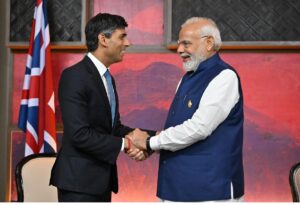
Rishi Sunauk with Indian PM Narendra Modi

South Asian communities, however, are no longer passive observers. They represent influential voting blocs in constituencies across London, Birmingham, Leicester, and Manchester. Indian-origin politicians like Rishi Sunak, the former Prime Minister, and several Labour MPs of Pakistani and Bangladeshi origin reflect this growing political clout. But, many community leaders worry that rallies like Robinson’s could polarize voters further, hardening stereotypes and complicating their engagement with both major parties.

A global echo chamber

The London march did not exist in a vacuum. Elon Musk’s video address to the rally, criticizing Britain’s political class and invoking free speech anxieties—gave it international attention. Experts warn that far-right groups across Europe and North America are increasingly coordinated, sharing slogans, strategies, and even celebrity endorsements.

For South Asians, this global networking of extremist rhetoric is alarming. Indian, Pakistani, and Bangladeshi diaspora communities in the U.S. and Canada have already faced the spillover effects of anti-immigrant sentiment. Analysts fear that what starts on London’s streets can embolden similar rhetoric abroad, further tightening the pressure on immigrant communities.

ALSO READ: U.S. Immigration Policy Shift: No Renewal for Humanitarian ‘Migrant Parole’ Program

Despite anxieties, South Asian communities have demonstrated resilience in the face of hostility. Community organizations, interfaith groups, and student associations mobilized rapidly during the London rally, ensuring counter-demonstrations remained visible and peaceful.

Several South Asian MPs condemned the violence, while business leaders highlighted the economic contributions of migrants. The NHS, universities, and city councils used the moment to reaffirm the importance of diversity in sustaining Britain’s institutions.

The London rally was framed by organizers as an assertion of patriotism, but for Britain’s South Asians, it was a stark reminder that questions of belonging are far from settled. While the community has built a visible and influential presence across sectors, the persistence of far-right mobilization threatens to undo decades of integration.

For now, South Asians are cautiously navigating rising hostility while shaping Britain’s future through political engagement, cultural leadership, and economic dynamism. As one activist in Leicester put it after the rally: “They want us out, but Britain cannot run without us.”

Massive Anti-Immigration Rally in London Turns Violent, 26 Police Officers Injured

London witnessed one of its largest far-right demonstrations in recent memory on Saturday, as a march led by activist Tommy Robinson spiraled into violence, leaving at least 26 police officers injured and resulting in 25 arrests.

According to the Metropolitan Police, clashes erupted when sections of Robinson’s supporters attempted to push through barriers separating them from a counter-protest organized by the group Stand Up to Racism. Officers were reportedly punched, kicked, and struck with bottles before riot police were dispatched to regain control.

Authorities confirmed that four officers sustained serious injuries, including broken teeth, a concussion, a suspected broken nose, and a spinal injury. Reinforcements carrying riot shields and helmets were rushed to the scene to contain escalating tensions.

Crowd estimates placed attendance at between 110,000 and 150,000, making it one of the biggest far-right gatherings in the UK in recent years. Organizers, however, claimed turnout was even higher, branding it the “Unite the Kingdom” march. Robinson hailed the event as a “tidal wave of patriotism” and described it as the beginning of a “cultural revolution.”

Robinson, born Stephen Yaxley-Lennon, is the founder of the nationalist and anti-Islam English Defence League. He has long been a controversial figure in British politics and remains one of the most prominent voices on the UK’s far-right.

The rally drew prominent figures from across Europe’s far-right networks and even saw a surprise video address from billionaire Elon Musk. In his message, Musk criticized Britain’s political leadership, argued that citizens were “scared to exercise their free speech,” and urged a push for political change.

Police said more than 1,600 officers were deployed across London to manage the rally, which coincided with several other major public events including football matches and concerts. Authorities confirmed that investigations into the violence were underway and that additional arrests were likely.

‘We Don’t Take Part In Wars’: China Reacts Sharply After Trump’s NATO Tariff Call

China has strongly rejected US President Donald Trump’s proposal that NATO members impose steep tariffs on Beijing, saying such measures would only worsen global tensions.

Chinese Foreign Minister Wang Yi made the remarks on Saturday during a press conference in Ljubljana, Slovenia, following talks with Deputy Prime Minister and Foreign Minister Tanja Fajon. His comments came just hours after Trump suggested NATO should consider tariffs of 50–100 per cent on Chinese goods until the war in Ukraine ends.

“China does not participate in or plan wars, and what China does is to encourage peace talks and promote political settlement of hotspot issues through dialogue,” Wang was quoted as saying by China Daily.

Wang argued that sanctions and tariffs would not resolve crises but only complicate them further. “China and Europe should be friends rather than rivals, and should cooperate rather than confront each other,” he said. “Making the right choices amid the greatest changes in a century demonstrates the responsibilities that both sides should fulfill towards history and the people.”

Wang also stressed that Beijing remains committed to multilateralism and the principles of the UN Charter, adding that the current international situation was defined by “intertwined chaos and continuous conflicts.”

Ukraine war with Russia

Trump, in a post on his Truth Social platform, had said NATO should take collective action on tariffs: “I believe that this, plus NATO, as a group, placing 50 per cent to 100 per cent TARIFFS ON CHINA, to be fully withdrawn after the WAR with Russia and Ukraine is ended, will also be of great help in ENDING this deadly, but RIDICULOUS, WAR.”

The former president claimed China maintains “a strong control, and even grip, over Russia,” suggesting punitive tariffs would weaken Beijing’s leverage over Moscow.

Trump’s proposal is unusual because NATO is a military alliance with no mandate on trade issues. Analysts say his idea of collective tariffs under NATO reflects a broadening of security tools into the economic sphere.

Earlier this month, Trump had accused Chinese President Xi Jinping of “conspiring against” the United States after Beijing held its largest-ever military parade on September 3, attended by Russian President Vladimir Putin and North Korean leader Kim Jong Un. However, in a subsequent remark, Trump said his personal relationship with Xi was still “very good,” underscoring his oscillating stance towards Beijing.

China’s Consistent Refrain on Tariffs

Wang Yi’s latest remarks echo Beijing’s long-standing response to US tariff threats. Since the onset of Trump’s trade war in 2018, China has consistently positioned itself as a supporter of global free trade and multilateral cooperation, while rejecting what it calls Washington’s “unilateral protectionism.”

During earlier rounds of tariffs on Chinese goods, Beijing responded with targeted counter-tariffs but avoided escalating rhetoric, often reiterating that dialogue and mutual respect should guide US-China relations. For instance, in 2019 when Trump raised duties on $200 billion worth of imports, Chinese officials said the “only way forward is cooperation, not confrontation,” while rolling out measured relief for domestic exporters.

China’s playbook has also involved appealing to Europe and other global partners. Wang’s emphasis in Ljubljana that “China and Europe should be friends rather than rivals” reflects Beijing’s strategy of preventing Washington from rallying its allies into a united front against China. This mirrors past efforts when Beijing sought closer ties with the EU even as US tariffs intensified.

The rhetoric of “peace talks” and “multilateralism” serves a dual purpose: projecting China as a responsible power amid global instability, and contrasting Beijing’s image with Washington’s protectionist posture. At the same time, China has been careful not to openly distance itself from Russia, maintaining energy imports and high-level diplomacy while rejecting suggestions that it is actively fueling the war in Ukraine.

If NATO were to adopt Trump’s proposed tariff scheme, unlikely though it may be, China would almost certainly respond with both diplomatic protests and retaliatory economic measures, just as it did during the first trade war. For now, Wang Yi’s remarks suggest Beijing will continue its balancing act: opposing punitive measures, promoting dialogue, and seeking to court European partners wary of being drawn into Washington’s hardening stance.

Param Sundari Faces Box Office Hurdles, Hovers Around ₹3 to 5 Crore

Bollywood’s recent weekend offerings highlight a striking divergence in audience response and box office performance. Among them, Param Sundari, starring popular actors and backed by significant promotion, has struggled to maintain momentum in its second and third weeks. The film’s performance underscores the unpredictable nature of Bollywood’s domestic market, where star power and marketing do not always guarantee sustained commercial success.

Param Sundari arrived with considerable expectations, driven by its vibrant marketing campaign and a cast that included established stars and rising talent. The film’s music, energetic dance sequences, and glossy production design were positioned as key selling points to attract younger demographics and multiplex audiences.

However, despite these efforts, initial audience feedback pointed to mixed reviews regarding narrative coherence and character arcs. Critics praised the film’s visual appeal and choreography but noted pacing issues and a predictable storyline, elements that often affect repeat viewership and word-of-mouth momentum.

Weekend Box Office Performance

Industry trackers report that Param Sundari collected modest figures during its latest weekend, reflecting a significant drop from its opening week. While precise totals vary, estimates suggest weekend collections hovered in the range of ₹3–5 crore, a notable decline compared to expectations. This contrasts sharply with other Bollywood releases, which, despite competing for attention, fared better due to stronger narratives or novelty appeal.

The occupancy trends indicate that urban multiplexes in metros such as Mumbai, Delhi, and Bengaluru saw moderate attendance, while single-screen theatres in smaller cities and towns reported even lower footfalls. Analysts attribute this disparity to both competition from regional hits and changing audience preferences favoring pan-India or globally themed narratives.

Param Sundari released alongside The Bengal Files and ongoing runs of regional blockbusters like Madharaasi and Lokah: Chapter 1 – Chandra. The latter titles, with their strong word-of-mouth and fan engagement, captured a significant share of audience attention, leaving less room for Param Sundari to perform.

Param Sundari

Additionally, the Bollywood landscape is experiencing a paradigm shift. Films that rely primarily on star power are facing challenges from content-driven releases and regional cinema with pan-India appeal. The success of films like The Kashmir Files and Gangubai Kathiawadi in recent years demonstrates that compelling storytelling often outweighs celebrity presence alone.

Social media reactions for Param Sundari have been mixed. While the film’s music tracks and dance numbers garnered appreciation, discussions around plot, character development, and engagement levels reflected disappointment among certain segments of the audience. Viral memes and humorous critiques have dominated online discourse, sometimes inadvertently keeping the film in public attention, though not translating into box office gains.

Viewer demographics indicate that younger audiences, who initially formed a strong part of the opening week crowd, were less inclined to return for repeat viewings. Critics highlight that the film’s core appeal, while visually rich, lacked narrative depth, reducing long-term engagement.

Param Sundari’s marketing campaign was robust, leveraging digital promotions, influencer partnerships, and music video launches to build pre-release anticipation. Distribution focused on maximizing screen presence in metropolitan cities and premium multiplex chains, aiming to target urban youth demographics.

However, the reliance on metro-centric strategies may have limited rural penetration, which, for Bollywood releases, often constitutes a substantial portion of total collections. In contrast, regional films such as Madharaasi and Lokah achieved broader reach across both urban and semi-urban markets, amplifying their box office resilience.

Critical Insights

The underperformance of Param Sundari highlights several key insights for Bollywood stakeholders:

  1. Narrative Weight Matters: A strong storyline with emotional resonance is crucial for sustaining box office momentum beyond the opening weekend.

  2. Competition With Regional Films: Regional cinema’s rising pan-India appeal requires Bollywood to compete not just with fellow Hindi films but also with high-quality regional releases.

  3. Marketing Beyond Hype: Pre-release buzz is insufficient; sustained engagement through content and audience connect is critical for extended theatrical runs.

  4. Audience Fragmentation: Urban multiplex audiences are increasingly discerning, while rural and smaller-city markets may respond differently, requiring a nuanced release strategy.

When compared to Baaghi 4 and The Bengal Files, Param Sundari illustrates the challenges Bollywood faces in balancing star-driven appeal with compelling content. While Baaghi 4 saw a drop in occupancy but benefited from franchise recognition, The Bengal Files leveraged topical storytelling to maintain steady collections. Param Sundari, despite high production values, struggled to achieve similar traction.

Future Bollywood Releases

The performance of Param Sundari may influence how studios approach mid-budget Bollywood projects. The reliance on aesthetics and dance-centric marketing alone appears insufficient. Audience expectations are shifting toward stronger scripts, character-driven narratives, and experiences that resonate emotionally or thematically.

For actors and producers, this signals the need to innovate within conventional Bollywood frameworks. Incorporating elements that offer novelty or align with current societal interests may prove decisive in future box office outcomes.

Param Sundari’s weekend performance serves as both a reality check and a learning opportunity for Bollywood. While its music, visuals, and star cast contributed to initial interest, the film’s inability to sustain momentum underscores the importance of content-driven appeal in today’s market.

In a landscape increasingly dominated by pan-India hits, regional cinema, and global releases, Bollywood must adapt strategies to align with evolving audience preferences. Param Sundari, despite underwhelming numbers, remains a talking point for industry analysis, providing insights into the changing dynamics of box office success in India.