London’s Far-Right Rally Sends Shockwaves Through South Asian Communities

London witnessed one of its most dramatic confrontations between far-right activists and anti-racism campaigners in recent memory this weekend. A march led by Tommy Robinson, founder of the English Defence League, drew an estimated 110,000 to 150,000 supporters, marking it as one of the largest right-wing gatherings in decades.

While organizers claimed even higher turnout, the rally descended into violence, leaving 26 police officers injured, four seriously, and 25 protesters arrested. For South Asians in the UK, who make up one of the country’s largest ethnic minority blocs, the violent rhetoric and size of the rally raise fresh concerns about rising hate crimes, and their identity of belonging.

The event, branded the “Unite the Kingdom” march, was celebrated by Robinson as a “tidal wave of patriotism.” Yet for many observers, the gathering was less about unity and more about exclusion. Anti-immigrant chants, placards criticizing multiculturalism, and speeches targeting Muslim communities made clear the undercurrent of hostility.

ALSO READ: Massive Anti-Immigration Rally in London Turns Violent, 26 Police Officers Injured

South Asians, particularly Muslims of Pakistani and Bangladeshi heritage, were indirectly placed in the crosshairs of this rhetoric. The clash between Robinson’s supporters and counter-protesters organized by Stand Up to Racism only deepened the sense that Britain’s immigrant communities are caught in the middle of an escalating ideological battle.

The South Asian footprint in the UK

According to the 2021 Census (ONS), South Asians form about 9.3% of the population in England and Wales. The breakdown highlights their importance in Britain’s demographic fabric:

  • Indian-origin population: ~1.86 million (3.1%).

  • Pakistani-origin population: ~1.59 million (2.7%).

  • Bangladeshi-origin population: ~0.6 million (1.0%).

  • Sri Lankan, Nepali and other South Asians: collectively ~0.3 million.

These communities are not just statistically significant; they are deeply woven into Britain’s social, cultural, and economic life. Indians form the backbone of the NHS’s medical workforce, Pakistanis and Bangladeshis drive the retail, hospitality, and transport sectors, while newer groups like Nepalis contribute heavily to service and defense.

The London rally revives memories of earlier flashpoints when South Asians became targets of xenophobia. Hate crime data from the Home Office shows a persistent rise in racially and religiously motivated offenses, with spikes often following political events such as Brexit or terror attacks. In 2022–23, police recorded over 109,000 hate crimes, with nearly 70% related to race.

South Asians, especially Muslims and Sikhs who are often mistakenly identified as Muslims, report a heightened sense of vulnerability after such rallies. Grassroots organizations warn that even when physical violence is limited, the psychological toll of being depicted as outsiders can erode trust in institutions and fray inter-community ties.

Generational divides: Young South Asians feel the heat

Second- and third-generation South Asians in Britain are often proud to identify as both British and Asian. However, far-right mobilizations complicate that identity. University campuses have seen rising incidents of racial harassment, and South Asian students often bear the brunt of verbal abuse in public spaces.

Gen-Z South Asians in London spoke on social media about avoiding certain neighborhoods during the rally and expressed anger at being indirectly portrayed as incompatible with Britishness. This sentiment echoes findings from the British Social Attitudes Survey, which noted that younger minorities increasingly feel less secure about their status in society compared to a decade ago.

The rally also arrives at a politically sensitive moment with elections looming in the UK, where immigration is again a headline issue. Far-right rhetoric influences mainstream parties, pushing them to adopt stricter stances on asylum and border control.

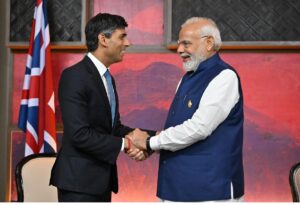
Rishi Sunauk with Indian PM Narendra Modi

South Asian communities, however, are no longer passive observers. They represent influential voting blocs in constituencies across London, Birmingham, Leicester, and Manchester. Indian-origin politicians like Rishi Sunak, the former Prime Minister, and several Labour MPs of Pakistani and Bangladeshi origin reflect this growing political clout. But, many community leaders worry that rallies like Robinson’s could polarize voters further, hardening stereotypes and complicating their engagement with both major parties.

A global echo chamber

The London march did not exist in a vacuum. Elon Musk’s video address to the rally, criticizing Britain’s political class and invoking free speech anxieties—gave it international attention. Experts warn that far-right groups across Europe and North America are increasingly coordinated, sharing slogans, strategies, and even celebrity endorsements.

For South Asians, this global networking of extremist rhetoric is alarming. Indian, Pakistani, and Bangladeshi diaspora communities in the U.S. and Canada have already faced the spillover effects of anti-immigrant sentiment. Analysts fear that what starts on London’s streets can embolden similar rhetoric abroad, further tightening the pressure on immigrant communities.

ALSO READ: U.S. Immigration Policy Shift: No Renewal for Humanitarian ‘Migrant Parole’ Program

Despite anxieties, South Asian communities have demonstrated resilience in the face of hostility. Community organizations, interfaith groups, and student associations mobilized rapidly during the London rally, ensuring counter-demonstrations remained visible and peaceful.

Several South Asian MPs condemned the violence, while business leaders highlighted the economic contributions of migrants. The NHS, universities, and city councils used the moment to reaffirm the importance of diversity in sustaining Britain’s institutions.

The London rally was framed by organizers as an assertion of patriotism, but for Britain’s South Asians, it was a stark reminder that questions of belonging are far from settled. While the community has built a visible and influential presence across sectors, the persistence of far-right mobilization threatens to undo decades of integration.

For now, South Asians are cautiously navigating rising hostility while shaping Britain’s future through political engagement, cultural leadership, and economic dynamism. As one activist in Leicester put it after the rally: “They want us out, but Britain cannot run without us.”

New study connects religiosity among Indian Americans to more cardiovascular disease

The Study on Stress, Spirituality and Health (SSSH), a cutting-edge proteomics analysis, suggests that religious beliefs modulate protein expression associated with cardiovascular disease in South Asians in the United States.

The research, published by investigators from Massachusetts General Hospital (MGH) and Beth Israel Deaconess Medical Center (BIDMC) and the University of California San Francisco (UCSF) in Scientific Reports, demonstrates that spiritual struggles, in particular, significantly modify the impact of unique proteins on risk of developing cardiovascular disease (CVD) in U.S. South Asians, a community that has especially high rates of CVD.

This study represents the first proteomics analysis ever conducted on protein levels in relationship to CVD within a U.S. South Asian population and the first published study to analyze proteomics signatures in relationship to religion and spirituality in any population.

“Before we can develop the best interventions to reduce CVD disparities, we need to understand the biological pathways through which health disparities are produced,” says the study’s principal investigator and co-senior author Alexandra Shields, director of the Harvard/MGH Center on Genomics, Vulnerable Populations and Health Disparities at the MGH Mongan Institute and associate professor of Medicine at Harvard Medical School (HMS).

“As this study shows, psychosocial factors – and religious or spiritual struggles in particular – can affect biological processes that lead to CVD in this high-risk population. Spirituality can also serve as a resource for resilience and have a protective effect. Given that many of the minority communities that experience higher levels of CVD also report higher levels of religiosity and spirituality, studies such as the SSSH may help identify new leverage points, such as spiritually focused psychotherapy for those in spiritual distress, that could reduce risk of CVD for such individuals.”

Results of the study, which included 50 participants who developed CVD and 50 sex- and age-matched controls without CVD from the Mediators of Atherosclerosis in South Asians Living in America (MASALA) Study (100 participants), indicate that there may be unique protein expression profiles associated with CVD in U.S. South Asian populations, and that these associations may also be impacted by religious struggles, in which, for example, individuals experiencing adverse life events feel they are being punished or abandoned by their God, or have a crisis of faith.

The MASALA study includes 1,164 South Asians who were recruited from the San Francisco Bay Area and the greater Chicago area and followed for approximately eight years with the goal of investigating factors that lead to heart disease among this high-risk ethnic group. MASALA is one of the original cohorts participating in SSSH, through which this research was conducted.

“Understanding the pathways of this mechanism at the molecular level using proteomics technology is crucial to developing potential interventions that can help reduce CVD incidence in this population,” says Long H. Ngo, PhD, lead author and co-director of Biostatistics in the Division of General Medicine at BIDMC and associate professor of Medicine at HMS.

Co-senior author Towia Libermann, PhD, director of Genomics, Proteomics, Bioinformatics and Systems Biology Center at BIDMC, adds: “The kinds of blood-based protein biomarkers used in this study are particularly effective in assessing CVD risk because they carry clinical information about risk of disease and are the most commonly used molecules for diagnostic applications.”

Texas Indian American Engineer faces charges over $10 million fraud PPP loan

An Indian-origin engineer by name Shashank Rai has been charged by Texas prosecutors for fraudulent applications for $10 million loans under the COVID-19 relief program claiming to be for his firm employees. The charges include bank fraud and making false statements to a federal agency.

Paycheque Protection Programme (PPP) is an initiative of the federal government to provide emergency help to small businesses hit by the COVID—19 crisis to enable them to keep their employees availing loans under the program, which are written off after eight weeks if all the workers stay on the payroll. US Congress approved $649 billion for the program.

Shashank Rai, 30, of Beaumont, Texas, allegedly sought millions of dollars in forgivable loans in forgivable loans guaranteed by the Small Business Administration (SBA) under the Coronavirus Aid, Relief, and Economic Security (CARES) Act, from two different banks by claiming to have 250 employees earning wages when, in fact, no employees worked for his purported business. Rai is charged with violations of wire fraud, bank fraud, false statements to a financial institution, and false statements to the SBA.

“As alleged, Rai fraudulently pursued millions of dollars in loans intended for legitimate small businesses suffering the economic hardships of the COVID-19 pandemic,” said Assistant Attorney General Brian A. Benczkowski of the Justice Department’s Criminal Division.  “The department and our law enforcement partners will remain vigilant in our efforts to protect critical CARES Act relief programs from fraud and abuse.”

“The behavior in this case was very brazen,” said U.S. Attorney Joseph D. Brown of the Eastern District of Texas.  “Those who submit these applications for loans or other assistance need to understand that there are people checking on the representations made, and those representations are made under oath and subject to the penalties of perjury. Federal agencies are watching for fraud, and people who lie and try to cheat the system are going to be caught and prosecuted.”

Pre-meditated plan, says prosecution

“To support small and community banks, the Federal Home Loan Banks can accept Paycheck Protection Program (PPP) loans as collateral when making loans to their members,” said Richard Parker, Acting Deputy Inspector General for Investigations for the Federal Housing Finance Agency, Office of Inspector General.

“Today’s charges hold the defendant responsible for his actions to swindle money out of a federal program intended to help those in need during a pandemic crisis,” said Inspector General Jay N. Lerner of the Federal Deposit Insurance Corporation Office of Inspector General (FDIC OIG).  “When an individual cheats the Paycheck Protection Program out of money, it deprives hard-working Americans and deserving small businesses.”

diaspora news

According to court documents unsealed today in U.S. District Court in Beaumont, Rai allegedly made two fraudulent claims to two different lenders for seek loans guaranteed by the SBA for COVID-19 relief through the PPP.  In the application submitted to the first lender, Rai allegedly sought $10 million in PPP loan proceeds by fraudulently claiming to have 250 employees with an average monthly payroll of $4 million.  In the second application, Rai allegedly sought approximately $3 million in PPP loan proceeds by fraudulently claiming to have 250 employees with an average monthly payroll of approximately $1.2 million.

According to court documents, the Texas Workforce Commission provided information to investigators of having no records of employee wages having been paid in 2020 by Rai under his business, Rai Family LLC. In addition, the Texas Comptroller’s Office of Public Accounts reported to investigators that Rai Family LLC reported no revenues for the fourth quarter of 2019 or the first quarter of 2020.

According to court documents, materials recovered from the trash outside of Rai’s residence included handwritten notes that appear to reflect an investment strategy for the $3 million, which is the amount of money that Rai allegedly sought from the second lender.

What is PPP?

The CARES Act is a federal law enacted on March 29, 2020, designed to provide emergency financial assistance to the millions of Americans who are suffering the economic effects caused by the COVID-19 pandemic.  One source of relief provided by the CARES Act was the authorization of up to $349 billion in forgivable loans to small businesses for job retention of employees. In April 2020, Congress authorized over $300 billion in additional PPP funding.

The PPP allows qualifying small-businesses and other organizations to receive loans with a maturity of two years and an interest rate of 1 percent.  PPP loan proceeds must be used by businesses on payroll costs, interest on mortgages, rent, and utilities.  The PPP allows the interest and principal to be forgiven if businesses spend the proceeds on these expenses within eight weeks of receipt and use at least 75 percent of the forgiven amount for payroll.