

London witnessed one of its most dramatic confrontations between far-right activists and anti-racism campaigners in recent memory this weekend. A march led by Tommy Robinson, founder of the English Defence League, drew an estimated 110,000 to 150,000 supporters, marking it as one of the largest right-wing gatherings in decades.
While organizers claimed even higher turnout, the rally descended into violence, leaving 26 police officers injured, four seriously, and 25 protesters arrested. For South Asians in the UK, who make up one of the country’s largest ethnic minority blocs, the violent rhetoric and size of the rally raise fresh concerns about rising hate crimes, and their identity of belonging.
The event, branded the “Unite the Kingdom” march, was celebrated by Robinson as a “tidal wave of patriotism.” Yet for many observers, the gathering was less about unity and more about exclusion. Anti-immigrant chants, placards criticizing multiculturalism, and speeches targeting Muslim communities made clear the undercurrent of hostility.
ALSO READ: Massive Anti-Immigration Rally in London Turns Violent, 26 Police Officers Injured
South Asians, particularly Muslims of Pakistani and Bangladeshi heritage, were indirectly placed in the crosshairs of this rhetoric. The clash between Robinson’s supporters and counter-protesters organized by Stand Up to Racism only deepened the sense that Britain’s immigrant communities are caught in the middle of an escalating ideological battle.
The South Asian footprint in the UK
According to the 2021 Census (ONS), South Asians form about 9.3% of the population in England and Wales. The breakdown highlights their importance in Britain’s demographic fabric:
-
Indian-origin population: ~1.86 million (3.1%).
-
Pakistani-origin population: ~1.59 million (2.7%).
-
Bangladeshi-origin population: ~0.6 million (1.0%).
-
Sri Lankan, Nepali and other South Asians: collectively ~0.3 million.
These communities are not just statistically significant; they are deeply woven into Britain’s social, cultural, and economic life. Indians form the backbone of the NHS’s medical workforce, Pakistanis and Bangladeshis drive the retail, hospitality, and transport sectors, while newer groups like Nepalis contribute heavily to service and defense.
The London rally revives memories of earlier flashpoints when South Asians became targets of xenophobia. Hate crime data from the Home Office shows a persistent rise in racially and religiously motivated offenses, with spikes often following political events such as Brexit or terror attacks. In 2022–23, police recorded over 109,000 hate crimes, with nearly 70% related to race.
South Asians, especially Muslims and Sikhs who are often mistakenly identified as Muslims, report a heightened sense of vulnerability after such rallies. Grassroots organizations warn that even when physical violence is limited, the psychological toll of being depicted as outsiders can erode trust in institutions and fray inter-community ties.
Generational divides: Young South Asians feel the heat
Second- and third-generation South Asians in Britain are often proud to identify as both British and Asian. However, far-right mobilizations complicate that identity. University campuses have seen rising incidents of racial harassment, and South Asian students often bear the brunt of verbal abuse in public spaces.
Gen-Z South Asians in London spoke on social media about avoiding certain neighborhoods during the rally and expressed anger at being indirectly portrayed as incompatible with Britishness. This sentiment echoes findings from the British Social Attitudes Survey, which noted that younger minorities increasingly feel less secure about their status in society compared to a decade ago.
The rally also arrives at a politically sensitive moment with elections looming in the UK, where immigration is again a headline issue. Far-right rhetoric influences mainstream parties, pushing them to adopt stricter stances on asylum and border control.

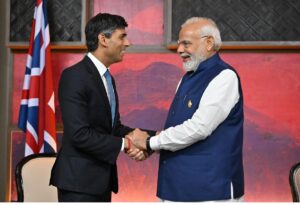
Rishi Sunauk with Indian PM Narendra Modi
South Asian communities, however, are no longer passive observers. They represent influential voting blocs in constituencies across London, Birmingham, Leicester, and Manchester. Indian-origin politicians like Rishi Sunak, the former Prime Minister, and several Labour MPs of Pakistani and Bangladeshi origin reflect this growing political clout. But, many community leaders worry that rallies like Robinson’s could polarize voters further, hardening stereotypes and complicating their engagement with both major parties.
A global echo chamber
The London march did not exist in a vacuum. Elon Musk’s video address to the rally, criticizing Britain’s political class and invoking free speech anxieties—gave it international attention. Experts warn that far-right groups across Europe and North America are increasingly coordinated, sharing slogans, strategies, and even celebrity endorsements.
For South Asians, this global networking of extremist rhetoric is alarming. Indian, Pakistani, and Bangladeshi diaspora communities in the U.S. and Canada have already faced the spillover effects of anti-immigrant sentiment. Analysts fear that what starts on London’s streets can embolden similar rhetoric abroad, further tightening the pressure on immigrant communities.
ALSO READ: U.S. Immigration Policy Shift: No Renewal for Humanitarian ‘Migrant Parole’ Program
Despite anxieties, South Asian communities have demonstrated resilience in the face of hostility. Community organizations, interfaith groups, and student associations mobilized rapidly during the London rally, ensuring counter-demonstrations remained visible and peaceful.
Several South Asian MPs condemned the violence, while business leaders highlighted the economic contributions of migrants. The NHS, universities, and city councils used the moment to reaffirm the importance of diversity in sustaining Britain’s institutions.
The London rally was framed by organizers as an assertion of patriotism, but for Britain’s South Asians, it was a stark reminder that questions of belonging are far from settled. While the community has built a visible and influential presence across sectors, the persistence of far-right mobilization threatens to undo decades of integration.
For now, South Asians are cautiously navigating rising hostility while shaping Britain’s future through political engagement, cultural leadership, and economic dynamism. As one activist in Leicester put it after the rally: “They want us out, but Britain cannot run without us.”