
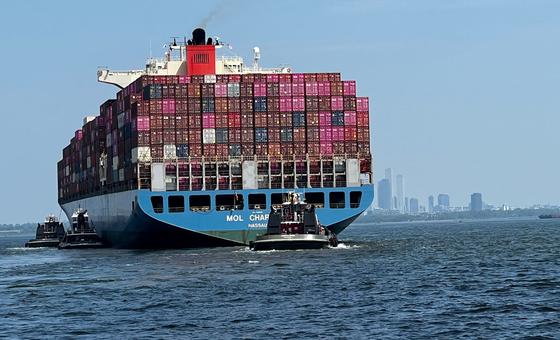
Shipping faces ‘stormy seas’ as trade slows and costs rise

After firm expansion last year, seaborne trade volumes are forecast to rise by just 0.5 per cent in 2025, the slowest pace in years, according to the agency’s Review of Maritime Transport 2025, launched in Geneva.

The slowdown comes as geopolitical tensions, new trade barriers and climate pressures reshape shipping routes, push up costs and expose vulnerabilities in the global economy.

The transitions ahead – to zero carbon, to digital systems, to new trade routes – must be just transitions,” said UNCTAD Secretary-General Rebeca Grynspan. “They must empower, not exclude. They must build resilience, not deepen vulnerability.”

Routes in flux, costs rising

Shipping carries over 80 per cent of the world’s merchandise for export and import, making it a critical barometer of global commerce.

UNCTAD reported that rerouting caused by crises in the Red Sea in 2024 and continuing tensions near the Strait of Hormuz have forced ships onto longer journeys, adding delays and costs.

At the Geneva launch, Regina Asariotis, Chief of UNCTAD’s Trade Logistics Branch, warned that vulnerable economies are paying the heaviest price:

“The global environment has become more complex. Geopolitical tensions are forcing costly reroutings, tariffs are disrupting trade flows, and freight rates are high and volatile.

Small island developing States, least developed countries, and net food importing nations are the most vulnerable, because higher freight costs quickly translate into more expensive imports and food insecurity.”

Ports under pressure

Global ports are struggling with congestion, longer waiting times and the pressure to modernise. UNCTAD highlighted the urgent need to invest in digital systems such as maritime single windows and port community platforms to cut costs and delays.

But many developing countries continue to lag behind in digitalisation. With cyber threats on the rise, the report warns that cybersecurity has become a critical priority for maritime logistics.

Climate challenge

The shipping industry’s greenhouse gas emissions rose by five per cent in 2024, the report said. Yet only eight per cent of the world fleet’s tonnage is currently equipped to use alternative fuels.

The International Maritime Organization will consider a Net-Zero Framework in October, including a global fuel standard and carbon pricing mechanism. UNCTAD says clear regulatory signals, fleet renewal and new fuel infrastructure are vital to reduce emissions.

Human cost at sea

Beyond trade flows and emissions, the report stressed the human toll. Seafarer abandonment cases reached a record high in 2024, leaving crews stranded without pay or support.

Amendments to the Maritime Labour Convention entering into force in 2027 will strengthen rights to repatriation and shore leave, but UNCTAD stressed that effective enforcement is essential.

Policy priorities

The review calls for governments and industry to work together on:

  • Stable trade policies to reduce uncertainty and restore confidence in supply chains;
  • Investment in sustainable, green and resilient port and shipping infrastructure;
  • Faster digitalisation and stronger cybersecurity;
  • Fleet renewal and cleaner fuels; and
  • Support for vulnerable economies to mitigate higher costs.

“Persistent high transport costs risk hitting developing countries the hardest,” Ms. Grynspan said. “Maritime transport must be resilient, inclusive and sustainable if we are to weather the turbulent waters ahead.”

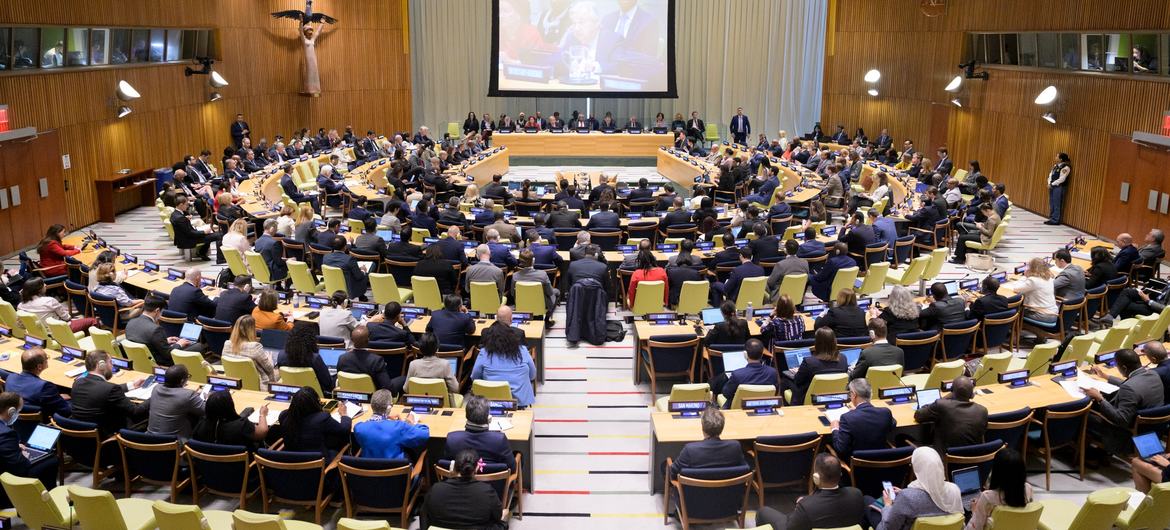
UN chief calls for major reforms to cut costs and improve efficiency

Briefing Member States in New York on Monday Mr. Guterres outlined wide-ranging effort to revamp how the UN system operates – cutting costs, streamlining operations, and modernizing its approach to peace and security, development and human rights.

“These are times of peril,” he said, “but they are also times of profound opportunity and obligation. The mission of the United Nations is more urgent than ever.

Three main objectives

Launched in March, the UN80 Initiative centres on three priorities: enhancing operational efficiency, assessing how mandates – or key tasks – from Member States are implemented, and exploring structural reforms across the UN system.

The conclusions will be reflected in revised estimates for the 2026 budget in September this year, with additional changes that require more detailed analysis presented in 2027.

‘Meaningful’ budget reductions

Mr. Guterres said the changes are expected to yield “meaningful reductions” in the overall budget. For example, the departments for political and peacekeeping affairs could see a 20 per cent reduction in staff by eliminating duplication.

This level of reduction, he said, could serve as a benchmark across the UN system – while also considering unique factors for each department.

Additional examples include consolidating all counter-terrorism work within the main Office of Counter-Terrorism (UNOCT), ending building leases and relocating posts away from expensive “duty stations” where cost of living is high.

“There might be immediate, one-off costs involved in relocating staff and providing potential termination packages,” he said, “but by moving posts from high-cost locations, we can reduce our commercial footprint in those cities and reduce our post and non-post costs.

UN Secretary-General António Guterres briefs on the UN80 Initiative.

Efficiencies and upgrades

The first workstream focuses on efficiencies and improvements, developing a new model that improves consolidation, looks at centralising services, relocating to cheaper locations, and expanding the use of automation and digital platforms.

Mr. Guterres said departments the UN’s headquarters in New York and Geneva have been asked to review whether some teams can be relocated to lower-cost duty stations, reduced or abolished.

Reviewing mandates

The second workstream involves a review of how existing mandates are being carried out – not the mandates themselves, which are the purview of Member States only.

A preliminary review identified more than 3,600 unique mandates for the Secretariat alone. A full and more detailed analysis is now underway.

Mr. Guterres emphasised that the sheer number of mandates – and the bureaucracy needed to implement them – places a particular burden on smaller Member States with limited resources.

“Based on this work, Member States may wish to consider the opportunity to conduct themselves a review of the mandates,” he added.

Structural change

The third workstream – focused on structural reform – is already underway, Mr. Guterres said.

Nearly 50 initial submissions have already been received from senior UN officials, reflecting what Mr. Guterres described as “a high level of ambition and creativity.”

Key work areas have been identified for review. These include peace and security, development, human rights, humanitarian, training and research and specialised agencies.

A wide view of the informal meeting of the General Assembly plenary that heard a briefing by the Secretary-General on the UN80 Initiative.

Not an answer to liquidity crisis

Mr. Guterres also touched on the UN dire cashflow situation, noting that the initiative “is not an answer” to the months-long liquidity crisis but by being more cost effective, it should help limit the impact.

The liquidity crisis is caused by one simple fact – the arrears,” he said, adding that structural reform is not the answer to a fundamental failure by some Member States to pay what they owe on time to meet running costs.

Unpaid dues

According to information provided by the UN Controller to the General Assembly’s Fifth Committee (Administrative and Budgetary), only $1.8 billion has been received against the $3.5 billion regular budget assessments for 2025 – a shortfall of around 50 per cent.

As of 30 April, unpaid assessments stood at $2.4 billion, with the United States owing about $1.5 billion, China ($597 million), Russia ($72 million), Saudi Arabia ($42 million), Mexico ($38 million), and Venezuela ($38 million). An additional $137 million is yet to be paid by other Member States.

For the peacekeeping budget (which runs on a July-June cycle), including prior-period arrears, the unpaid amount totals $2.7 billion. For the International Tribunals, total contribution outstanding was $79 million as of 30 April.

Close consultation

The Secretary-General told Member States he would be consulting with them  closely and regularly on the cash crisis and needed reforms, seeking guidance  and presenting concrete proposals for countries to act on.

UN staff members and their representatives are being consulted and listened to, he added: “Our concern is to be humane and professional in dealing with any aspect of the required restructuring.

In conclusion, he highlighted that the UN80 Initiative is a “significant opportunity” to strengthen the UN system and deliver for those who depend on it.

In response to the suggestion that the UN should focus on just the one key pillar of peace and security, he said it would be wrong to ditch development and human rights – all three are essential he underscored.

Let us seize this momentum with urgency and determination, and work together to build the strongest and most effective United Nations for today and tomorrow.”

Source link