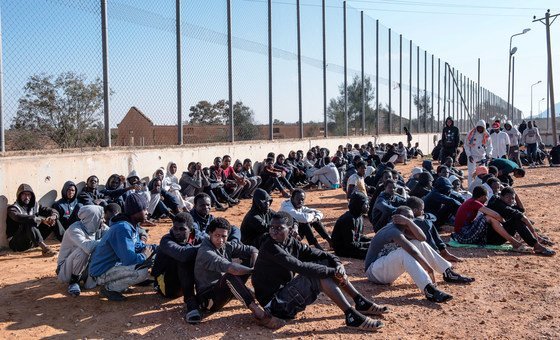
‘Our worst held fears are being confirmed’: Dozens of bodies discovered in Libya mass graves

“Our worst held fears are being confirmed: dozens of bodies have been discovered at these sites, along with the discovery of suspected instruments of torture and abuse, and potential evidence of extrajudicial killings,” Türk said.

The sites where bodies were discovered are run by the Stabilization Support Apparatus (SSA), an armed group tasked with increasing Government security in the capital, Tripoli.  They have long been suspected by the UN Support Mission in Libya (UNSMIL) – and independent rights experts – to be sites of torture and enforced disappearance.

Mr. Türk called for these sites to be sealed for forensic investigations to support accountability.

Libya has endured turmoil since the fall of the Muammar Gaddafi regime 15 years ago and the emergence of rival administrations in 2014: the UN-recognized Government of National Unity (GNU) in Tripoli and the Government of National Stability (GNS) based in Benghazi. 

The UN has supported many ultimately unsuccessful attempts to reunite the country and transition to democratic governance.

Over 80 bodies discovered

In May, the leader of the SSA – Abdul Ghani al-Kikli – was killed, triggering clashes between armed groups and state security forces. Protests also emerged, calling for an end to violence in Tripoli. Multiple civilians were killed and infrastructure – including hospitals – damaged. 

In the wake of this violence, 10 badly charred bodies were discovered at the SSA headquarters in the Abu Salim neighbourhood. 67 more bodies were discovered at hospitals in Abu Salim and Al Khadra hospitals, all in refrigerators and in various states of decay. 

The UN human rights office OHCHR also said that a burial site was discovered at the Tripoli Zoo, which is run by the SSA. 

The identities of the bodies are not known at this stage. 

Human rights abuses, at all levels

These were not the first mass graves discovered in Libya. In February, two mass graves were discovered in Jakharrah and Al-Kufra with 10 and 93 bodies respectively. Many of these bodies were migrants who are uniquely vulnerable to human trafficking, forced disappearance and killings.

The International Organization for Migration (IOM) recorded over 1,000 migrant deaths and disappearances in Libya in 2024 alone.

Mr. Türk expressed concern not only about the bodies discovered recently in Tripoli and the human rights abuses they confirm, but also about the force with which protests were met near the end of last month.

“We have received reports that these protests were themselves met with unnecessary force, raising serious concerns with respect to the guarantee of the fundamental rights of freedom of expression and assembly,” he said.

The High Commissioner for Human Rights also noted that images and videos of the bodies are circulating on social media, prompting him to call for preserving the dignity and privacy of victims.

Seal the sites, preserve the evidence

The Government of National Unity, the internationally-recognized administration based in Tripoli, announced the creation of two committees to investigate human rights abuses committed by State security forces, both in relation to the bodies and the protests.

While Türk noted this, he expressed concern that forensic authorities have not been allowed into the sites to examine and preserve related evidence.

He called on Libyan authorities to seal the recently discovered sites and promote immediate accountability efforts.

“Those responsible for these atrocious acts must be brought to justice without delay, in accordance with international standards,” he said.

Mr. Türk also urged all stakeholders to commit once more to transition attempts in order to move Libya towards an inclusive democracy once and for all, ending the “recurring cycle of transitional agreements.”

“The people of Libya have clearly expressed their demand for truth and justice, and their yearning for a peaceful and safe way of life with human rights and freedoms at the front and centre,” the High Commissioner added.  

Source link

Trichomonosis disease discovered among myna birds in Pakistan: Report

A strain of the disease responsible for killing off nearly two thirds of the UK’s greenfinches has been discovered in myna bird populations in Pakistan.

Mynas are native to the Indian subcontinent and are one of the world’s most invasive species. Although the disease is not generally fatal to them, experts from the University of East Anglia studying the birds say there is a risk they might pass it on to other species.

Avian trichomonosis, more commonly called canker or frounce, is carried by a parasite that primarily infects pigeons in the UK and the larger birds of prey which feed on them.

But in 2005 scientists found the disease had jumped into Britain’s garden songbird populations, predominantly affecting greenfinches and chaffinches.

Since then, the greenfinch population in the UK has fallen from around 4.3 million breeding pairs to fewer than 1.5 million in 2016.

In 2011, the disease was discovered to have reached European finch populations. Now researchers at the University of East Anglia (UEA) have found it in an entirely separate songbird species – the common myna.

Working in partnership with the University of Agriculture in Pakistan, researchers captured and screened 167 myna birds from eight different sites around the Faisalabad region of Pakistan. They discovered that around 20 per cent of the birds were infected with the disease and that there were infected birds at all of the sites surveyed.

The study, published in the journal Parasitology, also identified that the disease affecting the mynas was a different strain from the one found in the UK songbirds. Few of the infected birds had signs of poor health, suggesting that they can carry the disease without it being fatal.

Because myna birds are so invasive, however, there is a significant risk that they can spread the disease to other species that might not otherwise come into contact with it.

Dr Kevin Tyler, from UEA and a senior author of the study, said: “Mynas are able to roost almost anywhere in warm climates, which is one reason they are so successful, but it could also mean they are likely to spread the disease further.

“Mynas have already been implicated in the spread of bird flu through contact with poultry, so this could be of concern to poultry farmers. However, further research and testing is needed to see whether the disease has yet spread from mynas to other species.”

He added: “In the UK, pigeons carry this disease without serious symptoms and it looks like myna birds are able to do the same. This could be due to a natural resilience to the disease, or it could be that this is a less virulent strain – again, we need to carry out further research to investigate.”

Although mynas are thought to be native to the Indian subcontinent, populations of the birds have spread around the world, so the team is also keen to test for the disease in other countries.

Indian American Student Finds Simpler Solution to World Water Problem

Chaitnya Karamchedu has discovered a cheaper way to desalination, revolutionizing the approach to address water crisis. (Photo courtesy: jesuitcrusader.org)

Indian American student Chaitanya Karamchedu’s project has potential to revolutionize the method to purify salt water into safe drinkable fresh water and no wonder, many firms are vying for its commercial use.

Chaitanya from Portland, Oregon in the US, is a senior student at Jesuit High Schoo, has hit upon the idea more scientifically. “Sea water is not fully saturated with salt,” he explained. While the research hitherto focused on 10% of water that’s bonded to the salt in the sea, Chaitanya addressed the problem experimenting on 90% of the water that is free from salt bond.

Using a highly absorbent polymer, Chaitanya was able to discover a cheaper method effective way to remove salt from ocean water and turn it into fresh water.

Using superabsorbent hydrophilic polymers, with no external energy, under room temperature and pressure Chaitanya was able to produce drinkable water which stands WHO standards for potable water.

Based on saponified starch-grafted-polyacrylamide’s hydrophilic properties, he was able to create a hydrogel to separate freshwater from seawater, then separated hydrogel from the brine, dewatered the gel resulting in aqueous sulfuric acid and then recovered fresh water from the aqueous solution.

The use of hydrophilic polymers to desalinate water required no thermal or electrical energy and the extracted water was comparable to fresh water with an average conductivity of 306.32 µS/cm, comparable to the conductivity of 200 µS/cm for the reference distilled water used. It involved no cost for pre-treatment and post-treatment and it is amenable for small scale use.

Chaitanya Karamchedu has already won a $10,000 award from the US Agency for International Global Development at Intel’s International Science Fair and MIT’s TechCon Conference provided him research. He was also named one of 300 Regeneron Science Talent Search Semifinalists.