
World News in Brief: Türk slams relentless Russian attacks, Gaza update, Cyclone Gezani hits Madagascar

His reaction followed overnight attacks on energy infrastructure in Kyiv, Dnipro and the key port city of Odesa.

Nearly 8,800 multistorey buildings in Kyiv, Kharkiv and Odesa are without heating.

In Kharkiv, temperatures are forecast to drop to minus 10°C or 14°F on Thursday evening, said Viktoriia Andrievska from the UN aid coordination office, OCHA.

“Without heating or electricity, homes will turn freezing, basic services will stop, for example, the lifts will stop working, and people, especially older residents and families with children, will struggle to stay warm and safe,” she said.

Illegal strikes

In his statement, the UN human rights chief emphasised the lasting impact of “large-scale” attacks by Russia on Ukrainian energy infrastructure, which he stressed are prohibited under international law.

“Millions of households struggle with only a few hours of electricity each day,” Mr. Türk said, noting that unheated schools have been forced to shut and medical care has been impacted too.

International efforts to end the war in Ukraine continue, meanwhile, with Moscow announcing on Thursday that it expected the “next round” of talks “to take place shortly”, according to a Kremlin spokesperson.

Gaza: Another UN worker is killed, says UNRWA

Another UN worker has been killed in Gaza, despite a ceasefire agreement between Hamas fighters and the Israeli military.

According to the UN agency for Palestine refugees, UNRWA, a staff member was killed during Israeli airstrikes on Tuesday, reportedly after an attack by Hamas militants in Rafah.

UNRWA said that the Israeli strikes in Gaza City and shelling in Khan Younis killed at least four Palestinians, including their colleague, as he was hit while out walking on Salah Eddin Street in central Gaza.

Nearly 400 staffers killed

Since the war began, 391 UNRWA staff and partners have been killed.

In other Gaza news, Israeli forces have demolished a United Nations school in Jabalia in northern Gaza, it has been confirmed.

According to UNRWA, the school was one of a number of facilities it has behind the so-called “Yellow Line” of concrete blocks that separates the Israel Defense Forces from the people of Gaza.

Between January and February, eight UNRWA schools in the militarised area have been reportedly demolished by Israeli forces, the UN agency said.

Cyclone Gezani displaces thousands in northeastern Madagascar

Tropical Cyclone Gezani has killed at least 31 people and displaced thousands after making landfall in Madagascar on 10 February, bringing winds exceeding 195 km/h, heavy flooding and widespread destruction across eastern and central regions.

According to local authorities, four people remain missing and 35 have been injured. Preliminary reports indicate that more than 250,000 people have been affected, with nearly 7,000 displaced. 

Over 65,000 homes have been flooded, damaged or destroyed, and around 600 classrooms have been partially or completely rendered unusable.

UN emergency teams deployed

The UN International Organization for Migration (IOM) has deployed emergency teams to Toamasina to support authorities as displaced families shelter in 28 evacuation centres across 16 districts. A national state of emergency has been declared.

“The scale of devastation…has left families struggling to cope with urgent needs and heavy losses,” said IOM Chief of Mission Roger Charles Evina.

The Government is leading search-and-rescue operations and delivering emergency shelter and food assistance, including the distribution of 800 metric tonnes of rice, with support from UN agencies and partners.

A $3 million allocation from the UN Central Emergency Response Fund will assist more than 90,000 people as additional donor funding supports early response efforts.

The UN aid coordination office, OCHA, warned that the cyclone could also affect central and southern Mozambique in the coming days.

Source link

Cyclone Ditwah brings worst flooding in decades to Sri Lanka, killing hundreds

According to the UN relief coordination office, OCHA, 998,918 people across all 25 districts have now been affected, with 212 deaths reported and 218 people missing. More than 180,000 people from over 51,000 families are sheltering in 1,094 government-run safety centres as search and rescue efforts continue.

Cyclone Ditwah made landfall on 28 November before moving back over the Bay of Bengal, triggering some of the most severe flooding Sri Lanka has seen since the early 2000s.

The hardest-hit districts include Gampaha, Colombo, Puttalam and Mannar, as well as Trincomalee and Batticaloa, while deadly landslides in the central hill country have devastated Kandy, Badulla and Matale.

Homes destroyed, infrastructure shattered

Initial assessments indicate that more than 15,000 homes have been destroyed. Over 200 roads remain impassable, at least 10 bridges have been damaged, and sections of the rail network and national power grid affected.

Flooding along the Kelani River, which runs through Colombo and surrounding low-lying areas, continues to hamper access and disrupt information flow from affected communities, complicating rescue and relief operations.

Severe disruption to electricity, mobile and communications, and transport networks are reported in northern districts such as Jaffna, with entire villages isolated

Access to clean water also remains a major concern, with several areas reporting little or no supply.

Health system under strain, food insecurity looms

Sri Lanka’s already fragile health system is under severe pressure, OCHA said. Several district hospitals remain flooded and are receiving only limited supplies, with critically ill patients being airlifted to functioning facilities.

Response is further hindered by recurring landslides and the breach of multiple tank bunds (embankments or barriers), including at Mavilaaru, heightening risks in Trincomalee and Batticaloa.

Authorities have also warned of rising food insecurity, as submerged farmland, damaged storage facilities and severed supply routes threaten shortages and price increases in the weeks ahead.

The World Health Organization (WHO) warned that floods significantly raise the risk of vector-borne, food-borne and water-borne diseases, urging communities to prevent mosquito bites, ensure food safety and use safe drinking water wherever possible.

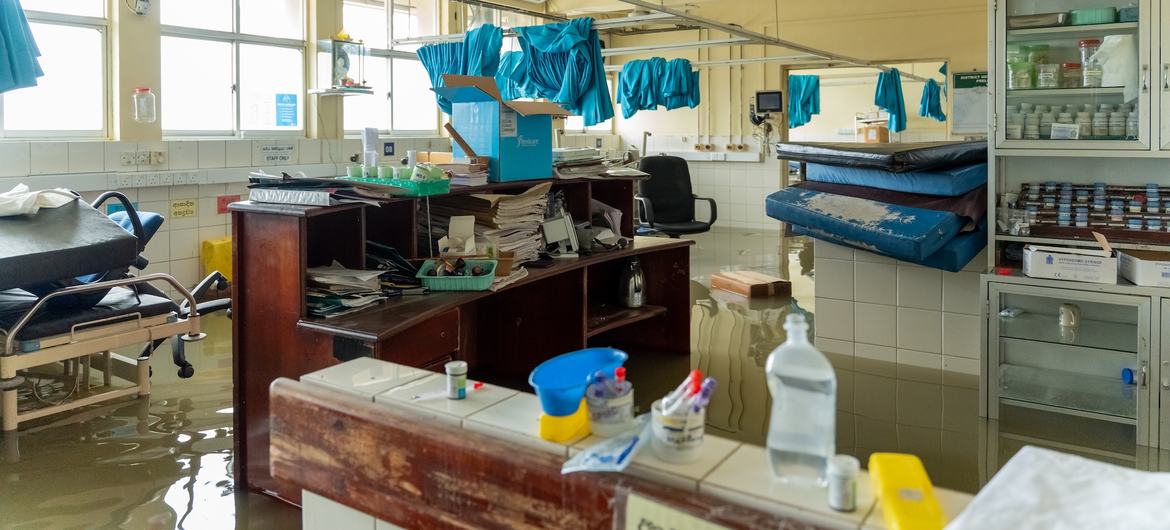
Floodwaters have entered several hospitals across Sri Lanka, further straining the health system.

UN mobilises coordinated response

The United Nations in Sri Lanka activated its emergency coordination system on Sunday to scale up a unified response with government agencies and humanitarian organizations.

Sector coordination has been set up across food security, health, water and sanitation (WASH), education, protection, shelter and early recovery, while a multi-sector needs assessment is under way with disaster management authorities to identify the most urgent gaps.

“The UN in Sri Lanka is mobilising its teams across the system to support national rescue and early recovery efforts, in coordination with authorities. We stand in solidarity with all affected communities,” said UN Resident Coordinator Marc-André Franche.

Despite access challenges, the UN Children’s Fund (UNICEF) has delivered portable water to 25 safety centres in Badulla in the central hills, which had been cut off from the rest of the country by floods and infrastructure damage.

To support government-led efforts, India and Pakistan have deployed emergency teams to work alongside Sri Lanka’s armed forces in the worst-hit districts.

Meanwhile, in the wider Asian region

Severe monsoon flooding continues across Thailand and Malaysia, affecting more than two million people in southern Thailand alone and displacing nearly 25,000 people in Malaysia, according to OCHA. People have been evacuated in several hard-hit Thai provinces, while the rainfall is expected to ease in coming days.

In Indonesia, media reports cite at least 440 deaths from floods and landslides, with more than 400 people missing, particularly in parts of Sumatra, where thousands remain stranded without access to food and water.

Cyclone Prapiroon: NASA’s GPM satellite finds heavy rainfall on southwestern side

When the Global Precipitation Measurement mission or GPM core satellite passed over the Northwestern Pacific Ocean, it saw very heavy rainfall occurring in one part of Tropical Storm Prapiroon.

Tropical Depression 09W was located east of the Philippines when it was upgraded early today, June 29, to Tropical Storm Prapiroon. The tropical storm is in a favorable environment for intensification. Vertical wind shear is low above the tropical cyclone and sea surface temperatures are warm below.

NASA’s GPM core observatory satellite had a good view of Tropical Storm Prapiroon on June 29, 2018 at 0246 UTC (June 28 at 10:46 p.m. EDT). GPM is a joint mission between NASA and the Japan Aerospace Exploration Agency, JAXA.

At the time GPM passed overhead, Prapiroon was barely a tropical storm with maximum sustained wind speeds estimated at about 35 knots (40.3 mph). GPM’s Microwave Imager (GMI) and Dual-Frequency Precipitation Radar (DPR) instruments measured precipitation around Prapiroon. GPM showed that intensifying the storm was fairly large with its most intense rainfall located in the southern part of the storm. GPM’s radar (DPR Ku Band) scanned convective storms in a feeder band on the southwestern side of the tropical storm where it found that some very intense storms there were dropping rain at a rate of over 192 mm (7.6 inches) per hour.

A 3-D view of Tropical Storm Prapiroon’s precipitation, looking toward the southwest, was created at NASA’s Goddard Space Flight Center in Greenbelt, Maryland, using data captured by GPM’s radar (DPR Ku Band). GPM’s DPR probes provided excellent information about the powerful storms in the large rain band wrapping around Prapiroon’s western side. Storm top heights in that part of the storm were measured by GPM’s radar reaching heights above 12.5 km (7.8 miles).

On June 29 at 11 a.m. EDT (1500 UTC), Prapiroon was centered near 20.0 degrees north latitude and 129.7 degrees east longitude. That’s about 404 nautical miles south-southeast of Kadena Air Base, Okinawa, Japan. The storm is moving to the northwest at 5 knots (5.7 mph/9.2 kph). Maximum sustained winds 45 knots (52 mph/83 kph).

The Joint Typhoon Warning Center (JTWC) predicts that Prapiroon will move toward the north-northwest and intensify into a typhoon on June 30. Prapiroon is expected to continue intensifying and have peak wind speeds of about 75 knots (86 mph/139 kph) as it passes over the East China Sea in a few days.

Prapiroon is predicted by the JTWC to be a minimal typhoon with winds of 65 knots (75 mph/120 kph) as it approaches South Korea on July 2, 2018.