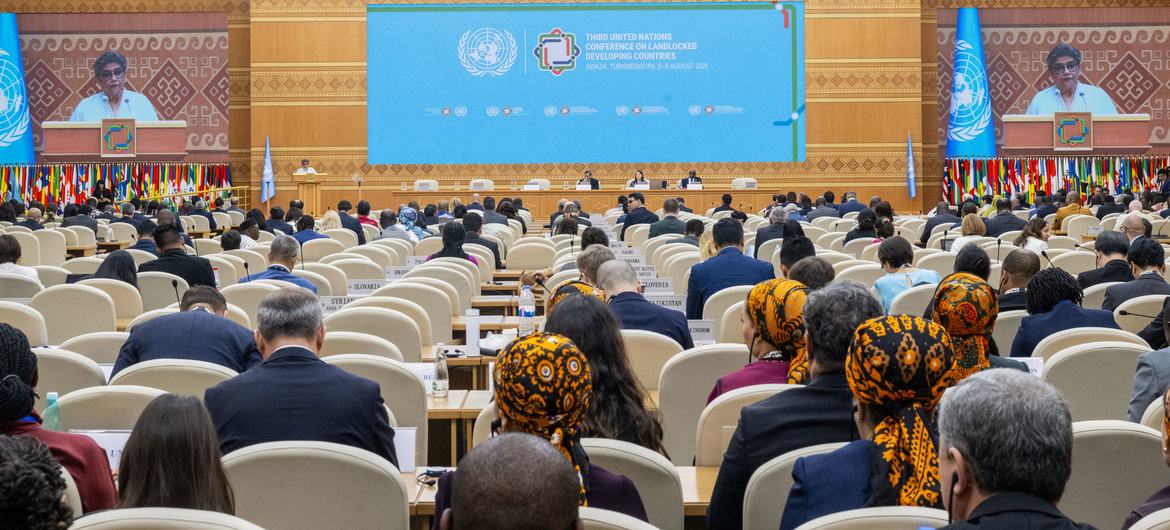
Held under the theme Driving Progress Through Partnerships, the four-day forum known as LLDC3, brought together Heads of State, senior UN officials, development partners, and private sector leaders to tackle persistent challenges faced by LLDCs, including high trade costs, inadequate infrastructure, and vulnerability to climate change.
Anchored by the Awaza Programme of Action for 2024–2034, which was adopted by the UN General Assembly last year, the new ‘Awaza Declaration’ outlines a unified strategy across five priority areas:
- Structural economic transformation;
- Trade and regional integration;
- Transport and infrastructure;
- Climate change adaptation and disaster risk reduction; and
- Mobilizing finance and partnerships.
“The Awaza Declaration marks a turning point. It is a blueprint for action, not just words,” said Under Secretary-General Rabab Fatima.
“With targeted investments in infrastructure, trade facilitation, and climate resilience, we can unlock the potential of LLDCs and ensure no one is left behind.”
Ms. Fatima, who also serves as the UN High Representative for the Least Developed Countries, Landlocked Developing Countries, and Small Island Developing States (UN-OHRLLS), said the conference would be remembered as a defining moment in the LLDC journey, ushering in a new era of bold partnerships and decisive action.
“It is this spirit…of solidarity, partnership, and shared purpose that will carry us forward. A future where we are not divided by geography, but connected through ideas, trade and innovation,” she said.
“Let us make the promise of ‘land-linked’ not only a phrase but a new way of life…the UN stands ready to support this decade of delivery,” she added.
A call for investment and inclusion
The Declaration calls for increased investments from multilateral development banks, stronger South-South cooperation, and broader inclusion of LLDC interests in global trade and climate agendas.
It also emphasizes the importance of monitoring implementation and ensuring that LLDCs themselves lead the process, coordinated by UN-OHRLLS.
Turkmenistan’s initiatives
As host country, Turkmenistan presented several initiatives aligned with the Conference’s goals, including the Global Atlas for Sustainable Transport Connectivity, the Global Hydrogen Energy Transition Programme, and the Caspian Environmental Initiative.
“The Awaza Declaration reflects our shared vision of partnership and progress,” said Gurbanguly Mälikgulyýewiç Berdimuhamedow, National Leader of the Turkmen People and Chairman of the People’s Council of Turkmenistan.
“Together – transit countries, development partners, and the private sector – we can overcome geographical constraints and build sustainable prosperity for our peoples.”
What’s next?
The Awaza Declaration represents a major step forward for LLDCs and a renewed symbol of global solidarity – turning a geographical disadvantage into a shared advantage.
Implementation will be tracked by the UN General Assembly through annual LLDC ministerial meetings.
Key upcoming platforms to advance LLDC priorities include:
- The 2025 UN climate conference in Brazil (COP30);
- The next meeting of the UN Conference on Trade and Development (UNCTAD); and
- The 2027 Global Mountain Summit in Kyrgyzstan.
A mid-term review of the Awaza Programme of Action is scheduled for 2030.
Rabab Fatima (on screen), Under Secretary-General and High Representative for the Least Developed Countries, Landlocked Developing Countries and Small Island Developing States, holds a wrap-up press conference at the Third UN Conference on the Landlocked Developing Countries (LLDC3).
Cooperation begins with neighbours
At a wrap-up press briefing, Aksoltan Ataeva, Permanent Representative of Turkmenistan to the United Nations, said that for his country, “hosting LLDC3 is not only a significant political event, but it also reflects Turkmenistan’s foreign policy philosophy: to be a bridge, not a barrier.”
UN Resident Coordinator in Turkmenistan Dmitry Shlapachenko told UN News the Conference was especially important for the region, bringing together several Central Asian heads of state.
Global partnerships matter – but real cooperation starts with neighbours.
Mr. Shlapachenko shared an example cited by the UN Secretary-General in meetings with Central Asian leaders:
“Before Portugal and Spain joined the European Union, trade between them was minimal. But once they became part of the EU, 40 per cent of all goods exported by Portugal went to Spain. This really improved life for [the people of both countries]. I think it’s very important to keep this in mind when we talk about Central Asia.”
“There is still a lot to be done here, but we are moving in the right direction,” he added.
UN Resident Coordinator in Uzbekistan Sabine Machl noted that UN country teams in Central Asia regularly meet to coordinate their work. Uzbekistan, one of only two double landlocked countries in the world (alongside Liechtenstein), faces unique challenges – but also opportunities.
“As the United Nations country team in Uzbekistan, for the next five years, what we want to do is to harness the demographic dividend by investing in the people of Uzbekistan,” she said.
“That’s our one strategic priority. Because Uzbekistan has a very young population – 60 per cent of the population is under 30 years old.”
In Lesotho, a landlocked African country, water is a major opportunity. UN Resident Coordinator Amanda Khozi Mukawashi told UN News that the country wants to share its abundant water and other resources – but needs investment.
“Lesotho has got water. It’s one of its biggest natural assets; lots of water that flows from Lesotho and saves lives in neighboring countries like Namibia, Botswana, and so on,” she said.
“What they’re trying to do is to look for investment, to develop the infrastructure so that they can produce renewable energy, hydropower.”
She added that Lesotho could use its wind and solar resources not just for its own industrial development, but to export into a region facing challenges in both water and energy.
These and other ideas were discussed on the sidelines of the Conference and will continue to be advanced at future forums.
Farewell to Awaza
On Friday, Awaza – nesteled on the shores of the Caspian Sea, the world’s largest inland body of water – bid farewell to its guests with a ceremonial lowering of the UN and Turkmenistan flags, which had been raised at the start of the week.
“Awaza will be remembered as a defining moment for the journey of LLDCs – not only for the great success of the Conference itself, but as the beginning of a new era of ambitious partnerships and decisive action,” said Ms. Fatima, wrapping up the forum.
The Third UN Conference on Least Developed Countries opened in Awaza, Turkmenistan on Tuesday, 5 August.
UN News was on the ground in Awaza, bringing you all the highlights and discussions. Find all our coverage here.