Deadly storms sweep South and Southeast Asia, leaving over 1,600 dead

Since mid-November, overlapping tropical storms and intensified monsoon systems have triggered catastrophic flooding and landslides across Sri Lanka, Indonesia, Thailand, Malaysia and Viet Nam.

UN teams across the region are supporting government-led emergency operations with food, health, water and sanitation aid, medical deployments and early recovery assessments, as heavy rains continue and fears grow that the crisis could deepen.

“We continue to closely monitor the situation and remain in close contact with national authorities,” UN Spokesperson Stéphane Dujarric told reporters in New York on Thursday.

The UN stands ready to support any ongoing efforts.

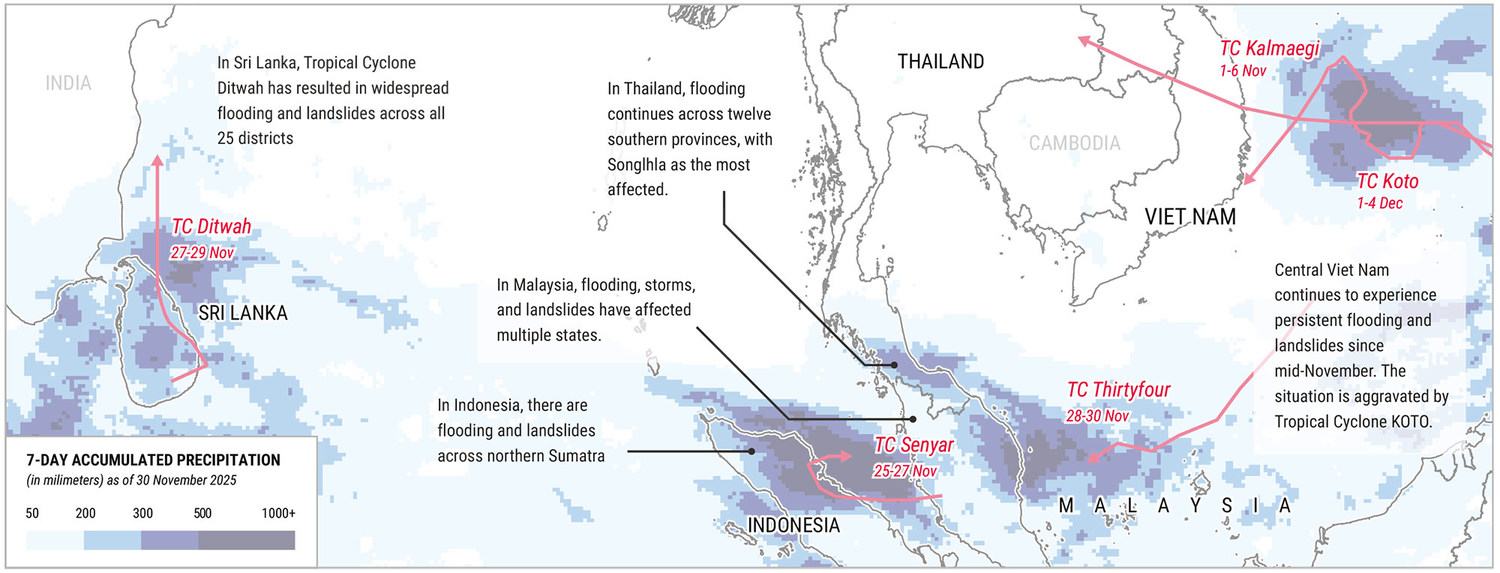
Storms and cyclones across south and southeast Asia from 17 November to 3 December.

Overlapping storms

Experts say the disasters were driven by an unusual convergence of powerful weather systems, including Cyclones Ditwah and Senyar, alongside a strengthened northeast monsoon.

Warm ocean temperatures and shifting storm tracks have produced extreme rainfall in areas that historically faced lower cyclone risk.

Across the region, nearly 11 million people have been affected, including about 1.2 million forced from their homes into shelters, while roads, utilities and farmlands have been washed away.

Heavy toll on children

Children are bearing a devastating share of the storms, with millions cut off from schools, clean water and basic services. More than 4.1 million children across the region have had their education disrupted since late November alone, according to the UN Children’s Fund (UNICEF).

Some three million students in Viet Nam have been unable to attend class, while nearly one million were affected in the Philippines, and hundreds of thousands more in Indonesia, Thailand and Malaysia.
Many children are now living in overcrowded evacuation shelters, exposed to disease, malnutrition and heightened protection risks.

Children are sitting at the frontline of the climate crisis, experiencing firsthand what it means when extreme weather becomes more frequent, more intense, and less predictable,” UNICEF Deputy Spokesperson Ricardo Pires said, calling for urgent action to protect them and their futures.

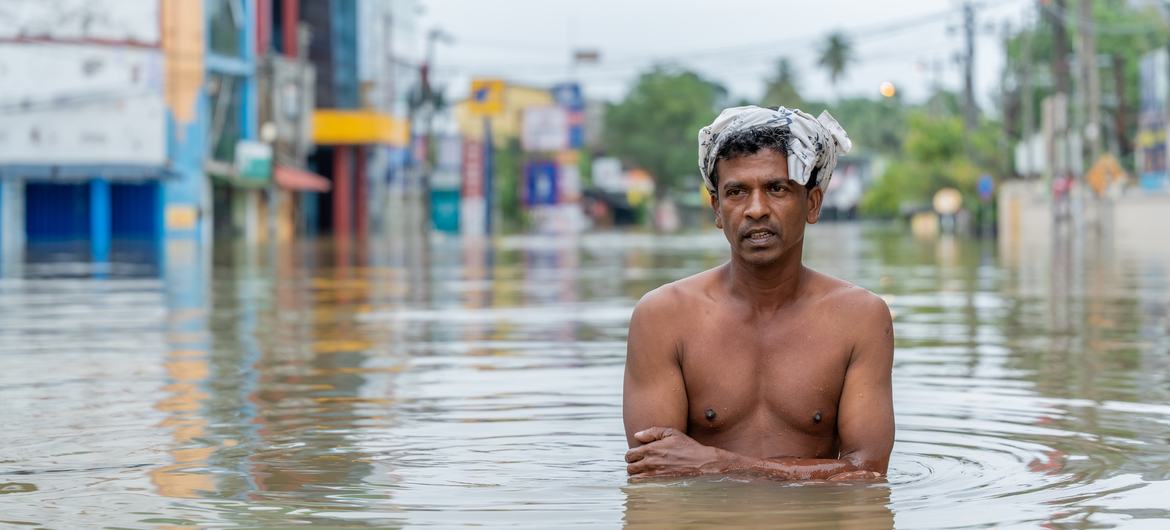
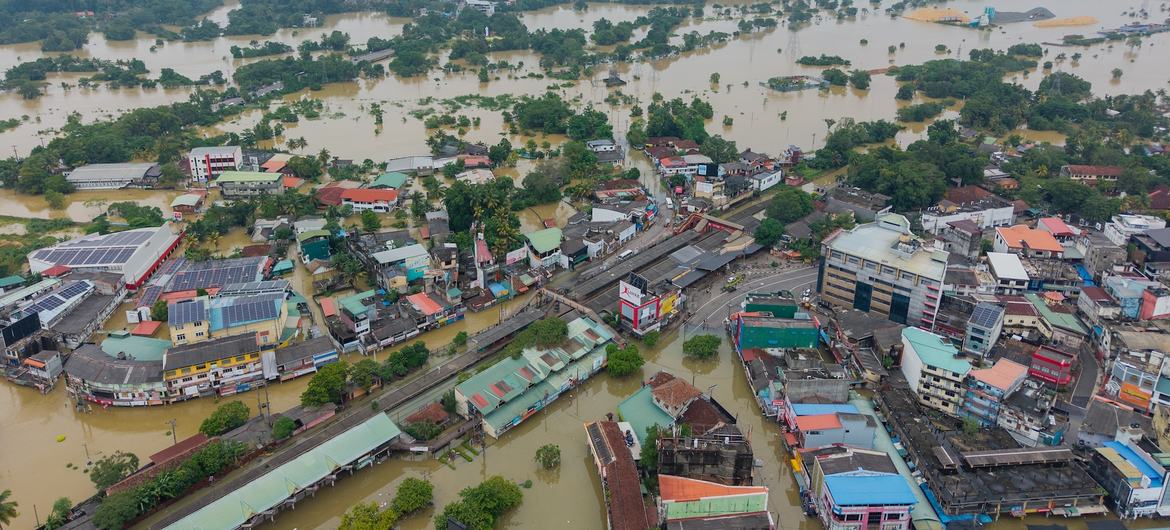
A man stands in over three feet of floodwaters in Gampaha, Sri Lanka.

Sri Lanka: Nationwide devastation

Sri Lanka bore some of the worst impacts after Cyclone Ditwah made landfall on 28 November, triggering floods and landslides across nearly the entire island.

The highest death tolls were reported in the hill districts of Kandy, Nuwara Eliya and Badulla, where landslides swept through plantation communities. Severe flooding also inundated western and north-western districts – including Colombo’s outer suburbs – disrupting markets, transport and water supplies.

Early assessments point to heightened gender-specific risks in the aftermath of the disaster.

With livelihoods disrupted and thousands sheltering in overcrowded centres, women and girls face increased exposure to gender-based violence, economic insecurity and interruptions to sexual and reproductive health services, particularly in rural and plantation communities already grappling with poverty and limited access to care.

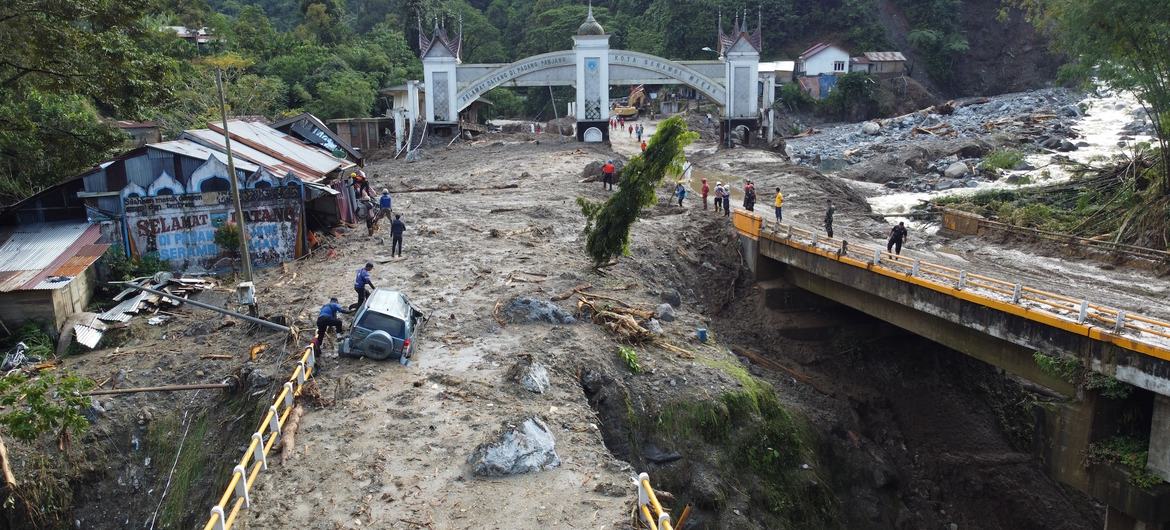
Bridges and access roads swept away by a landslide in West Sumatra, Indonesia.

Indonesia: Flash floods and landslides

In Indonesia, relentless downpours between 22 and 25 November triggered deadly floods and landslides across Aceh, West Sumatra and North Sumatra, devastating dozens of districts.

Official figures indicate more than 830 deaths, with at least 500 people still missing, and more than 880,000 displaced. In total, over three million people have been affected by floodwaters, collapsed hillsides and destroyed infrastructure.

Entire villages have been submerged, bridges washed away and roads cut off, isolating communities and slowing rescue efforts. Emergency teams are relying on helicopters and boats to deliver aid to areas unreachable by land.

“We are working closely with the government on water, sanitation and hygiene (WASH), logistics, and coordination with local partners,” UN Spokesperson Dujarric said.

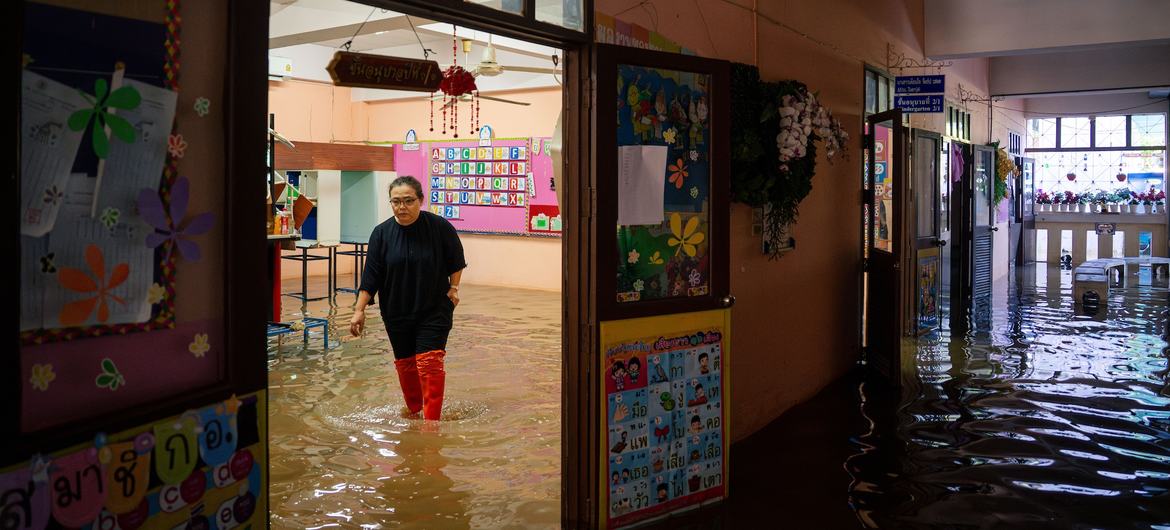
A teacher inspects the damage in a kindergarten classroom at a school in Thailand.

Thailand and Malaysia: Mass evacuations

Moving east, intensified monsoon rains have battered southern Thailand, where 12 provinces have been affected.

At least 185 people have died, with 367 missing and over four million people impacted. More than 219,000 residents have been displaced as rivers burst their banks and low-lying coastal areas flooded.

In neighbouring Malaysia, flooding across eight northern and central states has displaced around 37,000 people. Authorities continue to issue evacuation orders and weather warnings as rain persists.

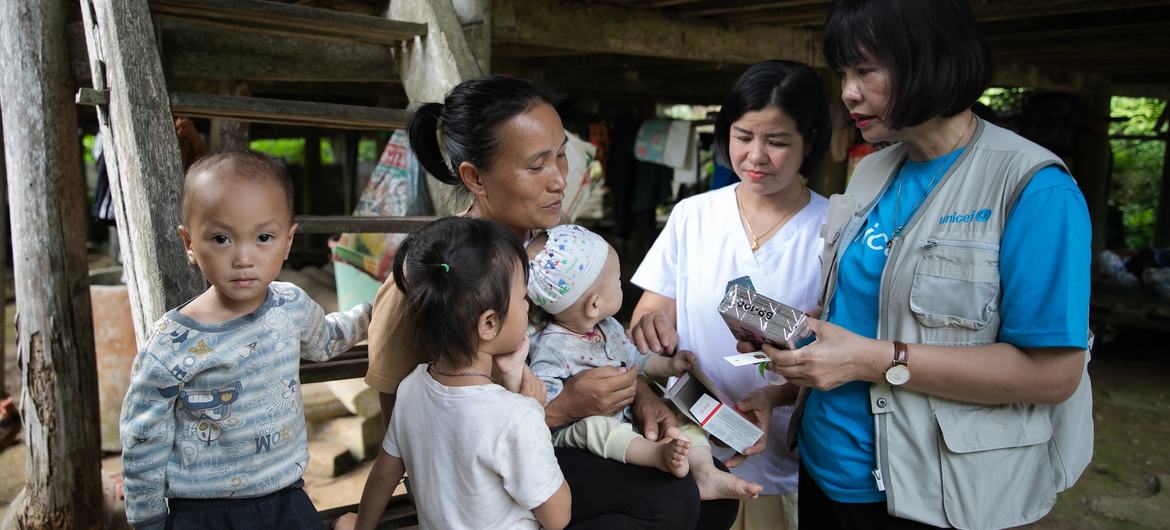
A UNICEF staff member hands ready to eat food to a family in Tuyên Quang, Viet Nam.

Viet Nam: A relentless typhoon season

Viet Nam is confronting the cumulative toll of one of its harshest typhoon seasons in years. Since October, a succession of storms has flooded and damaged large swathes of the country, particularly in northern and central provinces.

Persistent downpours since mid-November, compounded by Tropical Cyclone Koto, have triggered new landslides and prolonged displacement. A national joint response plan is under way to address food insecurity, health risks and damaged infrastructure.

To support the response, $2.6 million has been allocated from the UN Central Emergency Response Fund (CERF).

Gampaha (pictured), a district on Colombo’s outskirts, has been among the areas hardest hit by flooding after Cyclone Ditwah.

Disasters supercharged by climate change

UN agencies say the storms reflect a broader shift toward more intense and unpredictable weather across the Asia-Pacific. Cyclone Ditwah tracked unusually far south along Sri Lanka’s coast, while Cyclone Senyar formed near the equator in the Strait of Malacca – a rare occurrence.

The UN Economic and Social Commission for Asia and the Pacific (ESCAP), in its latest report issued last week, warned that rising temperatures are fundamentally reshaping the region’s risk landscape.

Warmer ocean waters are increasing the potential for extreme rainfall, while rapid urban growth, deforestation and wetland loss are magnifying flood impacts. Even where early warnings were issued, fast-rising waters overwhelmed evacuation routes in some locations.

‘No end’ expected to floods and storms as global heating continues

Water-related hazards continue to cause major devastation this year,” said Celeste Saulo, WMO Secretary-General. “The latest examples are the devastating monsoon flooding in Pakistan, floods in South Sudan and the deadly flash floods in the Indonesian island of Bali. And unfortunately, we see no end to this trend.”

Ms. Saulo highlighted that these emergencies have been happening amid increasingly warm air temperatures, which allow more water to be held in the atmosphere leading to heavier rainfall.

Her comments coincided with the publication of a new WMO report on the state of the world’s waterways, snow and ice which notes that 2024 was the hottest in 175 years of observation, with the annual mean surface temperature reaching 1.55 °C above the pre-industrial baseline from 1850 to 1900.

Storm Boris legacy

Against this backdrop in September 2024, central and eastern Europe experienced devastating flash-floods caused by deadly Storm Boris which uprooted tens of thousands of people. Similar disasters are likely to happen more often, even though they should – in theory – be extremely rare.

In the Czech Republic, several rivers flooded in an extreme fashion “that actually statistically should only occur every 100 years,” said Stefan Uhlenbrook, WMO Director of Hydrology, Water and Cryosphere Division.

A ‘century event’ happened…unfortunately, statistics show that these extreme events might become even more frequent,” he said, his comments echoing uncertainty over global water security, linked to the WMO report’s findings that only one-third of the world’s river basins have been at “normal” levels. 

Himalayan deluge

Another example of the increasingly erratic behaviour of the world’s water cycle is the extremely heavy rainfall that has affected parts of Himachal Pradesh or Jammu and Kashmir.

The region saw extremely heavy rainfall when it was not expected; the monsoon came early,” said Sulagna Mishra, WMO Scientific Officer. “So, this is what we are talking about as the unpredictability of the system is growing, more and more.”

Turning to the impact of last year’s pronounced El Niño weather phenomenon, WMO’s report indicates that it contributed to severe drought in the Amazon basin last year.

Equally, northwest Mexico and the northern part of North America saw below-average rainfall, as did southern and southeastern Africa.

“El Niño at the start of 2024 played a role,” explained Ms. Saulo, “but scientific evidence shows that our changing climate and rising temperatures lead to more extreme events, both droughts and floods.”

Our connected world

The WMO report’s other findings confirm wetter-than-normal conditions over central-western Africa, Lake Victoria in Africa, Kazakhstan and southern Russia, central Europe, Pakistan and northern India, southern Iran and north-eastern China in 2024.

One of the key messages of the UN agency report is that what happens to the water cycle in one part of the world has a direct bearing on another.

Melting glaciers continue to be a major concern for meteorologists because of the speed at which they are disappearing and their existential threat to communities downstream and in coastal areas.

“2024 was the third straight year with widespread glacial loss across all regions,” Ms. Saulo said. “Glaciers lost 450 gigatonnes, this is the equivalent of a huge block of ice seven kilometres in height, seven kilometres wide and seven kilometres deep, or 180 million Olympic swimming pools, enough to add about 1.2 millimetres to global sea level, increasing the risk of floods for hundreds of millions of people on the coasts.”

The report also highlights the critical need for improved data-sharing on streamflow, groundwater, soil moisture and water quality, which remain heavily under-monitored.  

Overlooked and underestimated: Sand and dust storms wreak havoc across borders

That’s how much sand and dust enters the atmosphere on an annual basis according to the World Meteorological Organization (WMO)’s annual report on the storms which scatter such particles across borders worldwide.

The UN weather agency’s reports warns that while the amount of dust decreased marginally in 2024, the impact on humans and economies is increasing.

WMO estimates that over 330 million people across 150 countries are affected by sand and dust storms, leading to premature deaths and other health consequences in addition to steep economic costs.

More than just a dark sky 

Sand and dust storms do not just mean dirty windows and hazy skies. They harm the health and quality of life of millions of people and cost many millions of dollars,” said Celeste Saulo, the Secretary-General of WMO.

While the movement of sand and dust is a natural weather process, increased land degradation and water mismanagement have, in the past few decades, exacerbated the prevalence and geographic spread.

Dust and sand particles – 80 per cent of which come from North Africa and the Middle East – can be transported thousands of kilometres across borders and oceans.

“What begins in a storm in the Sahara, can darken skies in Europe. What is lifted in Central Asia, can alter air quality in China. The atmosphere does not recognize borders,” said Sara Basart, WMO Scientific Officer, at a briefing in Geneva.

And this is precisely what happened in 2024. Dust and sand from the Western Sahara travelled all the way to Spain’s Canary Islands. And fierce winds and drought in Mongolia brought dust to Beijing and northern China.

Fast-growing challenge

“These extreme weather events are not local anomalies. Sand and dust storms are fast becoming one of the most overlooked yet far-reaching global challenges of our time,” said a senior official on Thursday morning speaking on behalf of Philémon Yang, President of the General Assembly.

The storms can obscure sunlight, altering ecosystems on land and in the ocean. In addition to environmental impacts, these weather occurrences have profound impacts on humans and their economies.

“Once considered seasonal or localised, sand and dust storms have escalated into a persistent and intensifying global hazard,” said Rola Dashti, the co-chair of the UN Coalition on Combating Sand and Dust Storms.

Between 2018-2022, over 3.8 billion people were exposed to dust particles, with the worst-affected regions experiencing dust exposure 87 per cent of the time during that same period.

These particles exacerbate cardiovascular diseases and have other adverse health effects, leading to 7 million premature deaths each year especially among already vulnerable populations.

Mr. Yang referred to this as the “staggering human toll”: from an economic perspective, storms can lead to a 20 per cent reduction in crop production among rural communities, pushing them towards hunger and poverty.

In the Middle East and North Africa alone, economic losses in 2024 as a result of sand and dust storms accounted for 2.5 per cent of the regional GDP.

Can’t go it alone

WMO is calling on the international community to invest more in early warning systems and data tracking.

No country, no matter how prepared, can face this challenge alone. Sand and dust storms are a trans-boundary threat that demands coordinated, multisectoral and multilateral action,” said Ms. Dashti.

With 2025-2034 declared the Decade on Combating Sand and Dust Storms, Mr. Yang said this should prove a turning point. He urged Member States to move from awareness to action – and fragmentation to coordination. 

Source link